Last updated: September 10, 2026
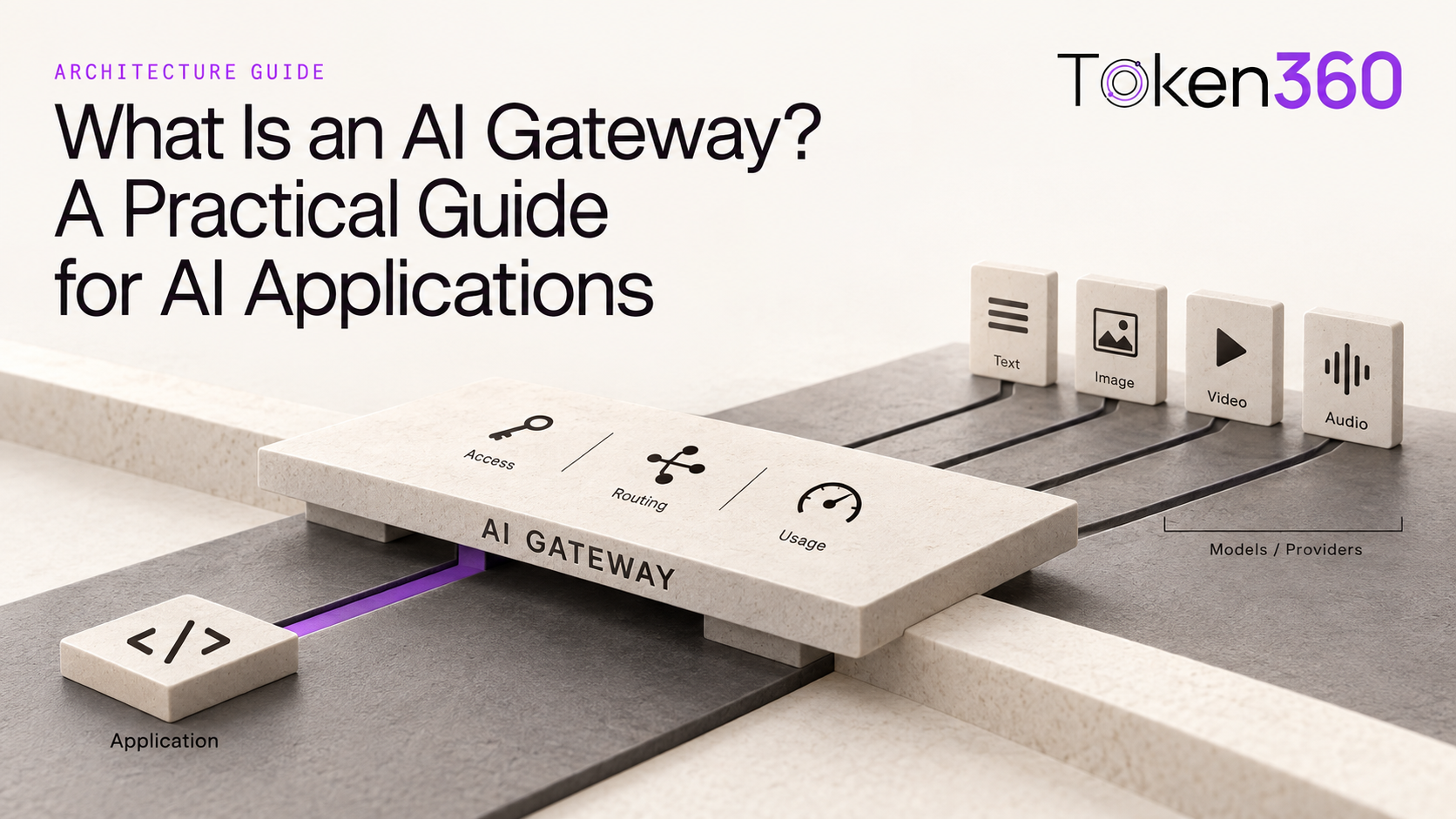
An AI gateway is a software layer that sits between an application and one or more AI models or inference providers.
Instead of connecting an application directly to every model provider, the application sends requests through the gateway. The gateway can then handle functions such as authentication, API normalization, model or provider routing, usage tracking, cost controls, observability and failure handling.
A simplified architecture looks like this:
Application → AI Gateway → AI Models / Providers
For example, an application might use one gateway to access a language model from Anthropic, an image model from Google, a video model from ByteDance and another inference provider—without maintaining an entirely separate top-level integration for each one.
However, “AI gateway” is not a single standardized product category with identical features across vendors.
Some gateways focus mainly on LLM routing. Others provide caching, budgets and observability. Some aggregate model providers and billing. Others extend the gateway across image, video and audio models.
The useful question is therefore not simply:
“Does this product call itself an AI gateway?”
It is:
“Which control-plane responsibilities does this gateway actually take over from our application?”
AI Gateway Definition
A practical definition is:
An AI gateway is an intermediary control layer that gives applications a consistent way to access, route, observe and manage requests across AI models or providers.
The gateway does not necessarily host the underlying model itself.
Instead, it can sit in front of providers and determine how an application interacts with them.
For example:
User Application
       │
       ▼
   AI Gateway
       │
       ├── Anthropic
       ├── Google
       ├── OpenAI
       ├── ByteDance
       ├── Alibaba
       └── Other Providers
Different products implement different parts of this architecture.
Vercel AI Gateway, for example, currently offers access to hundreds of models and can optimize provider routing around availability, cost or latency.
Cloudflare AI Gateway emphasizes visibility and control, including logging, caching, rate limiting, retries, model fallbacks and dynamic routing.
OpenRouter provides both provider routing and model fallbacks: the gateway can keep the same model running across alternative providers or move to another model when configured fallbacks are needed.
Token360 extends the gateway concept across language, image, video and audio, exposing those modalities through one OpenAI-compatible environment.
How Does an AI Gateway Work?
At the simplest level, the application changes where it sends its AI request.
Without a gateway:
Application → Provider A API
Application → Provider B API
Application → Provider C API
With a gateway:
Application → AI Gateway → Provider / Model
The gateway receives the request, authenticates it, evaluates the requested model or routing rule, sends it to the appropriate upstream service and then returns the resulting response to the application.
Depending on the gateway, it may also record latency, cost, token usage, errors and provider information.
This abstraction becomes increasingly useful as an application moves from one model to several.
What Does an AI Gateway Actually Do?
An AI gateway can perform several distinct jobs. Not every gateway includes all of them.
For example, Vercel now supports budgets at team, project, API-key and user scopes.
Cloudflare supports rate limits, spend limits, logging and dynamic routes that can evaluate conditions, enforce quotas and switch models without requiring the application to hard-code the routing logic.
These are examples of gateway functions—not requirements every product must implement.
AI Gateway vs API Gateway
An API gateway is a general infrastructure layer for managing API traffic.
An AI gateway applies similar control-plane concepts specifically to AI inference, where requests have additional characteristics such as models, tokens, prompts, inference providers, model-specific prices and long-running generation jobs.
A traditional API gateway may handle:
authentication, traffic management, rate limits, TLS termination and request routing.
An AI gateway may additionally understand:
models, providers, tokens, AI cost, model fallbacks, prompt traffic and modality-specific inference.
The categories can overlap.
For example, Cloudflare's AI Gateway applies conventional gateway concepts such as rate limits and logging while also tracking model/provider information and AI-specific cost.
So an AI gateway is not necessarily a replacement for your organization's general API gateway.
A production architecture can contain both:
User → API Gateway → Application → AI Gateway → AI Provider
AI Gateway vs LLM Gateway
The terms are sometimes used interchangeably, but they are becoming less equivalent.
An LLM gateway generally focuses on language-model inference.
An AI gateway can be broader.
For example, Token360 currently exposes language, image, video and speech workloads through the same gateway, while Vercel AI Gateway currently supports text, image, video and audio models.
That means:
Every multimodal AI gateway can function as an LLM gateway for supported language models, but an LLM-only gateway is not necessarily a multimodal AI gateway.
This distinction is increasingly relevant as production applications combine several modalities.
An advertising application may use:
LLM → image generation → video generation → speech
rather than only:
LLM A → LLM B → LLM C.
AI video generation APIs
AI Gateway vs AI Router
A router is usually one component of a gateway.
Routing answers:
Which model or provider should handle this request?
Gateway answers a broader question:
How should this application access and manage AI infrastructure?
Routing may consider variables such as:
cost, latency, availability, model capability, provider health, user tier or organizational policy.
OpenRouter provides a useful example of the distinction.
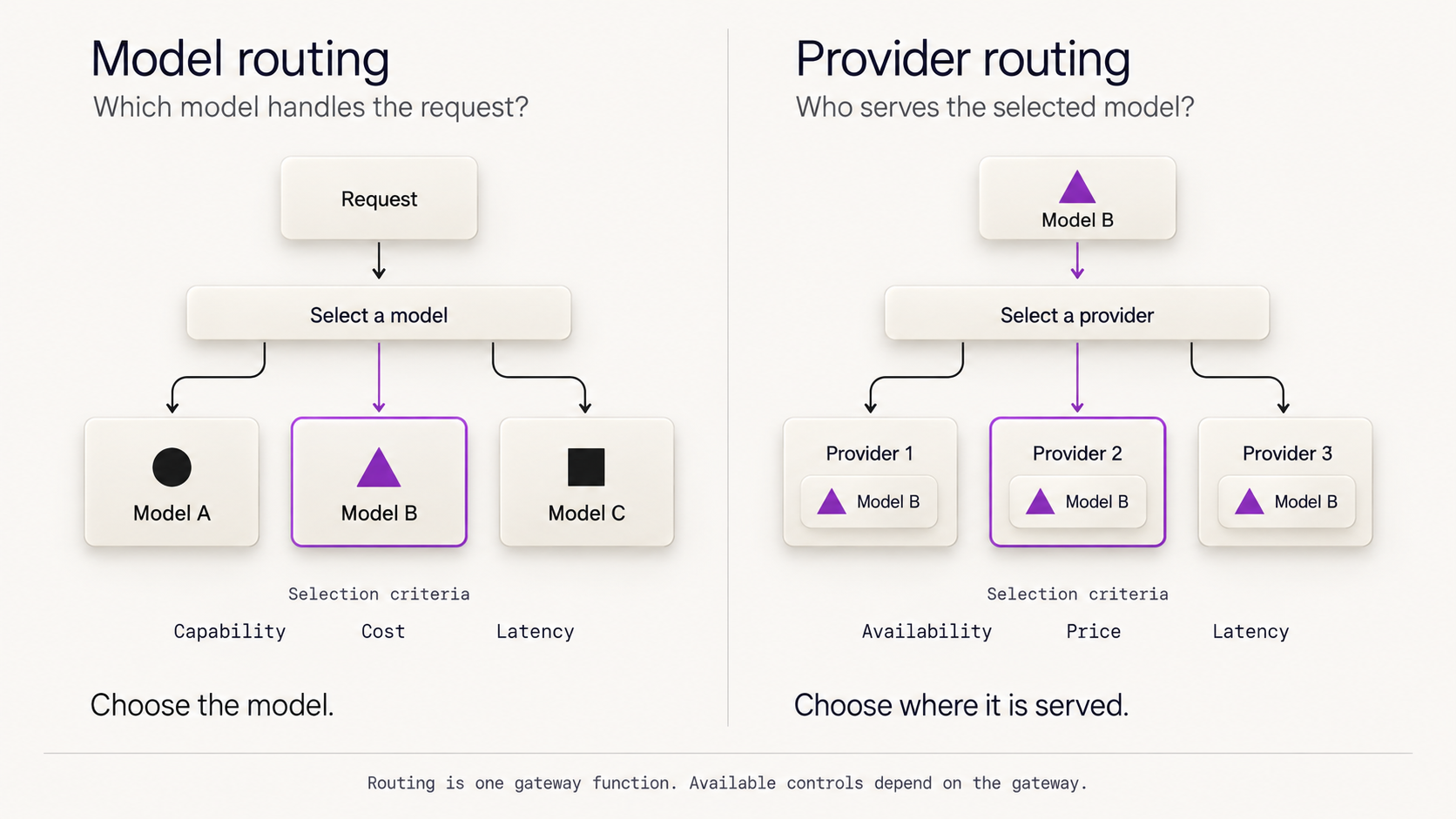
Its documentation describes two routing layers: model routing determines which model handles a request, while provider routing determines which provider serves that model. Model fallbacks can then move to another model if necessary.
Vercel similarly exposes provider-routing strategies based on cost, latency and availability.
Cloudflare's Dynamic Routing goes further into policy-style flows, allowing routes based on request metadata, percentage rollouts, rate limits and budgets.
So:
Routing is a decision function. An AI gateway is the broader control layer through which those routing decisions can be enforced.
Model Routing vs Provider Routing
Model routing
Model routing chooses which model handles a request.
For example:
Simple classification → low-cost model
Complex reasoning → frontier model
Video generation → Seedance
Image generation → image model
The application can define those rules itself, or the gateway may provide routing functionality.
Provider routing
Provider routing chooses where a model runs when the same model is available through multiple inference providers.
For example:
Claude model
   │
   ├── Provider A
   ├── Provider B
   └── Provider C
The gateway may select an upstream provider based on price, availability or latency.
These two decisions solve different problems.
Model routing optimizes what intelligence is used.
Provider routing optimizes where that intelligence is served.
OpenRouter's current routing documentation explicitly separates these two layers.
Why Use an AI Gateway?
The value of an AI gateway generally increases as the number of models, providers, teams and workloads increases.
If a prototype calls one model through one API, adding a gateway may provide little immediate value.
But imagine a production application that uses:
Anthropic → reasoning
Google → vision
Image model → creative assets
Seedance → video
Speech model → transcription
Without a gateway or equivalent internal control layer, the engineering organization may need to maintain different credentials, APIs, billing systems, SDK conventions, monitoring workflows and failure behavior.
A gateway can move some of that complexity out of the application.
The architectural benefit is therefore not simply:
“One API looks cleaner.”
It is:
“The application becomes less responsible for knowing how every AI provider operates.”
AI Gateways and Reliability
One major reason teams introduce a gateway is failure handling.
AI infrastructure can fail because of:
rate limits, provider outages, model availability, timeout conditions or capacity constraints.
A gateway can implement fallback logic so the application does not need to manually recreate it for every upstream provider.
OpenRouter, for example, lets developers supply an ordered model fallback list. If the primary model returns an applicable error, the gateway attempts the next configured model.
Cloudflare similarly supports retries and model fallbacks and can incorporate them into Dynamic Routing flows.
However, gateways do not eliminate failure.
A gateway itself can fail, providers can experience broader outages and fallback models can behave differently from primary models.
Therefore the correct claim is:
An AI gateway can improve resilience through centralized routing and fallback logic; it does not guarantee zero downtime.
AI Gateways and Cost Management
AI infrastructure creates an unusual cost-management problem because different models can have dramatically different prices and workloads.
One request may consume:
tokens.
Another may create:
an image.
Another may generate:
20 seconds of video.
A gateway can centralize those costs and apply controls around them.
Vercel's current AI Gateway supports budgets at team, project, API-key and user levels.
Cloudflare's current Spend Limits can track cumulative dollar costs and apply limits by model, provider or custom metadata such as user, team or application. When configured with dynamic routing, hitting a budget can even trigger a fallback to a cheaper model.
This creates a useful architectural pattern:
Premium users → frontier model
Standard users → lower-cost model
Budget exceeded → cheaper fallback
That is more flexible than embedding model-specific cost logic throughout application code.
AI Gateways and Observability
AI applications introduce observability questions that do not exist in ordinary API traffic.
Teams may want to know:
Which model was used?
Which provider served it?
How much did the request cost?
How long did it take?
Did it fail?
How many tokens were used?
Cloudflare's current AI Gateway logs, for example, can include the request, response, provider, timestamp, request status, token usage, cost and duration.
Token360's current console and API expose usage information including tokens consumed, cost, latency and error rates, while requests are individually metered.
Observability becomes especially important when an organization operates several models because a single “AI spend” number does not explain which application, model or provider created that cost.
AI Gateways and Caching
Some gateways can cache eligible AI responses.
Caching works best when identical or highly repeatable requests occur frequently.
Cloudflare currently supports caching for text and image responses and can return an identical cached response instead of making another paid upstream request. Its current implementation uses exact request matching unless the cache key is customized.
That can reduce:
latency, repeated inference and upstream API cost.
However, caching is not appropriate for every AI workload.
Highly personalized conversations, rapidly changing information and stochastic creative generation may provide little cache value.
So:
Caching is a useful gateway capability, not a universal AI optimization.
AI Gateways and Governance
As AI usage expands across an organization, the problem can shift from:
“How do we call this model?”
to:
“Who is allowed to call which model, under which budget, using which key?”
This is where gateways begin functioning as an organizational control plane.
Examples of gateway-level governance can include:
API-key management, user/project budgets, model allowlists, rate limits, usage attribution, audit information and policy controls.
Vercel's current budgets can be scoped across team, project, key and user.
Cloudflare's Dynamic Routing can apply rules according to metadata such as user or plan and enforce budget or rate-limit nodes as part of the route.
Token360 currently offers enterprise sub-accounts, unified wallet billing and tenant-wide API-key auditing as part of its enterprise layer.
enterprise AI infrastructure
Governance requirements vary significantly by organization, so “enterprise-ready” should never be inferred only from the fact that a product calls itself a gateway.
What Is a Multimodal AI Gateway?
A multimodal AI gateway extends the same gateway architecture beyond language models.
Instead of only:
App → Gateway → LLMs
the architecture becomes:
┌→ Language model
                    ├→ Image model
App → AI Gateway ───┼→ Video model
                    └→ Audio model
This matters because modern AI applications increasingly combine modalities.
Token360 currently defines itself as a unified AI gateway and exposes leading language, image, video and audio models through one OpenAI-compatible platform.
Its current production catalog is live through both the console and GET /public/models, and the documentation explicitly advises developers to verify live model IDs because names change as new versions ship.
Vercel AI Gateway likewise currently describes its model catalog as covering text, image, video and audio.
The emergence of these multimodal gateways is one reason the broader term AI gateway is increasingly more useful than LLM gateway.
How Token360 Works as an AI Gateway
Token360 currently exposes an OpenAI-compatible API at:
https://api.token360.ai/v1
The application can keep a compatible client and change the base URL instead of maintaining a completely separate SDK integration for every supported model provider.
A language-model request can look like:
from openai import OpenAI

client = OpenAI(
    api_key="YOUR_TOKEN360_API_KEY",
    base_url="https://api.token360.ai/v1"
)

response = client.chat.completions.create(
    model="claude-opus-5",
    messages=[
        {"role": "user", "content": "Explain AI gateways in one sentence."}
    ]
)
The same gateway also exposes separate endpoint families for image, video and speech workloads.
When Do You Actually Need an AI Gateway?
You probably do not need an AI gateway solely because AI gateways exist.
A direct provider integration may be simpler when:
your application uses one model, one provider, one engineering team and straightforward billing.
A gateway becomes more useful as complexity increases.
A useful rule of thumb is:
If AI-provider logic is spreading across your application code, billing workflows and operational tooling, it may be time to introduce a gateway or build an equivalent internal control layer.
When Should You Not Use an AI Gateway?
An AI gateway introduces another architectural dependency.
For very simple applications, that additional abstraction may not be justified.
A direct integration can make more sense when one provider/model is strategically central, you need immediate access to every new provider-native feature, you require extremely provider-specific APIs or you prefer to own the routing layer yourself.
A gateway can also create migration work if your application depends heavily on proprietary extensions from that gateway.
So the goal should not be:
“Use a gateway at all costs.”
It should be:
Put complexity in the layer where it is easiest for your team to manage.
AI Gateway vs Direct Model APIs
Neither architecture is universally superior.
Direct APIs optimize for provider-native control.
Gateways optimize for cross-provider operational consistency.
What Should You Look for in an AI Gateway?
Before selecting a gateway, evaluate the product against the responsibilities you actually want it to own:
This is much more useful than selecting a gateway based only on:
“Number of models.”
A catalog of 1,000 models provides little value if the five models your application needs are poorly integrated.
Frequently Asked Questions About AI Gateways
What is an AI gateway?
An AI gateway is an intermediary control layer between an application and AI models or providers. It can centralize functions such as authentication, routing, usage tracking, cost management, observability and failure handling.
The exact feature set varies by gateway.
Is an AI gateway the same as an API gateway?
No.
An API gateway manages general API traffic. An AI gateway applies gateway concepts specifically to AI inference and can understand model/provider routing, tokens, AI cost, model fallbacks and other AI-specific information.
Organizations can use both in the same architecture.
Is an AI gateway the same as an LLM router?
No.
Routing is one function an AI gateway may provide.
An LLM or model router decides which model/provider handles a request. An AI gateway is the broader access and control layer that may also provide authentication, billing, observability, budgets, caching and governance.
Why use an AI gateway instead of calling AI APIs directly?
An AI gateway becomes useful when an application works with several models or providers and needs centralized routing, credentials, cost controls, logging or fallback behavior.
For a simple one-model application, direct integration may still be the easier architecture.
Can an AI gateway reduce AI costs?
It can help.
A gateway may reduce costs through provider selection, lower-cost model routing, budgets, caching or centralized usage visibility. Vercel supports cost-aware provider routing, while Cloudflare currently supports caching and dollar-based spend limits.
A gateway does not automatically make every inference request cheaper.
Can an AI gateway improve reliability?
Yes, when the gateway supports retries, provider failover or model fallbacks.
OpenRouter and Cloudflare both currently document fallback mechanisms for handling certain provider/model failures.
However, a gateway cannot guarantee uninterrupted service.
What is a multimodal AI gateway?
A multimodal AI gateway provides a common access layer across more than one AI modality, such as language, image, video and audio.
Token360 currently exposes all four of those modalities through one gateway.
Does an AI gateway host the models?
Not necessarily.
Some gateways primarily route requests to third-party inference providers. Others combine gateway functionality with their own inference infrastructure.
Therefore “AI gateway” describes the control layer more reliably than it describes who physically runs the underlying model.
Build Across AI Models Through One Gateway
As AI applications expand from one model into multiple providers and modalities, the infrastructure challenge increasingly becomes coordination, not simply access.
Token360 provides one OpenAI-compatible gateway across supported language, image, video and audio models, with centralized authentication, metering and billing.
Explore the Token360 model catalog
Read the Token360 API documentation


 Comparison
 Comparison
 Comparison