Last updated: September 29, 2026
To migrate AI providers safely, inventory the capabilities your application depends on, isolate provider access behind an internal interface, test both integration behavior and output quality, and move traffic through controlled rollout stages. Keep the previous path available until active work, stored assets, and outstanding charges are resolved.
Changing an API key, base URL, or model name may be the smallest part of the migration.
The harder questions appear after the first successful response. Does streaming still work with your parser? Can the replacement model produce the required tool arguments? Which service owns a video job that started before the switch? Can customers still retrieve an asset if you roll back?
A successful migration preserves acceptable product behavior throughout the transition. API compatibility helps reduce integration work, but workload testing determines whether the destination fits.
Before You Read
If you are still comparing integration approaches, start with the OpenAI-Compatible API Guide and Multi-Model API Guide.
The first explains the compatibility boundary. The second explains how to organize access to multiple models. This guide focuses on moving a working application between providers without losing control of its traffic or state.
AI Provider Migration at a Glance
Define What the Migration Is Supposed to Improve
Start with a specific reason to switch AI API providers.
You may need a capability the current service lacks, more suitable commercial terms, better performance for a particular task, or fewer separate integrations across modalities.
Turn that reason into an acceptance criterion. “Lower cost” is incomplete unless you define the workload, the quality threshold, and the costs included. A lower inference price may be offset by longer outputs, additional retries, or more manual review.
Also distinguish three changes:
-
Moving access to the same model through another service.
-
Replacing one model with another.
-
Redesigning the application workflow around a different capability.
These changes require different evidence. Even access to the same named model can involve different serving configurations, limits, or supported parameters.
Choose the smallest useful migration scope first. A document-classification workflow can move independently of an interactive assistant if they have separate dependencies and routing controls.
Inventory Dependencies Beyond the Request Code
Provider coupling often lives outside the SDK call.
A model identifier may appear in deployment configuration, a retry policy, a dashboard query, a customer-facing settings page, or a billing export. File and conversation identifiers may be stored in databases that nobody considers part of the integration.
Build an inventory with an owner and a destination decision for each dependency.
Mark unsupported capabilities explicitly.
Silently dropping a parameter can produce a successful response that no longer satisfies the product requirement. If a critical feature cannot be reproduced, narrow the migration scope or make the necessary application change before rollout.
Put Provider Access Behind Product Operations
An internal interface should describe what your application needs to accomplish.
Operations might include generateAnswer, classifyDocument, createVideoJob, or getGenerationStatus. Each adapter translates those operations into the selected provider’s request and response format.
Return stable application concepts such as operation status, output references, usage, and categorized errors. Preserve original provider identifiers and diagnostic details for investigation.
For asynchronous work, a useful application record might contain:
operation_id
adapter_id
provider_resource_id
endpoint_family
model_id
routing_policy_version
prompt_version
status
billing_status
created_at
This is an illustrative internal record, not a provider API schema.
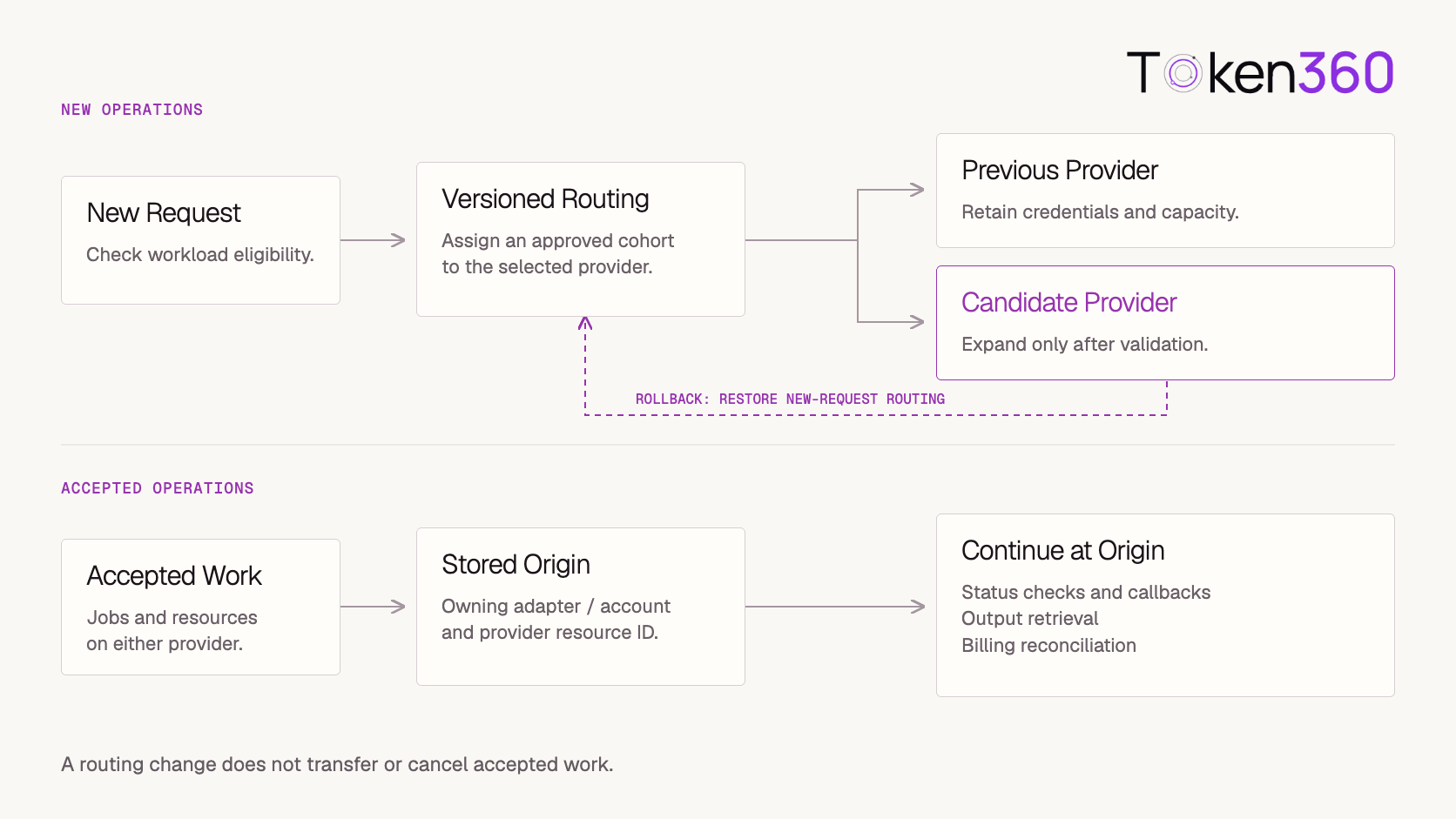
Separate routing for new operations from dispatch for existing operations. New work can follow the current rollout policy. Existing work should be accessed through the adapter and account that own it.
Keep provider-specific extensions explicit. A useful abstraction exposes meaningful differences instead of forcing every model into an interface too limited for the product.
Test the Contract Before Testing the Model
First establish whether the integration behaves correctly.
Check authentication, required fields, unsupported parameters, response parsing, tool-call structure, streaming completion, errors, and timeout handling. Include negative cases rather than testing only successful requests.
For example, a stream parser should distinguish a completed answer from a connection that ended halfway through a response. An asynchronous create timeout should not automatically become a second submission.
Contract testing focuses on the messages exchanged between applications. Pact’s documentation provides a useful explanation of that boundary.
However, mocks validate the assumptions encoded in your tests. They do not prove that an independent provider currently implements those assumptions.
Combine adapter tests with a small authorized set of live integration checks. Keep model-quality evaluation separate: valid JSON can still contain an incorrect answer.
Compare Workloads Under Controlled Conditions
Build a representative evaluation set before changing production routing.
Include common requests, difficult inputs, long-context cases, relevant languages, malformed inputs, and examples where the current path has failed. For multimodal workloads, include realistic media formats and sizes.
Begin with the same approved inputs and prompt versions on both paths. This establishes a baseline. Then evaluate any destination-specific prompt changes as a separate candidate configuration.
Record the model, adapter, prompt, parameters, and evaluation version together. Otherwise, an apparent provider improvement may actually come from a prompt change.
Use task-specific acceptance criteria:
For variable outputs, repeated trials may be needed to understand consistency. Review failures by workload segment; an overall average can hide a regression in a critical use case.
Handle Shadow Traffic as a Separate Experiment
Shadow traffic runs a candidate path alongside the live path while keeping the candidate response out of the customer’s result.
It can reveal behavior under realistic inputs, but it introduces additional data handling, inference cost, and capacity demand.
Start with approved samples. Apply the destination’s data requirements and restrict access to captured inputs and outputs.
Most importantly, prevent duplicate external actions.
If a live assistant can send an email, create a ticket, or update a record, its shadow counterpart should propose the tool call into an isolated test harness. It should not execute the same action again.
Give shadow requests their own identifiers and spending limits. Include their failures and retries in the experiment’s cost accounting.
Shadow results can help assess outputs and timing. They do not fully reproduce a customer’s multi-turn interaction with the candidate.
Move New Traffic Gradually and Measure the Right Cohort
Begin with internal use, then a small eligible production cohort.
Eligibility should reflect the scope already tested. A candidate validated for short English classification requests should not automatically receive long multilingual conversations or media jobs.
Assign traffic at a stable boundary when necessary. Keeping an entire session or workflow on one configuration can avoid unexpected state and behavior changes.
Google’s SRE guidance on canary releases describes using limited exposure and comparative signals to assess a release before broader deployment.
For an AI migration, the evaluation needs both operational and product measures:
-
Task success and reviewed output quality.
-
Errors by category and workload.
-
Time to first output and total completion time.
-
Final cost per accepted result.
-
Customer support and correction signals.
Version the routing policy and record which configuration served each operation. Advance only when the cohort provides enough evidence for the intended workload; a quiet dashboard with very little traffic is weak evidence.
Keep Active Jobs and Stored State Attached to Their Origin
Changing the route for new requests does not transfer existing resources.
A video job accepted by the old provider may still require that provider’s credentials for status checks and downloads. A file ID or conversation object may have no meaning at the destination.
Continue operating the old path for the resources it owns.
Consider this illustrative sequence:
-
A video job is accepted through Provider A.
-
New video requests begin moving to Provider B.
-
The original job completes at Provider A.
-
Your application retrieves its output and reconciles its charge through Provider A.
The routing change affects step two. It does not change ownership of the earlier job.
Plan separately for files, conversation history, cached state, batch results, and generated assets. Export or recreate resources where supported, and validate the recreated form.
For embeddings, matching vector dimensions does not establish compatibility. A model change may require re-embedding the corpus and coordinating the query-model and index switch.
Compare Final Economics and Failure Behavior
Migration cost includes more than the destination’s listed price.
Track retries, duplicate submissions, failed generations, shadow traffic, asset transfer, reprocessing, and any temporary cost of operating both paths.
Choose a useful denominator. Cost per accepted document extraction or usable video can be more informative than cost per request.
Reconcile recorded usage with final charges before drawing conclusions. Token360’s billing and usage documentation distinguishes estimates from final billing and documents request-level reconciliation. It also notes that asynchronous charges may finalize after a job reaches a terminal state.
Test retry behavior separately. A timeout can leave the acceptance outcome unknown, particularly for asynchronous creation.
AWS’s discussion of safe retries with idempotent APIs explains why explicit request identity and service behavior matter. An internal correlation ID alone does not make a provider operation idempotent.
Use the destination’s documented mechanism where available. Otherwise, reconcile uncertain submissions before repeating billable work.
Rehearse Rollback Before Expanding the Rollout
A rollback plan should specify the trigger, owner, action, and verification.
Define triggers before launch. They may include a critical capability failure, unacceptable task-quality regression, sustained latency degradation, or an unexplained increase in cost per successful outcome.
Use workload-specific thresholds and review windows. Some failures justify stopping immediately; noisy quality measures may require additional evidence.
A practical rollback exercise should verify that the team can:
-
Stop assigning new work to the candidate.
-
Restore the previous approved routing configuration.
-
Continue processing work already accepted by both paths.
-
Preserve access to outputs and diagnostic records.
-
Confirm customer-facing recovery.
Keep valid credentials and sufficient permitted capacity on the previous path during the transition.
Rolling back routing does not undo emails already sent, records already changed, or state created on the candidate. Those outcomes require their own reconciliation or recovery procedures.
Retire the Previous Provider Deliberately
Retirement is a separate migration phase.
Do not remove the old adapter simply because most new traffic now uses the destination. Check whether anything still depends on it.
Before retirement, confirm that:
-
Active jobs are resolved or have an explicit disposition.
-
Required assets remain accessible.
-
Conversation and file dependencies are handled.
-
Outstanding charges and usage records are reconciled.
-
Callbacks and background workers no longer require the integration.
-
Support documentation and dashboards reflect the new operating model.
-
The rollback window has closed with owner approval.
Then revoke unnecessary credentials and remove obsolete configuration.
Retain the records required for troubleshooting and internal reporting according to your organization’s policies. A migration should leave a clear operational history, not an unexplained break in identifiers or spending data.
Where Token360 Fits in an AI Provider Migration
Token360 can be evaluated when the destination needs shared access to language, image, video, and audio models.
Its API overview documents OpenAI-compatible access and multiple endpoint families through a common gateway. This can reduce the amount of separate provider integration code a team maintains.
The same migration checks still apply: validate the selected model, endpoint, parameters, output behavior, and lifecycle against your workload.
Token360’s routing documentation explains that public model names resolve to eligible upstream routes. It does not guarantee a fixed upstream provider unless an enterprise configuration explicitly pins that behavior, and arbitrary provider-ordering or cross-model fallback fields should not be assumed.
Keep the application’s migration rollout policy explicit. Gateway route handling does not replace your decisions about which workloads are eligible, when to expand traffic, or how to roll back.
AI Provider Migration Checklist
-
[ ] Define the business reason, workload scope, and acceptance criteria.
-
[ ] Inventory request, state, operational, and billing dependencies.
-
[ ] Identify unsupported capabilities before rollout.
-
[ ] Separate new-operation routing from existing-resource access.
-
[ ] Test adapters and run authorized live integration checks.
-
[ ] Evaluate representative workloads with versioned configurations.
-
[ ] Isolate shadow responses and disable duplicate side effects.
-
[ ] Roll out through stable, eligible cohorts.
-
[ ] Compare final cost per successful outcome.
-
[ ] Rehearse rollback while preserving work on both paths.
-
[ ] Resolve jobs, assets, and charges before retirement.
-
[ ] Revoke obsolete credentials after the transition is complete.
Frequently Asked Questions
Does an OpenAI-compatible API eliminate migration work?
It can reduce changes to request code. You still need to validate supported parameters, model behavior, streaming, tools, errors, state, and billing for the destination.
Should prompts stay identical during evaluation?
Use identical prompts for the initial comparison where supported. Then test prompt adaptations as a separate, versioned candidate so their effect remains visible.
Can I switch providers in the middle of a conversation?
Only if the destination can receive the necessary context and your application handles differences in stored state and message semantics. Keeping sessions on one path during the rollout can simplify this transition.
Is shadow traffic safe for tool-using applications?
It requires deliberate isolation. Shadow tool calls should be captured or simulated so that customer-visible actions are not performed twice.
What happens to jobs created before the switch?
They generally remain with the service that accepted them. Keep the necessary status, callback, retrieval, and billing integrations running until those jobs are resolved.
Does rollback cancel work already accepted by the new provider?
No. Changing routing for future requests does not cancel existing work. Use documented cancellation where available and continue reconciling accepted operations.
When can the old provider be removed?
After the destination meets acceptance criteria, the rollback window closes, and old jobs, assets, state dependencies, and charges have been addressed.
What to Read Next
-
AI Model Evaluation Framework: build the task-specific evidence required before expanding a migration.
-
Embeddings API Guide for Search Index Migration: plan coordinated changes to document vectors, query embeddings, and retrieval evaluation.
-
AI Model Version Upgrade Guide for Regression Control: apply similar controls when the provider stays the same but the model changes.
Evaluate Your Next Model Path Through Token360
Start with one eligible workload and a versioned evaluation set. Confirm the required capabilities, compare product outcomes and final costs, and rehearse rollback before moving broader traffic.
Evaluate models through Token360.


 Tutorial
 Tutorial
 Prompt Guide