Budget Speechify API usage by identifying the developer plan, model-specific rate, available balance and expected synthesis volume. Do not treat a reading-app subscription as API credit or assume a promotional rate applies throughout the contract. Enterprise buyers should also verify capacity and operating responsibilities before comparing the proposal with another model supplier.
A company adding narration to its product needs more than a voice it likes in a demo. Finance needs to know what cash will be committed, engineering needs predictable access, and the product owner needs acceptable audio. An attractive price per million characters answers only part of that brief.
This article examines SpeechifyAI’s published API arrangements as a procurement reference. Token360 provides enterprise model access across text, images, audio and video. The comparison is about buying a defined speech capability, not a claim that Token360 resells Speechify or already offers a particular Simba model.
Does a Speechify reading subscription include the API?
Choose the developer product when the requirement is speech generation inside your application. A subscription purchased for employees to listen to documents is a different procurement item. Confirm the account, plan and billing owner before counting any existing subscription toward the new application’s budget or assuming it grants programmatic access.
Speechify’s API pricing page, checked November 21, 2026, explicitly separates SpeechifyAI billing from the Reader app and says a Reader subscription does not include API usage.
Put the intended deliverable on the purchase request: “generate spoken audio for our application,” rather than “buy Speechify.” Include the technical owner who will integrate and operate the API. If the business actually wants a ready-to-use reading tool, an API procurement project may be unnecessary.
Which plan and model rate should go into the forecast?
Attach an effective date to the rate and identify the model it covers. Do not combine a monthly fee from one plan with a usage rate from another. When introductory pricing is present, prepare the production forecast using the terms expected during production, while keeping any temporary benefit visible and separate.
On November 21, 2026, the official page lists Starter at $10 per month. For Simba 3.0 and 3.2 it shows $10 per million characters; for Simba 3.5 it shows a $15 list rate with a $10 launch rate until November 21. These are dated published terms, not a promise of future pricing. Source: SpeechifyAI pricing.
Ask the account owner to save the accepted plan terms and confirm when changes apply to that account. Do not turn an approximate “characters included” display into an exact entitlement across models. A shared monetary balance can purchase different amounts of output when the model rate changes.
For example, compare the same additional one million billable characters at two candidate rates of $10 and $15: the usage draw would be $10 or $15. This illustrates rate sensitivity only. It is not a total monthly bill and does not account for an available balance, credits or taxes.
How should monthly allowance and top-ups be budgeted?
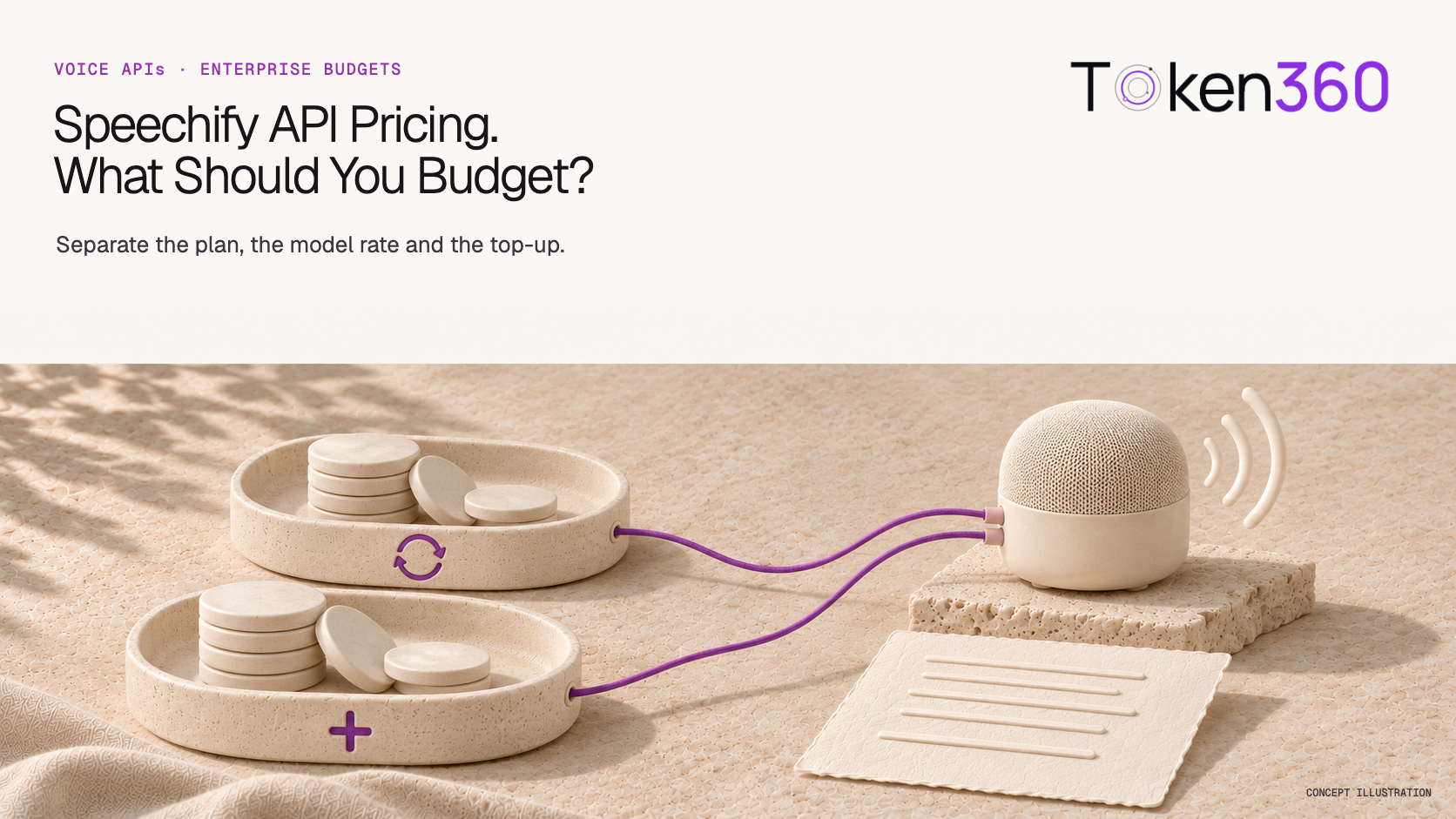
Separate the subscription payment, included usage balance and purchased top-up in the forecast. Then estimate how much usage consumes each balance during the billing period. This avoids counting included usage twice or mistaking prepaid funds for an additional charge each time those same funds are later consumed by an API request.
Speechify’s pricing page says monthly plan balance expires at the billing-period end, while purchased top-ups do not expire. Paid plans can consume top-ups after the included balance; auto top-up is off until enabled. Confirm current account terms before funding production. Source, checked November 21, 2026.
| Budget record | Question for finance and operations |
|---|
| Recurring plan payment | What cash is due each renewal, and which billing period does it cover? |
| Included usage balance | How much is available, which rates consume it, and when does it expire? |
| Purchased top-up | Who approves funding and reconciles unused prepaid amounts? |
| Consumption forecast | How much text will be synthesized with each model? |
| Funding trigger | Who responds when remaining funds reach the agreed threshold? |
For a seasonal business, estimate a quiet month and a peak month separately. A large allowance is not automatically economical if much of it is unused before expiry. Conversely, avoiding a paid plan solely to reduce fixed cost is not a complete decision if the application needs different operational terms.
These are planning scenarios, not tested savings. The broader comparison of character and other TTS billing units belongs in how to compare text-to-speech API pricing.
Does more API credit mean more production capacity?
Funding and capacity should be approved separately. Enough credit to pay for a month’s text does not show that the service can handle the application’s busiest moment. Specify expected simultaneous requests, request sizes and response requirements, then verify the plan and endpoint limits against that workload before scheduling a launch.
Speechify’s API limits documentation, checked November 21, 2026, distinguishes character limits, request-rate limits and concurrency limits. Rate and concurrency allowances are shared per account across synthesis endpoints. Creating another API key does not provide a separate account allowance.
The same document lists a 2,000-spoken-character limit for the speech endpoint and 20,000 for streaming endpoints. A long narration may therefore need a different request design. Ask engineering to confirm chunking, output assembly and playback behavior; do not assume additional funds remove an input limit.
A useful pilot includes a normal request, a long script and a representative burst. Record errors, time to usable audio and output completeness. This article does not report such a test or promise a latency result. Capacity arrangements in an enterprise proposal need written confirmation.
What should you send Token360 for a comparable voice quote?
Send Token360 a model-independent description of the speech output and workload, together with any model or voice requirements that are mandatory. Ask which proposed model can satisfy them and how it is billed. Compare the confirmed scope against the Speechify API plan rather than assuming matching prices buy interchangeable services.
| Requirement | Include in the quote request |
|---|
| Output quality | Languages, voice requirements, pronunciation examples and acceptance criteria |
| Usage | Monthly synthesis volume, model mix, repeated generations and seasonal peaks |
| Delivery | Completed files or streaming, formats, timestamps and response expectations |
| Operations | Peak concurrency, integration owner, monitoring and support needs |
| Commercial scope | Usage unit, volume tier, funding terms, exclusions and contract requirements |
Token360 uses tiered enterprise quotes: higher usage receives lower quoted rates. It does not charge a separate service fee. These facts do not establish a particular discount against Speechify, identical balance rules or availability of a specific voice. The proposal must identify the actual model and applicable terms.
Dedicated capacity, contracts and compliance requirements can be scoped for a Token360 engagement. Speechify also lists an enterprise/custom offer, so enterprise purchasing is not exclusive to either route. Discuss requirements through Token360’s enterprise offering and review company information during supplier diligence.
What should be verified before approving recurring spend?
Approve a configuration that has passed both a product review and a commercial review. The product review establishes whether the audio and delivery behavior suit the application. The commercial review establishes which account, rate, balance and funding rules apply. Neither review should be treated as a substitute for the other.
Save the model and voice configuration, a sample of authorized input text, returned audio and corresponding usage record. Review pronunciation and output completeness with the intended users. Reconcile the sample’s billed usage with the documented meter instead of inferring cost from audio length alone.
Before renewal, revisit any promotional rate, changed model mix and unused allowance. If a different voice or model becomes necessary, update the budget and acceptance record together. This is particularly important when an experiment becomes a recurring customer-facing feature.
Method and limits: Yuki Yu prepared this procurement analysis from the linked official pages and company-confirmed Token360 commercial information. No voice-quality, latency or savings benchmark was performed. Prices are a dated snapshot; final account terms and model availability require confirmation before purchase.


 Guides
 Guides
 Guides