An AI video API can make it straightforward to submit a prompt and receive a generated clip. Turning that interaction into a reliable product requires a more complete workflow.
A user may close the browser before generation finishes. A submission may time out after the provider has already accepted it. A completed video may be available through a temporary URL that expires before your application saves the file.
These situations affect whether users receive their videos, whether requests create duplicate charges, and whether your team can explain what happened when something goes wrong.
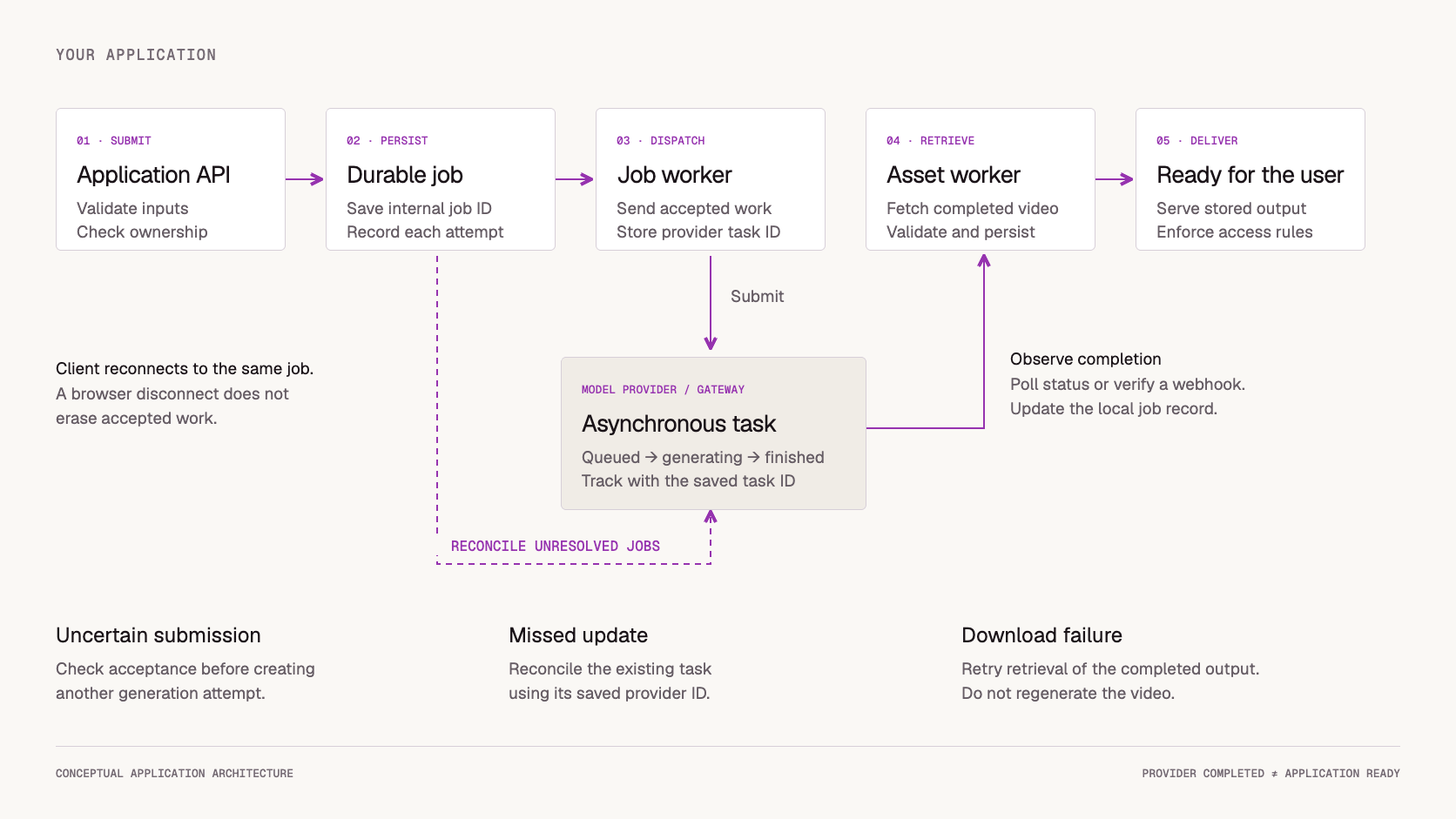
A production AI video API architecture should therefore manage generation as a durable asynchronous job. The application accepts the request, records its identity, tracks execution, retrieves the result, and preserves enough information to recover from interruptions.
The core workflow is submit, persist, observe, retrieve, and reconcile.
The implementation depends on the provider and model. Some endpoints support webhooks, some rely on polling, and capabilities such as cancellation or idempotent submission should be verified individually. The architecture should make those differences explicit while giving users a consistent experience.
Before You Read
This guide focuses on the application architecture around video generation. If you have not yet submitted a video request or worked with an asynchronous task, start with these resources:
-
Choose an API — Understand where video generation fits within Token360’s API interfaces and why it uses an asynchronous workflow.
-
Poll Video Generation Status — Learn how to use a returned task ID to distinguish queued, running, completed, and failed generations.
If you already understand task submission and status retrieval, continue below to learn how to make that workflow durable, recoverable, and ready for production.
AI Video API Architecture at a Glance
These are logical responsibilities. A small application may implement several inside one backend and use a database-backed worker. Higher traffic or stricter isolation requirements may justify separating them.
The important requirement is that accepted work survives the request or process that originally received it.
Why AI Video Generation Needs an Asynchronous Architecture
Video generation can outlast the connection that initiated it.
The browser, application server, reverse proxy, and upstream provider may each enforce different timeouts. If one of those connections closes, the generation may continue elsewhere.
Consider a user generating a product video. Your backend submits the request, but the response is lost before the provider task ID reaches your application. The user sees an error and clicks Generate again.
Without recovery logic, the application may create a second video while the first task is still running.
Increasing the HTTP timeout does not resolve this uncertainty. It also does not help a user who closes the tab or loses connectivity.
An asynchronous interface separates acceptance from completion. A common application API pattern returns HTTP 202 Accepted, a status URL, and a suggested polling interval. Microsoft documents this approach in its asynchronous request-reply pattern.
Your application can use that pattern even when the upstream provider uses different response conventions. The user interacts with your job resource, while the backend manages the provider-specific lifecycle.
What a Production Architecture Needs to Guarantee
Before selecting a queue, webhook service, or workflow engine, define the behavior your product needs.
For most applications, five requirements matter:
-
Accepted requests remain discoverable after a restart or disconnect.
-
Repeated delivery of the same request does not accidentally create new work.
-
Uncertain upstream outcomes remain distinguishable from confirmed failures.
-
Completed assets remain accessible for the product’s required retention period.
-
Operators can trace a user request through its execution attempts and final result.
These requirements also clarify ownership.
The provider executes the generation according to its API contract. Your application owns the user-facing job, access permissions, recovery policy, and delivery experience.
A gateway may simplify access to models, but you should still decide where these application responsibilities live.
Create a Durable Job Before Dispatching Generation
Primary purpose: Make accepted work recoverable independently of the client connection.
When a generation request arrives, authenticate the caller, validate the inputs, and create an internal job record before acknowledging acceptance.
The record should identify the owner, requested model, input assets, generation settings, and creation time. A worker can then submit that job to the provider and attach the returned task ID.
There is a failure boundary between saving a job and dispatching it. If the database write succeeds but queue publication fails, the job must still be discoverable.
One approach is to let workers claim pending jobs directly from the database. Another is a transactional outbox: save the job and a dispatch record in the same transaction, then have a separate process publish the dispatch record to the queue.
In both cases, worker retries must account for duplicate delivery.
For example, restarting a worker should not cause every recently accepted job to be submitted again. The worker needs to inspect the job’s submission state and any existing upstream attempt before deciding what to do.
Where it matters most: Applications that must survive deployments, worker crashes, or intermittent queue failures without losing user requests.
Implementation boundary: Recording a job locally proves that your application accepted it. It does not prove the provider accepted the generation.
Separate the User’s Job from Provider Attempts
Primary purpose: Preserve a stable identity while tracking execution accurately.
Use an internal job ID in the application’s result pages and status endpoints. Store upstream task IDs in separate attempt records.
This allows one user request to remain stable if an authorized retry creates another provider task. It also preserves the history needed to understand cost and failures.
A practical data model includes:
Define states that reflect your application’s workflow. For example, accepted, submitting, queued, generating, processing_output, and ready.
Also represent exceptional conditions such as submission_unknown, failed, or needs_review. These are proposed application states, not a claim that providers expose the same names.
Keep generation completion separate from asset readiness. A provider may finish successfully while your download worker is still retrying.
Where it matters most: Support investigations, model migrations, controlled retries, and workflows with additional processing after generation.
Implementation boundary: A single status field can become misleading if it tries to represent both upstream execution and downstream delivery. Preserve both where necessary.
Make Repeated Submissions Safe
Primary purpose: Prevent accidental duplicate generation while preserving intentional new requests.
Repeated requests are normal. A user double-clicks, a browser retries, or a backend loses the response to a submission.
Assign an idempotency key to each intended generation operation. Scope it to the relevant user or workspace, and enforce uniqueness in durable storage.
If the same key arrives with the same request, return the existing job. If the key arrives with different parameters, reject the conflict rather than silently changing the original job.
Do not rely on a prompt hash alone. A user may intentionally generate two variations from identical inputs. Those are separate operations and should receive separate keys.
This approach follows the client-request-identifier principle described in the Amazon Builders’ Library discussion of idempotent APIs.
Upstream submission still needs its own protection. Where a provider supports idempotency, follow its documented key scope and retention rules. Where it does not, your local key cannot remove the uncertainty created by an accepted request whose response was lost.
Record that outcome as uncertain and use available lookup or recovery mechanisms before resubmitting.
Where it matters most: Paid generation workflows and applications exposed to client or network retries.
Implementation boundary: Application-level deduplication does not guarantee that an external provider executes a request only once.
Choose Polling and Webhooks Around the Endpoint
Primary purpose: Keep job state current without making updates fragile or unnecessarily expensive.
Polling is often the simplest starting point. A backend process checks the provider’s status endpoint and updates your job record.
Use backoff, a maximum interval, and jitter. Respect documented rate limits and any retry guidance returned by the API. A failed status read should retry the read; it should not create another video.
Your frontend can poll your application’s database-backed status endpoint. It does not need to trigger a provider request every time the user refreshes the page.
Webhooks can reduce repeated upstream checks where the endpoint supports them. They require a publicly reachable receiver, signature validation, duplicate-event handling, and a recovery path for missed deliveries.
Replicate, for example, documents webhooks as one update mechanism while also supporting polling and server-sent events. That illustrates why the tracking strategy should follow the provider’s actual interface. See its webhook documentation.
For webhook processing, acknowledge receipt after durably recording or enqueueing the event. Perform downloads and other expensive work separately.
Where it matters most: Long-running jobs, larger request volumes, and applications that notify users after completion.
Implementation boundary: Treat incoming events as potentially repeated or delayed. Prevent an older update from moving a completed job back into a running state.
Separate Retries, Deadlines, and Cancellation
Primary purpose: Ensure recovery does not create additional failures or unexpected spending.
A production workflow needs different retry rules for different operations.
A temporary status-read failure usually calls for another read. A completed generation followed by a failed download calls for another download. An invalid input requires correction.
Submission errors need more care because their meaning depends on whether the provider accepted the task.
Set separate limits for an individual HTTP request, the expected generation window, and the overall recovery period.
A local deadline indicates how long your application has waited. It does not prove the provider stopped processing.
Cancellation also requires an explicit policy. If the provider supports it, track cancellation requests and confirmed outcomes separately. If it does not, the application may stop waiting or hide the job while upstream work continues.
Where it matters most: Workloads with variable generation times, user cancellation, and strict spending limits.
Implementation boundary: Automatic fallback to another model can alter output quality, supported inputs, duration, or cost. Treat it as a product decision with recorded attempt history.
Preserve Outputs Before Calling the Job Ready
Primary purpose: Turn a completed generation into an asset the product can reliably deliver.
A provider output URL may be temporary. Your application should know whether it needs to retrieve the file immediately and how long the stored result must remain available.
For example, Replicate documents automatic deletion of API prediction input and output data after an hour. Its webhook guide recommends persisting prediction data and files. Other providers may use different retention rules.
A retrieval worker should download the output, validate the file, record metadata, and save it to controlled storage where required.
Use a deterministic storage location or an equivalent deduplication mechanism so repeating the retrieval step does not create unnecessary copies. Verify that the asset exists before recording it as ready.
Apply any required moderation or processing before exposing the result. Private workspace assets should use appropriate access controls, such as authorized downloads or short-lived signed links.
For image-to-video workflows, input availability matters too. An input URL that expires before the provider fetches it can break an otherwise valid request.
Where it matters most: Asset libraries, collaborative workspaces, and products where users return to results later.
Implementation boundary: Generation success, successful storage, and user access are separate conditions. Monitor each one.
Recover Jobs That Stop Receiving Updates
Primary purpose: Resolve gaps left by interrupted submissions, missed events, and incomplete processing.
A reconciler periodically finds jobs that have remained unresolved longer than expected.
It can query known provider tasks, resume missing downloads, or flag submissions whose acceptance remains uncertain. Schedule checks using a next-check time or another bounded mechanism so recovery does not repeatedly scan every historical job.
Recovery workers must coordinate with normal event processing. If a webhook handler and reconciler both observe completion, they should converge on the same asset and state.
Use atomic state changes, job claims, or version checks to prevent conflicting updates.
For example, a reconciler may find that a provider task finished while the application was unavailable. It should resume output retrieval and complete the existing job. Creating a replacement generation would waste work and could introduce another charge.
Where it matters most: Systems that must recover from deployments, outages, and third-party delivery failures.
Implementation boundary: Some outcomes cannot be resolved automatically. Preserve the evidence and route the job to review after bounded recovery attempts.
Measure the Full Workflow and Control Admission
Primary purpose: Understand delivery reliability and prevent overload before work reaches the provider.
Successful API submission is only an intermediate milestone. Users care whether they receive a usable video within an acceptable time.
Measure:
-
Time waiting in your own queue.
-
Provider queue and generation time, where available.
-
Time spent retrieving and processing outputs.
-
End-to-end time from acceptance to readiness.
-
Uncertain submissions and recovery outcomes.
-
Total cost per successfully delivered video.
Segment results by model, requested duration, resolution, and workflow type. A blended average can hide poor performance for a specific request category.
Apply concurrency and spending controls before dispatch. If a workspace is already at its permitted concurrency, keep additional jobs queued locally rather than generating repeated upstream rate-limit errors.
Define how estimated costs reserve budget and how actual usage settles it. Where final usage is delayed or unavailable, retain that distinction in your records.
Where it matters most: Shared applications, enterprise workspaces, and products with significant variation in generation cost.
Implementation boundary: More accepted jobs do not necessarily mean more throughput. Unbounded queues can increase waiting time while hiding capacity problems.
Which Architecture Should You Start With?
A smaller application can start with an authenticated API, a durable job table, a background worker, backend polling, controlled asset storage, and a scheduled reconciler.
That structure covers the essential recovery boundaries without requiring a separate service for every responsibility.
As traffic grows, add dedicated queues, independent submission and retrieval workers, webhook ingestion, and provider-specific concurrency controls where they address measured bottlenecks.
Teams with multiple models should define an explicit capability map. Record supported input types, status mechanisms, cancellation behavior, idempotency support, and output retention for each integration.
Avoid flattening those differences into a generic interface that promises capabilities some models cannot provide.
The right architecture is the smallest one that can reliably preserve accepted work, resolve uncertainty, and deliver the finished asset under your expected load.
How Token360 Fits into an AI Video API Architecture
Token360’s API selection guide documents video generation through POST /v1/videos as an asynchronous operation. It also notes that certain media models require vendor-native request bodies, with the native-parameter header used only where the model documentation instructs it. See Choose an API.
This gives developers a documented integration point for video submission. The application can place that integration behind its submission worker while maintaining its own job identity, user ownership, and delivery state.
Token360 also documents an endpoint for listing video tasks in its video API reference. Use the reference for the exact operations and response structures available to your integration.
For production planning, verify the selected model’s parameters and lifecycle behavior before implementing retries or recovery. Do not infer webhook, cancellation, or idempotency support merely because generation is asynchronous.
Token360 belongs at the model-access layer of this architecture. Your application still needs an explicit plan for persisting jobs, controlling access, retaining assets, and recovering unresolved work.
How to Validate the Architecture Before Launch
Test failure boundaries with the same input sizes, concurrency, and authentication rules expected in production.
Also test authorization. Knowing or guessing a job ID must not grant access to another workspace’s status, prompt, or output.
Run these checks again after changing provider adapters, model versions, retry behavior, or storage policies. The most useful validation demonstrates recovery from realistic interruptions.
Frequently Asked Questions About AI Video API Architecture
What is an asynchronous video generation API?
It accepts a generation request and lets the caller obtain the result later. The initial response typically identifies a task whose progress can be observed through the provider’s supported mechanisms.
Should the browser call the provider directly?
A backend-managed workflow is generally more suitable when the application needs private credentials, ownership checks, usage controls, and durable recovery. The browser can interact with the application’s job endpoint.
Do I need both polling and webhooks?
No. Polling can support a complete workflow. If webhooks are available, they can improve update efficiency, while reconciliation helps recover missed events.
How do I prevent duplicate video generation?
Use durable application-level idempotency for repeated client requests. Follow upstream idempotency rules where supported, and resolve uncertain submissions before creating additional attempts.
Does a timeout mean generation failed?
No. A timeout describes the caller’s waiting period or connection. The provider may still be processing the request, so check the existing task where possible.
When should a video job be marked complete?
Mark it ready for the user after generation succeeds, required processing finishes, and the output is accessible through the application’s delivery mechanism.
Can I automatically retry with another video model?
Only within a defined policy. Another model may require different inputs or produce different duration, audio, quality, and cost characteristics. Record the fallback as a separate attempt.
What to Read Next
Once you have defined the job lifecycle, use these guides to work through the operational details:
-
Video Webhooks — Connect task completion to background processing, correlate callbacks with local jobs, and handle repeated or missed deliveries.
-
Rate Limits, Timeouts, and Retries — Develop separate recovery policies for temporary capacity limits, spending restrictions, and uncertain submission outcomes.
-
Security and Data Handling — Review credentials, uploaded assets, generated media, logs, and retention requirements before moving the workflow into production.
Together, these resources help turn the architecture described here into an implementation with explicit recovery behavior and data controls.
Ready to Build Your Video Generation Workflow?
Start with the selected model’s request format and asynchronous lifecycle. Then connect submission, tracking, output retrieval, and recovery to a durable job in your application.
Explore the Token360 video API documentation →


 Tutorial
 Tutorial
 Prompt Guide