An AI API fallback is a controlled attempt to complete an operation through another provider, model, or approved mode when the preferred path cannot deliver an acceptable result.
The word “controlled” matters.
A replacement model may produce different answers. A second video-generation request may create another paid job while the first is still running. A fresh response cannot necessarily replace text the user has already read. A tool action may already have completed even though the surrounding conversation failed.
A useful fallback policy must therefore answer more than “Which model should we try next?”
It must establish what happened to the original attempt, whether another attempt is permitted, what requirements the replacement must preserve, and when recovery should stop.
A fallback succeeds when it delivers an accepted result within the product’s deadline, budget, and policy—not merely when another endpoint returns HTTP 200.
Before You Read
Start with these related guides:
For platform-specific behavior, review Token360’s Rate Limits, Timeouts, and Retries documentation.
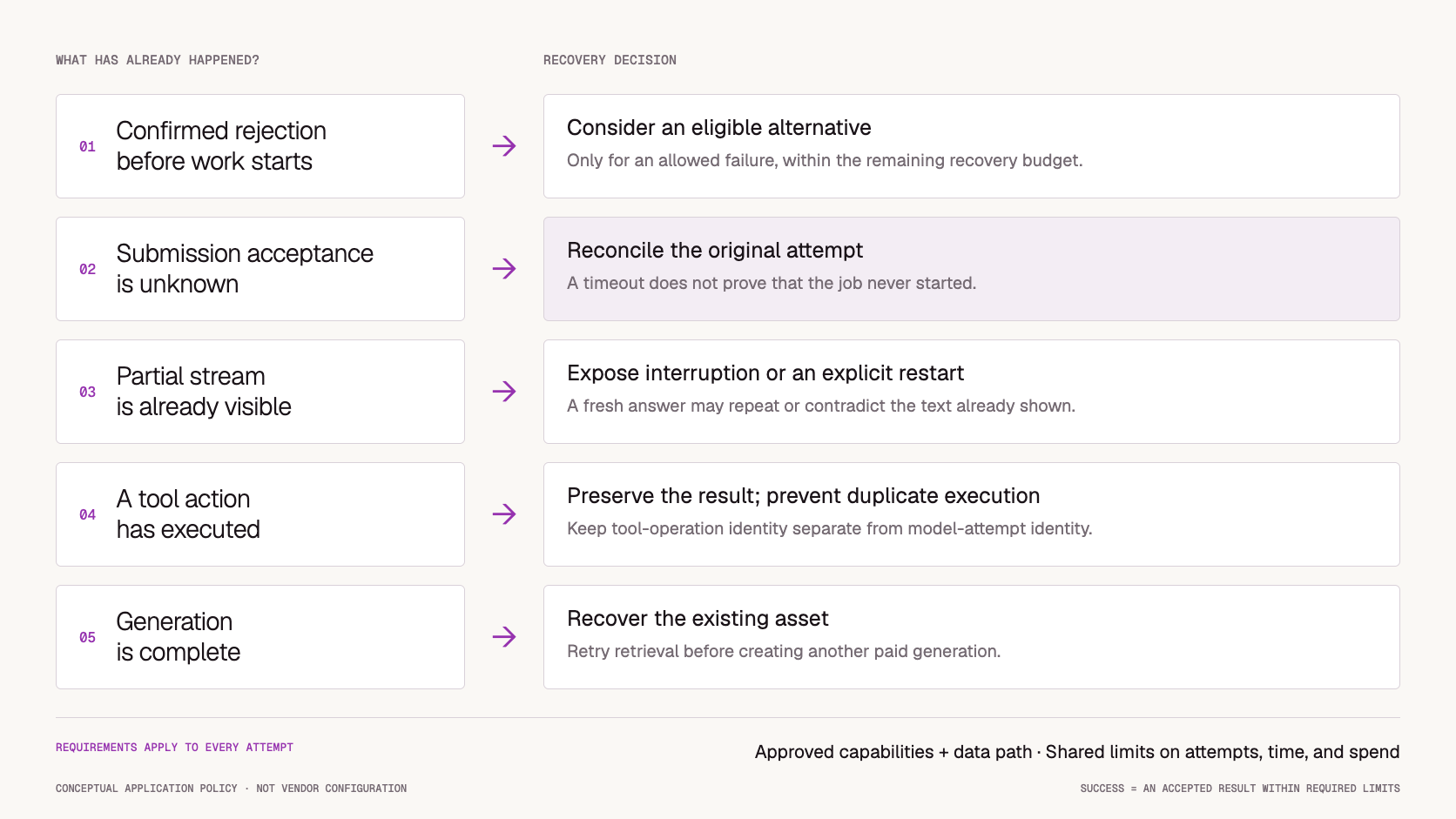
AI API Recovery Options at a Glance
A reliable design can use several of these options. It should not treat them as interchangeable.
Define What the Fallback Must Preserve
Start with the operation’s requirements, not an ordered list of model names.
A replacement may need to preserve:
-
Required input types and context capacity.
-
Structured-output constraints.
-
Tool-calling capabilities.
-
Approved processing locations and data paths.
-
Model or provider restrictions.
-
Minimum evaluated quality.
-
Output format and delivery deadline.
-
Remaining spending allowance.
Separate mandatory requirements from optional preferences.
For example, reducing image resolution may be an approved degraded mode for a preview feature. Removing a required reference image from a generation request changes the requested operation.
Similarly, replacing a model that produces a required structured result with one that returns unvalidated prose is not equivalent recovery.
Define these rules per workload. A fallback approved for internal summarization should not automatically become eligible for customer-facing extraction or tool execution.
Distinguish Provider, Model, and Feature Fallbacks
Each type of fallback needs a different validation process.
Provider failover
Provider failover changes where a selected model is served.
Check the actual endpoint contract. Model revision, quantization, parameter support, region, and execution limits can vary between deployments.
A matching model name is useful evidence, but it is not sufficient proof of compatibility.
Model fallback
Model fallback changes the model itself.
Validate the replacement using representative inputs and the same product acceptance criteria. Include difficult cases, required schemas, and tool behavior.
The replacement should be approved before an outage. An incident is a poor time to discover whether a model supports a mandatory feature.
Feature fallback
Feature fallback moves the product into a defined degraded mode.
Examples might include a lower-resolution preview or deferred generation instead of immediate delivery.
Describe material changes in the interface and obtain a choice where the product requires one. User consent to a lower-resolution result does not override mandatory access or data-location restrictions.
Classify the Failure Before Taking Action
An HTTP status is a starting point, not a complete recovery policy.
Determine whether the failure is transient, whether work may already have started, and whether switching paths would address the underlying cause.
Token360’s retry documentation explicitly distinguishes temporary capacity limits from quota, balance, and spending controls, even when they share a status such as 429. Inspect the error details before deciding to retry or change routes. Rate Limits, Timeouts, and Retries
Also distinguish transport success from product success. An output can arrive successfully and still fail a schema or quality check.
If such a failure is allowed to trigger replacement, make that a separate, evaluated policy. Do not classify every unsatisfactory answer as an infrastructure outage.
Treat an Unknown Submission as a Separate State
A timeout means the caller stopped waiting. It does not necessarily mean the provider stopped working.
For a paid generation request, this creates a difficult case:
-
The application submits the job.
-
The provider accepts it.
-
The response containing the job ID is lost.
-
The application launches a fallback.
-
Both jobs complete.
An internal operation ID helps correlate attempts, but it cannot independently prevent the provider from running duplicate work.
Use documented idempotency where available
A service may support an idempotency key that identifies repeated submissions of the same intended operation. Its scope, retention window, and parameter rules must be part of the documented contract.
AWS’s discussion of making retries safe with idempotent APIs explains why explicit caller-provided request identity is more reliable than simply assuming identical parameters represent duplicate intent.
Do not assume that an arbitrary request ID enables deduplication. Do not assume the same key deduplicates work across unrelated providers.
Reconcile before replacing
If you have an upstream job ID, inspect the existing job.
If you do not, use available request history, resource listings, or correlation-based investigation. These mechanisms depend on the provider.
When the outcome remains unknown, keep that uncertainty visible. An application may explicitly permit another attempt when duplicate cost is acceptable, but it should record the unresolved original attempt and enforce the relevant budget.
For consequential tool actions or expensive jobs, unresolved acceptance may require stopping automatic recovery.
Preserve the Boundary After Output Has Started
Recovery becomes different once the user or another system has observed an effect.
Interrupted streams
If a stream stops after displaying text, a new model may repeat, contradict, or reinterpret the partial answer.
Choose a deliberate product behavior: retain and label the incomplete output, offer a restart, or use a specifically designed continuation workflow.
Even if you provide the partial answer as context, a continuation is not guaranteed to preserve the original model’s intent.
Executed tool actions
Keep tool-operation identity separate from model-attempt identity.
If a tool already created a record, sent a message, or performed another action, regenerating the surrounding answer should not repeat that action.
Persist the tool outcome. Where the downstream action supports idempotency, enforce it at that boundary. Model failover alone does not provide exactly-once execution.
Keep All Attempts Under One Internal Operation
For asynchronous workloads, maintain one customer-facing operation with separate upstream attempt records.
An illustrative structure is:
Operation: internal-job-42
  Attempt 1: preferred model
    upstream_job_id: recorded when available
    state: unknown
  Attempt 2: approved replacement
    upstream_job_id: recorded when available
    state: running

Published result: none
Recovery policy version: media-recovery-v3
This is application bookkeeping, not a vendor API schema.
Each attempt should retain its requested model, reported serving information when available, correlation IDs, timestamps, status, and usage references.
Publish one intended result
Define which completed attempt is eligible for publication. Validate the output, then use an atomic application-state transition to commit the selected result.
A late callback from another attempt should update that attempt’s record without overwriting the published result.
Deduplicate repeated events and reconcile contradictory or out-of-order notifications using the authoritative status source.
If cancellation is supported, you can request it for unnecessary attempts. Do not treat a cancellation request as proof that execution or billing has stopped.
For Token360 video jobs, the documented video status endpoint provides a way to inspect an existing generation when its identifier is known.
Enforce One Recovery Budget Across All Layers
A fallback chain needs limits on:
-
Total inference submissions.
-
Total elapsed time.
-
Remaining estimated spend.
-
Concurrent attempts.
-
Reconciliation and polling activity.
Define whether “three attempts” includes the initial submission. Ambiguous counting makes policies hard to verify.
Use one operation-level deadline. A new attempt should consume the remaining time rather than restarting the full timeout.
Account for hidden retries
The application, SDK, gateway, and upstream provider may each perform retries.
For example, three outer submissions with up to three SDK attempts each can produce nine outbound attempts. Additional layers can amplify that further.
Inventory retry behavior and establish one controlling policy where possible. Record the distinction between application-visible attempts and any upstream attempts you cannot fully observe.
Treat projected spend as an estimate
Before starting another paid attempt, check the remaining allowance and constrain output size or duration where supported.
An estimate is not a guaranteed billing ceiling. Unknown in-flight work may still incur charges, and final usage may arrive later.
Reconcile all attempts, including unpublished or failed ones. Token360’s Billing and Usage documentation distinguishes estimates from final charges and notes that asynchronous billing may settle after a terminal generation state.
Prevent Fallback From Spreading an Outage
A fallback can overload a healthy secondary route if every request moves there at once.
Combine several controls.
Backoff and jitter
For eligible transient failures, increase waiting time between retries and add randomness so clients do not all retry together.
Honor server-provided retry guidance when applicable and when it fits the operation’s remaining deadline.
Circuit breakers
A circuit breaker can temporarily stop normal traffic to a failing route. Limited probes can determine whether it is recovering.
Scope breakers carefully. One tenant’s invalid credentials should not mark an otherwise healthy provider unavailable for everyone.
Circuit breakers do not create spare capacity. They reduce repeated calls to a route already believed to be failing.
Admission limits and load shedding
Cap concurrent fallback work. Queue requests only when their deadlines permit it, and reject excess work clearly when necessary.
Reserve fallback capacity where available, but test how much additional traffic the secondary path can actually absorb.
Finally, inspect shared dependencies. Two different service brands may use the same upstream infrastructure. Redundancy is stronger when it spans independent failure domains.
Make Degradation Visible to Users and Operators
User-facing disclosure and operational records serve different purposes.
Users need to know when a change affects the promised result: reduced resolution, delayed delivery, an interrupted answer, or a different supported mode.
Operators need enough detail to investigate recurring recovery:
-
Triggering failure.
-
Original and replacement model.
-
Available provider or route metadata.
-
Policy version and selection reason.
-
Attempts and elapsed time.
-
Acceptance outcome.
-
Estimated and reconciled cost.
A fallback rate can reveal a primary-path outage even while overall completion remains high.
Measure recovery with a denominator that includes unsuccessful operations:
Recovery success rate = fallback-triggered operations delivering accepted results within required limits ÷ all fallback-triggered operations.
Also track duplicate-job incidence, interrupted streams, unreconciled attempts, deadline misses, and fallback capacity saturation.
An HTTP success arriving after the customer’s deadline should not count as successful recovery for that workload.
Test a Shared Outage Before Production
Test more than “primary returns an error, secondary succeeds.”
Use fault injection or controlled test environments where practical. Verify customer-visible behavior, application state, and billing records together.
Keep a versioned rollback configuration for recovery-policy changes.
Where Token360 Fits
Token360’s Routing and Reliability documentation describes eligible upstream route handling for public model names. It does not establish universal cross-model fallback, a fixed provider for every unpinned request, or arbitrary provider-ordering controls.
For an integration, keep the responsibility boundary explicit:
-
Confirm the route behavior supported by your account and endpoint.
-
Maintain application approval for any replacement model.
-
Apply operation-level recovery budgets.
-
Reconcile uncertain asynchronous submissions.
-
Preserve request and generation identifiers.
-
Validate the final output before publishing it.
Some products expose an ordered model-fallback mechanism. OpenRouter’s model-fallback documentation provides one example. Its configuration and triggers belong to that platform and should be reviewed against your own product policy.
A platform’s ability to attempt another model does not determine whether that replacement is appropriate for your operation.
Implementation Checklist
Before enabling an AI API fallback:
-
Separate same-route retries, provider failover, model replacement, and feature degradation.
-
Define allowed failure triggers and terminal conditions.
-
Validate replacements against mandatory capabilities and policies.
-
Represent unknown submission acceptance explicitly.
-
Use idempotency only where the endpoint documents it.
-
Separate tool-operation identity from model-attempt identity.
-
Enforce shared limits for attempts, time, concurrency, and spend.
-
Protect the published result from duplicate or late completions.
-
Monitor recovery quality and final costs.
-
Test primary and secondary failures together.
Frequently Asked Questions
Should every AI request have a fallback?
No. Some operations require one approved model, region, or feature set. A clear failure is appropriate when no replacement satisfies those requirements.
What is the difference between retry and fallback?
A retry makes another attempt on the same path. A fallback changes the provider, model, or approved execution mode. Both can create duplicate work if the original outcome is unknown.
Can a fallback change the answer?
Yes. Model changes, provider deployment differences, and nondeterministic generation can affect the result. Evaluate product behavior rather than only endpoint availability.
Is a timeout enough to trigger another generation?
Not automatically. The original request may already be running. Reconcile it where possible and apply a documented policy for unresolved outcomes.
Does an idempotency key prevent duplicates across providers?
Generally, provider-specific idempotency applies only within its documented scope. Your application still needs to coordinate attempts across different services.
How many fallbacks should an application use?
Use a short, tested chain that fits the deadline and budget. More candidates are useful only if they are eligible, sufficiently independent, and operationally available.
Can a fallback recover an interrupted stream invisibly?
Usually not reliably. The user may already have seen text that the replacement contradicts or repeats. Define an interruption, restart, or continuation experience.
What counts as successful recovery?
An accepted result delivered within required time, policy, and budget limits. A successful HTTP response alone is insufficient.
What to Read Next
-
AI API Observability — for tracing operations across multiple attempts and detecting hidden primary-path failures.
-
AI API Capacity Planning for Rate Limits and Concurrency — for sizing secondary capacity and controlling recovery traffic.
-
Async AI Video API Architecture — for durable jobs, status reconciliation, and output retrieval.
Return to AI Model Routing when revising how the first attempt is selected. Initial selection and recovery should use consistent eligibility rules while retaining separate execution policies.
Validate the Final Customer Outcome
Start with one workload and one approved recovery path. Simulate a failure, inspect every upstream attempt, and verify that the customer receives one acceptable result within the intended limits.
Review models and endpoints on Token360.


 Tutorial
 Tutorial
 Prompt Guide