Last updated: September 10, 2026
AI model governance is the set of policies, technical controls and operating practices an organization uses to decide which AI models can be used, who can access them, what they can be used for, how their performance and risks are evaluated, and how usage is monitored over time.
For a small prototype using one model, governance may be relatively simple.
For a production organization using GPT, Claude, Gemini, open models, image generators, video models and third-party inference platforms across multiple teams, the problem becomes much larger.
Questions quickly emerge:
-
Which models are approved?
-
Who can create API keys?
-
Which teams can use expensive models?
-
Who owns each integration?
-
How are model versions tracked?
-
What happens when a provider changes or deprecates a model?
-
How is AI spend allocated?
-
Which requests need logging or auditability?
-
Which models can process particular data?
-
How are model failures or incidents investigated?
AI model governance is the operating system for answering those questions consistently.
A useful short definition is:
AI model governance is the process of controlling model selection, access, use, risk, cost and accountability throughout the AI lifecycle.
Governance is not only a legal or compliance activity. It also affects engineering reliability, cost management, vendor management and operational control.
Why AI Model Governance Matters
AI adoption often starts decentralized.
One developer integrates an OpenAI model.
Another team adds Anthropic.
Marketing starts using an image-generation provider.
The product team adds a video API.
A data-science group deploys an open model.
Very quickly, the organization can end up with:
Team A → Provider 1
Team B → Provider 2
Team C → Provider 3
Team D → Provider 4
Team E → Self-hosted model
Each integration may have its own:
credentials, pricing, data-handling rules, model versions, rate limits, monitoring and vendor contract.
The governance problem is therefore not simply:
“Are we using AI responsibly?”
It is also:
“Do we know what AI models our organization is actually using, who controls them, what they cost and what happens when they change?”
That operational layer becomes especially important once AI moves from experimentation into customer-facing production.
AI Model Governance vs AI Governance
These terms overlap, but they are not identical.
AI governance is the broader organizational discipline covering how AI is selected, designed, deployed and overseen.
It can include:
policy, legal obligations, ethics, data governance, security, human oversight, risk management, model governance and accountability.
AI model governance is narrower.
It focuses specifically on the lifecycle and control of the models being used.
For example:
A strong AI-governance program therefore usually contains model governance as one component.
AI Model Governance vs Model Management
Model management is often operational.
It may include:
deploying models, versioning, endpoint management, scaling, monitoring and updating models.
Model governance adds decision rights and accountability.
It asks questions such as:
Who approved this model?
Which applications are allowed to use it?
What evidence supports that approval?
When must the model be reviewed again?
What happens if its risk profile changes?
A team can have excellent model management infrastructure while still having weak governance.
For example, automatically deploying ten models reliably does not answer whether all ten should have been deployed in the first place.
AI Model Governance vs AI Risk Management
AI risk management and governance are tightly connected, but governance is the organizational framework through which risk-management decisions are made and enforced.
The NIST AI Risk Management Framework (AI RMF) organizes AI risk management around four functions:
GOVERN
MAP
MEASURE
MANAGE
NIST describes GOVERN as a cross-cutting function that should inform the other three functions throughout the AI lifecycle.
A simple way to translate that framework into model governance is:
One current-awareness note matters here: NIST AI RMF 1.0 is being revised as of 2026, so organizations should treat it as a living framework rather than assume the 2023 version will remain unchanged indefinitely.
What Should an AI Model Governance Program Include?
A practical production governance system usually needs several layers.
Model Inventory
The first governance question is very simple:
Which models are we using?
Organizations should maintain an inventory containing information such as:
Without an inventory, most later governance controls become difficult.
For example, if a provider announces that a model will be deprecated in 60 days, the organization needs to know which applications depend on it.
Approved Model Catalog
A model inventory tells you what exists.
An approved model catalog tells teams what they are allowed to use.
Instead of every engineer independently deciding:
“I'll use whichever model appears best today,”
the organization can maintain categories such as:
Approved for production
Approved for internal experimentation
Approved for public data only
Restricted
Deprecated
Blocked
This reduces model sprawl and makes procurement, security and engineering decisions more repeatable.
An approved catalog should not necessarily contain only one model.
A production team may deliberately approve several options:
Model A → reasoning
Model B → low-cost classification
Model C → image generation
Model D → video generation
Governance should enable appropriate choice—not force every workload onto one model.
Model Ownership
Every production model integration should have an identifiable owner.
That owner does not have to be the person who created the model.
For third-party APIs, the model owner may be:
a product team, platform team, ML infrastructure group or application team.
Ownership should answer:
-
Who approves changes?
-
Who reviews new versions?
-
Who responds to incidents?
-
Who monitors spend?
-
Who owns the provider relationship?
-
Who decides when the model is replaced?
Without ownership, governance decisions tend to fall between Engineering, Security, Legal and Finance.
API Key and Access Governance
API keys are one of the most practical governance controls.
A common anti-pattern is:
one shared production API key used by several teams and applications.
That makes it difficult to answer:
Who generated this traffic?
Which system should be disabled?
Which team owns the spend?
What happens if the key leaks?
A stronger design gives keys identifiable owners and scopes usage by application, team or workload where practical.
Useful controls include:
named keys
key ownership
expiration
revocation
usage limits
rate limits
separate production/dev keys
per-team or per-project allocation
Token360's current API-key management supports listing and managing keys, with metadata including ownership, creation and expiration timestamps, daily/weekly/monthly usage, configurable spend limits and per-minute rate-limit metadata. Keys can also be disabled through the management API.
That means a governance policy can move from:
“Please don't spend too much.”
to a technical control such as:
“This application's API key has a monthly budget.”
Model Access Control
Not every team necessarily needs every model.
A practical access policy might look like:
Public marketing content
→ approved image/video models

Internal productivity
→ approved language models

Customer-facing production
→ production-approved models only

Sensitive workflows
→ restricted model/provider set
The exact policy depends on the organization.
The important governance principle is that model access should reflect the risk and purpose of the application, not simply whether the API is technically available.
This aligns with NIST's MAP function, which emphasizes understanding an AI system's intended purpose, context, users, constraints and potential impacts before deployment.
Spend and Usage Governance
AI governance is increasingly also a FinOps problem.
Different models can vary dramatically in cost.
A team can accidentally route high-volume traffic to a premium model when a cheaper model would meet the requirement.
Video generation can make this even more obvious: cost may depend on output seconds, resolution, audio and reference assets rather than tokens.
Model governance should therefore define:
-
who owns AI budgets;
-
how usage is attributed;
-
what spending thresholds exist;
-
which models are allowed for which workloads;
-
when usage requires review;
-
when requests should be throttled or blocked.
Token360's current API provides usage information at the key level, including daily, weekly and monthly usage plus optional spending limits.
At the request level, Token360 also exposes a billing-reconciliation endpoint:
GET /v1/billing/{request_id}
which can return model, modality, billing status, amount, duration and usage information for an inference request.
That creates a technical foundation for questions such as:
Which model generated this charge?
What did this request cost?
Which video workload created this usage?
Model Version Governance
An AI model name is not always a permanent object.
Providers continuously release:
new model versions, preview versions, fast variants, cheaper variants and deprecated endpoints.
That creates governance questions that ordinary software teams can underestimate.
For example:
Model v1
↓
Model v1.1
↓
Model v2 Preview
↓
Model v2 GA
↓
Model v1 deprecated
Should production automatically switch?
Usually, that decision should be explicit.
A practical governance process might require:
-
detect new model;
-
evaluate it;
-
compare against current production model;
-
approve or reject;
-
update application configuration;
-
monitor rollout;
-
keep rollback capability.
Token360's current model documentation explicitly recommends checking the live catalog because model names change as new versions ship.
That is exactly why model freshness should be part of governance.
Model Evaluation Governance
Governance should define what evidence is required before a model enters production.
That does not mean every organization needs a giant academic benchmark.
A product team might evaluate:
task success
accuracy
latency
cost
failure rate
format reliability
hallucination rate
safety behavior
human preference
depending on the use case.
NIST's MEASURE function explicitly emphasizes selecting appropriate metrics, assessing risks, benchmarking where relevant and continually monitoring deployed systems.
The important principle is:
Model approval should be based on evidence relevant to the actual use case, not only the provider's marketing benchmark.
For example, a coding benchmark may provide very little evidence about whether a model is appropriate for a customer-support workflow.
Model Change Management
A model can change even when the application code does not.
Providers may alter:
-
versions;
-
pricing;
-
rate limits;
-
context windows;
-
safety behavior;
-
APIs;
-
regions;
-
availability.
Therefore model changes should be treated similarly to other production dependencies.
A practical governance process can define:
Provider announces change
        ↓
Identify affected applications
        ↓
Review impact
        ↓
Test replacement/version
        ↓
Approve
        ↓
Roll out
        ↓
Monitor
A mature organization should also know how to disable or replace a model quickly if an incident occurs.
Third-Party AI Vendor Governance
Most enterprises are not training every model themselves.
They rely on third-party providers.
So model governance inevitably becomes vendor governance.
Important questions can include:
-
Who operates the model?
-
Where is inference performed?
-
What commercial terms apply?
-
How does pricing change?
-
What data-handling commitments exist?
-
What support is available?
-
What happens during an outage?
-
How quickly can the model be replaced?
-
Are contract requirements different across providers?
NIST's GOVERN function explicitly includes consideration of third-party software, hardware and data across the AI lifecycle.
A gateway architecture can reduce some operational fragmentation by separating applications from individual provider integrations.
But a gateway does not eliminate vendor governance.
It changes where some of that governance is performed.
Model Auditability and Traceability
If an AI-generated output creates a problem, the organization may need to answer:
Which model produced it?
Which request created it?
When did it happen?
Which API key initiated it?
How much did it cost?
Which provider handled the inference?
This is why traceability matters.
Token360 currently exposes request-level generation metadata through:
GET /v1/generation
The endpoint can return metadata such as request ID, API family, model, provider-related information, usage, timing and cost where available.
Token360's request-billing endpoint can separately reconcile cost against the request correlation ID.
This is useful operationally because governance becomes tied to concrete request records rather than only monthly aggregate spend.
However, logging should itself be governed.
Organizations should decide what request or response content may be stored, how long logs are retained and who can access them.
AI Incident Management
AI systems can fail in different ways from conventional APIs.
Examples include:
incorrect outputs, harmful outputs, provider outage, unexpected cost spike, model regression, policy violation, leaked credential or unexpected model behavior after an upstream change.
Governance should define an incident path.
For example:
Incident detected
      ↓
Identify application + model + owner
      ↓
Contain
      ↓
Disable key / model / route if necessary
      ↓
Investigate request history
      ↓
Select replacement / mitigation
      ↓
Restore
      ↓
Document lessons learned
NIST's MANAGE function focuses on prioritizing identified risks, responding to them and establishing ongoing monitoring and improvement.
Governance without an incident process is largely documentation.
Multimodal AI Governance
AI governance becomes more complicated when the organization moves beyond language models.
A text model might be billed by tokens.
An image model may be billed per output.
A video model may be billed by:
duration, resolution, audio or reference media.
Speech models may be billed by seconds or characters.
The governance layer therefore needs to understand modality, not only model name.
For example:
Language
→ customer support
→ approved text models

Image
→ marketing assets
→ approved image generators

Video
→ advertising
→ approved video models

Audio
→ transcription
→ approved speech models
Token360's current production catalog spans language, vision-language, image generation, video generation, speech-to-text and text-to-speech models through a common platform.
That means multimodal model governance can be handled from a common operating layer rather than treating every modality as a completely disconnected system.
How an AI Gateway Can Support Model Governance
An AI gateway can become one technical enforcement point for governance.
Without a centralized layer:
App A → OpenAI
App B → Anthropic
App C → Google
App D → video provider
App E → image provider
Governance controls have to be recreated across several providers.
With a gateway:
Applications
     │
     ▼
 AI Gateway
     │
     ├── Model A
     ├── Model B
     ├── Model C
     └── Model D
the organization may be able to centralize:
authentication, key management, model catalog, usage, billing, model selection and request metadata.
This does not mean an AI gateway automatically provides complete AI governance.
Legal review, model evaluation, organizational policy, data governance and business accountability still exist outside the gateway.
The better statement is:
An AI gateway can enforce and operationalize parts of a model-governance program, but it is not a substitute for the governance program itself.
A Practical AI Model Governance Framework
For teams building their first governance process, a simple operating model can be organized around four questions.
GOVERN — Who decides?
Define:
-
governance owner;
-
model owner;
-
approval authority;
-
security/legal input;
-
risk tolerance;
-
escalation path.
MAP — What are we using?
Maintain:
-
model inventory;
-
provider;
-
model version;
-
application;
-
owner;
-
data classification;
-
intended purpose.
MEASURE — How do we know it works?
Track:
MANAGE — What do we do when something changes?
Define:
-
approve;
-
restrict;
-
migrate;
-
disable;
-
investigate;
-
rollback;
-
retire.
This mirrors the logic of NIST's current AI RMF without pretending the framework is a one-size-fits-all checklist. NIST itself says its Playbook is voluntary and is not intended as an ordered checklist every organization must implement in full.
AI Model Governance and ISO/IEC 42001
Another relevant framework is ISO/IEC 42001:2023.
ISO describes it as an international standard specifying requirements for establishing, implementing, maintaining and continually improving an Artificial Intelligence Management System (AIMS).
The important distinction is that ISO/IEC 42001 addresses AI management at the organizational level.
Model governance can support that broader management system through practices such as:
model inventory, ownership, risk review, monitoring, documentation and lifecycle controls.
But don't write:
“Following this blog makes you ISO 42001 compliant.”
It doesn't.
Nor should Token360 claim ISO/IEC 42001 certification unless the company actually holds that certification.
For this article, ISO/IEC 42001 is best used as evidence that AI governance is increasingly being formalized as an organizational management discipline, not as a Token360 certification claim.
A Practical AI Model Governance Checklist
For a production team, a useful starting checklist is:
This is a starting point—not a legal, regulatory or certification checklist.
That's an important disclaimer.
What Token360 Can Support Today
This section needs to remain very factual.
Token360's current public enterprise and API documentation supports several controls relevant to model governance.
Production model catalog
Token360 maintains a live catalog of production model IDs and explicitly recommends verifying the catalog as versions change.
API key ownership and management
Current API endpoints let users list, create, inspect, update, disable and delete keys. Key records can include owner, timestamps, usage and spend-limit information.
Tenant-wide key audit
Token360 Enterprise currently provides tenant-wide API-key auditing, including key ownership and revocation controls.
Sub-accounts
Approved enterprise accounts can create and manage sub-accounts.
Unified billing
Enterprise organizations can use unified wallet billing across the organization.
Request-level billing records
Token360 exposes request-specific billing records containing model, modality, amount, duration and usage metadata where available.
Usage monitoring
The platform's documentation describes console monitoring for tokens consumed, cost, latency and error rates.
These capabilities can support parts of an enterprise model-governance process.
But we should not write:
Token360 provides a complete AI governance system.
That claim is too broad.
And several current enterprise capabilities—including custom-model deployment, higher throughput features and Serverless GPU Infrastructure—remain marked Coming Soon on the public site.
Example: Governance Through API Key Controls
A governance policy can say:
“The video-production service may spend up to a defined monthly amount.”
That policy can then become a technical control by applying a spend limit to the service's API key.
Token360's current key-management API supports a configurable limit and reset period such as daily, weekly or monthly.
Conceptually:
{
  "name": "production-video-service",
  "limit": 500,
  "limit_reset": "monthly"
}
The point is not the specific $500 number.
The governance pattern is:
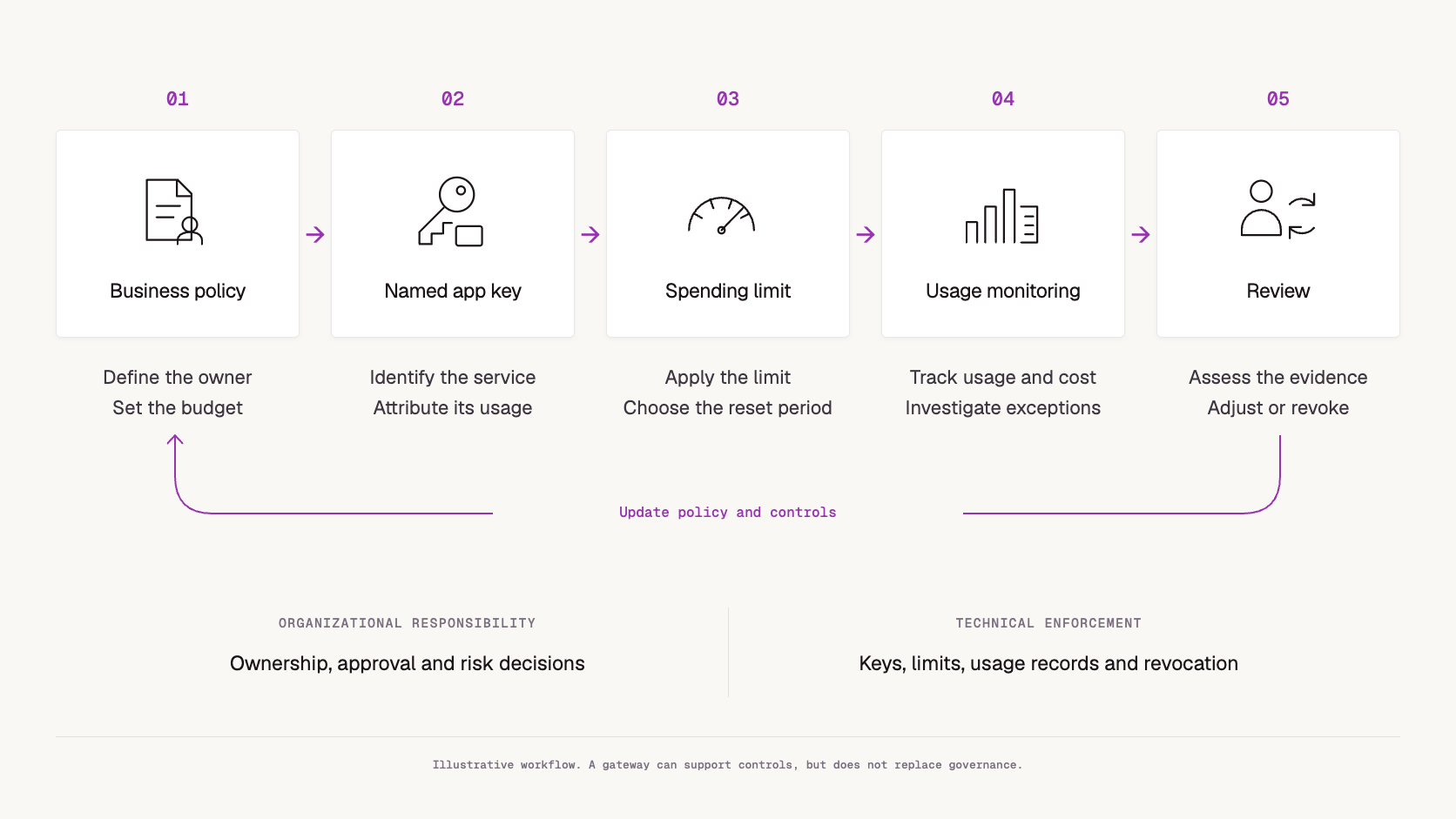
Business policy
      ↓
Named application key
      ↓
Technical spending limit
      ↓
Usage monitoring
      ↓
Review
This is a good example of turning governance from a PDF into an operational control.
Common AI Model Governance Mistakes
One shared API key for everything
This destroys attribution.
When spend or an incident occurs, it becomes much harder to identify which application created it.
Approving providers but not models
A company might approve “Google” or “OpenAI” without separately reviewing model versions.
But model capabilities, pricing and behavior can change substantially within the same vendor.
Using benchmark rankings as approval criteria
A model that tops a public benchmark may still perform poorly on your actual workload.
Production evaluation should be tied to the intended use.
Never reviewing approved models
Governance is not:
Approved once → approved forever.
AI models evolve quickly.
Reviews should occur after significant provider/model changes or at an appropriate recurring cadence.
Treating governance as only Legal's job
Legal and compliance may play important roles, but model governance also requires:
Engineering, Product, Security, Finance, Procurement and sometimes ML/AI platform teams.
NIST's approach similarly treats governance as cross-cutting rather than isolated to one department.
Logging everything without a logging policy
More logs do not automatically equal better governance.
Sensitive inputs or outputs can themselves create risk.
Organizations should define what is logged, where it is stored, who can access it and how long it is retained.
When Should a Company Formalize AI Model Governance?
Governance becomes particularly valuable when one or more of these conditions appear:
-
more than one team uses AI;
-
several providers are involved;
-
AI is customer-facing;
-
spend is becoming material;
-
API keys are difficult to track;
-
sensitive workflows exist;
-
production models change frequently;
-
failures could affect customers;
-
enterprise customers ask governance questions;
-
finance/procurement wants centralized visibility.
A useful rule of thumb is:
If you can no longer answer “which models are running in production, who owns them and what they cost?” without asking several people, your organization probably needs a more formal model-governance process.
Frequently Asked Questions About AI Model Governance
What is AI model governance?
AI model governance is the system of policies, technical controls and operating practices used to manage model selection, access, use, evaluation, cost, risk and accountability across the AI lifecycle.
It helps organizations answer which models are approved, who can use them, how their performance is evaluated and what happens when they change.
What is the difference between AI governance and model governance?
AI governance is the broader organizational framework for responsible AI use.
Model governance is one part of that framework and focuses specifically on the models themselves: approval, ownership, access, evaluation, usage, versioning and retirement.
What are the four functions of the NIST AI Risk Management Framework?
The NIST AI RMF Core is organized around Govern, Map, Measure and Manage.
Govern is designed as a cross-cutting function, while Map identifies context and risks, Measure assesses those risks, and Manage prioritizes and responds to them.
NIST is currently revising AI RMF 1.0, so teams should monitor the official NIST resources for updates.
What should an AI model inventory include?
At minimum, an inventory should identify the model, version, provider, owner, application, intended use and approval status.
Larger organizations may also track data classification, evaluation evidence, spend, region, contract, review date and lifecycle status.
How do API keys relate to AI governance?
API keys can act as a technical governance boundary.
Named keys with identifiable owners, limits and revocation controls make it easier to attribute usage, control spending and respond to incidents than one organization-wide shared credential.
Token360's current key APIs expose ownership, usage and configurable spend-limit information and support disabling keys.
Can an AI gateway help with model governance?
Yes, but only partially.
An AI gateway can centralize model access, keys, routing, usage, cost and request metadata.
It cannot replace organizational responsibilities such as risk policy, legal review, human accountability or application-specific model evaluation.
Is AI model governance only for regulated industries?
No.
Regulated organizations may have stronger governance requirements, but any company operating several models, teams or providers can benefit from clearer ownership, cost control, access management and change management.
Is AI model governance the same as compliance?
No.
Governance is the broader system through which AI decisions and controls are managed.
Compliance with a particular law, contract or standard may be one governance requirement, but governance also includes operational concerns such as model ownership, cost, reliability and version management.
Govern AI Model Access Without Slowing Down Development
The purpose of AI model governance should not be to make every model change require weeks of approval.
A useful governance system makes the safe path easier and more visible:
approved models are easy to discover;
developers know which credentials to use;
spending can be attributed;
production changes can be reviewed;
incidents can be investigated;
new models can enter the system through a repeatable process.
Token360 provides one API across its supported model catalog with current controls around API keys, usage, billing and enterprise account structure that can support parts of that operating model.
Explore supported AI models
Token360 documentation
Explore Token360 for Enterprise
Token360 documentation


 Tutorial
 Prompt Guide
 Tutorial