An AI model evaluation framework is a repeatable process for deciding whether a model configuration can meet the requirements of a production workload.
It combines representative tasks, explicit acceptance criteria, quality assessment, operational measurements, and a documented deployment decision.
The purpose is more specific than finding the model with the highest score.
A model can produce fluent answers while missing required facts. It can generate attractive images while failing reference constraints. It can perform well in an isolated test and become too slow under production concurrency.
A useful evaluation asks:
Can this configuration deliver an acceptable result for our users, within our operating constraints, with enough evidence to justify the change?
This guide explains how to answer that question—from defining the decision to maintaining a regression set after deployment.
Before You Read
These guides establish the implementation context:
For an initial view of available workloads and access patterns, review the Token360 overview.
AI Model Evaluation at a Glance
The result should be an approval for a defined workload and configuration, with recorded limitations.
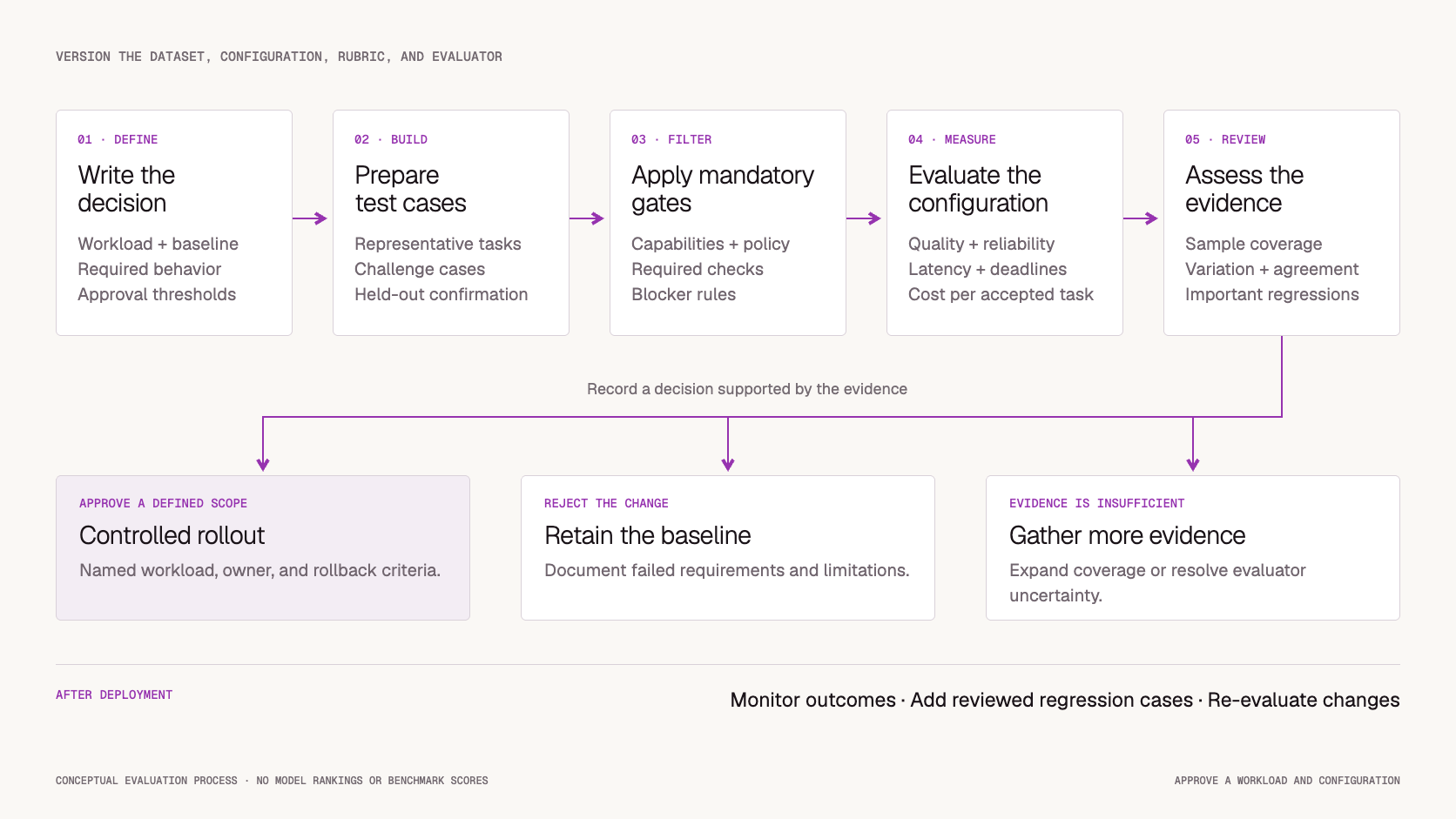
Define the Decision Before Running Tests
Different decisions require different evidence.
Choosing a default model is not the same as approving a fallback, reducing cost, or validating a version upgrade.
Write the minimum acceptable result before examining candidate scores.
For an extraction feature, that might include schema validity, accuracy on critical fields, appropriate treatment of missing information, and a completion deadline.
Also define the outcome that would justify keeping the baseline. A useful evaluation can conclude that the evidence does not support migration.
Evaluate a Configuration, Not Just a Model Name
The output depends on more than the selected model.
Record the configuration that produced it:
-
Requested model and reported version, when available.
-
Provider or serving-route information, when available.
-
Endpoint and API contract.
-
Prompt-template version.
-
Generation parameters and output limits.
-
Retrieval inputs and relevant document versions.
-
Tool definitions and execution environment.
-
Retry and fallback policy.
-
Preprocessing and post-processing.
-
Evaluator and scoring-code versions.
If several components change together, the result is a system comparison. Do not attribute the improvement entirely to the model.
Choose the comparison you intend to make
A controlled model comparison holds the surrounding configuration as consistent as practical.
A deployment comparison can allow candidate-specific prompts or settings, provided each candidate receives a documented tuning budget and is tested against the same product requirements.
Both approaches are useful. State which one you used.
Identical parameter values do not always imply equivalent behavior across models. Unsupported options should be recorded rather than silently dropped.
Filter Ineligible Candidates First
Before generating a large evaluation set, check whether each candidate supports the required workload.
Eligibility may depend on:
-
Input and output modalities.
-
Input capacity.
-
Required structured-output features.
-
Tool-calling support.
-
Approved data handling and serving location.
-
Execution mode.
-
Required media controls.
-
Account access and operational limits.
A candidate that lacks a mandatory feature should not recover its position through an excellent style score.
Some requirements can be checked in documentation; others need executable tests. Use both where appropriate.
Document uncertainty. If a required feature is not confirmed, keep the candidate unapproved until the missing evidence is resolved.
This makes the shortlist smaller and the subsequent evaluation more meaningful.
Build a Dataset That Represents the Workload
Organize evaluation cases around the situations the product must handle.
Include:
Use permitted data and remove unnecessary sensitive content. Synthetic cases can help cover gaps, but they should not automatically replace evidence from realistic workloads.
Preserve the complete test case
For text, retain the instructions, relevant context, expected properties, and scoring reference.
For image or video tasks, preserve reference assets, creative briefs, generation settings, and review criteria.
For speech, retain audio conditions, language, speaker characteristics relevant to the task, and the reference transcript or listening rubric.
Separate representative and challenge sets
A deliberately difficult test set is valuable, but its failure rate may not estimate production performance.
Report challenge results separately or apply a documented weighting scheme. Show important segment results even when you also publish an aggregate.
Keep related examples together when splitting the data. Near-duplicate documents or segments from the same conversation can leak information across development and confirmation sets.
Protect an Independent Confirmation Set
Use development cases to improve prompts, adapters, and evaluation logic.
Use a held-out set to check whether the resulting configuration generalizes.
If the team repeatedly inspects confirmation failures and tunes against them, that set has become part of development. Retire or rotate it deliberately rather than continuing to call it independent.
Restrict reference answers and hidden scoring information from candidate inputs.
For a fair comparison, also freeze the rubric before the confirmation run. Changing acceptance criteria after seeing the scores can make a preferred candidate appear stronger without improving the product.
Separate Mandatory Gates From Quality Scores
A rubric should make different failure types visible.
Consider a hypothetical document-extraction workflow:
Define the deployment rule separately from individual output checks.
For example, invalid schema output may fail that case. Whether one observed failure blocks deployment depends on the workload’s predetermined tolerance and mitigation strategy.
Some failures can be designated deployment blockers. Others may have permitted rates. Make that distinction explicit.
Avoid collapsing everything into one average. A high presentation score should not conceal failure on required actions or critical fields.
Use Evaluators That Match the Task
Different properties need different evaluators.
Deterministic checks are useful for schemas, required fields, file properties, and executable outcomes.
Human review is valuable when correctness or usefulness cannot be captured adequately by those checks.
Model-based judges can help scale selected assessments, but their behavior needs validation.
OpenAI’s evaluation best practices recommends task-specific tests and calibrating automated scoring against human feedback. The process in this article does not depend on a particular hosted evaluation service.
Calibrate reviewers
Provide examples of acceptable, borderline, and unacceptable outputs.
Blind reviewers to candidate identity where practical. Randomize presentation order, permit ties in comparative tasks, and preserve disagreement before adjudication.
A split decision may expose an unclear rubric or a real product tradeoff.
Validate automated judges
Check whether the judge’s decisions agree with qualified reviewers on representative and important failure cases.
Inspect order sensitivity, preference for verbosity, and cases where persuasive writing hides incorrect content. Version the judge model, prompt, and rubric.
Keep candidate content separate from grading instructions, and test whether embedded instructions can manipulate the evaluator.
Adapt the Quality Rubric to Each Modality
A shared evaluation process can support several modalities, but the acceptance criteria must change.
For tool workflows, use a controlled execution environment. Evaluate whether the action should occur as well as whether the model can construct its arguments.
For creative work, define which properties are mandatory and which are preferences. Review the full deliverable under a consistent protocol.
Measure Reliability, Latency, and Cost With Quality
A quality evaluation and a production-readiness evaluation should share the same operation records.
Retain every attempt, including failures.
Run performance tests under stated conditions: concurrency, input-size distribution, output limits, cache state, and test period.
A single-request latency test does not establish production capacity.
If recovery is enabled, distinguish first-attempt performance from final system performance. A fallback should not silently make the original candidate appear more reliable.
For Token360 evaluations, use its Billing and Usage documentation to distinguish estimates from final charges and reconcile asynchronous usage.
Report Uncertainty Alongside the Result
A small score difference is not automatically a useful improvement.
Report:
-
Number of distinct cases.
-
Workload categories and their representation.
-
Repetitions per case.
-
Failures and missing results.
-
Evaluator agreement.
-
Observed differences from the baseline.
-
Uncertainty intervals where appropriate.
-
Segments with limited evidence.
Repeating a stochastic task helps measure output variation. It does not create the same evidence as adding new independent tasks.
For paired comparisons, preserve the relationship between candidates evaluated on the same cases. Statistical analysis should account for repeated outputs or related cases rather than treating them all as independent.
Choose sample size based on the decision’s risk, the improvement you need to detect, and the variability observed in a pilot. There is no universal evaluation-set size.
A finite test with no observed critical failures does not prove that the failure rate is zero.
Predefine confirmation and stopping rules so repeated checking does not become a search for a favorable result.
Turn the Evaluation Into a Decision Record
A scorecard should lead to an explicit decision.
A useful record contains:
The outcome can be conditional approval.
For example, a candidate may be suitable for one language or document category while remaining unapproved for others.
Do not convert that scoped approval into a universal claim that one model is “best.”
Move From Offline Tests to Controlled Production Validation
Offline tests help narrow candidates. Live conditions introduce queueing, changing inputs, user behavior, and infrastructure effects.
Choose an appropriate next stage:
Shadowing can duplicate paid inference. It should not duplicate consequential tool actions.
Keep assignment stable at the appropriate unit, such as a conversation or customer, when switching configurations mid-workflow would distort the experiment.
Predefine rollback conditions for critical failures, deadline misses, cost increases, or degraded acceptance.
Production monitoring complements the evaluation; it does not replace a missing approval process.
Where Token360 Fits
Token360’s model catalog can provide a starting shortlist. The next step is to validate the exact endpoint and configuration required by your workload.
Its Routing and Reliability documentation explains that a public model identifier can resolve through eligible upstream routes. Record available serving metadata and avoid claiming a fixed deployment unless that behavior is explicitly supported.
Shared access can simplify the mechanics of running candidates through one evaluation harness. It does not establish equivalent capabilities or prove that a replacement is acceptable.
The evaluation should approve the configuration your application will actually use.
Keep the Evaluation Useful After Deployment
Version datasets, prompts, scoring code, and configuration records.
Add important production failures to a reviewed regression set. Preserve the expected behavior and the reason the case matters.
Re-evaluate when changes can affect the result, including:
-
Model or version changes.
-
Prompt-template revisions.
-
Tool or retrieval changes.
-
Routing and recovery policies.
-
Output limits or media settings.
-
Evaluator changes.
-
Material shifts in production traffic.
Keep historical results, but do not compare incompatible rubric versions as if they measured the same thing.
When the evaluator changes, consider rescoring a fixed reference set to understand how the measurement changed.
Implementation Checklist
Before approving a model configuration:
-
Write the decision and minimum requirements.
-
Establish a fixed baseline.
-
Filter candidates for capabilities and policy.
-
Version the complete configuration.
-
Build representative and challenge datasets.
-
Protect an independent confirmation set.
-
Separate mandatory gates from preferences.
-
Calibrate human and automated evaluation.
-
Retain failed and unresolved attempts.
-
Measure latency and cost under stated conditions.
-
Report uncertainty and important segment results.
-
Define rollout, monitoring, and rollback.
-
Maintain a reviewed regression set.
Frequently Asked Questions
Can one public benchmark choose the best model?
Rarely. It can inform a shortlist, but its tasks, scoring, and operating conditions may differ from your product.
How large should an evaluation set be?
Large enough to cover important workload segments and support the intended decision. Start with a pilot, inspect variability and rare failures, then expand using a predefined plan.
Should every candidate receive the same prompt?
That depends on the question. A controlled comparison can hold the prompt fixed. A deployment comparison can use candidate-specific tuning with equal, documented effort and common acceptance criteria.
Is a model-based judge sufficient?
Not for every property. Validate its decisions against qualified review and combine it with deterministic checks where those are more reliable.
Should failed requests count in the results?
Yes. Keep them visible in reliability measures and cost calculations. Do not calculate deployment quality only from successful responses without reporting what was excluded.
Should users evaluate the outputs?
User signals are useful, especially during controlled rollout. Interpret them alongside task-specific tests because behavior such as regeneration or abandonment can have several causes.
Does a shared API make evaluation reproducible?
It can simplify request handling, but reproducibility still requires configuration, dataset, route information, and evaluation-version records. Some upstream details may remain unavailable.
When should the evaluation run again?
When a change can affect product behavior, or when production data indicates drift. The necessary scope depends on what changed and the associated risk.
What to Read Next
-
How to Run a Reproducible AI Video Benchmark — for full-clip review and controlled media-generation comparisons.
-
Speech API Evaluation Guide for Transcription and Voice Quality — for task-specific speech assessment.
-
AI Model Version Upgrade Guide for Regression Control — for applying evaluation during migration.
For implementation, use AI API Fallbacks to validate replacement paths and AI API Cost Management to connect results with reconciled spending.
Build a Shortlist, Then Approve a Workload
Start with eligible candidates and a written rubric. Compare them against the baseline, preserve the uncertainty, and approve only the scope supported by the evidence.
Build a shortlist from the Token360 model catalog.



 Tutorial
 Tutorial
 Prompt Guide