An enterprise AI gateway provides a shared access layer between applications and AI models. Depending on the product and configuration, it may also manage credentials, routing, usage records, spending controls, and organizational policies.
For a production buyer, the important question is whether those capabilities work for the exact workloads and boundaries the organization needs.
A large model catalog does not prove that required endpoints support structured output. A workspace label does not establish tenant isolation. A spending dashboard does not establish a blocking budget. An enterprise landing page does not establish a contractual availability commitment.
A useful evaluation turns each important requirement into current evidence, a testable acceptance criterion, and a named owner.
This checklist explains what to verify across engineering, security, finance, and operations—and how to turn unresolved gaps into a decision.
Before You Read
Start with these guides if the architecture decision is still open:
For a product-specific starting point, review Token360 for Enterprise, then verify the capabilities relevant to your account and workload.
Enterprise AI Gateway Evaluation at a Glance
The checklist defines procurement questions. It does not imply that every gateway offers every capability.
Define the Buying Decision and Mandatory Requirements
Begin with the workloads the gateway must support.
Document their modalities, data categories, expected traffic, required features, deadlines, and acceptable failure behavior.
An internal text assistant and a customer-facing video-generation service may need different controls even when they use the same platform.
Separate requirements into three groups:
Define this classification before reviewing vendor scores.
A critical unsupported data requirement should not disappear into a weighted average because the platform has attractive pricing or many models.
Frameworks can help structure the questions. The NIST AI Risk Management Framework is voluntary guidance for incorporating trustworthiness into AI design, use, and evaluation. Referencing it does not certify a gateway or demonstrate a particular product control.
Verify Exact Model and API Coverage
Ask for the models, versions, endpoint families, and account permissions required by your application.
Then test them.
A broad compatibility statement may cover basic chat while leaving important differences in tools, streaming, media inputs, or asynchronous execution.
Include requests that exercise:
-
Required structured-output constraints.
-
Tool arguments and multi-step behavior.
-
Streaming completion and interruption handling.
-
Image, video, and audio inputs where applicable.
-
Asynchronous submission, status inspection, and retrieval.
-
Required provider-specific parameters.
-
Unsupported parameter combinations.
-
Relevant input and output limits.
Record whether invalid options are rejected, ignored, or transformed.
Check the change process
Ask how the platform communicates model revisions, moving aliases, deprecations, and endpoint changes.
Determine whether you can pin the configuration you need and how much notice is available when that configuration changes.
Evidence to retain: successful and failed request examples, the tested account configuration, documentation date, and unresolved compatibility differences.
Separate Human Administration From Machine Access
Administrative access and inference credentials serve different purposes.
Evaluate who can:
-
Create or revoke keys.
-
Change model permissions.
-
Raise spending limits.
-
View usage or sensitive request content.
-
Export records.
-
Manage other users.
-
Change tenant-wide policies.
Where your organization requires single sign-on, multifactor authentication, automated provisioning, or specific role boundaries, verify each requirement directly.
Do not infer these capabilities from the word “enterprise.”
Test the credential lifecycle
Create a test key, constrain it where supported, rotate it, and revoke it.
Verify how quickly revocation affects new requests and what happens to work already accepted.
Check whether management credentials and inference credentials can be separated. Record which activities are attributable to individual administrators or service identities.
A shared production key may make an initial demo easier, but it makes ownership and selective containment harder.
Evidence to retain: an action-permission matrix, lifecycle test results, and examples of administrative audit records.
Test the Actual Isolation Boundary
A tenant, account, workspace, project, and API key may represent different boundaries.
Ask the vendor to define each one.
A workspace may only organize keys. A tenant may enforce broader access restrictions. Generated assets or logs may have their own authorization rules.
Using vendor-approved test accounts and resources, check whether one identity can access another identity’s:
Test negative cases, not only successful access.
For example, a denied job-status request does not prove the corresponding asset URL is also protected. Verify both paths.
Evidence to retain: the intended boundary, authorized test procedure, observed results, and any resources governed by a different access model.
Map the Complete Data Path
Ask where each relevant data category travels, who can access it, and how long it remains available.
A useful review separates:
Review gateway processing and upstream-provider processing separately.
Regional routing describes one part of the data path. It does not, by itself, explain logging, support access, backups, retention, or training use.
Request specific commitments
Replace “data is secure” with questions that have verifiable answers:
-
Which service and configuration does the statement cover?
-
Does the policy apply to all supported models?
-
Are there exceptions for diagnostics or abuse monitoring?
-
How are subprocessor changes communicated?
-
What deletion mechanism and confirmation are available?
-
Which settings must the customer enable?
Route contractual questions to the organization’s responsible reviewers and record the resulting requirements in the procurement decision.
Check Where Governance Is Enforced
A policy visible in a dashboard may be descriptive rather than preventive.
For each required control, ask:
-
What does it restrict?
-
At which scope does it apply?
-
When is it enforced?
-
Which access paths are covered?
-
What happens when the policy service is unavailable?
Examples include approved model lists, data-path restrictions, key limits, and environment separation.
Exercise the denied path
Attempt a request that should be blocked and inspect both the response and the resulting records.
Check whether the same restriction applies through alternative endpoint families, batch jobs, asynchronous operations, and replacement credentials.
A rule enforced only by an application wrapper can be useful, but it is an application control. Record that dependency and verify that unmanaged access cannot silently bypass it.
The detailed implementation belongs in AI API Governance Implementation. Procurement should establish who owns each control and what evidence demonstrates its operation.
Review Assurance Evidence Within Its Scope
Security reports, certifications, and questionnaires can support due diligence. Their value depends on what they actually cover.
Record:
-
The assessed organization and service.
-
The reporting or validity period.
-
Relevant exclusions and exceptions.
-
Covered infrastructure and subprocessors.
-
Customer responsibilities.
-
How the assessed service maps to the offering being purchased.
A report covering one service should not automatically be treated as evidence for every model route or newly launched feature.
Similarly, a certificate does not establish the correctness of your application’s authorization or asset-retention logic.
Maintain separate evidence types:
For important requirements, several types of evidence may be necessary.
Evaluate Reliability Beyond an Uptime Claim
Review the full path from request acceptance to usable output.
Ask about rate limits, concurrency, queueing, submission timeouts, partial streams, and output retrieval.
Understand which recovery mechanisms are platform-managed and which your application must implement.
Distinguish:
Each can affect capabilities, costs, and data handling.
Run a failure exercise
Test the primary path becoming unavailable while the alternative has limited capacity.
Verify that the system preserves required constraints, bounds attempts, and exposes unresolved submissions.
For asynchronous work, confirm how the application identifies a job that may have been accepted before a timeout.
Also inspect shared dependencies. Several provider names can still depend on the same underlying infrastructure.
Read commitments precisely
If an SLA is required, confirm its service scope, measurement method, exclusions, remedies, and effective date.
Support response time, restoration time, and service availability are different commitments.
Use AI API Fallbacks to define the customer outcome you expect during recovery.
Validate Billing and Spending Controls
Request a worked example that connects a customer operation to its attempts, usage units, and final charge.
Check how the billing records represent:
-
Model-specific units.
-
Retries and fallbacks.
-
Failed or canceled work.
-
Delayed asynchronous settlement.
-
Platform fees and provider charges.
-
Credits and adjustments.
-
Currency and reporting-period boundaries.
Do not assume a listed unit price captures the total cost of a successful operation.
Test blocking behavior
A notification threshold is not a hard limit.
Use an agreed, bounded burst test to determine how the relevant control behaves under concurrency and delayed usage updates.
Ask whether it blocks new work, affects in-flight work, or only notifies an owner.
Verify the interaction between key-level, account-level, and commercial credit controls. A more permissive setting at one scope should not be assumed to override another.
Evidence to retain: configuration screenshots or exports, test results, reconciled sample records, and documented enforcement limitations.
For implementation detail, see AI API Cost Management.
Rehearse Investigation and Support
Select one failed operation and ask the team to investigate it end to end.
Can they identify:
-
The requested model and endpoint?
-
The available serving-route information?
-
Every application-visible attempt?
-
The error category and timestamps?
-
Any asynchronous job?
-
The selected output?
-
The usage or final charge?
Check export formats, retention, access controls, and whether records can be joined to your internal operation IDs.
Do not require raw prompts to be included in routine support tickets. Establish the approved process for sharing additional diagnostic content when needed.
Test the handoff
Prepare a sample incident package and verify the support channel, coverage hours, severity definitions, escalation path, and ownership.
A sales contact is not automatically an operational escalation channel.
Use AI API Observability to define the evidence your own application must retain when platform visibility ends.
Verify Portability Before a Long-Term Commitment
Portability is easiest to assess while the integration is still small.
Export representative usage and operational records. Confirm that the fields, timestamps, and identifiers remain useful outside the vendor’s console.
Inventory dependencies on:
-
Public model identifiers.
-
Endpoint-specific request fields.
-
Provider extensions.
-
Hosted files and job resources.
-
Routing configuration.
-
Authentication and administration APIs.
-
Billing and export formats.
Then run one representative workload through an alternative approved path.
Record the required changes and the tests that fail. A common SDK can reduce migration work without making the change automatic.
Also define offboarding: access revocation, final exports, retained resources, and the handling of unresolved charges or jobs.
The strongest evidence is a working migration exercise with known limits.
Run a Pilot With Explicit Acceptance Criteria
Use the same core requirements and request set across vendors wherever practical.
A focused pilot should include:
Agree on success criteria before the pilot begins.
Include security, platform engineering, product, finance, and procurement or legal reviewers according to their responsibilities. Each should evaluate the evidence relevant to their role.
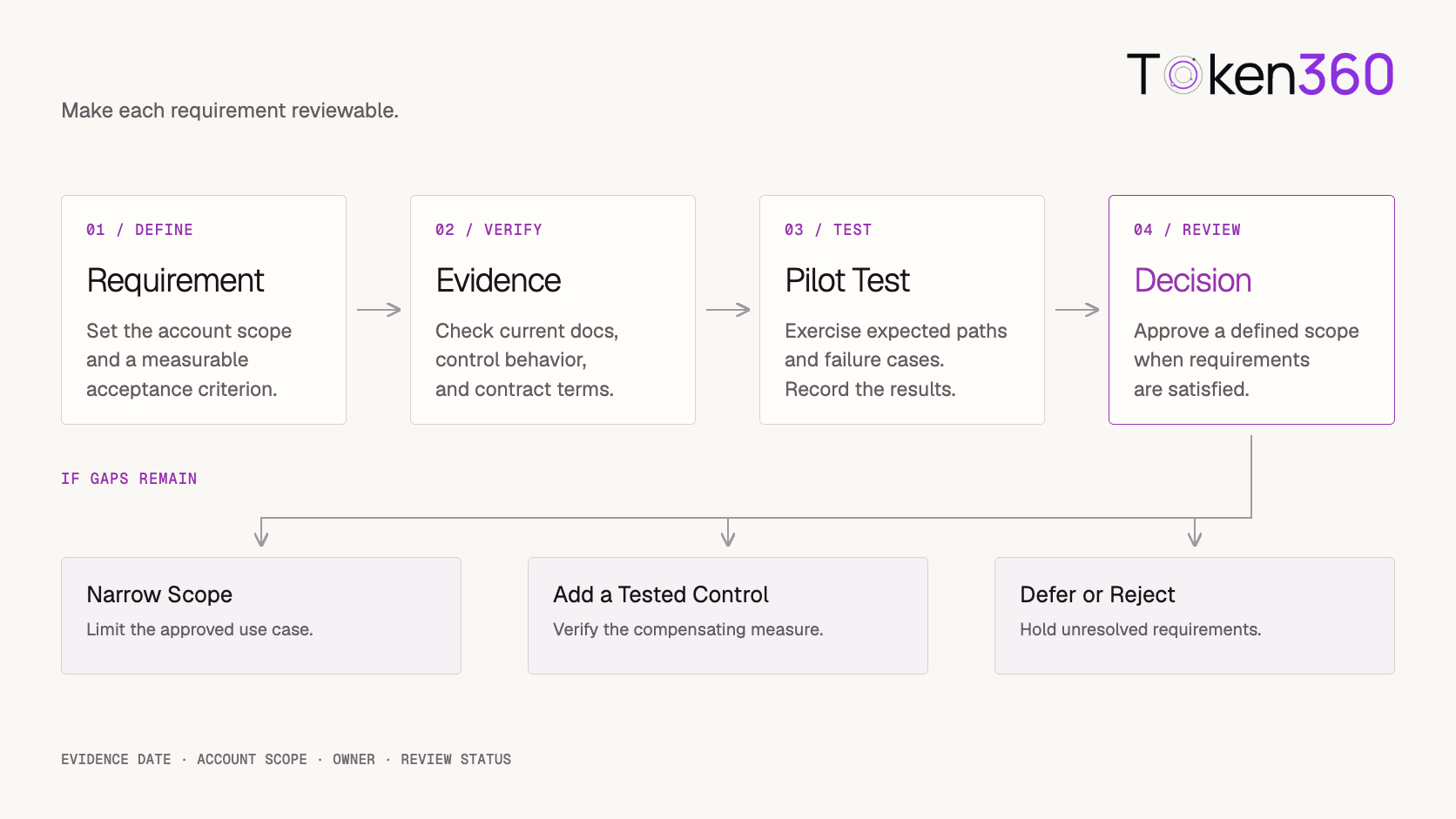
Turn gaps into decisions
For each unresolved requirement, choose one outcome:
-
Reject the product for the intended workload.
-
Narrow the approved scope.
-
Implement and test a compensating control.
-
Obtain the required commitment before proceeding.
-
Defer the decision pending further evidence.
Assign an owner and review date. Do not mark a gap as resolved solely because it appears on a roadmap.
Where Token360 Fits
Apply the same checklist when evaluating Token360.
The current Token360 Enterprise page describes tenant-wide key auditing, sub-account management, unified wallet billing, and enterprise pricing discussions. It also labels several offerings—including priority support and SLAs, custom deployment, and higher throughput—as Coming Soon. Confirm the status and contractual scope of any capability required for your pilot.
Its API Keys and Workspaces documentation explains key organization and lifecycle controls. Its Routing and Reliability documentation describes eligible upstream routing without establishing universal cross-model fallback or a fixed unpinned provider.
Use the Billing and Usage documentation to design a sample reconciliation test.
An enterprise evaluation should end with a documented supported configuration, known gaps, and a concrete integration plan.
Procurement Checklist
Before approving an enterprise AI gateway:
-
Define mandatory requirements and decision owners.
-
Test exact models, endpoints, and advanced features.
-
Exercise credential rotation and revocation.
-
Verify the documented isolation boundaries.
-
Review the complete data path and retention commitments.
-
Test denied requests and enforcement timing.
-
Check assurance scope and customer responsibilities.
-
Run a primary-and-secondary failure exercise.
-
Reconcile representative charges.
-
Verify alerts versus blocking controls.
-
Rehearse operational support.
-
Export data and test an alternate access path.
-
Assign explicit outcomes to unresolved gaps.
Frequently Asked Questions
Is a large model catalog enough to choose an enterprise gateway?
No. The exact workflows, controls, operational behavior, and support available to your account matter more than the headline model count.
Does a workspace guarantee tenant isolation?
Not necessarily. A workspace may organize keys or usage without defining a full security boundary. Verify the resource and permission model.
Does an enterprise label imply SSO or an SLA?
No. Check whether each requirement is deployed, available for your account, and included in the relevant agreement.
Is regional routing the same as complete data residency?
It describes part of the processing path. Review storage, logging, backups, support access, and upstream handling separately.
Are audit logs and request logs the same?
No. Request logs describe inference activity. Administrative audit records describe actions such as changing permissions or revoking keys. Your evaluation may require both.
Should procurement run the evaluation alone?
No. Engineering, security, product, finance, and other responsible reviewers need different evidence and should own their acceptance criteria.
What is the best proof of portability?
A representative workload running through another approved path, supported by export checks and a record of the required changes.
How should roadmap features affect the decision?
Record them as planned capabilities. They should not satisfy a current mandatory requirement without the necessary deployment evidence and commitments.
What to Read Next
Return to AI Gateway vs Direct APIs if the pilot reveals that a different access architecture better fits the workload.
Bring a Workload and an Evidence Checklist
Define the production requirements, bring representative requests, and ask for evidence that can be reviewed by the people responsible for operating the system.
Contact Token360 for enterprise model access.


 Tutorial
 Tutorial
 Prompt Guide