AI model routing decides which model should handle a request. In a broader routing system, a second decision may determine which provider or deployment serves that model.
The goal is to match each request to an eligible option that can deliver the required result within the application’s operating constraints.
That requires an order of decisions.
A route that cannot support the required output schema should not compete on price. A fast endpoint outside an approved data path should not become eligible because another endpoint is busy. A low-cost model that frequently produces rejected outputs may increase the cost of completing the task.
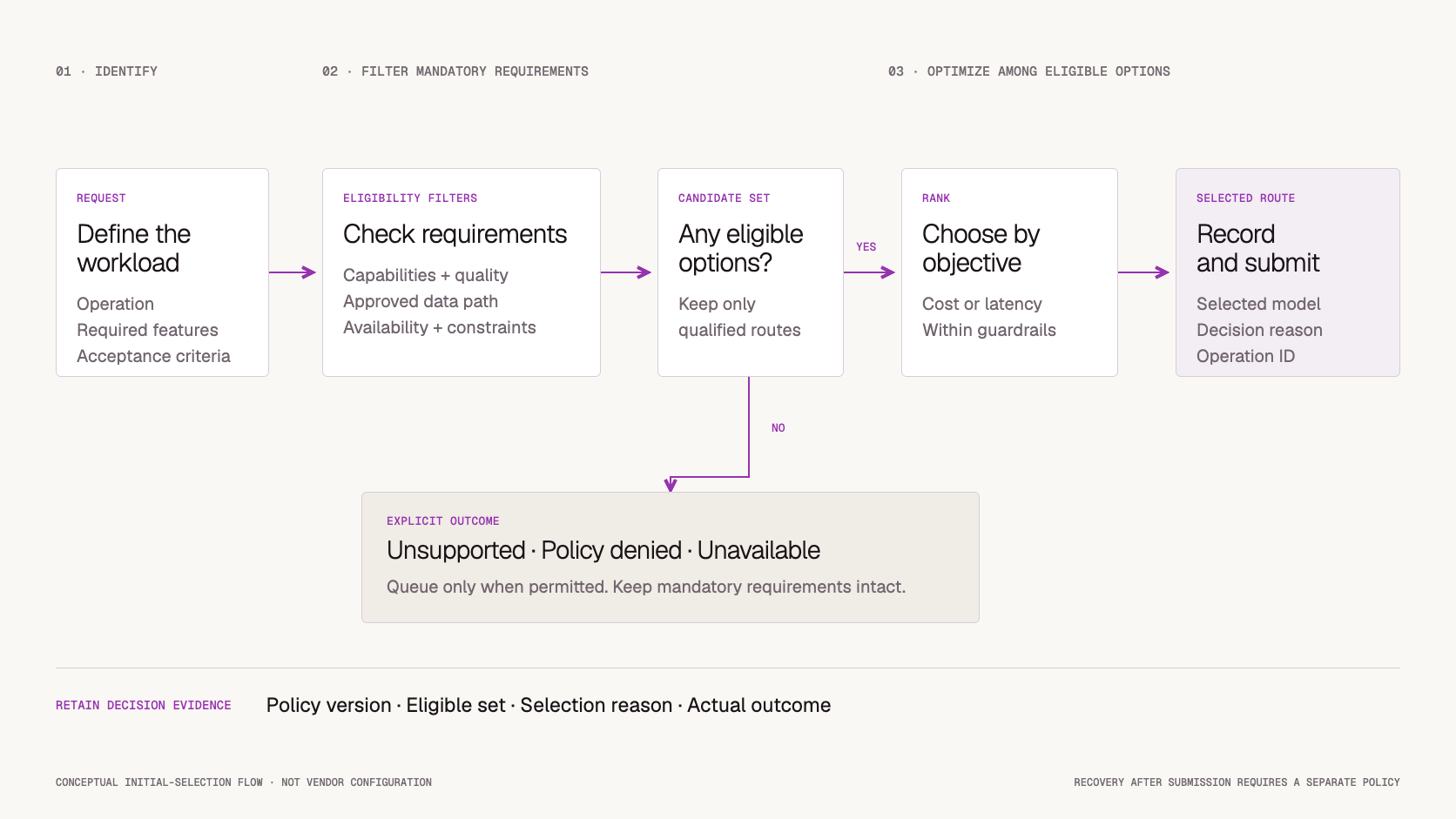
A practical routing policy therefore follows this sequence:
Filter for eligibility → rank qualified options → submit → measure the outcome.
This guide explains how to build that policy, choose an appropriate routing strategy, and evaluate whether routing improves on a fixed-model baseline.
Before You Read
These guides provide useful context:
For Token360-specific behavior, review the Routing and Reliability documentation alongside the application design in this guide.
AI Model Routing at a Glance
Not every application needs a separate service for each stage. The important part is preserving the order and making the decision explainable.
Separate Model Routing From Provider Routing
Model routing and provider routing operate at different levels.
Model routing selects among models with potentially different behaviors. An application might choose one approved model for support classification and another for complex document analysis.
Provider routing selects a serving path for a chosen model. Depending on the platform, that path may identify a provider, deployment, region, or endpoint variant.
Switching providers can still change relevant details, including model revision, quantization, supported parameters, or execution limits.
If your application controls only the public model identifier, its decision log should not imply that it also selected the final upstream provider.
Define the Workload Before Choosing the Model
“Answer this prompt” is often too broad to serve as a routing contract.
Start with the product operation:
-
Classify an incoming support request.
-
Extract fields from a document.
-
Generate a customer-facing response.
-
Summarize an offline report.
-
Create a video using required reference assets.
Each operation needs its own acceptance criteria.
For document extraction, success might require schema-valid output, correct field values, and explicit treatment of missing information. For interactive support, the response deadline and answer quality may matter more than raw generation throughput.
Use application metadata where it is reliable. A request originating from a known extraction workflow may not need another model to determine that it is an extraction task.
When workload classification is uncertain, define an explicit outcome: use a conservative approved default, request more information, or return an unsupported-operation result.
Uncertainty should not silently expand the set of permitted models.
Filter Hard Constraints Before Ranking Candidates
Some requirements determine whether a route is eligible at all.
Examples include:
-
Required input and output modalities.
-
Sufficient input capacity and output allowance.
-
Required tool-calling behavior.
-
Support for the necessary structured-output constraints.
-
Approved model and endpoint family.
-
Permitted processing location and data path.
-
Tenant-specific restrictions.
-
Required execution mode.
A routing score should not allow a lower price to compensate for failure on one of these requirements.
For example, a video model that does not accept the required reference input is ineligible for that operation. It should be excluded before cost comparison.
The same applies to unknown capability information. For a mandatory feature, missing evidence is a reason to withhold eligibility until support is validated.
Handle an empty eligible set explicitly
When no candidates remain, distinguish the reason.
A route that violates a mandatory boundary is not a valid improvement in availability.
Choose One Primary Optimization Goal
After eligibility filtering, the router still needs a definition of “better.”
Start with one primary objective and explicit guardrails.
Examples include:
-
Minimize expected task cost among candidates meeting quality and latency thresholds.
-
Minimize end-to-end latency among candidates meeting quality and budget requirements.
-
Distribute work across approved capacity while maintaining acceptance standards.
This is easier to evaluate than an opaque score combining many unrelated metrics.
A price, a latency measurement, and a quality rating use different units. Adding them together with arbitrary weights can produce rankings that are difficult to explain or maintain.
If you use a weighted score, document its normalization, weights, measurement window, and tie-breaking behavior. Show how changes in the score correspond to a product outcome.
Quality qualification is empirical
A model passing an evaluation threshold does not guarantee every future answer will be acceptable.
Use representative samples, inspect important workload segments, and account for uncertainty. A small measured difference between two candidates may not justify a routing change.
Compare the Main Routing Strategies
The appropriate routing strategy depends on how much useful evidence you have.
Static routing
A fixed model is a useful production option and an essential evaluation baseline.
It makes changes easier to attribute and reduces the number of moving parts. Keep it when more complex routing does not demonstrate a meaningful benefit.
Rule-based routing
Rules work well when the application already knows relevant categories.
For example, interactive support and offline summarization can use separate approved defaults because their latency requirements differ.
Keep rules ordered and versioned. Define what happens when multiple rules match.
Score-based routing
A scoring policy can adapt to measured cost, latency, or capacity differences.
Use comparable measurements from relevant workloads. A provider-wide average may not describe the performance of the endpoint, input size, and output length your application uses.
Learned routing
A learned router predicts something useful about the request, such as which approved model is likely to meet a quality threshold.
Treat that prediction as an estimate. Evaluate calibration, uncertain cases, and changing traffic patterns. A learned router also needs an approved default for cases outside its validated scope.
A Worked Example: Eligibility Before Price
Consider a hypothetical invoice-extraction workload.
The application requires an approved data path, support for its output schema, and satisfactory results on a representative evaluation set.
Its objective is to minimize estimated cost among candidates that meet those requirements and an operational latency target.
All figures are illustrative. They are not vendor prices, benchmarks, or guarantees.
If the operational target accepts both A and C, Model A ranks first on estimated cost.
Model B never enters the cost ranking because it lacks a required capability. Model D is excluded because its data path is not approved.
If A becomes unavailable before submission, the initial-selection policy can choose C if C remains eligible and fits the applicable budget.
Once a request has been submitted, switching after failure becomes a recovery decision. That requires separate rules about retries, duplicate work, and partial results, covered in AI API Fallbacks.
Include the Router’s Own Cost and Latency
A router can become expensive enough to erase the savings it was intended to create.
A model-based classifier adds an inference step. Remote policy checks add network calls. Repeated metadata lookups add delay and failure points.
Measure the complete system:
End-to-end latency includes routing, waiting, inference, and required post-processing.
For cost, compare total spend with accepted outcomes:
Cost per accepted result = total routing and execution spend ÷ accepted results.
Include unsuccessful attempts and applicable recovery costs. Report rejection rates separately so that refusing difficult requests does not appear to be a cost improvement.
Cache decisions carefully
Caching can reduce routing overhead when the relevant inputs are stable.
A reusable decision may depend on workload class, tenant, policy version, required capabilities, and input-size range. It may also require fresh capacity checks before submission.
A cached decision should not survive a policy change simply because the prompt category looks similar.
If routing examines prompt content, the classifier becomes part of the data path. Apply the same approval and handling requirements that govern other services receiving that content.
Evaluate the Router Against a Fixed Baseline
A routing policy should improve a measurable outcome compared with a simpler alternative.
Start with a fixed approved model and evaluate both approaches on the same workload distribution.
Track more than successful response counts.
For streaming workloads, distinguish time to first useful output from total completion time.
For asynchronous work, include queue time when measuring customer-visible completion latency.
Control for traffic selection
A model receiving easier requests can appear more accurate and reliable than another model receiving difficult cases.
Use a representative replay set or a properly controlled live experiment. Examine important segments separately, such as long inputs, specific languages, or requests requiring tools.
Offline replay establishes comparative evidence. Limited live testing helps reveal queueing, concurrency, and other operating conditions that replay may not reproduce.
Both are useful, but they answer different questions.
Make Every Routing Decision Explainable
A useful decision record should answer:
-
Which policy version was active?
-
Which workload and requirements were identified?
-
Which candidates were eligible?
-
Why were other candidates excluded?
-
Which option was selected, and why?
-
Which model or route was reported after execution?
-
What result, latency, and cost followed?
Keep requested identity separate from reported serving identity. If the upstream platform does not expose the actual provider or revision, record that information as unknown.
You do not need to retain full prompt contents to explain every decision. Prefer sufficient metadata, controlled references, and reason codes, with retention appropriate to the workload.
Treat freshness as part of the policy
Capability records, price estimates, and health signals can become stale.
Record when they were refreshed and define what happens after their validity window expires. A router should not continue treating an old health observation as evidence of current availability.
For rapidly changing signals, use smoothing or a minimum switching margin where appropriate. This can reduce unnecessary oscillation between similarly ranked candidates.
Respect the Routing Contract of the Platform
An application policy and a platform’s routing interface are different things.
Some platforms expose provider ordering, parameter requirements, price preferences, or data-policy filters. Others keep those controls internal or offer them only through account configuration.
For example, OpenRouter’s provider-routing documentation describes request-level controls for provider selection, supported parameters, and ranking preferences.
Those controls are specific to that platform. They should not be copied into another API unless its published schema supports them.
Also check whether a setting is a preference or an enforced restriction. A preferred latency value is not automatically a hard deadline, and a price preference is not necessarily a total-spend cap.
Your application must understand which requirements the platform actually enforces and which remain its responsibility.
Where Token360 Fits
Token360 provides shared access to models, while its documented routing layer resolves public model names to eligible upstream routes.
Its Routing and Reliability documentation distinguishes public model identifiers from serving routes. It also states that arbitrary OpenRouter-style provider ordering, price ceilings, and cross-model fallback fields are not generally exposed.
For a Token360 integration, separate two decisions:
-
Application model selection: choose an approved public model for the workload.
-
Platform route selection: Token360 resolves that model through its eligible route configuration.
Do not assume the application can select a specific upstream provider unless that behavior is explicitly supported by the account’s configuration.
Measure outcomes using available correlation and serving metadata. Reconcile actual charges using the documented Billing and Usage mechanisms rather than treating an initial estimate as the final cost.
A Practical Routing Pilot
Start with one workload and two qualified candidates.
-
Define acceptance criteria. Specify required features, quality checks, data-policy constraints, and operational targets.
-
Establish a fixed baseline. Measure its acceptance rate, latency, and cost.
-
Validate the alternative. Confirm that it meets the same mandatory requirements.
-
Introduce one rule. Use a category or signal the application can explain.
-
Run offline evaluation. Inspect both aggregate results and difficult segments.
-
Release limited live traffic. Keep a versioned policy and a known rollback configuration.
-
Expand only after review. Require evidence that the rule improves the intended outcome without breaking guardrails.
Frequently Asked Questions
What is AI model routing?
AI model routing selects a model for a request according to application policy. The policy may consider required capabilities, evaluated quality, cost, latency, and operating conditions.
Is LLM routing different from AI model routing?
LLM routing focuses on language-model workloads. AI model routing is a broader term that can also cover image, video, audio, and other model operations.
How is model routing different from provider routing?
Model routing chooses the model. Provider routing chooses a serving path for that model. Both require validation, but they involve different capabilities and risks.
Should the cheapest model always be selected?
Only when it is eligible and meets the workload’s quality and operational requirements. Compare total cost per accepted result, including routing overhead and unsuccessful attempts.
Can routing use prompt content?
Yes, when the data path is approved and the classification is validated. Use application metadata when it already provides a reliable decision signal.
Is a learned router better than simple rules?
Not automatically. It should outperform a fixed or rule-based baseline after accounting for quality, cost, latency, maintenance, and uncertainty.
What should happen when no model is eligible?
Return an explicit unsupported, policy-denied, or temporary-unavailability outcome. Queueing may be appropriate when the workflow permits it. Do not silently relax mandatory requirements.
Is fallback the same as routing?
Fallback is a later selection triggered by a failure or another defined condition. Initial routing chooses where the first attempt goes. Recovery needs additional rules for duplicate submissions and partial results.
What to Read Next
Before implementing provider-specific controls, review the platform’s current routing documentation and the operation you plan to use.
Start With One Explainable Routing Rule
Choose one workload, preserve a fixed baseline, and compare a simple policy using accepted results, end-to-end latency, and actual cost.
Add complexity when the evidence supports it.
Compare supported models on Token360.


 Tutorial
 Tutorial
 Prompt Guide