Last updated: September 29, 2026
AI API governance becomes operational when policy changes what a request is allowed to do.
That means connecting identifiable workloads to approved models, permitted data paths, spending limits, evaluation requirements, and accountable owners. Each decision needs an enforcement point and evidence that the control worked.
A policy that says “use approved models responsibly” leaves important questions unanswered. Which models are approved for which tasks? Can a development key access production data? What happens when a fallback route uses a different provider? Does an exception stop working when its approval expires?
A practical governance system answers those questions before they become incidents.
This guide explains how to turn policy into request-level decisions, test those decisions, and maintain them as models, applications, and teams change.
Before You Read
Start with AI Model Governance for the broader ownership and lifecycle framework.
If you are evaluating a platform, read the Enterprise AI Gateway Checklist first. It explains what evidence to request from a vendor. This article focuses on implementing and operating controls across your own application and access paths.
AI API Governance at a Glance
Turn Policy Statements Into Specific Decisions
Begin with one policy and make its conditions explicit.
For example, replace “production applications must use approved AI” with:
A production workload may call a model only when an active approval covers its task, environment, data class, and required route conditions.
This creates questions that can be answered programmatically. It also identifies information that must exist before a request arrives.
Assign a policy owner, an implementation owner, and a reviewer. These responsibilities may belong to different people, but none should be implicit.
Maintain one authoritative version of the policy and a record of changes. If different services use different revisions during a rollout, make that visible.
The NIST AI Risk Management Framework provides voluntary guidance for managing AI risks. It can inform your governance questions, but adopting an implementation pattern does not establish NIST certification or regulatory compliance.
Bind Access to a Workload and an Owner
A valid credential proves possession of a secret or identity. It does not establish that every available model, dataset, or operation is permitted.
Associate each production workload with a service owner, environment, approved purpose, and budget owner. Use separate credentials or workload identities where supported so that activity can be attributed and access can be revoked precisely.
Avoid accepting ownership or environment labels solely from caller-controlled request fields. Derive authoritative attributes from trusted identity and deployment records.
Separate administration from inference. A service that generates answers generally does not need the ability to issue new credentials or change organization-wide access rules.
OWASP’s authorization guidance recommends least privilege, explicit authorization checks, and denial where access has not been granted.
For AI workloads, apply those principles to model invocation, job access, asset retrieval, and administrative actions.
Maintain an Approval Record With a Defined Scope
An approved-model list needs more context than a collection of model names.
A model suitable for internal drafting may not be approved for customer-facing decisions. Approval for public inputs may not cover confidential documents. Access through one route may have different conditions from access through another.
A useful approval record includes:
Record a model version or deployment identifier when available. If a public alias can change and the platform does not expose an exact revision, document that uncertainty and define how you will detect meaningful behavior changes.
Place Controls Where They Can Stop the Operation
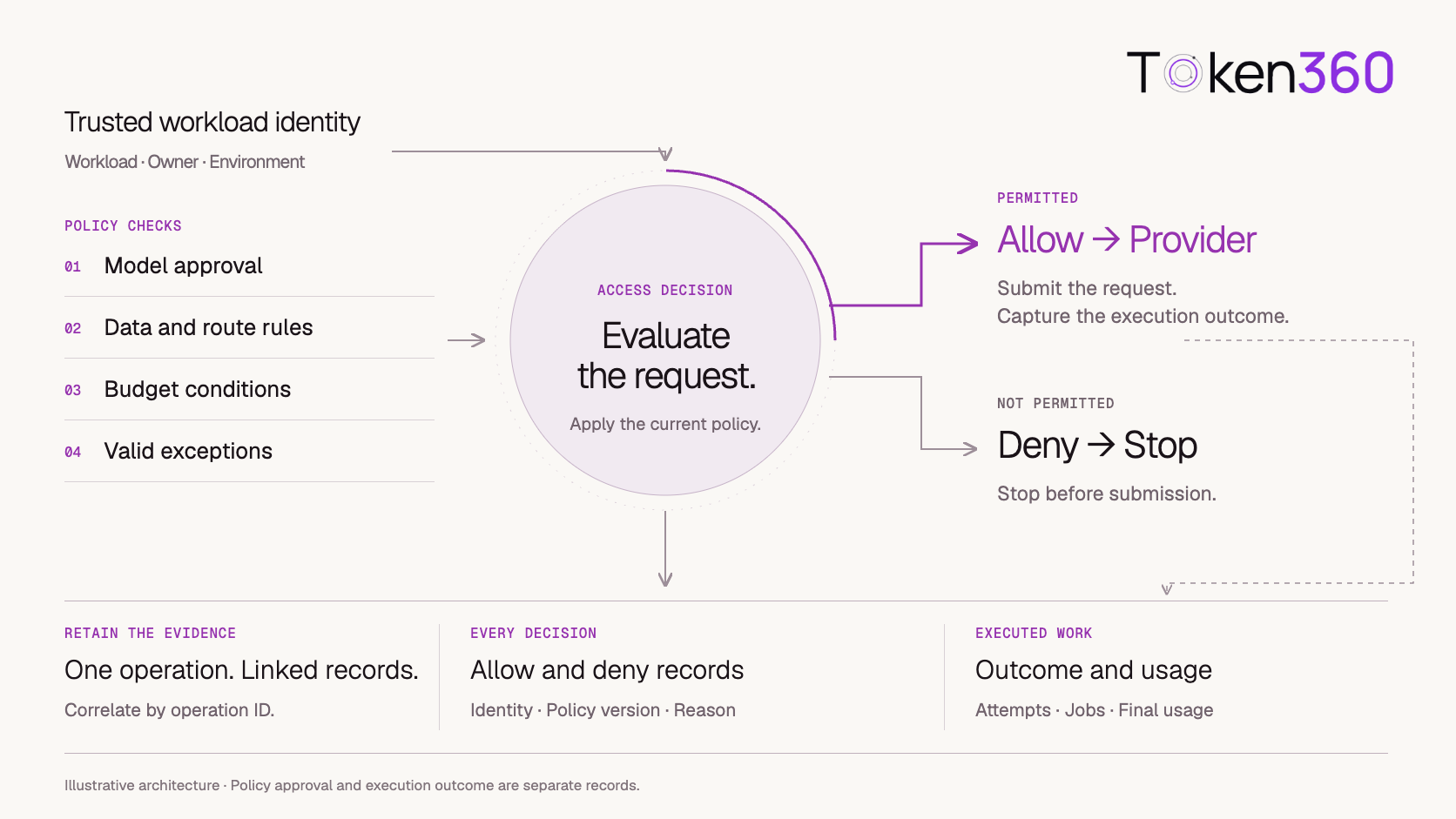
Map each policy to an enforcement point.
Some checks belong before a provider request: identity, model approval, route eligibility, and spending admission. Others belong before a tool action, before an output is published, or before an asset is downloaded.
The following map is an illustrative architecture, not a statement about features available in every gateway.
Close bypass paths as well. Inventory direct provider credentials, scheduled jobs, local scripts, CI tasks, and emergency integrations.
A gateway can control traffic that passes through it. Your surrounding credential, network, and deployment controls determine whether that path is mandatory.
Make Data Rules Cover the Full Workflow
Data policy needs to account for more than the initial prompt.
An AI workflow may send document extracts, images, audio, tool results, or retrieved passages to a model. Outputs may then enter logs, storage, another model call, or a human review queue.
Define allowed destinations for each relevant data class and stage.
Use trusted source metadata where possible, supplemented by inspection when appropriate. A classifier can assist a decision, but its uncertainty and failure behavior need their own policy.
Also distinguish route location from other data conditions. A regional endpoint does not, by itself, establish the behavior of diagnostic logs, retained assets, backups, or training use.
For chained workflows, check the next step’s eligibility before forwarding data. Approval of the first model call should not become blanket approval for every downstream service.
Separate Spending Alerts From Admission Controls
Cost governance needs both visibility and a decision about whether more work may begin.
A spending alert informs an owner. A blocking limit changes request behavior. Make that distinction explicit in policy and user-facing operations.
Define the scope of each limit: credential, application, team, account, or customer. Specify reset periods, ownership, and what happens when several limits apply.
For application-managed budgets, account for concurrent requests and work whose final cost is not yet known. One implementation approach reserves estimated capacity at admission and reconciles it against final usage.
That approach requires careful handling of failed, timed-out, and unresolved operations. A reservation does not guarantee an exact final bill unless the system also bounds the relevant billable work.
Token360’s billing documentation distinguishes API-key limits, account daily spending protection, credit limits, and alerts. It also documents request-level reconciliation and notes that asynchronous billing can finalize after a job reaches a terminal state.
Gate Material Changes With Evaluation
Approval should apply to a configuration and use case, not an indefinitely reusable model label.
Define which changes trigger review. Examples include a new model, a changed alias or version, a different route requirement, a new data class, expanded tool permissions, or a prompt change that materially alters behavior.
Keep the evaluation evidence connected to the proposed deployment:
-
Evaluation dataset and version.
-
Model, prompt, and relevant configuration.
-
Task-specific acceptance criteria.
-
Results and known limitations.
-
Reviewer and approved scope.
Use a controlled rollout for changes that pass evaluation. Preserve a previous approved configuration when rollback is feasible.
Do not assume that a model remains suitable because the request schema is unchanged. A technically compatible update can still change output quality, refusal behavior, or tool selection.
Define What Happens When Control Dependencies Fail
A policy store, identity service, budget ledger, or audit pipeline can become unavailable.
Decide the behavior before an outage.
For a sensitive operation, the appropriate response may be to deny new work when the required authorization cannot be established. Another workload may be allowed to use a recently validated policy snapshot for a strictly bounded period.
If snapshots are permitted, define their integrity requirements, maximum age, applicable scope, and revocation behavior. A cached permission can remain technically available after the business has withdrawn approval.
Treat missing attributes and evaluation errors explicitly. They should not accidentally become an “allow” result.
Logging failures also need a decision. Depending on the workload, a bounded local buffer may be acceptable, or the operation may need to stop until required evidence can be retained.
An outage should produce the behavior you reviewed, with a reason code that operations teams can understand.
Govern Queued Jobs, Retries, and Fallbacks
Request admission is only one point in a longer lifecycle.
A job may wait in a queue while its approval expires. A retry may occur after a key is disabled. A fallback may use a route that does not satisfy the original request’s conditions.
Define where authorization must be checked again.
For queued work, decide whether the original admission remains sufficient or whether execution requires a fresh decision. For retries and fallbacks, preserve the original workload identity and apply the relevant current constraints to the proposed action.
Once a provider has accepted a job, revoking permission may not cancel that work. Use supported cancellation where available and continue handling the resulting state deliberately.
Protect status endpoints and asset retrieval separately. Knowing a resource ID should not grant access to another workload’s output.
Keep operational ownership available so that authorized teams can investigate and reconcile accepted work even when new submissions have been stopped.
Give Exceptions a Scope, Expiry, and Enforcement Path
Exceptions should be reviewable records with concrete limits.
Include the business justification, affected workloads, exact policy deviation, compensating controls, approver, owner, and expiration time.
Apply the exception only when all of its conditions match. An exception for one experiment should not authorize unrelated production traffic.
Check expiry during authorization. A reminder to review an exception is useful, but it does not stop access if nobody responds.
Track renewal separately from the original approval. Repeated renewals should trigger a discussion about whether the standard policy needs revision or the workload needs a different design.
Emergency access also needs a defined process. Make activation explicit, restrict its scope, retain evidence, and require follow-up review.
Record Decisions Without Collecting Unnecessary Content
A useful governance record explains why an operation was allowed or denied and what happened afterward.
An illustrative decision event could include:
decision_id
operation_id
workload_id
environment
policy_version
approval_reference
requested_model
decision
reason_code
exception_reference
evaluated_at
Record the actual route or model revision separately when execution exposes it. Keeping requested and observed values distinct avoids implying that unavailable details were verified.
Link the decision to attempts, jobs, assets, and usage through correlation identifiers. A pre-request approval record alone cannot show whether execution succeeded.
Avoid putting API-key secrets or unnecessary prompt content into decision logs. Apply access controls, retention rules, and tamper protection to the evidence itself.
OWASP’s logging guidance covers useful event context, sensitive-data handling, and protection of logging systems.
Test Allowed, Denied, and Degraded Paths
Test governance as executable behavior.
A small regression suite should include normal use, clear violations, expired permissions, and control-dependency failures.
Use controlled integration tests to verify whether a provider call was actually made. A dashboard entry saying “denied” is insufficient if a separate code path already submitted the request.
Monitor unexpected denials too. A control that blocks legitimate work without a clear resolution path encourages bypasses and emergency exceptions.
Connect Incidents Back to the Control System
Define who can disable a credential, stop a workload, suspend a route, or withdraw a model approval.
During an incident, identify affected operations using decision and execution records. Containment may need to address both future requests and work already accepted.
After recovery, update the relevant policy, implementation, or test. If an unauthorized fallback caused the incident, add a regression case that proves the disallowed route cannot be selected.
Track recurring causes such as missing ownership, stale approvals, or bypass integrations. These indicate gaps in the operating process as well as the software.
Where Token360 Fits in AI API Governance
Token360 can provide part of the access and operational layer for a governed AI deployment.
Its API keys and workspaces documentation describes separate service keys, expiry, spending limits, and IP restrictions for eligible enterprise accounts. Workspaces are described as labels for organizing keys; that should not be interpreted as proof of every isolation or budget boundary an application may require.
The routing documentation describes account policy and route eligibility. It also distinguishes regional routing constraints from broader retention, logging, and training behavior.
Token360’s enterprise page lists tenant-wide key metadata auditing and revocation, sub-accounts, and unified wallet billing. Priority support and SLAs, custom model deployment, higher throughput limits, and serverless GPU infrastructure are currently marked as coming soon.
Your organization still needs to define policy ownership, evaluation approvals, exception handling, and incident responsibilities. Verify the exact control coverage available to your account and implement remaining requirements in the appropriate application or infrastructure layer.
AI API Governance Implementation Checklist
-
[ ] Assign policy, workload, model, and budget owners.
-
[ ] Derive authorization attributes from trusted records.
-
[ ] Define model approval by task, environment, data, and route scope.
-
[ ] Map each policy to an enforcement point and evidence.
-
[ ] Inventory and address direct-access bypasses.
-
[ ] Separate spending alerts from blocking limits.
-
[ ] Gate material changes with evaluation and approval.
-
[ ] Document control-dependency failure behavior.
-
[ ] Cover queued jobs, retries, fallbacks, and asset access.
-
[ ] Enforce exception expiry during authorization.
-
[ ] Connect decision records to execution and usage.
-
[ ] Test allowed, denied, and degraded paths.
-
[ ] Feed incident findings back into controls and regression tests.
Frequently Asked Questions
Is AI API governance only for regulated companies?
No. Shared spending, credential ownership, model changes, and customer-facing behavior create governance needs in any multi-team production environment. The depth of controls should reflect the workload.
Can an AI gateway implement all governance?
A gateway can enforce some access and routing controls. Evaluation, organizational approvals, contracts, data ownership, and incident responsibilities also depend on systems and processes outside it.
Is an approved-model list enough?
No. Approval needs a scope, such as the task, environment, data class, and route conditions. The same model can be appropriate for one use and unsuitable for another.
Should the system deny requests when the policy service is unavailable?
Choose and document the behavior for each workload. Some operations should stop; others may use a bounded, validated snapshot. An unavailable dependency should never silently remove required controls.
Does a regional route guarantee all data stays in that region?
A routing setting alone does not describe every storage, logging, backup, or retention path. Review the complete data flow and applicable service terms.
Should governance logs store every prompt and response?
Only when there is a justified requirement and appropriate handling. Many access decisions can be audited using identities, policy versions, reason codes, and correlation IDs without retaining full content.
How often should approvals be reviewed?
Review them after material changes and on a schedule appropriate to the workload. Include changes to model behavior, data use, tool permissions, and route conditions.
What to Read Next
-
AI API Key Security: implement credential issuance, rotation, revocation, and ownership.
-
AI API Observability: connect policy decisions to requests, attempts, jobs, and outcomes.
-
AI API Cost Management: design attribution, spending controls, and reconciliation.
-
AI Model Version Upgrade Guide for Regression Control: turn model changes into reviewed releases.
Discuss Governed Model Access With Token360
Start with one production policy. Define its owner, enforcement point, failure behavior, and required evidence. Then verify an allowed request and a denied request before expanding the design.
Discuss governed model access with Token360.


 Tutorial
 Tutorial
 Prompt Guide