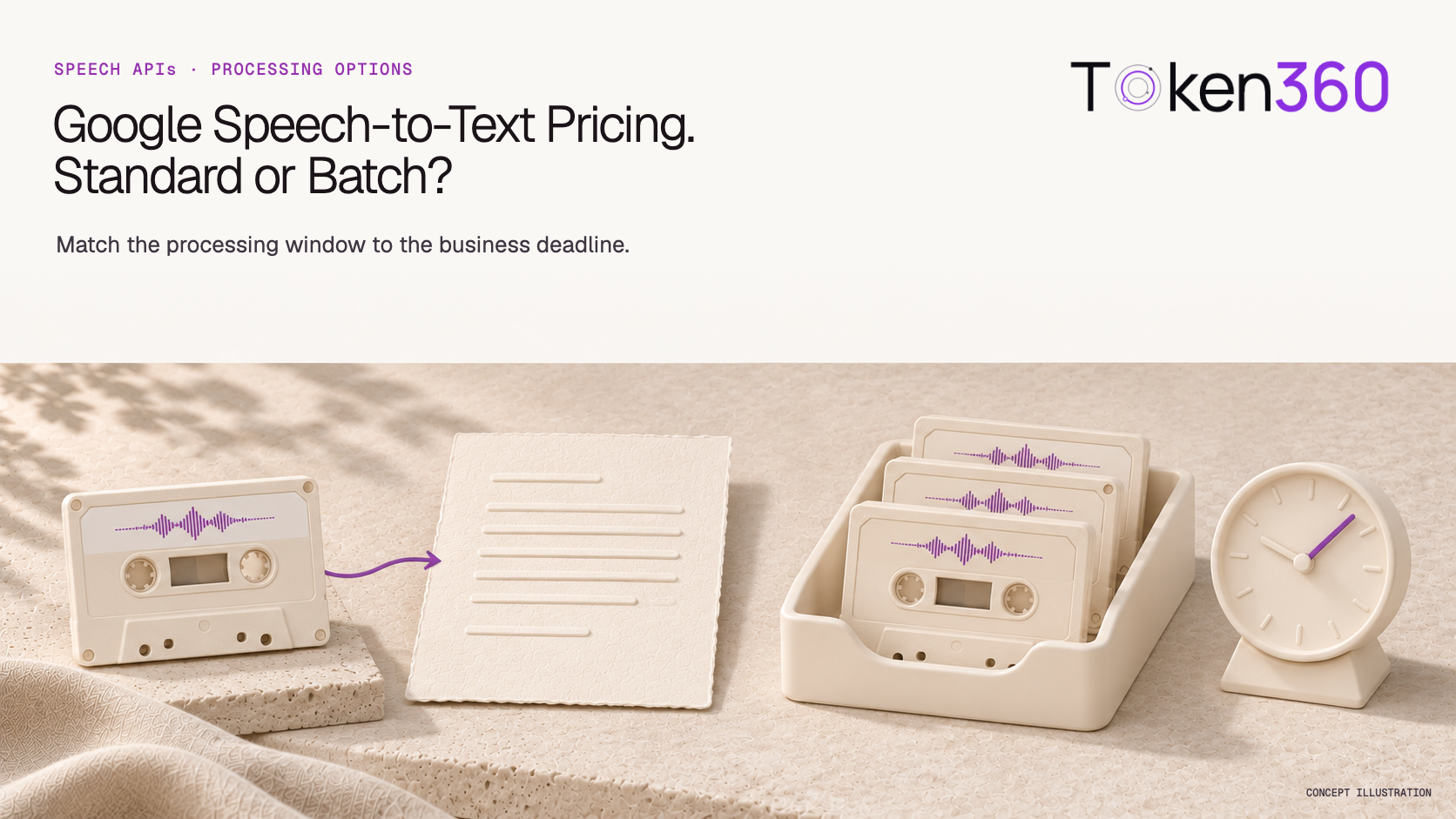
Google Speech-to-Text API pricing depends on which service configuration you buy. For an enterprise comparing V2 standard recognition with dynamic batch, the important decision is whether the transcript can wait. Establish the required delivery window, then apply the relevant rate to processed audio—not simply the number of recordings.
A contact-center team might need some transcripts during an investigation and others only for a later quality review. Treating both as one undifferentiated monthly volume makes a price comparison less useful. The purchasing question is whether the proposed processing mode can deliver each group when the business needs it.
This article examines Google’s published V2 options as a procurement reference, not a claim that Token360 resells this specific service. Token360’s business is enterprise model access across text, images, audio and video. Any proposed speech model, endpoint and commercial arrangement must be confirmed in the quote.
Which Google Speech-to-Text V2 price should you compare?
Compare the standard recognition rate with the dynamic batch rate only after specifying V2, the eligible model and the workload’s deadline. A low batch price is not a quote for live transcription. Keep the selected processing option on the purchase request so finance and engineering are evaluating the same service.
| Published V2 option | USD list rate checked November 21, 2026 | Procurement interpretation |
|---|
| Standard recognition, first 500,000 monthly minutes | $0.016 per minute | Baseline for the selected standard configuration; not a latency guarantee |
| Standard dynamic batch recognition | $0.003 per minute | Assess whether deferred delivery is acceptable |
These are the base published rates, not commitment-plan discounts or a Token360 quote. Google lists additional standard volume bands and separate V1 pricing. Check the applicable model and SKU rather than carrying a V1 allowance into V2. Source: Google Cloud Speech-to-Text pricing, checked November 21, 2026.
Do not ask purchasing to choose between two unexplained numbers. Label each proposal with the API version, model, processing mode and required output. For the broader cross-supplier comparison, use how to compare speech-to-text API pricing; this page focuses on Google’s specific V2 standard-versus-dynamic-batch decision.
Does dynamic batch fit an overnight transcription deadline?
Dynamic batch fits work that can tolerate deferred completion, not every job described as overnight. Define the latest usable delivery time and compare it with the documented processing window. If an upload arrives late in the evening and must be reviewed early the next morning, verify that the selected mode actually fits.
Google’s V2 API reference for DYNAMIC_BATCHING says requests are processed during lower-utilization periods and fulfilled within 24 hours. That documented window is not a measured completion time for your account. A transcript needed within eight hours cannot be planned around a 24-hour window merely because both are called batch processing.
For a hypothetical support operation, separate urgent escalations from an archive review that can wait until the following day. Ask the business owner to approve that split before seeking a volume quote. Record the deadline from a defined event, such as successful submission, and include upload and review time in the operational schedule.
Also specify what happens when a result is late: wait, investigate, or submit through another approved path. An automatic second submission should not be assumed free. This is a proposed operating policy, not a tested claim that a particular fallback will meet the deadline.
What would a sample monthly transcription budget look like?
Build a small, explicit scenario before extrapolating a monthly budget. State the processed minutes, channel treatment, selected rate and excluded costs. Keep the calculation separate from a supplier quote. The useful result is a checkable assumption set, not a savings claim based on two configurations that may serve different needs.
Illustrative calculation only: assume 10,000 billable mono minutes, all eligible for the chosen option, within the first standard volume band. At the rates above, recognition alone is $160 standard or $30 dynamic batch. No trial credit, commitment discount, tax or other service cost is included. This is arithmetic, not a measured invoice.
Google bills processed channels separately and rounds requests up to one-second increments. Other Cloud resources, including storage, can add charges. Those rules come from the same pricing page. Confirm how the actual recordings are processed before using elapsed file minutes as billable minutes.
The lower subtotal is relevant only if the batch configuration satisfies the delivery requirement. If both options need different engineering work, add those implementation estimates separately. Do not invent a percentage for integration overhead; obtain an estimate from the team responsible for the workflow.
What changes when the purchase includes a batch workflow?
A batch purchase needs an owner for storing recordings, submitting jobs, retrieving results and handling incomplete work. It is not complete when an API key has been issued. Ask the technical team to describe how a recording becomes a usable transcript and identify which responsibilities belong to the supplier or to your application.
Google’s batch recognition guide requires audio in Cloud Storage and describes a long-running operation whose completion can be polled. Dynamic batching is an explicit processing strategy; uploading a file does not by itself select that option. Output handling and storage access therefore belong in the integration design.
Before approval, ask engineering to demonstrate one authorized recording from ingestion to the location where a reviewer will use the transcript. The demonstration should establish access boundaries and output format. It should not be described as an accuracy benchmark unless the team has defined and completed that evaluation.
A separate requirement is recognition quality for company terminology. If that is the procurement risk, use the evaluation approach in whether a speech-to-text API recognizes your product names. A cheaper processing route does not establish that names, numbers or speaker attribution are accurate enough.
What should you ask Token360 to include in a speech quote?
Send Token360 a workload brief that identifies the business deadline and required transcript, then ask which model and delivery arrangement it can offer. Request explicit confirmation of availability rather than assuming a Google price page describes Token360’s catalog. Keep the model usage charge, processing scope and acceptance conditions together in the proposal.
| Include in the brief | Ask the proposed supplier to confirm |
|---|
| Languages, recording types and representative authorized samples | Named model, version and supported input configuration |
| Monthly volume and urgent versus deferrable work | Billing unit, eligible volume band and turnaround terms |
| Timestamps, speaker labels and output destination | Included capabilities and integration responsibilities |
| Data handling and procurement requirements | Applicable contractual scope, exceptions and supporting evidence |
| Pilot acceptance criteria | How quality, delivery and billed usage will be checked |
Token360 uses tiered enterprise quotes: higher usage receives lower quoted rates. It does not charge a separate service fee. This does not mean free inference, a guaranteed discount against every Google configuration or identical billing rules. The quote must establish the actual models, volume eligibility and terms.
Dedicated capacity, contracts and compliance requirements can be scoped for an enterprise engagement. They are not blanket guarantees. Discuss the brief through Token360’s enterprise offering, and review Token360’s company information as part of supplier diligence.
What evidence should the buyer require before approving volume?
Approve volume after the proposed configuration has demonstrated the required transcript quality and delivery behavior on representative recordings. Keep commercial validation separate from technical acceptance. A correct unit-price calculation does not prove the transcript is usable, and a successful sample does not establish performance for the full monthly workload.
A practical pilot record has three parts: submission and completion times; a human review against the required transcript fields; and the supplier’s usage record reconciled to the submitted files. Store the model and processing configuration alongside those observations so later reviewers know what was tested.
Define rejection conditions before running the pilot: an output missing a required field, completion after the agreed deadline, or unexplained billed usage should prompt investigation. Decide whether each issue blocks the purchase or needs a documented exception. No such pilot was performed for this article.
Method and limits: Yuki Yu prepared this procurement analysis from the linked Google documentation and company-confirmed Token360 commercial information. The worked example is hypothetical. No transcription accuracy, completion-time or cost-saving benchmark is claimed. Recheck provider prices and obtain a current written quote before committing spend.


 Guides
 Guides
 Guides