Last updated: September 28, 2026
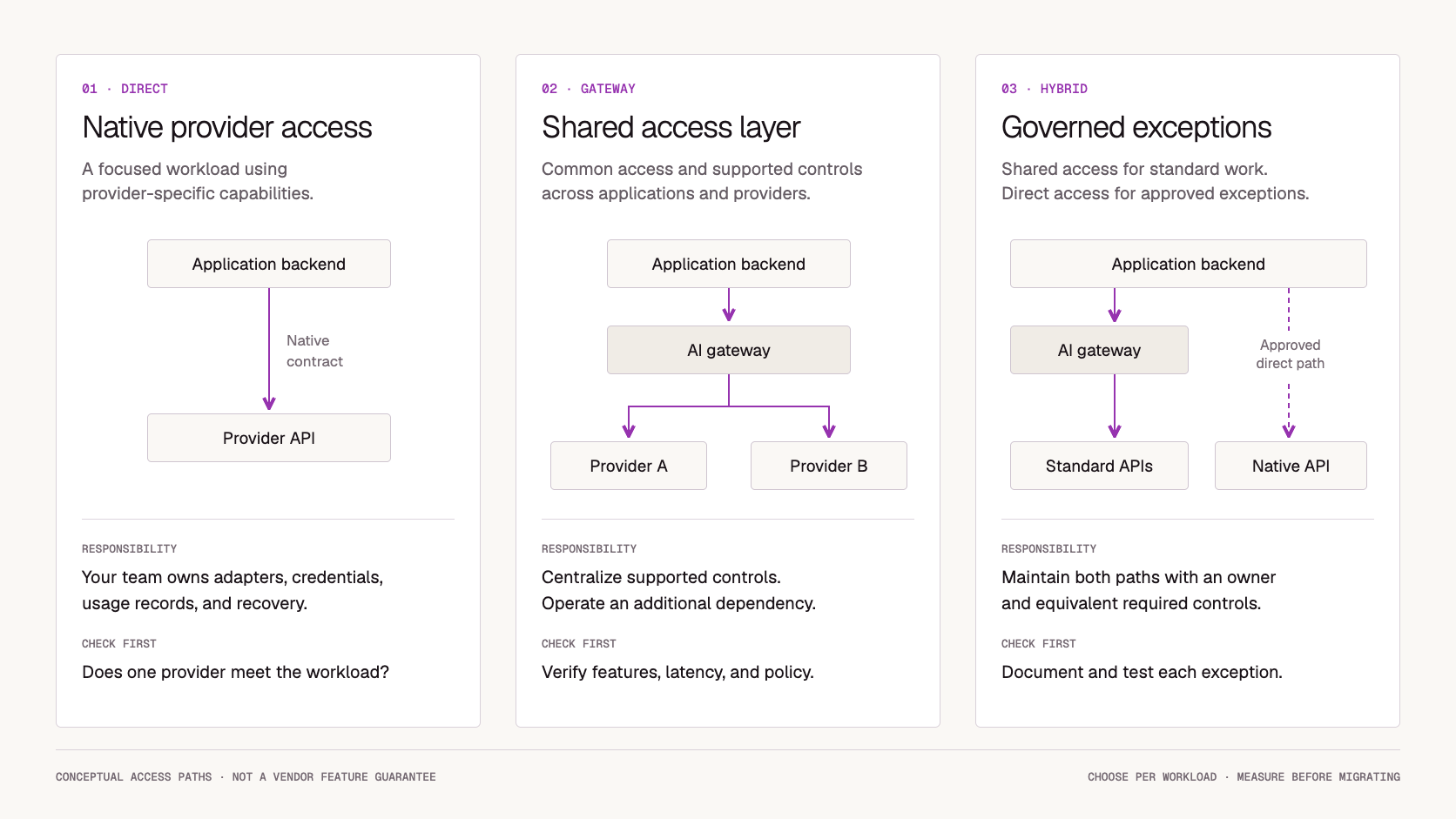
Use a direct model API when a provider meets the workload’s requirements and native capabilities are central to the product. Consider an AI gateway when multiple applications or teams need a shared approach to model access, credentials, usage controls, and operational visibility.
A hybrid can make sense when standard workloads benefit from a gateway while a small number of specialized features require direct integration.
The decision becomes clearer when you look beyond the endpoint.
Every production integration needs someone to own authentication, SDK changes, rate limits, errors, usage records, and incident response. Direct access keeps those responsibilities close to the application. A gateway can centralize some of them, while introducing another service and contract to evaluate.
Neither architecture is automatically cheaper, faster, or more reliable.
The right choice depends on the workload, the capabilities that must remain available, and the responsibilities your team is prepared to operate.
This guide compares those trade-offs and explains how to test the decision before expanding it across production.
Before You Read
If you are still defining the integration layer, start with:
For a concrete platform overview, see Token360’s unified AI gateway documentation.
This article focuses on where those responsibilities should live and how to evaluate the architectural consequences.
AI Gateway vs Direct API at a Glance
These are architectural tendencies rather than guarantees. A direct integration can have strong internal controls, and a gateway can offer only a narrow subset of the capabilities above.
Why the Decision Changes as AI Usage Grows
A product built around one model may need little abstraction.
Its backend stores a provider credential, calls the native endpoint, and handles a known set of errors. The team can evaluate changes directly against that provider’s interface.
As usage expands, the integration surface grows.
A second provider introduces another credential lifecycle, response format, billing source, and support path. Additional applications may independently implement the same timeout, logging, and spending rules.
The reason to consider a gateway is often this repeated operational work.
However, centralization has a cost. The gateway becomes a shared dependency, and its abstraction may not expose every provider feature.
Evaluate the work being removed and the responsibilities being added. Model count alone does not establish whether a gateway is worthwhile.
How to Evaluate the Two Architectures
Use one representative workload and compare the same model and settings where possible.
If the direct path uses one model while the gateway path uses another, differences in output quality or latency cannot be attributed solely to architecture.
Evaluate six areas:
-
Required features and request semantics.
-
Credential and policy ownership.
-
Failure behavior and recovery.
-
Application-observed latency.
-
Total cost and operational effort.
-
Migration and exit requirements.
Record mandatory constraints before scoring preferences. A route that cannot satisfy a required input format or data policy should not remain a candidate because it performs well elsewhere.
This guide is published by Token360. The comparison treats direct access, gateway access, and hybrid designs as valid options depending on the workload.
Direct Model APIs — Best for Focused Provider-Native Workloads
Best for: Products centered on a provider’s differentiated capabilities.
A direct integration connects your backend to the provider’s API without an additional model-access gateway.
Your team can implement the native request and response contract, adopt supported features, and investigate provider-specific behavior directly.
This is particularly useful when the product depends on specialized streaming events, media inputs, model controls, or asynchronous operations that a gateway does not expose.
Direct access also gives the team a clear view of which provider account, endpoint, and commercial agreement serves the request.
The operational responsibilities remain with you. Your backend or internal platform must manage credentials, usage attribution, retry behavior, client upgrades, and support diagnostics.
Where it stands out: A focused product with a stable provider choice and important native requirements.
Potential limitation: Each additional provider can introduce another integration and operating model. Direct access does not automatically reduce total complexity as the portfolio grows.
AI Gateways — Best for Shared Model Access and Controls
Best for: Several applications or teams that would otherwise repeat the same integration work.
A gateway places a common service between applications and model providers.
Depending on the product, it can centralize authentication, model selection, usage records, routing, rate limits, and commercial access. Some gateways use provider credentials supplied by the customer; others aggregate access and billing.
Cloudflare’s AI Gateway documentation illustrates functions such as analytics, logging, caching, and rate limiting. These are examples of responsibilities a gateway may centralize, not proof that every vendor offers the same features.
The value comes from the controls your workloads actually use.
A gateway that supports the relevant models but lacks required diagnostics may still leave substantial operational work in each application. Conversely, a narrower catalog may be sufficient if the shared controls remove a meaningful maintenance burden.
Where it stands out: Repeated needs across providers, features, and application teams.
Potential limitation: The gateway adds a dependency and another interface to understand. Validate enforcement and behavior rather than relying on a feature checklist.
Hybrid Access — Best for Standard Workloads with Specific Exceptions
Best for: Teams that benefit from a shared layer but need selected native capabilities.
A hybrid routes standard workloads through the gateway and maintains a direct integration for documented exceptions.
For example, a product might use the gateway for common language and media requests while calling a native endpoint for a specialized feature not yet exposed by the gateway.
Place both behind an internal application interface where practical. Keep the exception explicit so developers know which path is used and why.
Each direct path needs an owner, approved credentials, usage records, and a review condition. It should follow the same data and spending requirements as the gateway path.
A hybrid does not have to mean automatic failover. Choosing direct access for a specialized feature is different from switching paths during an incident.
Where it stands out: A mixed workload where broad standardization would otherwise block a necessary capability.
Potential limitation: Your team operates two paths. An undocumented exception can become a permanent source of inconsistent controls.
Test Feature Coverage Beyond Basic API Compatibility
Primary purpose: Determine whether the proposed path preserves the behavior the product needs.
A compatible request format is only the starting point.
Test the exact features that matter: structured output, tool calls, streaming, image inputs, video task handling, audio behavior, and model-specific parameters.
A shared schema may normalize common operations while leaving specialized options in extensions or native request bodies.
That is not necessarily a problem. The important question is whether the required behavior remains available and clearly documented.
Token360’s Choose an API guide distinguishes API interfaces and notes that some media models require vendor-native request parameters.
Keep native options contained in an adapter where possible. Spreading gateway-specific or provider-specific fields throughout application code makes later migration harder.
Implementation consideration: Contract tests should verify response meaning and failure behavior, not just that a request returns HTTP success.
Evaluate Reliability as a Dependency Graph
Primary purpose: Understand which failures each architecture can tolerate.
Direct access depends on the application’s integration and the provider path. Gateway access also depends on the gateway’s availability and configuration.
A gateway may offer useful route management or recovery features, but it can also concentrate failures across applications.
Microsoft’s Gateway Routing pattern describes both endpoint abstraction and the risk of introducing a bottleneck or single point of failure.
Ask concrete questions:
-
What happens if the provider rejects or rate-limits a request?
-
What happens if the gateway is unavailable?
-
Which layer retries, and how are retries bounded?
-
Does fallback preserve the model and required settings?
-
Can a route change alter the data path?
-
Who investigates an uncertain asynchronous submission?
Do not assume “routing” means arbitrary cross-model fallback. Token360’s routing and reliability documentation explicitly describes its route-selection boundaries and limitations.
Implementation consideration: Recovery must preserve request semantics. Repeating an asynchronous generation through another path can create duplicate work if the first submission was already accepted.
Measure Latency at the Application Boundary
Primary purpose: Determine whether the architecture meets the user experience requirement.
A gateway adds processing and a network hop, but the end-to-end effect depends on geography, connection reuse, routing, caching, and upstream behavior.
Avoid declaring a universal latency penalty or benefit.
Test under comparable conditions. Keep the model, settings, traffic pattern, cache state, and client location as consistent as possible.
Measure the stages relevant to the workload:
Compare latency distributions, not only averages.
Do not subtract unrelated P95 values to invent gateway overhead. The requests contributing to each percentile may differ. Where internal timing is unavailable, report the measured end-to-end difference with its test conditions.
Implementation consideration: A quicker initial acknowledgment is not the same as a faster usable result.
Compare Total Cost and Operational Effort
Primary purpose: Understand the financial effect of the architecture rather than only its advertised usage price.
Direct provider access may offer a simpler commercial relationship for a focused workload. A gateway may reduce the effort spent integrating and operating several providers.
Compare:
-
Inference charges for the same workload.
-
Gateway fees or subscription costs.
-
Applicable commitments and discounts.
-
Networking and logging costs.
-
Engineering maintenance.
-
Incident investigation and support effort.
-
Costs caused by retries or changed routing.
Do not assume an upstream public price is the price of the gateway route.
Token360’s billing and usage documentation directs users to the pricing applicable to the selected model and route and distinguishes estimates from final charges.
For a pilot, record operational effort separately from usage cost. Reduced integration work can matter, but it should not be presented as a measured saving unless the team has evidence.
Implementation consideration: More consolidated billing does not automatically mean lower inference cost.
Map the Data and Policy Boundaries
Primary purpose: Verify that the architecture applies the required controls along the full request path.
Identify where credentials, prompts, media, generated outputs, and logs are processed or retained.
With a hosted gateway, the data path may include the application, gateway infrastructure, upstream provider, and asset storage. With a self-hosted gateway, your team owns more of the intermediary infrastructure.
Direct access still requires application logging controls, credential management, and provider-policy review.
For each path, establish:
-
Who can authorize model access.
-
Where provider credentials are stored.
-
Which spending controls block requests.
-
What content is logged and for how long.
-
Which routing or regional constraints apply.
-
Who can retrieve outputs and diagnostic records.
A region setting does not by itself describe every log, storage, or retention location. Review the full policy boundary, including the topics covered in Token360’s security and data handling guidance.
Implementation consideration: If the gateway enforces mandatory policy, a direct bypass must implement equivalent approved controls before it can be used.
Design the Exit Path Before Expanding Adoption
Primary purpose: Keep future migration effort visible.
A gateway can reduce application dependence on individual provider APIs while introducing dependence on its own routing fields, usage records, and operational tools.
Direct access also creates coupling through native SDKs, request schemas, and provider resources.
Keep model identifiers and endpoint configuration outside business logic. Isolate integration-specific fields in adapters and retain the request metadata needed to reproduce important behavior.
For asynchronous media, migration has an additional boundary. Tasks created through the old path may need to finish there. Their IDs, callbacks, and output URLs should not be assumed portable to the new integration.
Plan how to:
-
Route new requests after migration.
-
Drain existing jobs.
-
Preserve required assets and usage records.
-
Export configuration and audit information.
-
Rotate or revoke old credentials.
-
Validate the replacement path.
Implementation consideration: A successful base-URL change is not a complete migration test.
Which Architecture Should You Choose?
Choose direct access when a focused provider integration meets the workload, native features matter, and the team can own the associated operations.
Choose gateway access when shared controls and supported multi-provider access reduce meaningful duplicated work, and the gateway meets feature, latency, reliability, and data requirements.
Choose a governed hybrid when standard workloads benefit from the gateway but specific capabilities justify a maintained direct path.
Make the decision per workload. A single organization can reasonably choose different paths for different requirements.
How Token360 Fits into This Decision
Token360 documents a unified model-access layer across language, image, video, and audio workloads, with authentication, routing, metering, and billing handled through the platform.
It is relevant when applications need supported models through a shared integration and operational layer.
Its routing documentation also defines limits. Public model names map to eligible routes; a fixed upstream provider is not guaranteed for an unpinned route. Arbitrary provider ordering and cross-model fallback should not be assumed.
Evaluate the exact endpoint, parameters, account configuration, and data requirements of the workload.
If an essential native capability is unavailable through the gateway, a documented direct exception may remain appropriate.
The useful question is whether Token360 reduces the responsibilities your team repeatedly implements while preserving the behavior the product requires.
Run a Bounded Pilot Before Migrating More Traffic
Move one noncritical feature through the candidate architecture.
Use representative inputs and traffic, and define rollback criteria before the test begins.
Do not create duplicate paid work merely to compare architectures unless that test cost is intentional and controlled.
Record the decision, its owner, evidence date, and review trigger. Review it when workloads, provider features, gateway support, or commercial terms materially change.
Implementation Checklist
Before committing to the architecture, confirm that you have:
-
Identified the workload and mandatory capabilities.
-
Counted providers, applications, and credential owners.
-
Assigned retry and incident-response responsibilities.
-
Tested the exact API contract.
-
Measured application-observed performance.
-
Compared usage charges and operational effort.
-
Mapped data, logging, and policy boundaries.
-
Governed any direct exceptions.
-
Defined an exit path for active jobs and stored records.
Frequently Asked Questions About AI Gateways vs Direct APIs
Does an AI gateway remove vendor lock-in?
It can reduce coupling to individual providers. Gateway-specific fields, routing behavior, and operational tools can create a different dependency.
Is direct API access always faster?
No. It avoids an additional gateway layer, but practical latency depends on the complete network and execution path. Measure the actual workload.
Is a gateway only useful with many providers?
No. Shared policies or usage controls can be useful even with one provider. The benefit should still justify the additional dependency.
Does an OpenAI-compatible interface guarantee feature parity?
No. Compatibility may cover common request formats while specialized operations require different fields, endpoints, or native integrations.
Can direct and gateway access coexist?
Yes. Define which workloads use each path, who owns the exception, and how both satisfy the same required policies.
Should direct access automatically activate when the gateway fails?
Only if the alternate path is approved, tested, and safe for the operation. It must preserve policy and avoid duplicate work from uncertain submissions.
Does a gateway always reduce cost?
No. It can reduce operational duplication, but total cost depends on pricing, traffic, maintenance, and the controls actually used.
When should the architecture be reviewed?
When required features, workload scale, service behavior, commercial terms, or policy requirements change.
What to Read Next
Continue with the guide that matches your next decision:
These readings move from architecture selection to interface evaluation and implementation.
Ready to Evaluate a Shared Model Access Layer?
Bring one representative workload, its required capabilities, and a clear list of operational responsibilities.
Test the complete path before expanding adoption, and retain direct access where a documented requirement justifies it.
Explore Token360 as a unified model access layer →


 Tutorial
 Tutorial
 Prompt Guide