AI API cost management connects every billable operation to an owner, estimates its spending exposure before execution, reconciles the final charge, and applies controls that match the product’s priorities.
A monthly invoice is necessary, but it arrives too late to make many operational decisions.
By then, an expensive default may have served thousands of requests. A retry loop may have generated duplicate jobs. An asynchronous queue may contain more committed work than the remaining budget can support.
Cost management therefore needs to operate throughout the request lifecycle.
It should answer four questions:
-
Who owns this spending?
-
How much exposure are we accepting before the work starts?
-
What was actually charged?
-
Did the spending produce an acceptable result?
The optimization target is cost per accepted product outcome, supported by reliable usage records and explicit budget policies.
Before You Read
These guides explain the systems this article builds on:
For platform-specific billing behavior, start with Token360’s Billing and Usage documentation.
AI API Cost Management at a Glance
These layers can start small. One well-accounted workload is more useful than a broad dashboard with uncertain ownership and incomplete charges.
Assign Cost Ownership at the Application Boundary
Capture ownership when the application accepts work, before model requests are submitted.
A useful allocation record includes:
Derive trusted ownership fields from authenticated application context. Do not allow arbitrary client-supplied labels to move charges between customers or teams.
Preserve historical ownership. If a service changes teams, its earlier usage should remain explainable under the allocation policy that applied at the time.
Start with showback
Showback reports spending to responsible teams without necessarily transferring charges through internal accounting.
Chargeback assigns those costs through a formal internal process.
You can begin with showback while ownership and allocation rules mature. The FinOps Foundation’s allocation guidance provides context for organizing technology costs into meaningful business dimensions.
Keep unallocated spending visible. An “unknown owner” category is preferable to silently distributing uncertain charges across unrelated teams.
Define Which Costs Your Report Includes
An API invoice and the full cost of operating an AI feature are different measures.
Start by distinguishing:
Do not add a gateway charge and its underlying provider cost if they represent the same purchased service. Identify which party actually bills your organization.
Likewise, distinguish gross usage charges from net payable amounts after credits or adjustments.
A promotional credit can lower an invoice without making the workload more efficient. Report that difference when presenting savings.
Estimate Exposure Before Execution
An estimate should reflect the operation’s actual configuration.
For language workloads, relevant inputs may include input size, output allowance, separately priced token categories, and additional model calls.
For media workflows, consider duration, resolution, quantity, reference inputs, and model-specific options.
Keep the estimate’s source, pricing version or effective date, currency, and assumptions.
Include the full operation
A customer action may trigger several billable steps:
Decide whether to reserve for the whole permitted operation or reserve incrementally before each step.
Incremental reservation can improve budget utilization, but later steps may be denied if the remaining allowance is insufficient. The product should define how to handle that outcome.
Recheck delayed work
Queued jobs can execute after a pricing or configuration change.
Validate the estimate again before submission when the original assumptions are no longer reliable. Release and replace the reservation through a traceable update rather than silently changing its meaning.
An expected-cost estimate supports planning. A conservative admission estimate can help limit exposure. Neither is a guaranteed maximum unless the underlying operation and charging contract provide that bound.
Use a Budget Ledger That Separates Reservations From Charges
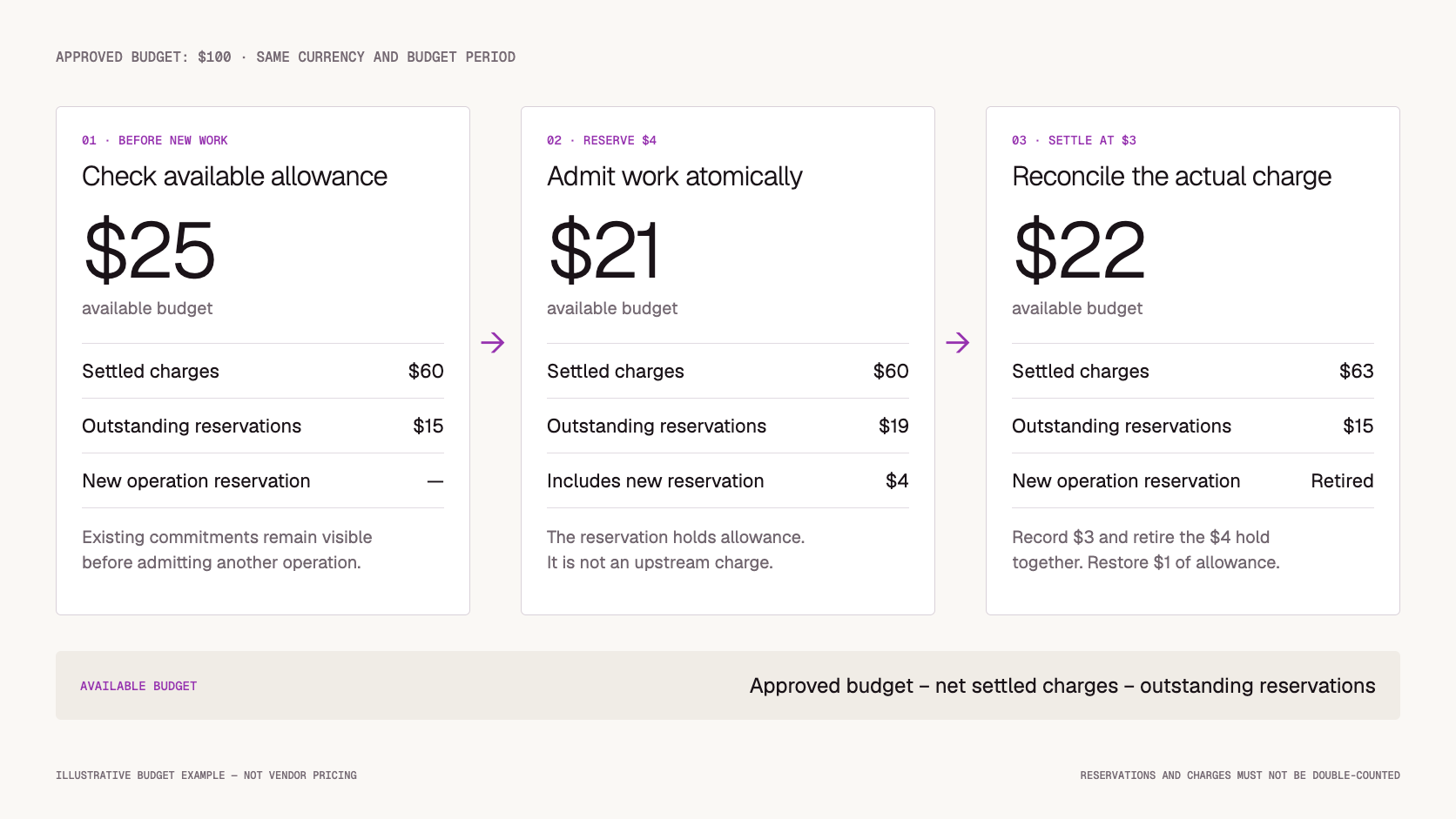
A reservation is an internal commitment of budget capacity. It is not an upstream charge or a movement of money.
Maintain a budget-control record that distinguishes:
For a single currency and defined budget period, an application might calculate:
Available budget = approved budget − net settled charges − outstanding reservations.
Outstanding reservations should represent exposure not already included in settled charges.
A hypothetical example
Assume a workload has a $100 budget, $60 in settled charges, and $15 reserved for other pending work.
These figures illustrate application bookkeeping, not vendor pricing.
Settlement and reservation retirement should be coordinated so the operation is neither double-counted nor briefly omitted from exposure.
If the actual charge exceeds the reservation, record the real charge and the variance. Do not discard the excess to make the budget appear compliant.
Use traceable correction entries instead of overwriting financial history. Store monetary values using an appropriate exact representation rather than binary floating-point arithmetic.
Enforce Admission Atomically
A pre-request balance check is insufficient when several workers can admit work concurrently.
Suppose five workers each observe $10 available and independently approve a $4 operation. The application has accepted $20 of estimated exposure against $10 of allowance.
The check and reservation must occur atomically for the relevant budget scope, using a transactional mechanism, conditional update, or equivalent coordination.
Make reservation creation idempotent for the intended operation so a repeated admission request does not reserve twice.
Apply all relevant scopes
An operation may need to satisfy a customer allowance, feature budget, and organization-wide budget.
Checking one scope should not bypass another. Coordinate their reservations or use a design that can safely reconcile partial admission failures.
Define what happens when the budget service is unavailable. Some workloads may stop admission; others may use a tightly bounded local allowance. That behavior should be explicit and tested.
Count queued and uncertain work
Once the application commits to executing a queued job, represent its expected exposure.
If submission times out, do not immediately release the reservation. The provider may already be processing the request.
Move stale reservations into reconciliation. An expiry timestamp alone is not proof that the charge disappeared.
Explain What Each Spending Control Actually Does
Teams often use “budget” to describe several different controls.
Even a well-designed application reservation system may not precisely cap the external invoice.
Variable usage, delayed settlement, existing in-flight requests, and traffic outside the enforcement path can all create variance.
Document whether a control blocks new submissions, affects existing work, or only alerts. Do not assume disabling a key cancels jobs already accepted upstream.
Make the product response understandable
When admission is denied, the application can offer an appropriate next step: wait for a reset, request approved allowance, or choose a supported lower-cost configuration.
Do not silently remove required features or switch to an unrestricted credential.
Token360’s rate-limit and retry guidance distinguishes capacity errors from exhausted quota and spending limits; repeated retries do not solve a billing stop.
Reconcile Actual Charges Without Double-Counting
Build a repeatable reconciliation process between application operations and the source that bills you.
A useful sequence is:
-
Collect authoritative usage and charge records.
-
Match them to request IDs, attempts, and operations.
-
Compare them with estimates and reservations.
-
Record final charges and retire corresponding reservations.
-
Investigate unmatched or inconsistent records.
-
Apply later credits and corrections as traceable adjustments.
Repeated imports should not create repeated charges. Use stable source identifiers and understand whether a record is incremental usage or a cumulative total.
Separate timing from ownership
Record both when the service was consumed and when the charge was posted or settled.
A long-running operation can cross a daily or monthly boundary. Define how it affects operational budgets and reporting periods, and preserve late-arriving adjustments.
Keep an exception view for:
-
Charges without an operation.
-
Operations without final billing.
-
Duplicate source records.
-
Unexpected currencies or pricing units.
-
Stale reservations.
-
Material estimate-to-charge differences.
Unknown charges are unresolved data, not zero spending.
Optimize the Workload Before Chasing the Lowest Unit Price
Optimization should preserve the acceptance criteria established for the feature.
Treat caching modes separately
Provider prompt caching and application response caching solve different problems.
Prompt caching may change the price or latency of repeated input processing. Response caching avoids a new inference only when returning the stored result is valid for the request.
Neither automatically guarantees savings. Check support, storage or write charges, cache lifetime, hit rate, and the cost of maintaining the cache.
Batching also does not inherently imply a discount. Verify the applicable service terms and include the operational cost of waiting or handling failed items.
Measure Cost per Accepted Outcome
Cost per token explains resource pricing. It does not establish whether the product became cheaper to operate.
Choose a business unit that reflects the feature: a correctly extracted document, an accepted asset, or a resolved support case.
The FinOps Foundation’s unit economics guidance distinguishes resource-efficiency measures from business-outcome measures. That distinction is useful when evaluating AI optimization.
For a defined cohort:
API cost per accepted outcome = total attributable API charges for the cohort ÷ accepted outcomes in that cohort.
Include charges from rejected outputs and recovery attempts.
Compare equivalent work
Suppose two configurations process the same 1,000-operation evaluation set.
These are hypothetical figures, not measured model results.
The candidate lowers total API charges but produces fewer accepted outcomes and a higher cost per accepted outcome.
Report acceptance rate and deadline performance alongside the cost measure. Otherwise, a system can appear cheaper simply because it refuses or fails more work.
Keep API charges separate from broader estimates of reviewer time, engineering effort, or customer support. A fully loaded comparison can include those costs, but it should state its assumptions.
Forecast Demand and Detect Abnormal Spending
A forecast estimates likely future usage. A budget defines permitted spending. They should inform each other without being treated as the same number.
Forecast by workload where possible, using expected operation volume, attempts per operation, input and output sizes, and model mix.
Include known launches, migrations, and seasonal patterns. A sudden increase after a planned rollout needs different interpretation from unexplained overnight test traffic.
Useful anomaly signals include:
-
Spend velocity increasing faster than operation volume.
-
More attempts per operation.
-
Longer average outputs or generated durations.
-
Unexpected adoption of an expensive model.
-
Growing development traffic.
-
More paid work with no accepted result.
-
Rising unallocated spend.
-
Reservations remaining unresolved beyond expectations.
Pair every alert with an owner and a containment action.
Possible actions include pausing an affected queue, reducing a workload’s admission allowance, disabling an unused key, or restoring an approved configuration.
Containment should preserve mandatory capabilities and access rules.
Where Token360 Fits
Token360’s Billing and Usage documentation describes model-specific usage meters, estimate-versus-final-charge distinctions, and request-level reconciliation. It also documents API-key spending limits, account daily spend protection, and credit controls; alerts have different behavior from blocking controls.
Use those mechanisms as part of the upstream control layer. Confirm the applicable pricing and account configuration rather than substituting another provider’s public rate.
Its API Keys and Workspaces documentation describes workspaces as labels for organizing keys by project or environment. Do not infer a pooled workspace budget from that labeling alone.
Your application can maintain finer-grained customer, feature, and operation budgets where needed. Those records should reconcile with actual billed usage.
A Practical Implementation Checklist
Start with one workload and verify that you can:
-
Assign a trusted owner and product purpose.
-
Separate direct API charges from broader operating costs.
-
Estimate the operation’s permitted billable steps.
-
Reserve budget atomically before admission.
-
Track queued and unresolved exposure.
-
Distinguish alerts from request-blocking controls.
-
Reconcile all attempts without duplicate charges.
-
Preserve credits and corrections.
-
Report stale reservations and unallocated spending.
-
Compare optimizations using acceptance and cost together.
-
Give responders a clear containment action.
Frequently Asked Questions
What is AI API cost management?
It is the process of assigning usage to owners, estimating exposure, applying spending policies, reconciling charges, and improving cost relative to accepted product outcomes.
What is showback?
Showback reports costs to responsible teams without necessarily transferring those costs through formal internal accounting. It is often a useful first step before chargeback.
Is a budget reservation an actual charge?
No. It holds internal allowance for expected work. Final billing still needs to be measured and reconciled.
Can an application budget guarantee the exact upstream invoice?
Not always. Estimates, delayed charges, in-flight work, and traffic outside the application’s controls can create differences. Document the actual enforcement boundary.
Should a timed-out request release its reservation?
Not automatically. The upstream job may still be running or may already have completed. Reconcile its status and charge before releasing the unresolved exposure.
Is the cheapest model usually the best optimization?
Only if it meets required quality and operational targets at a lower total cost. Rejected outputs, retries, and additional review can offset a lower request price.
Is caching always cheaper?
No. Savings depend on the caching mechanism, actual hit rate, fees, validity requirements, and permitted data reuse.
Should developers see estimated prices?
Yes, when estimates are clearly labeled and explain their assumptions. Early cost visibility helps teams evaluate architecture and product choices before large-scale execution.
What to Read Next
-
AI Video API Pricing and Cost per Usable Clip — for media-specific unit economics.
-
AI API Capacity Planning for Rate Limits and Concurrency — for controlling queued commitments and bursts.
-
AI API Governance Implementation — for approval rights, ownership, and policy enforcement.
Return to AI API Observability when cost records cannot be reliably connected to operations and attempts.
Start With One Accountable Workload
Connect one owner to the workload’s reservations, final charges, accepted outcomes, and budget actions.
Use that reconciled view to evaluate the next optimization.
Review Token360 usage documentation.


 Tutorial
 Tutorial
 Prompt Guide