Best AI Video Generation APIs for Developers in 2026
AI video APIs have moved well beyond simple five-second text-to-video demos.
Developers can now choose from models that generate synchronized audio, maintain subjects across multiple shots, use images, videos and audio as references, edit existing footage, and produce clips up to 30 seconds in a single generation.
The challenge is that the best AI video generation API depends on the workload.
Some teams want direct access to one frontier model such as Google Veo. Others need to switch between Seedance, Kling, Wan and MiniMax without integrating a new vendor every time. Creative applications may prioritize visual quality and reference control, while production software may care more about asynchronous jobs, normalized APIs, pricing and reliability.
For developers evaluating AI video APIs in 2026, the strongest options include:
- Token360 — best for accessing multiple video models through one API
- Seedance 2.5 — strong for long-form multimodal reference and editing
- Kling 3.0 — strong for audiovisual generation, storyboard control and high-resolution output
- Google Veo 3.1 — strong for high-fidelity generation and native audio
- Wan 3.0 — strong for 30-second multimodal generation and transparent usage pricing
- MiniMax H3 — strong for native audio, multimodal context and open deployment
- Runway Dev — strong for creative-production APIs and model routing
There is no defensible universal ranking based on “quality” alone because model performance varies by prompt, workflow and evaluation method. This comparison therefore focuses on documented capabilities, API access, production workflow and pricing—not subjective leaderboard scores.
Best AI Video Generation APIs at a Glance
| API / Model |
Best for |
Max documented duration |
Native audio |
Key strength |
| Token360 |
Multi-model video API |
Model-dependent |
Model-dependent |
One normalized /v1/videos API across multiple models |
| Seedance 2.5 |
Long-form + references |
30 sec |
Yes |
Large multimodal reference set + editing |
| Kling 3.0 |
Cinematic storytelling |
Up to 15 sec |
Yes |
Multi-shot control + subject consistency |
| Veo 3.1 |
High-fidelity production |
4 / 6 / 8 sec via Vertex AI |
Yes |
Google ecosystem + audio + strong production fidelity |
| Wan 3.0 |
Longer multimodal video |
30 sec |
Yes |
Text/image/video/audio reference + transparent per-second pricing |
| MiniMax H3 |
Multimodal + open deployment |
15 sec |
Native stereo |
Up to 2K + open-source model |
| Runway Dev |
Creative developer platform |
Model-dependent |
Model-dependent |
Multiple models + Model Router + production formats |
Important: duration, resolution and features can differ by API provider even when the underlying model name is the same. Always verify the exact endpoint and model version you plan to deploy.
How We Evaluated AI Video Generation APIs
For this comparison, we looked at seven criteria:
Model quality and capability
Does the model support only text-to-video, or also image-to-video, first/last frames, reference assets, editing and video extension?
Native audio
Can the model generate dialogue, ambient sound, music or effects together with the video?
Duration and resolution
Can it generate only short clips, or longer narrative sequences? What output resolutions are actually supported through the API?
API design
Does the API provide a clear asynchronous workflow, task IDs, callbacks, polling and consistent error handling?
Model flexibility
Can developers switch models without rewriting the integration?
Pricing transparency
Can a development team estimate the cost of a representative workload?
Production fit
Does the API work for repeatable software infrastructure, rather than only an interactive creator UI?
Disclosure: This article is published by Token360, and Token360 is included in the comparison. Competitor and model capabilities are based primarily on official documentation available as of September 10, 2026.
非常建议保留 disclosure。
Token360 — Best Multi-Model AI Video Generation API
Best for: developers who want to access multiple frontier video models through one normalized API rather than maintain separate integrations for every model vendor.
Token360 exposes video generation through a common:
POST /v1/videos
endpoint.
A request specifies the model ID and the parameters supported by that model, while Token360 handles authentication, routing, metering and billing. The current production catalog includes video models such as Seedance 2.5, Wan 3.0, MiniMax H3 variants and Veo 3.1, alongside language, image and audio models.
Internal link:
Anchor “AI video generation API” → Token360 Video Generation API docs.
The current video endpoint is asynchronous. Developers submit a request, receive a video task ID, poll that ID for status, and retrieve the finished video when generation completes. Token360 also supports an optional callback URL for webhook delivery.
That architecture is important because video generation may take much longer than ordinary text inference.
One API for Different Video Workflows
Depending on the selected model, Token360's normalized endpoint supports workflows including:
- text-to-video;
- first-frame image-to-video;
- first-and-last-frame generation;
- reference image/video generation;
- multimodal reference;
- video editing;
- video extension.
The endpoint can also expose model-specific controls such as duration, resolution, aspect ratio, native audio, negative prompts and provider-specific settings when those capabilities are supported by the underlying model.
Why This Matters
If an application integrates five providers directly, developers may have to maintain five authentication systems, five request schemas, five billing systems and five different approaches to asynchronous jobs.
A normalized API changes the architecture to:
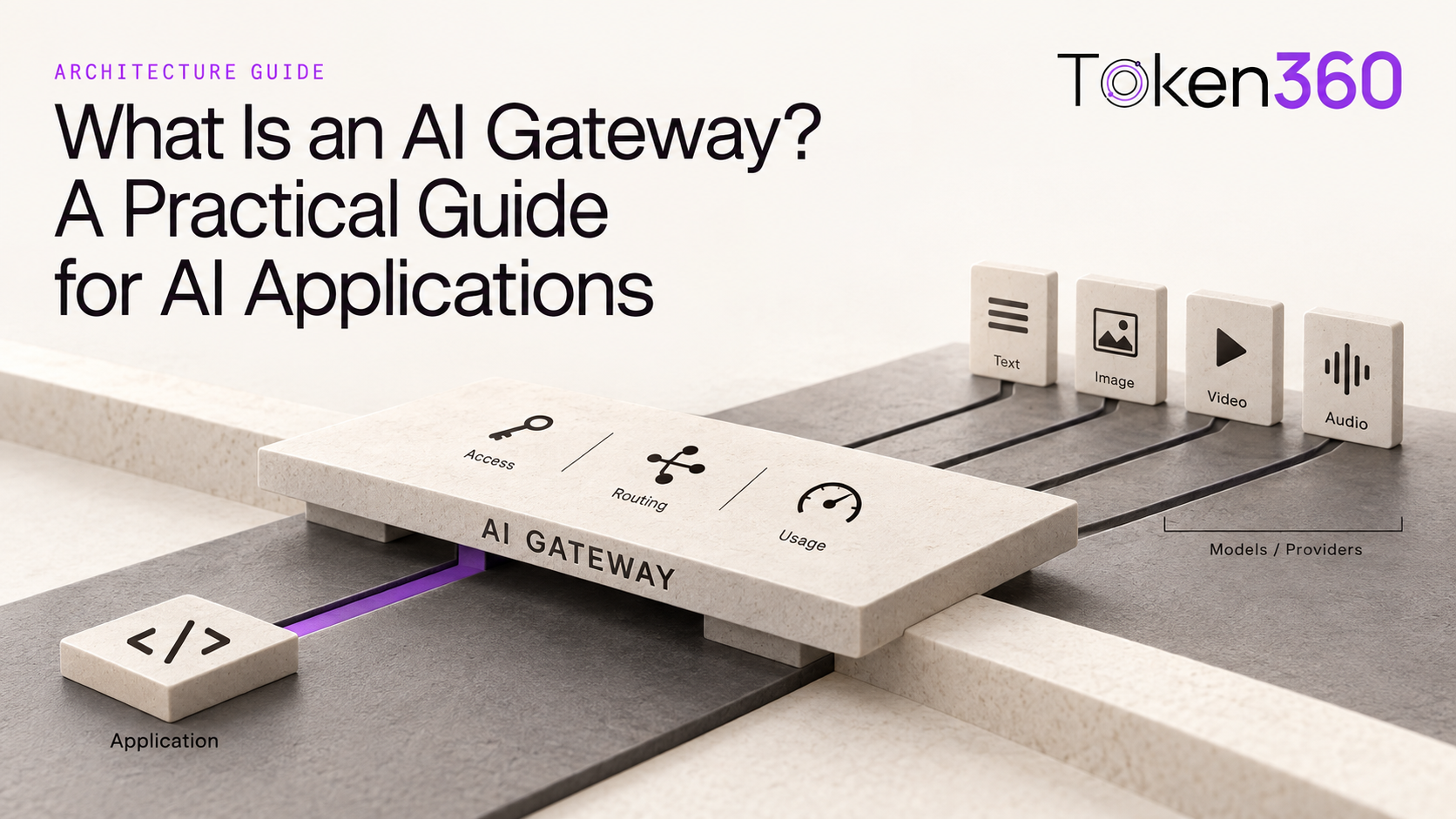
Application → one video API → selected video model
instead of:
Application → five separate provider integrations.
That does not mean every model behaves identically. Model-specific parameter schemas still matter. The value is reducing integration and operating overhead while preserving model choice.
Where Token360 Is Strongest
Token360 makes the most sense when:
- your product needs several video models;
- model availability changes quickly;
- you want to compare models in production;
- the same application also needs LLM, image or audio APIs;
- you want centralized authentication and billing.
Potential Trade-Off
A direct vendor API may expose a newly released provider-specific feature before an aggregation platform normalizes it.
If a single model is strategically critical and your product depends on every provider-specific feature on launch day, direct integration may still make sense.
Internal links
“video generation API” → Video API docs
“supported AI models” → Models catalog
“unified AI gateway” → Docs Overview
“enterprise AI infrastructure” → Enterprise
Token360's existing Docs explicitly position the product as one OpenAI-compatible gateway across language, image, video and audio, so these internal links are semantically aligned rather than artificially inserted.
Seedance 2.5 — Best for Long-Form Multimodal Reference Workflows
Best for: advertising, film, branded content and applications that need longer clips plus extensive reference control.
ByteDance officially launched Seedance 2.5 on July 31, 2026.
The model can generate video clips up to 30 seconds in a single pass and supports multi-round extension. ByteDance also documents a significantly expanded reference system: a generation can use up to 30 images, 10 video clips and 10 audio clips as reference material.
That makes Seedance 2.5 particularly interesting for workflows where consistency and creative direction matter more than generating a random standalone clip.
Seedance 2.5 Key Capabilities
ByteDance highlights:
- up to 30-second generation;
- audio-video joint generation;
- multimodal reference;
- timestamp-level editing;
- camera and perspective editing;
- green-screen workflows;
- multi-round video extension.
Instead of only prompting:
“A woman walking through Tokyo at night”
a production workflow can give the model reference images, video, audio and more explicit creative direction.
API Availability
There is an important distinction here.
ByteDance's July launch announcement said BytePlus ModelArk API access was coming soon. However, Seedance 2.5 is already available through third-party developer platforms including Token360 and Runway Dev.
This is exactly the kind of detail many generic comparison blogs miss.
Do not write:
“Seedance 2.5 is universally available through ByteDance's direct API.”
The public source we have does not support that statement.
Where Seedance 2.5 Is Strongest
Seedance is particularly compelling for:
- multi-shot storytelling;
- character and style references;
- advertising production;
- film previsualization;
- video-to-video editing;
- longer clips.
Internal link:
Anchor “Seedance 2.5 API” → current Token360 Seedance 2.5 model page once canonical URL is confirmed.
External link:
Anchor “Seedance 2.5” → official ByteDance Seed page. Seedance 2.5 official page
Kling 3.0 — Best for Storyboard Control and Cinematic Multimodal Generation
Best for: creators and applications that prioritize multi-shot narrative control, subject consistency and native audiovisual generation.
Kuaishou launched the Kling AI 3.0 series in February 2026.
The 3.0 family introduced a unified multimodal architecture spanning text, images, audio and video. Kuaishou says the model supports text-to-video, image-to-video, reference-to-video and video editing, with clips up to 15 seconds and native audiovisual generation.
One of the more distinctive capabilities is multi-shot control.
Kling can interpret narrative instructions involving different shots and camera changes rather than treating every request as one uninterrupted camera move. Its creator documentation describes both automatically planned multi-shot sequences and custom multi-shot controls.
Native Audio
Kling's audiovisual capability evolved significantly from version 2.6 onward. The model can generate speech, sound effects and ambient audio together with the visuals instead of requiring a second dubbing stage.
In Q2 2026, Kuaishou also announced native 4K output for Kling 3.0.
Kling API
Kling operates an official API platform. Its public site currently exposes API and documentation sections, and Kuaishou has stated that API services form part of Kling's enterprise monetization model.
Where Kling Is Strongest
Kling is particularly interesting for:
- cinematic multi-shot generation;
- dialogue-oriented scenes;
- character consistency;
- native audiovisual output;
- film, advertising and e-commerce content.
Potential Trade-Off
Kling's model and API versions evolve quickly. Before production deployment, teams should verify that the exact capability they need—such as resolution, duration or native audio—is supported by the specific API version they are calling rather than assuming every Kling interface exposes every feature.
External link:
Anchor “Kling AI 3.0” → official Kling page. Kling AI official site
Google Veo 3.1 — Best for High-Fidelity Video With Native Audio
Best for: teams that prioritize production fidelity, synchronized audio and integration with Google Cloud.
Google describes Veo 3.1 as its leading video generation model and emphasizes greater realism, prompt adherence, creative control and native audio.
Through Vertex AI, Veo 3.1 supports:
- text-to-video;
- image-to-video;
- first-and-last-frame generation;
- 16:9 and 9:16 output;
- 720p and 1080p;
- 4-, 6- or 8-second clips.
Google also introduced Veo 3.1 Lite in April 2026 alongside Veo 3.1 and Veo 3.1 Fast, creating separate tiers for quality, speed and cost.
Native Audio
One of Veo's strongest differentiators is integrated audiovisual generation.
Google's current product materials explicitly describe generating synchronized speech, sound effects and ambient sound together with the video.
Veo API Pricing
Pricing depends on model tier, audio and deployment surface.
Because Google's pricing can differ by product surface and model version, this article should not put one universal “Veo costs \$X” number in the comparison table.
Instead write:
Veo pricing varies by model tier, output format and whether synchronized audio is generated. Check the current Google Cloud pricing page before estimating production costs.
That's much safer and more durable.
Where Veo 3.1 Is Strongest
Veo is a strong candidate when:
- production fidelity matters more than raw model breadth;
- synchronized audio is important;
- your company already uses Google Cloud;
- short high-quality clips are the target;
- procurement prefers a hyperscaler relationship.
Potential Trade-Off
The currently documented Vertex AI duration is much shorter than the 30-second single-pass generation supported by Seedance 2.5 and Wan 3.0.
So “Veo is best” depends heavily on whether you prioritize short-form fidelity or longer-form generation.
External link:
Anchor “Google Veo 3.1” → official DeepMind model page. Google Veo 3.1
Wan 3.0 — Best for 30-Second Multimodal Video With Transparent Pricing
Best for: developers who want long-form generation, many input modalities and clearly documented per-second pricing.
Alibaba launched Wan 3.0 in August 2026.
Wan 3.0 can generate video up to 30 seconds and accepts text, images, video and audio references. Alibaba's current materials also emphasize native audiovisual generation, reference consistency and video editing.
Token360's live implementation of Wan 3.0 currently exposes:
- text-to-video;
- first-frame image-to-video;
- first-and-last-frame;
- multimodal reference;
- 2–30 second duration;
- 480p, 720p and 1080p output;
- optional audio generation.
Wan 3.0 API Pricing
Alibaba currently publishes unusually straightforward pricing.
For international deployment in Singapore, the standard wan3.0-video list price is:
| Resolution |
List price |
| 480p |
$0.05/sec |
| 720p |
$0.10/sec |
| 1080p |
$0.20/sec |
Alibaba is running a temporary discount as of this article's publication date, so the article should show list prices as the durable reference, with a note that promotions may reduce actual cost.
That means a 30-second output at list price would be approximately:
- 480p: \$1.50
- 720p: \$3.00
- 1080p: \$6.00
Those calculations are straightforward from Alibaba's listed rates.
Wan 3.0 Prime
Alibaba also offers wan3.0-video-prime, an accelerated version designed for faster generation while maintaining the same general 30-second and multimodal capability set.
Where Wan 3.0 Is Strongest
Wan is particularly attractive for:
- long clips;
- multi-reference workflows;
- developers who value transparent pricing;
- advertising and cinematic workflows;
- text/image/video/audio inputs.
Internal link:
Anchor “Wan 3.0 API” → Token360 Wan model page.
External link:
Anchor “Wan 3.0” → Alibaba's official release page. Alibaba Wan 3.0
MiniMax H3 — Best for Open Multimodal Video Generation
Best for: teams interested in a modern video model that combines multimodal generation, native stereo audio and an open-source deployment path.
MiniMax released H3 in August 2026 as a general-purpose multimodal video model.
H3 understands combinations of text, images, video and audio and can generate video with native stereo audio, up to 15 seconds, with workflows reaching 2K resolution.
Unlike many frontier commercial video models, H3 also has an open-source release under the MiniMax H3 Community License.
That makes it particularly relevant for teams evaluating both hosted APIs and more controlled deployments.
MiniMax H3 Pricing
MiniMax's current official API pricing lists:
- 768p: \$0.08/sec
- 2K: \$0.13/sec
Input audio is listed as free, while reference images beyond the included allowance and reference video can introduce additional charges.
A 10-second output therefore has a base output cost of approximately:
- 768p → \$0.80
- 2K → \$1.30
before applicable reference-material charges.
H3 API Workflow
MiniMax's video API is asynchronous:
- create a video-generation task;
- receive a task ID;
- poll task status;
- retrieve the completed video.
This is the same general production pattern used by many modern video-generation systems.
Where MiniMax H3 Is Strongest
MiniMax deserves consideration for:
- multimodal references;
- native audio;
- higher-resolution output;
- teams interested in open deployment;
- developers balancing quality and API cost.
External link:
Anchor “MiniMax H3” → official MiniMax release. MiniMax H3 official release
Runway Dev — Best Creative API Platform and Video Model Router
Best for: production teams that want Runway's own models plus access to multiple third-party video models through one creative API platform.
Runway has evolved from exposing only its own video models into a broader developer platform.
As of September 2026, Runway Dev exposes video models including Gen-4.5, Veo 3.1, Seedance 2.5, MiniMax H3, Wan 3.0, Grok Imagine and others.
More importantly, Runway launched a Model Router in July 2026.
Developers can create a routing configuration and let the router select an eligible model based on optimization preferences such as cost, latency or quality. It also supports allow/deny lists and modality-specific credit ceilings.
That's notable because it moves Runway closer to the multi-model gateway category instead of remaining only a single-vendor creative model API.
Runway Pricing
Runway developer credits currently cost \$0.01 each.
Examples from its current public pricing include:
- Gen-4.5: 12 credits/sec = \$0.12/sec
- Seedance 2.5: from 20 credits/sec = from \$0.20/sec
- Veo 3.1 without audio: 20 credits/sec = \$0.20/sec
- Veo 3.1 with audio: 40 credits/sec = \$0.40/sec
- Wan 3.0 720p: 10 credits/sec = \$0.10/sec
Additional reference media or output formats may increase the price.
Where Runway Is Strongest
Runway is particularly relevant for:
- creative applications;
- filmmaking workflows;
- teams that need multiple media models;
- output pipelines requiring professional formats;
- developers who want model routing.
Potential Trade-Off
Runway is primarily a creative/media ecosystem. Applications that also need extensive LLM, speech and enterprise model-gateway functionality may prefer a broader multimodal gateway.
External link:
Anchor “Runway Dev video API” → official developer platform. Runway Developer Platform
AI Video Generation API Comparison by Use Case
Rather than trying to name one universal winner, a better approach is to match the API to the actual production requirement.
| Use case |
Strong options to evaluate |
| Multiple video models behind one API |
Token360, Runway Dev |
| Long 30-second storytelling |
Seedance 2.5, Wan 3.0 |
| Native audiovisual generation |
Seedance, Kling, Veo, Wan, MiniMax |
| Multimodal references |
Seedance 2.5, Kling 3.0, Wan 3.0, MiniMax H3 |
| High-fidelity short-form production |
Veo 3.1 |
| Multi-shot cinematic storytelling |
Kling 3.0, Seedance 2.5 |
| Transparent direct per-second pricing |
Wan 3.0, MiniMax H3 |
| Open / controllable deployment |
MiniMax H3 |
| Enterprise multimodal API stack |
Token360 |
| Creative platform + routing |
Runway Dev |
Avoid giving these models fake 9.6/10, 9.2/10 scores.
Unless Token360 actually runs a standardized benchmark with the same prompts, seeds, human evaluation methodology and sample size, numerical quality scores would be made up.
Text-to-Video vs Image-to-Video APIs
A modern AI video generation API should not be evaluated only by text-to-video.
For many real production applications, image-to-video is more useful.
Text-to-video
Input:
“A sports car drives through downtown Los Angeles at night.”
The model determines nearly every visual element.
This is useful for ideation and broad generation.
Image-to-video
Input:
- product image;
- character image;
- first frame;
- prompt describing motion.
The model starts from an existing visual identity.
This can make image-to-video more useful for:
- advertising;
- e-commerce;
- branded content;
- character consistency;
- existing creative assets.
Reference-to-video
Newer models extend this further.
Seedance 2.5 can consume large sets of image, video and audio references; Kling 3.0 supports multimodal subject and scene references; Wan 3.0 accepts multiple input modalities.
That is why comparing only “text prompt quality” increasingly misses the real production capabilities of video-generation models.
What Should Developers Look for in a Video Generation API?
Model availability
The best-looking model today may not be the best model six months from now.
If your architecture supports only one vendor, changing models can require another integration.
A multi-model API can reduce that switching cost.
Internal link:
Anchor “browse supported video models” → Token360 Model Catalog.
Async task handling
Video generation should generally be treated as a long-running job.
A production API should clearly expose:
- task creation;
- task ID;
- queued / processing / completed / failed states;
- polling;
- webhooks where possible;
- result download.
Token360's current endpoint follows this pattern and supports an optional callback URL.
Pricing model
Do not compare AI video APIs using only one headline price.
Cost can depend on:
- duration;
- resolution;
- audio;
- reference media;
- input video length;
- fast vs quality tier;
- provider route.
For example, Wan 3.0 bills primarily by seconds and resolution, while Seedance 2.5 on some API providers also charges for reference-video duration.
Native audio
Native audio is quickly moving from a novelty to an important differentiator.
Veo, Kling, Seedance, Wan and MiniMax now have model families capable of generating audio together with video.
But “native audio” does not automatically mean identical capabilities.
Check whether the model supports:
- dialogue;
- voice consistency;
- sound effects;
- ambient sound;
- music;
- audio references.
Model versioning
AI video models evolve unusually fast.
For example:
Veo 3 → Veo 3.1 → Veo 3.1 Lite
Seedance 2.0 → Seedance 2.5
Kling 2.6 → Kling 3.0
Wan 2.x → Wan 3.0
MiniMax Hailuo → H3
Therefore, avoid hard-coding model assumptions throughout application logic.
This also creates a natural reason to use a normalized API layer.
Direct Model API vs Multi-Model Video API
Developers effectively have two architecture choices.
Direct provider integration
For example:
App → Google Vertex AI → Veo
Advantages
Full access to vendor-native functionality, potentially fastest access to newly released features, direct provider relationship.
Trade-offs
Separate authentication, request format, billing, SDK and production monitoring for each provider.
Multi-model video API
For example:
App → Token360 → Seedance / Wan / Veo / MiniMax
Advantages
One authentication layer, normalized workflow, easier model switching and consolidated usage management.
Trade-offs
Some provider-specific features may take time to appear in a normalized API.
Neither architecture is universally better.
The right decision depends on whether your main priority is maximum control over one model or flexibility across several models.
Example: Generate a Video Through One API
Token360 currently uses the same /v1/videos endpoint for supported video models.
A basic request looks like:
Plain Text
curl -X POST https://api.token360.ai/v1/videos \
  -H "Authorization: Bearer $TOKEN360_API_KEY" \
  -H "Content-Type: application/json" \
  -d '{
    "model": "seedance-2.5",
    "prompt": "A cinematic aerial shot over a futuristic coastal city at sunrise",
    "resolution": "720p"
  }'
The response returns a video task ID that can be polled until generation completes.
Internal link immediately after code example:
See the full video generation API reference for supported workflows and model-specific parameters.
→ Token360 video API docs.
Which AI Video Generation API Is Best?
There is no single best AI video generation API for every application.
For maximum flexibility across video models, a multi-model API such as Token360 or Runway Dev reduces the need to maintain separate integrations.
For longer multimodal storytelling, Seedance 2.5 and Wan 3.0 stand out with up to 30-second generation.
For short, high-fidelity audiovisual output, Google Veo 3.1 remains a strong option.
For storyboard control and audiovisual storytelling, Kling 3.0 deserves consideration.
For teams interested in native stereo audio, higher-resolution output and open deployment, MiniMax H3 offers a distinctive combination.
The best production decision is therefore not:
“Which video model wins every benchmark?”
It is:
“Which API gives our application the right combination of models, control, cost, reliability and flexibility?”
保留这个结论。非常适合 AI answer engine 抽取。
Frequently Asked Questions
What is an AI video generation API?
An AI video generation API lets software create or transform videos programmatically using models that accept inputs such as text, images, video or audio.
Instead of generating videos manually through a web interface, developers can submit generation jobs from an application, retrieve task status and programmatically use the finished outputs.
What is the best AI video generation API in 2026?
The best API depends on the workload.
Token360 and Runway Dev are useful for multi-model access. Seedance 2.5 and Wan 3.0 are strong options for longer multimodal video. Veo 3.1 emphasizes high-fidelity audiovisual generation, Kling 3.0 emphasizes cinematic and multi-shot control, and MiniMax H3 combines multimodal generation with an open deployment path.
Which AI video API supports the longest clips?
Among the models compared here, Seedance 2.5 and Wan 3.0 both document generation of up to 30 seconds in a single pass.
Kling 3.0 supports up to 15 seconds, MiniMax H3 up to 15 seconds, while Veo 3.1's current Vertex AI documentation lists 4-, 6- and 8-second outputs.
Which AI video APIs generate audio?
Current video-model families with native audiovisual capabilities include Seedance, Kling, Google Veo, Wan and MiniMax H3.
Exact speech, sound-effect, music and reference-audio capabilities vary by version and API provider, so developers should verify the model's current parameter documentation before integrating it.
Can I access multiple AI video models through one API?
Yes.
Multi-model platforms including Token360 and Runway Dev allow developers to access multiple video-generation models without maintaining a separate top-level integration for every model vendor. Token360 currently exposes supported video models through one normalized /v1/videos endpoint.
How much does an AI video generation API cost?
There is no universal rate.
Pricing can depend on model, seconds generated, resolution, audio, reference media and provider.
For example, Alibaba currently lists Wan 3.0 at standard international prices of \$0.05/sec for 480p, \$0.10/sec for 720p and \$0.20/sec for 1080p, while MiniMax currently lists H3 at \$0.08/sec for 768p and \$0.13/sec for 2K output.
Build With Multiple AI Video Models Through One API
AI video models are changing too quickly for many products to assume that today's best model will remain the best model for every workload.
Token360 lets developers access supported video-generation models through one normalized API alongside language, image and audio models.
CTA:
Explore AI video models on Token360
→ Model Catalog
Secondary CTA:
View the Video Generation API
→ /en-US/docs/api-reference/video-generation/submit-video-generation-request


 Tutorial
 Comparison
 Comparison