How to Read an AI Video Editing Leaderboard When Scores Are Close
Three video editing models share a 2–4 rank range. Compare their Elo intervals and download a blind-review sheet to test edits on your own footage.
By Yuki Yu
Three video editors sit next to each other on a leaderboard. One scores 1152, another 1151, and the third 1149. You have a product shot to revise by Friday. Is a three-point spread enough reason to put one model at the front of the queue?
On November 3, 2026, the Artificial Analysis video editing board assigned all three entries the same rank range of 2–4. For a team choosing how to edit an existing shot, those rows make a sensible shortlist. The deciding question is what happens to the parts of your footage the brief requires you to keep. Artificial Analysis video editing leaderboard.
The AA-Video-Editing v1.1 board compares edits to existing footage made in response to a text instruction. The snapshot used here is the board with audio kept. Artificial Analysis derives its Elo ratings from pairwise human preferences. The board also offers a no-audio view, so save the view and date when copying a result into a decision memo. Task definition and board settings.
A text-to-video trial starts from a prompt and gives the generator considerable freedom to compose the shot. An edit starts with a particular take. If the request is “change the backdrop,” the existing camera movement, bottle shape and spoken line can all be part of the deliverable. An attractive replacement shot may cost an editor more time than a modest-looking revision that preserves those details.
What did the neighboring ranks actually show?
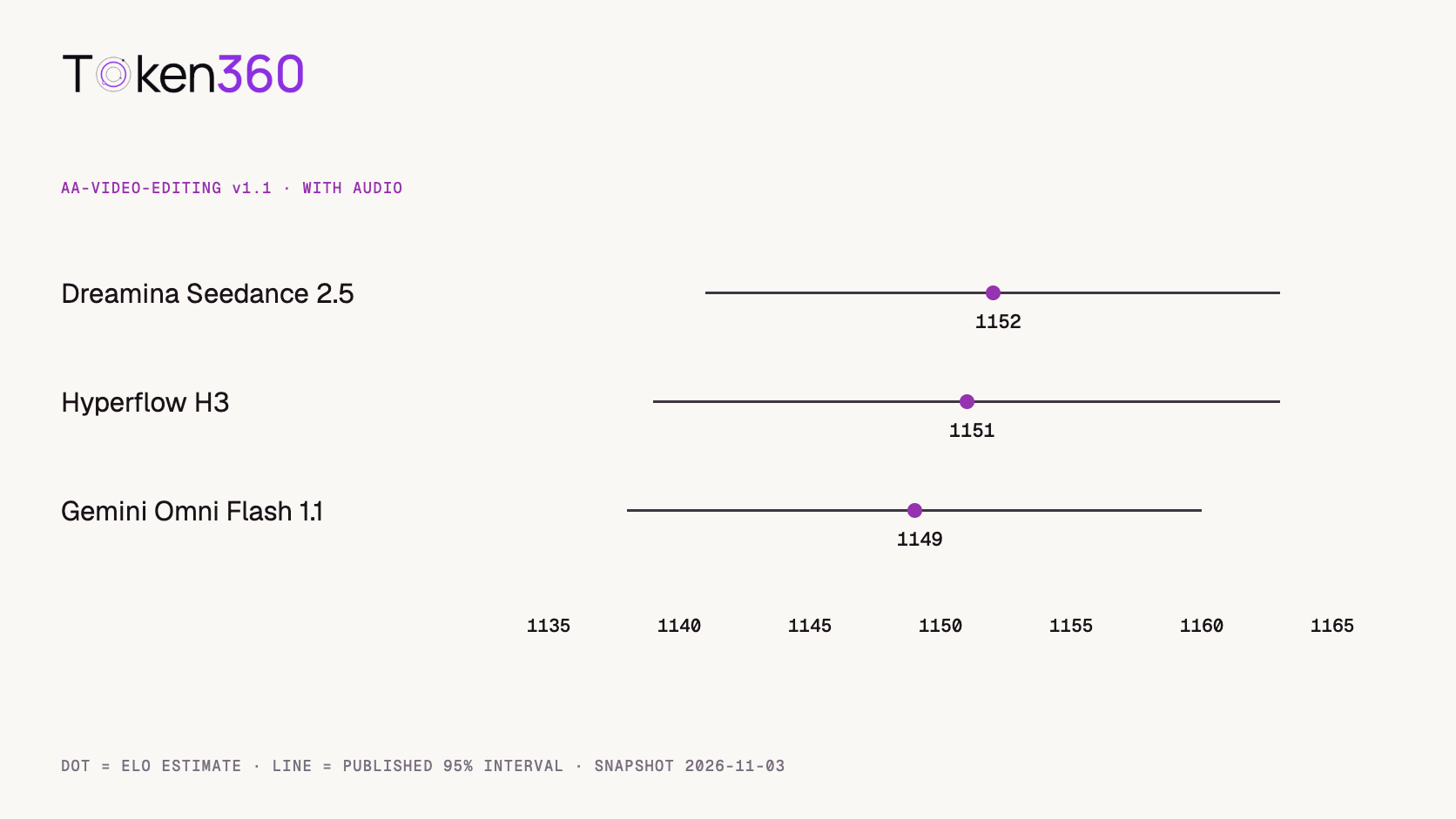
Dreamina Seedance 2.5, Hyperflow H3 and Gemini Omni Flash 1.1 occupied rows two through four in the snapshot. Their displayed 95% Elo intervals overlapped. The published rank range for each was 2–4. We chose this group to examine a close decision, rather than to summarize the entire board.
Listed rank
Model
Elo
Displayed 95% interval
Rank range
2
Dreamina Seedance 2.5
1152
1141–1163
2–4
3
Hyperflow H3
1151
1139–1163
2–4
4
Gemini Omni Flash 1.1
1149
1138–1160
2–4
At the top of the same board, Wan 3.0 had a point estimate of 1196 and a displayed rank range of 1. A team evaluating the leader should include that row too. The close trio answers a narrower question: when several viable candidates cluster together, what evidence would justify choosing among them? Source for the November 3 snapshot.
What can a three-point difference tell an editor?
It tells you the order of the reported point estimates on that board. It cannot establish that the second entry will deliver more acceptable versions of a particular product shot than the fourth. A three-point Elo difference also has no direct interpretation as three percentage points of production accuracy.
The chart deliberately uses one horizontal scale. The point marks show the listed estimates and the lines show the individual published intervals. Reading their overlap is a useful reminder to consult the board’s rank ranges. It does not yield a pairwise significance test. Such a test would need information about the comparison procedure and the relationship between the estimates. Nor does overlap prove that the models are interchangeable. An edit type that is uncommon in the board’s voting mix might dominate your queue.
Take a close-up of a blue bottle with a pale highlight sliding around the shoulder. One creative team might prefer a richer backdrop. Another may reject any version in which the moving highlight jumps, because the client approved that particular finish. A single aggregate preference number cannot encode both briefs. Write down what the client has already approved before looking at any model output.
Which edit would expose a meaningful difference?
Use one instruction that changes an identifiable part of a real shot, and name the details that must survive. For a first pass, give each candidate the same source file and ask for one comparable output. A narrow task makes it easier to explain why an editor accepted or rejected the result.
For our proposed bottle test, the instruction is: “Replace the plain background with a soft gray studio wall. Keep the blue bottle, cap and original camera move. Preserve the source audio.” Use a source with audible content if audio retention matters. Record the exact input-file version and keep the original beside the outputs. The point is to make a reviewer’s next action reproducible: watch the edge of the cap, follow the reflection, then listen across the join.
Review item
Where to look or listen
What to record
Requested change
Backdrop through the whole shot
First time the old background reappears, if any
Product identity
Cap contour and bottle shoulder
Timestamp and a short description of any shape change
Motion continuity
Original camera path and highlight
Whether the edit introduces visible drift or a jump
Source audio
An identifiable event in the source
Whether the event survives and remains aligned
Keep approval criteria distinct from optional preferences. If the cap changes shape, an editor can reject that take even if the new wall looks beautiful. If two takes preserve the product equally well, a softer shadow might decide between them. Recording both judgments helps procurement distinguish a failed requirement from a creative preference.
How can three candidates be reviewed blind?
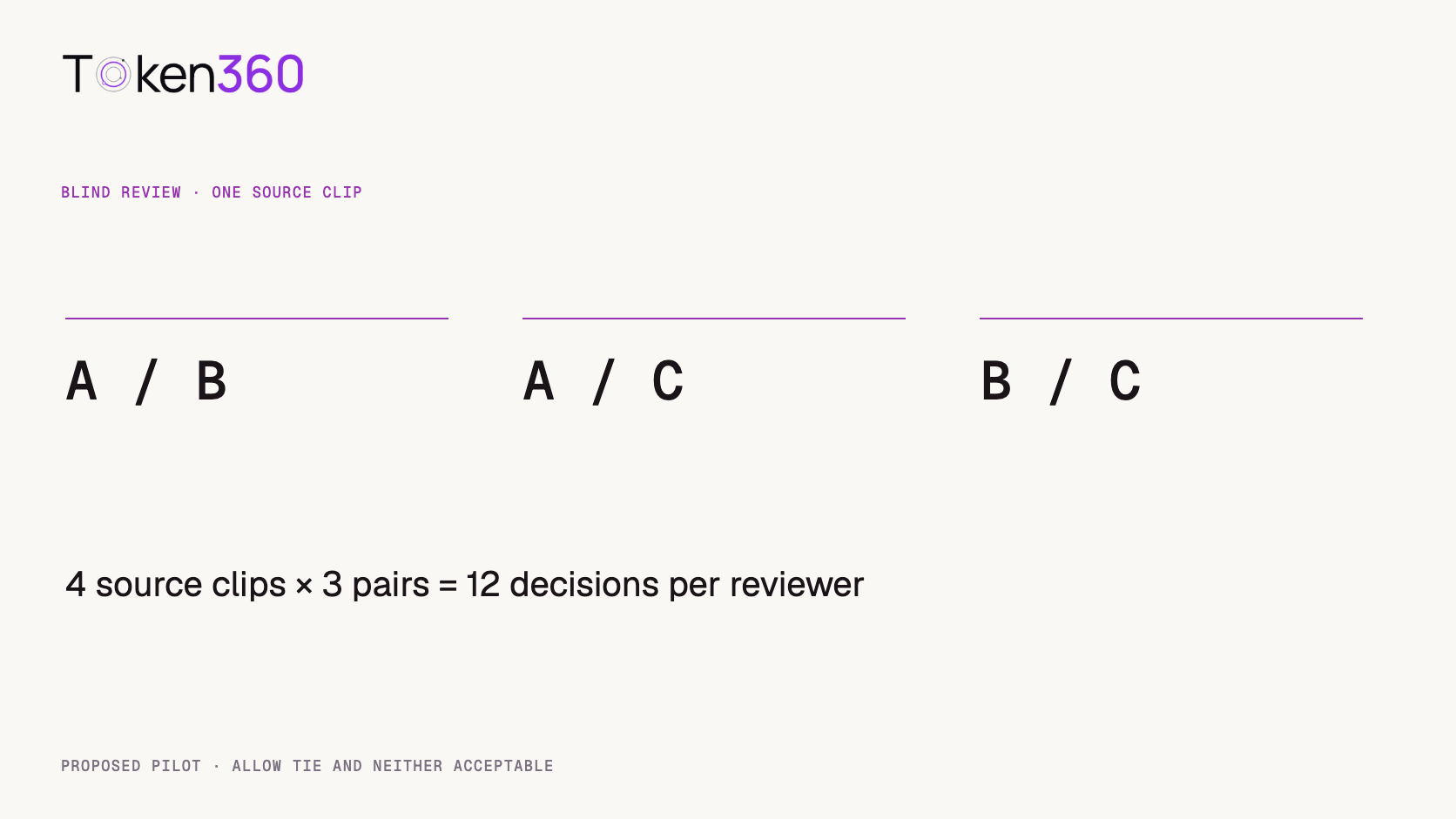
Assign the outputs anonymous labels A, B and C and compare each pair once per source clip. Three candidates produce three distinct pairs. Four source clips therefore require twelve pair comparisons per reviewer. Allow a tie and a “neither acceptable” response so a reviewer can distinguish a hard choice from two failed edits.
Use the copyable review sheet below. It contains twelve empty rows, the clip and pair labels, fields for each take’s acceptance, a preference field and room for timestamped evidence. The coordinator should keep the mapping from labels to models separately and vary left-right presentation across reviewers. A second reviewer can record an independent pass before discussing disagreements.
Copy video-editing-blind-review.csv from the complete source below
This is a proposed pilot. We have not run these candidates on the bottle clip. Four clips are enough to illustrate the review procedure and surface a concrete defect. They are too few to support a broad claim about a model’s reliability. If rerun variability drives your costs, add repeated outputs for each source and preserve their attempt numbers instead of quietly selecting the best-looking take.
How should pricing enter the shortlist?
Compare the cost of accepted edits at the route and settings you can actually buy. Artificial Analysis labels its pricing column as creator API pricing for the settings it benchmarks. Your provider, resolution, billing unit, audio options and rerun policy can change the cost of the delivered shot. Verify those details before using the board as a budget. Leaderboard pricing note.
For a pilot, log the charge for every attempt and the number of outputs that pass the agreed checks. If a route produces zero accepted outputs, report the spend and zero deliveries. Dividing by zero or dropping that route from the table makes the worst outcome disappear. Track correction minutes separately until the team agrees on the labor rate to apply. AI video cost per usable output.
Frequently asked questions
Does a rank range of 2–4 mean a three-way tie?
The board reports three point estimates and the same range for each. Keep both pieces of information. The shared range alone does not establish equal quality on any individual editing task.
Can I use a text-to-video leaderboard for this decision?
It can suggest candidates for fresh generation. For a revision to approved footage, use evidence about editing an existing video and preserving the elements the client signed off.
Why include the original audio in review?
This snapshot uses the board view with audio kept. If your brief requires the source sound, compare an identifiable audio event with its original timing. For silent deliveries, document the different requirement.
What if the reviewer prefers a take that fails a requirement?
Record the preference and the failed requirement independently. An attractive take can guide the next iteration even when the production team cannot deliver it.
Does a high rank confirm a model is available through my API?
Check the exact model ID, endpoint, supported edit inputs and options on the intended route. A public evaluation describes the tested configuration. Token360 model capability reference.
When should I revisit the comparison?
Recheck after a route or model version changes, when the editing brief changes, or when the board updates its task or settings. Keep the dated snapshot with your own source clips and acceptance notes.
Read next. Once a take passes creative review, verify the actual exported asset before handing it over. AI video output validation guide. More production resources from Token360.
Editorial revision: November 4, 2026. Test dates and dated source snapshots remain as stated in the article.
Video Editing
Media Validation
Tutorial
Build faster with one AI API.
Use Token360 to call video, image, audio, and text models with one key and one bill.



 Prompt Library
 Insights
 Insights