Artificial Analysis Rankings, October 2026: What the New Leader Means for AI Buyers
Explore Artificial Analysis rankings for October 2026: Gemini 4 Carbon leads v5, while access, effort settings, and task fit still shape the right model choice.
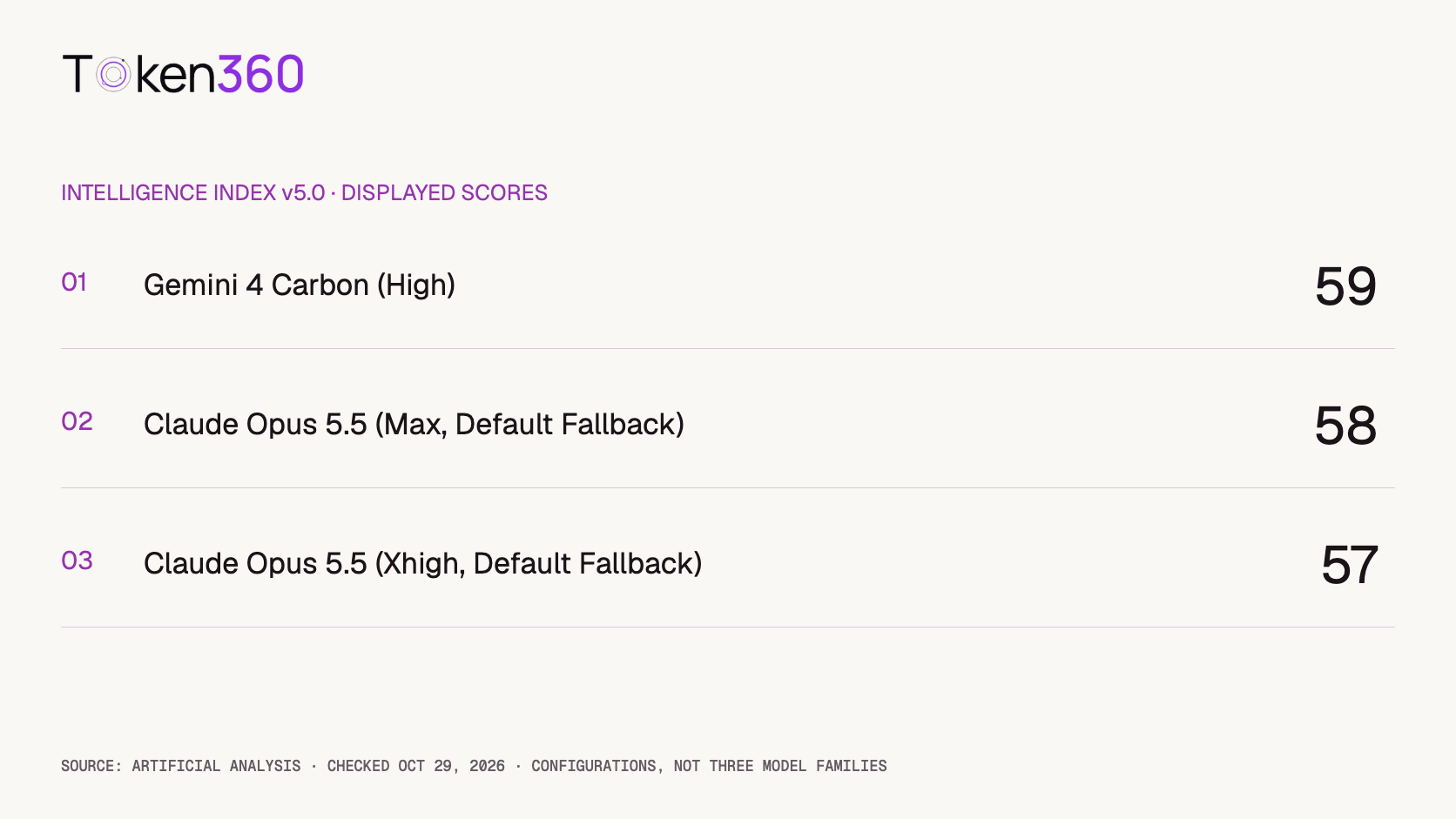
Snapshot checked October 29, 2026. Gemini 4 Carbon (High) leads the Artificial Analysis Intelligence Index v5.0 with a displayed score of 59. The next two configurations highlighted on the index page are Claude Opus 5.5 at Max and Xhigh, with scores of 58 and 57. Those are configurations, not three different model families. Source: live Intelligence Index page.
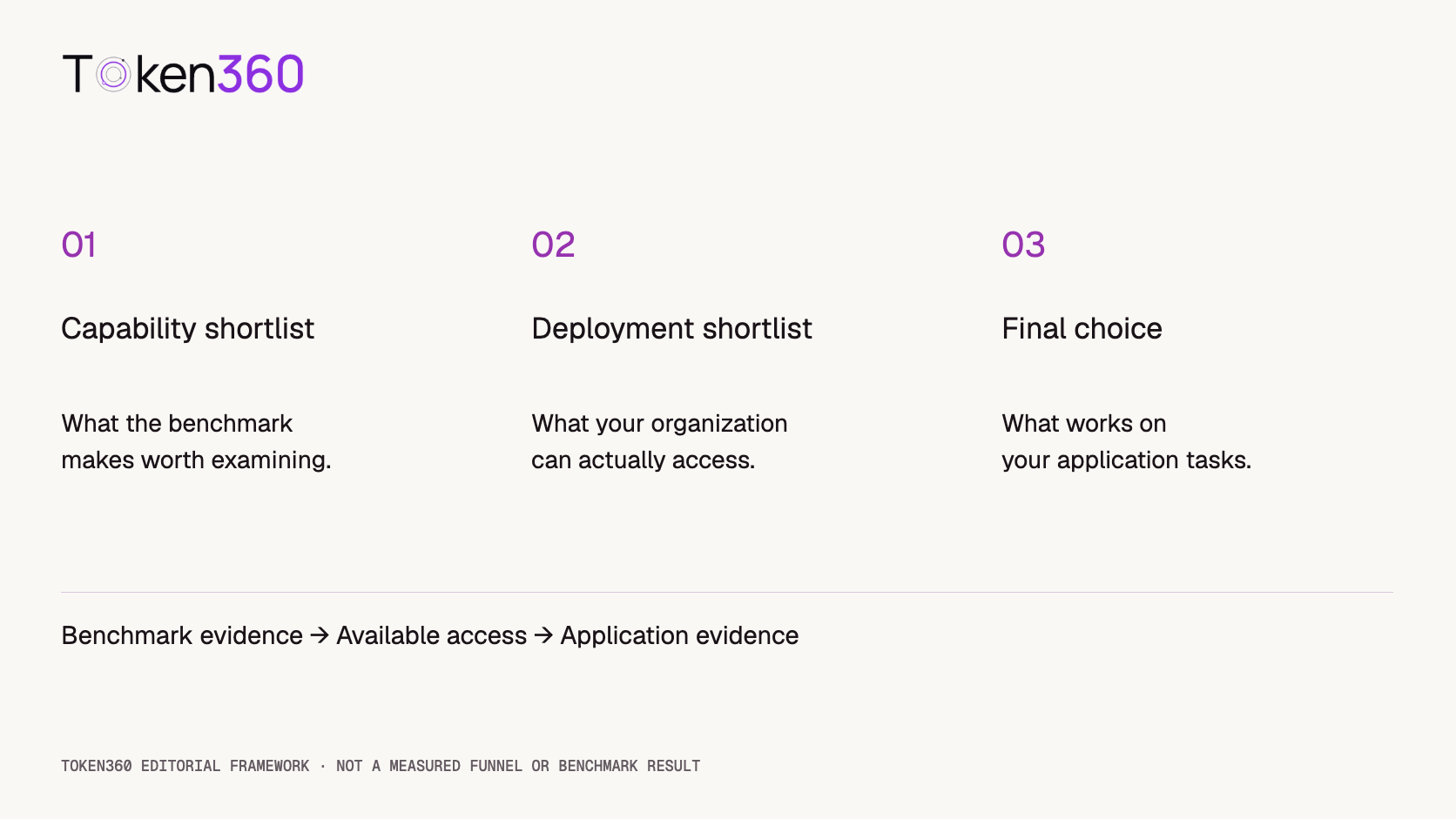
The useful business story is broader than a new name at the top. A ranking can identify a candidate worth evaluating, while availability, task fit, and economics determine whether it belongs in production. Our reading of this snapshot is that buyers should maintain a capability shortlist and a deployment shortlist—and understand why they may differ.
This article reports third-party findings and adds Token360’s editorial analysis. It is not a Token360 benchmark, an endorsement by Artificial Analysis, or confirmation that the named models are available through Token360.
The current intelligence leaders: preserve the full configuration name
Order highlighted by the source
Exact configuration
Displayed v5.0 score
1
Gemini 4 Carbon (High)
59
2
Claude Opus 5.5 (Max, Default Fallback)
58
3
Claude Opus 5.5 (Xhigh, Default Fallback)
57
This is a focused snapshot of the leading configurations explicitly identified by the index page, not a reproduction of the entire leaderboard. It keeps effort and fallback labels visible because removing them would change what the reader thinks was evaluated.
A one-point displayed lead should not be translated into a percentage advantage on your workload. The values are composite index scores, not a universal accuracy percentage, and this article has not established statistical significance for that gap. “Leads this index in this snapshot” is a stronger factual statement than an unsupported claim of universal superiority.
The winner is not automatically available to every buyer
Artificial Analysis’s October 28 Carbon analysis says the model is being rolled out to selected users and is not yet publicly available. It also reports a 50% launch discount with no confirmed end date, while using standard prices in its charts. These are the source’s statements at publication, not a promise about your account or a future contract.
That distinction changes the procurement conversation. A research team can track a frontier model before it can access it. A product team with a near-term deadline needs an available, supportable option. Neither team is wrong; they are making decisions with different constraints.
Availability should therefore sit beside performance, not below a long specification list. A model that cannot be called by your organization today may belong on a watchlist rather than a launch dependency. Conversely, limited access does not invalidate its benchmark result. It limits the operational conclusions you can draw from that result.
Version five changes the frame of comparison
The v5.0 methodology combines nine evaluations across four equally weighted categories: knowledge work, coding, science, and general capability. It is primarily an English-language, text-based suite, with image inputs included in some evaluations for models that support them. Other capabilities are assessed separately.
Those design choices are useful context for interpreting the result. A buyer whose work is mostly multilingual customer support is not purchasing an equal mixture of all four categories. A document-analysis team may care disproportionately about evidence handling. A composite ranking helps organize the market, but it does not make those workload differences disappear.
The site's dated changelog records the v5 methodology update on October 27. This matters because an article published a day earlier can describe a different version. A newer model name in an older article does not make its score directly comparable with the current index.
A concrete example of the version trap
The October 26 article “GPT-6.1 Terra pushes the cost efficiency frontier” labels its Intelligence Index breakdown v4.3.2. It reports cost-efficiency findings across reasoning levels, including an advantage at low and medium effort in that analysis. That is dated evidence, not a current v5 ranking for Terra.
Our editorial decision is to keep those observations out of the v5 score table. Combining them would create a tidy comparison with an inconsistent measurement basis. Historical context is still valuable when its version travels with it.
This is also why “latest AI rankings” should be a dated editorial series rather than an undated list that silently accumulates old figures. Update the claims, source dates, configuration labels, and chart captions together. If a score disappears from a source, do not fill the gap with a value remembered from a previous version.
Intelligence leadership and coding-agent leadership are different stories
The same Carbon launch analysis reports a coding-agent score of 59 for Carbon in Antigravity CLI, behind 62 for Claude Opus 5.5 in Claude Code. This is a comparison of model-and-agent configurations on a different index, not a contradiction of Carbon’s intelligence lead.
The Coding Agent Index page evaluates three components and explicitly compares agents, models, and execution settings. Its cost metric concerns pay-per-token API usage rather than the full operating cost of a deployed system.
For an engineering buyer, the implication is practical: the unit being evaluated may be an assembled system. A model inside one agent can have access to different tools, context handling, and execution behavior from the same model in an application you build. Preserve the tested configuration before drawing conclusions about what your team will experience.
A ranking does not need to predict every deployment to be useful. It needs to be read at the level it actually measures. Treating a coding-agent result as a bare-model guarantee weakens an otherwise informative comparison.
Cost per task is more informative than a token price—but still specific
The Carbon model page lists $7.76 per Intelligence Index task and standard prices of $4 per million input tokens and $20 per million output tokens. The task figure describes the benchmark workload; it is not the price of an ordinary chat message or a Token360 quote.
This distinction prevents a common buying error. A token rate is a unit price. A task cost also depends on how much work is performed, which tokens are produced, and the applicable billing conditions. Your application can have a different input length, response budget, cache behavior, and tool sequence.
Our interpretation is that benchmark task cost belongs in the shortlist discussion, while application cost belongs in the deployment decision. The former can challenge an assumption that the highest score is affordable. The latter determines whether the product can support its actual traffic and quality requirements.
There is no need to convert the published benchmark cost into a fictitious forecast. A useful article can identify what remains unknown. In this case, Token360-specific availability, route behavior, billing, and task success have not been tested for the leaders named here.
What a buyer should conclude from this snapshot
Buying situation
Our interpretation
Evidence still needed
Exploring frontier capability
Carbon deserves attention as the current intelligence leader
Access and results on the intended tasks
Choosing a coding agent
Compare complete agent configurations
Repository-level behavior in the intended environment
Operating a high-volume application
A lower-ranked affordable configuration may remain appropriate
Quality, latency, and cost under production-like inputs
Serving multilingual or media workloads
The intelligence headline is insufficient on its own
Relevant language or modality evidence
These are editorial conclusions, not additional leaderboard findings. They leave room for a team to choose an existing model even after a new leader appears. Switching only makes sense when the expected benefit outweighs integration, regression testing, and operational disruption for that team.
The opposite conclusion can also be rational. If a difficult task repeatedly fails with the incumbent, a stronger candidate may justify a more expensive evaluation. The point of a public benchmark is to improve the starting hypothesis, not eliminate the need to know what the product requires.
Original Token360 editorial framework. This is a decision model, not a measured conversion funnel.
Where Token360 fits—and where this article stops
Token360’s documentation directs developers to each model’s public page and schema for inputs, limits, supported fields, and pricing rules. Use those sources to establish what a particular integration supports. A provider family name is not a substitute for an exact model ID.
We have not verified Carbon or the listed Opus configurations as callable Token360 models for this article. There is therefore no “try the winner now” claim or invented model-detail link. The appropriate next step is to compare the currently available catalog with the configurations your use case justifies evaluating.
Token360 has a commercial interest in model access. Our analysis remains useful only if it distinguishes that interest from the third-party evidence. Artificial Analysis supplies the reported benchmark results; Token360 supplies the interpretation and the boundaries of the purchasing argument.
FAQ
Which model leads the Artificial Analysis Intelligence Index in this snapshot?
Gemini 4 Carbon (High), at a displayed score of 59 on v5.0, checked October 29, 2026. Recheck the linked live source before making a later “current leader” claim.
Are the three leading configurations three different models?
No. The table includes two effort configurations of Claude Opus 5.5. Configuration-level rankings should not be presented as a count of distinct model families.
Does the intelligence leader also lead coding agents?
Not in the cited Carbon launch comparison. The coding-agent result uses a separate index and includes the agent configuration. Keep the two comparisons distinct.
Can v4 and v5 scores be placed in the same ranking?
Not as if they were measured on an unchanged basis. Keep the index version visible and use a consistent version for a direct ranking table.
Does the benchmark cost predict my API bill?
No. It describes the benchmark’s workload and cost assumptions. Your actual bill depends on your inputs, outputs, configuration, usage, and provider terms.
Is every model discussed here available on Token360?
This article does not establish that. Check the live model catalog and supported schema, then validate the exact configuration you intend to use.



 Comparison
 Comparison
 Tutorial