GPT-5.1 Reasoning Effort: A Paired Evaluation Guide
Compare GPT-5.1 reasoning settings with the same tasks and grader. Use paired outcomes, complete-response time and billed cost to choose a configuration.
By Yuki Yu · November 4, 2026 · No live model test claimed
Choose GPT-5.1 reasoning effort by comparing supported settings on the same tasks with the same validator. Start with correctness, then inspect complete-response time and billed cost. A higher setting is a candidate to test, not evidence that every answer will improve or that a product should always use it.
Read first. The model evaluation framework provides the general acceptance process. This guide narrows the decision to changing one reasoning setting while holding the workload and grader fixed.
Which reasoning settings are documented for GPT-5.1?
Separate the upstream model’s supported values from the parameters exposed by the route you actually call. Confirm the accepted field and allowed values before testing. A request that ignores or rejects an effort setting cannot support a conclusion about how that setting changes task quality or latency.
Checked November 4, 2026: OpenAI’s GPT-5.1 reference lists none, low, medium and high, with none as its default. The page also marks the model Deprecated. This is a guide for evaluating an existing configuration, not a new-model launch announcement.
The historical Token360 ID supplied for this series is gpt-5.1. Confirm its current route and supported request fields using Token360 model capability checks. No live GPT-5.1 trace or measured effort comparison is presented here.
What does a paired test keep constant?
Give each effort setting the same task instance, source material, output contract and acceptance rule. Keep unrelated parameters fixed and record any setting that cannot be held constant. Pairing lets you examine which individual tasks improve or regress instead of comparing unrelated averages from different inputs.
For example, a low-effort run on a short invoice and a high-effort run on a difficult policy question are not a useful pair. Use the identical invoice or identical policy question under both configurations. Retain exact prompts rather than summaries so an accidental wording change is visible.
Treat none as a named configuration rather than an instruction to skip validation. It may suit a workload, but the same quality gates apply. If the serving route does not expose all four documented upstream values, run the supported subset and state that limitation.
Proposed design, not completed testing. Run only settings verified as supported by the selected route.
How would you design a small first pilot?
Start with distinct task types that expose different errors, and repeat each configuration enough to detect obvious instability. A small pilot can find configuration mistakes and failure patterns, but it cannot establish population-level reliability. Preserve the per-task outcomes rather than presenting one percentage as a general model score.
Task type
Example check
Why it matters
Direct extraction
A missing due date remains null
Detects unsupported inference
Constraint solving
A single-worker schedule has no overlaps
Tests dependency and resource handling
Evidence-bounded answer
A claim cites the supplied policy passage
Tests support rather than fluent explanation
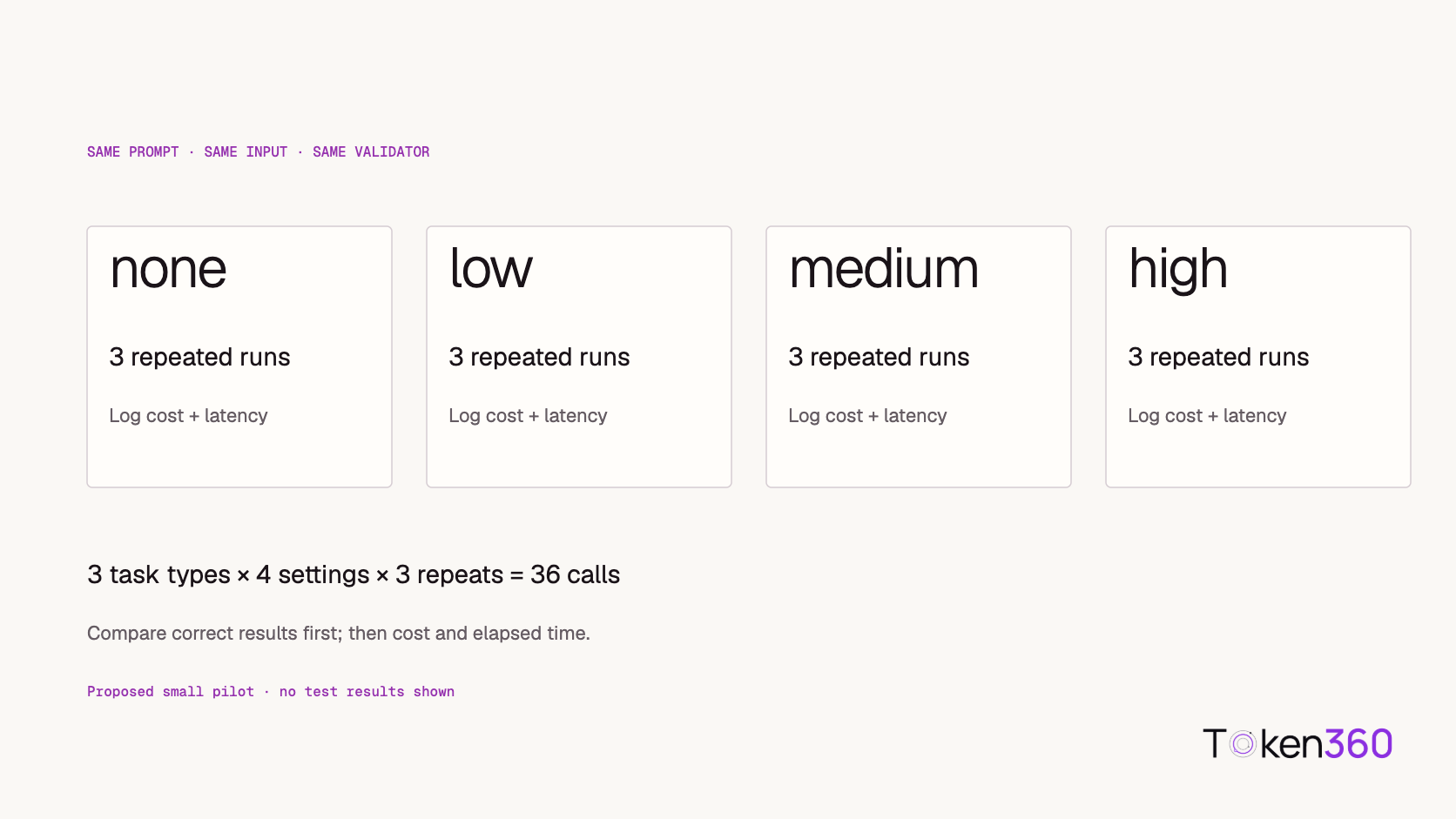
The existing illustration proposes three task types × four supported settings × three repeats = 36 calls. That arithmetic was checked locally; the calls were not made. One example per task type is only a smoke test. A production decision needs representative cases within each type and independent held-out examples.
Interleave configurations during the run where practical so one setting is not tested only during a different load window. Record the order and timestamp. Do not claim that interleaving removes all provider-load effects; it simply makes the comparison less dependent on one block of time.
What belongs in the run log?
Record the task instance and repeat index alongside the exact configuration, full response and acceptance result. Keep request failures separate from valid but incorrect answers. Preserve the response’s usage and identifiers so a quality difference can be investigated without losing the corresponding time and billing information.
Field
Purpose
task_id and repeat
Matches the same case across settings
model and requested effort
Identifies the experimental configuration
response and acceptance reason
Shows what passed or failed
elapsed time and timing method
Makes timing comparisons interpretable
usage, request ID and charge
Supports accounting and reconciliation
An absent response is not a correct answer. If a request fails before producing output, log it as a request failure and investigate whether the route accepts the requested setting. Replacing it with an unrecorded retry biases both latency and cost downward.
Read wins and regressions together
Compare paired acceptance outcomes before comparing average latency. Count tasks that both settings pass, tasks that only the higher setting passes, tasks that only the lower setting passes and tasks neither passes. These categories reveal regressions that an aggregate success count can hide.
Suppose an invented ten-task pair has six shared passes, two high-only passes, one low-only pass and one shared failure. High accepts eight tasks; low accepts seven. The net gain is one task, but the low-only task still matters if it represents a mandatory product behavior.
These numbers are a worked example, not GPT-5.1 results. Review the actual cases in each category, including repeated-run variability. If the grader changes after inspection, rerun both configurations with the revised rule rather than applying the change to only the preferred candidate.
Choose a setting without overfitting
Choose a configuration that satisfies the workload’s mandatory acceptance and response-time requirements, then compare the cost of eligible choices. Make the decision on held-out cases after using development examples to refine prompts. Keep a documented reevaluation trigger for model, route or workload changes.
A useful result can be workload-specific: one setting for direct extraction and another for a validated complex task class. That does not justify an automatic router unless the application can reliably identify the classes before submission. Start with an explicit feature-level configuration rather than a speculative complexity score.
Report medians and observed ranges for a small timing sample instead of presenting unstable tail statistics as guarantees. For pricing, use recorded charges from all attempts. A higher-effort setting that improves one difficult case may still fail the product’s latency limit; quality and delivery requirements need separate gates.
A paired result needs an outcome, not just a token total
For each task, compare both effort settings against the same expected result before comparing usage. A longer reasoning trace or higher token count is not the outcome the product needs. The following interpretation grid can be filled after the planned calls; it contains no measured GPT-5.1 results.
Lower effort
Higher effort
Interpretation
Pass
Pass
Compare total cost and latency for equivalent accepted work
Fail
Pass
Inspect the corrected constraint and whether that task recurs
Pass
Fail
Retain the regression; higher effort is not automatically preferable
Fail
Fail
Repair the task, evidence or workflow before buying more reasoning
A transport error needs its own status rather than a fabricated quality score. In the run log, retain the task identifier, requested setting, actual response, acceptance reason, elapsed time and returned usage. This article remains a paired evaluation design until those rows contain actual runs; the sample size in the design is not a claim of completed testing.
Frequently asked questions
Is high always better than none?
No result in this article establishes that. Evaluate each supported configuration against the same task and acceptance rule, then inspect both improvements and regressions.
Is none the same as returning no answer?
No. It is the documented name of a reasoning-effort setting for GPT-5.1. The application still receives and validates the response under the selected route’s contract.
Are 36 calls enough to choose a production default?
They are a small proposed smoke test. Expand the dataset and test held-out cases before making broader reliability claims.
Can GPT-5 effort names be copied into GPT-5.1 requests?
Do not assume that. The upstream references list different lowest settings, and a gateway route may expose its own subset. Verify the exact schema.
Read next. AI model routing covers the broader decision of choosing among eligible candidates. Latency measurement explains how to define the timing window. Publisher: Token360.
Editorial revision: November 4, 2026. Test dates and dated source snapshots remain as stated in the article.
API
Model Evaluation
Developer Guide
Build faster with one AI API.
Use Token360 to call video, image, audio, and text models with one key and one bill.



 Comparison
 Guides
 Guides