Why Does One AI Workflow Need More Than One Model?
Use multiple AI models when workflow stages need different capabilities. Compare task fit, handoffs, cost, and quality before adding another model.
One AI workflow may need multiple models when its stages require different capabilities, output formats, or performance tradeoffs. Reading a product brief, writing approved copy, generating a video, and producing narration are different jobs. Assigning suitable models to those jobs can make sense. Adding models without a demonstrated need can instead increase cost, waiting time, and maintenance.
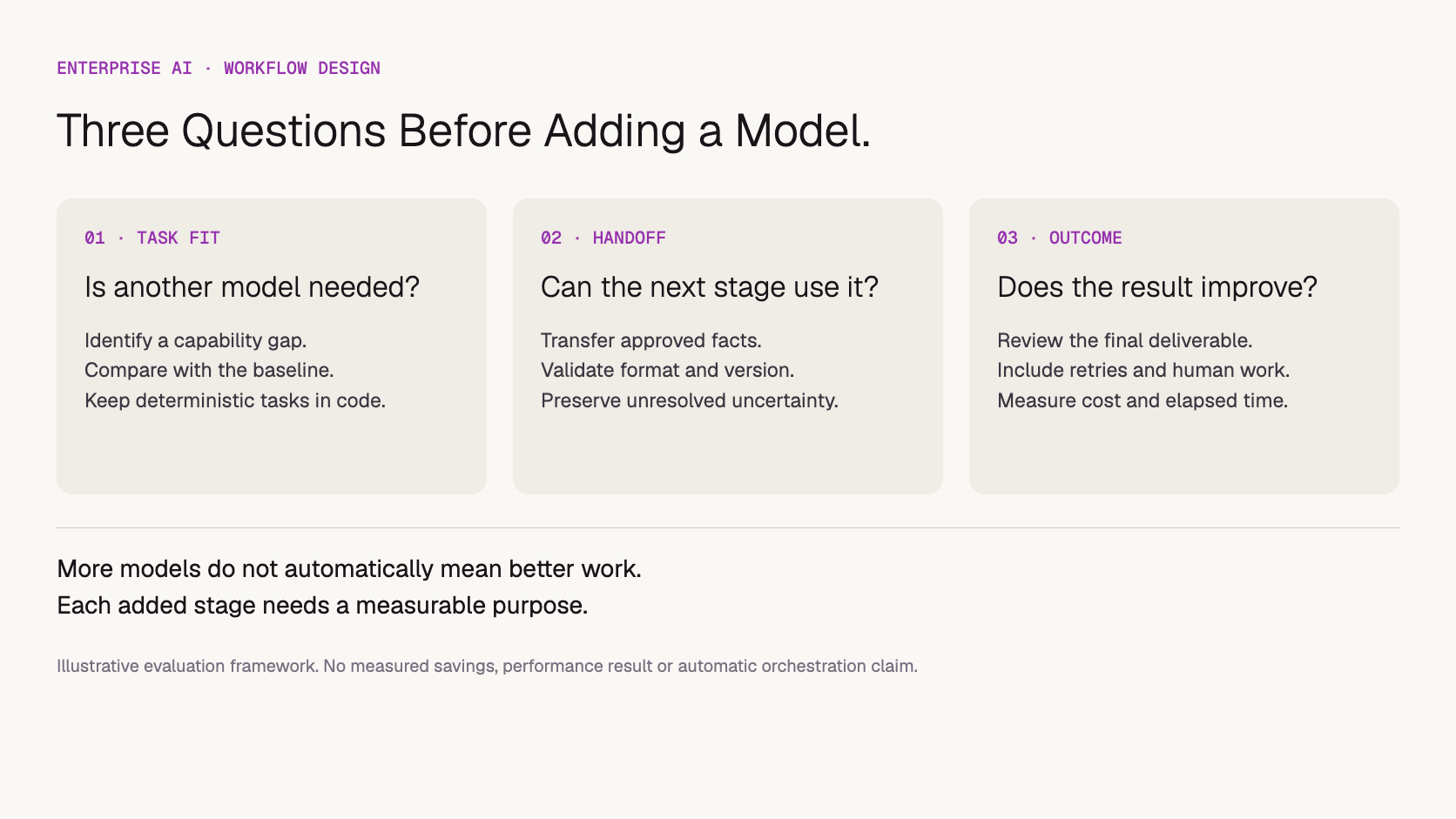
The right question for an enterprise is not “How many models should we buy?” It is “Which stages of this workflow cannot meet our requirements with the current approach?” Start with the simplest workable design, identify the gap, and add a model only when it addresses that gap at an acceptable end-to-end cost.
Scope and evidence: This is a business workflow design guide, not a benchmark or a claim that multiple models always outperform one. Examples are illustrative, not Token360 customer results. Official sources were checked on November 15, 2026. No cost savings or quality improvements are presented as measured results.
A model may lack a required output capability, fail an important acceptance criterion, or use more resources than a particular stage can justify. Those are different reasons to consider another model. Identify which one applies before changing the architecture; a disappointing result may also come from incomplete inputs or an unclear task.
Reason to investigate
Example
What to verify
Missing capability
The workflow needs a generated video, but the selected model returns text
Required input and output support in the specific model
Different task requirements
Extraction needs faithful fields; copywriting needs approved tone
Whether one model meets both acceptance criteria
Different cost or latency needs
A frequent simple classification stage dominates usage
Whether a suitable alternative improves the complete workflow
Additional review function
A proposed output needs a separate evidence check
Whether the check catches meaningful errors without excessive false alarms
A model that accepts images is not necessarily able to generate images. A model family name also does not establish which formats or parameters a particular API entry supports. Token360's model capabilities documentation directs developers to the selected model's detail page and schema for modalities, limits, parameters, and pricing meters.
Before adding another model, also consider whether a deterministic tool is the better fit. A database lookup, arithmetic calculation, or required-field check may belong in ordinary application code. More AI calls are not a substitute for explicit business rules.
What does a multi-model workflow look like in practice?
A multi-model workflow assigns distinct jobs to explicit stages and passes approved information between them. Each stage should have an input, an output, and an acceptance rule. The point is not to have several models independently improvise the entire job; it is to make the handoff between specialized tasks reliable.
Illustrative example: A creative operations team needs a short product explainer from an approved brief. The source specifies product facts, claims that may be used, visual references, and the intended audience. A possible workflow is:
Stage
Possible tool or model role
Acceptance condition
Extract the brief
Text or vision-capable model, depending on source
Facts and missing information remain linked to the brief
Write the script
Text model
Claims, duration assumptions, and tone are approved
Generate selected shots
Video model supporting the required references
Product appearance and action meet the shot requirements
Create narration if needed
Suitable speech-generation model
Approved script, pronunciation, and usage requirements are met
Assemble and approve
Editing software and human review
The complete deliverable meets the brief
This is an option, not a recommendation to use four models. One model might handle both extraction and writing. A video model's audio output may be suitable, making separate narration unnecessary. Existing footage could remove the video-generation stage. Choose the stages from the deliverable, then choose the tools.
The business should evaluate the finished explainer. Individually attractive clips do not help if the product changes between shots, narration contradicts the script, or the final asset requires extensive rework.
Can several text models also be useful?
Yes, but different text tasks do not automatically require different text models. A single model may handle extraction, classification, drafting, and summarization with separate instructions. Introduce another model when representative evaluation shows that a stage needs different capabilities or economics, and when the benefit survives the added integration and review effort.
For example, an internal document workflow might classify incoming requests, extract a structured record, and prepare a response. Start by testing one suitable model across those stages. If classification is straightforward and high volume, compare a less expensive candidate for that stage while keeping downstream acceptance criteria unchanged.
Do not judge only whether the classifier produces the expected label format. A misclassified document can send the next stage the wrong instructions. The relevant result includes downstream corrections and the final outcome.
Anthropic's engineering guidance on building effective agents recommends starting with the simplest solution and adding complexity when warranted. Its discussion of workflows and agents is architectural guidance, not evidence that a particular combination of models will improve your workload. The article was originally published in December 2024 and now notes that tooling has changed.
Is this the same as routing, fallback, or a model cascade?
No. Task specialization gives different models different jobs within a workflow. Routing selects an eligible model for a request; fallback handles failure; a cascade escalates a request based on a quality or difficulty decision. These patterns can coexist, but they answer different questions and should have separate evaluation criteria.
Pattern
Question it answers
Related guide
Task specialization
Which tool should perform each stage of one deliverable?
Neither multiple calls nor multiple agents necessarily means multiple models. A workflow can call one model several times. Several agents can use the same model with different instructions and tools. Conversely, a fixed sequence of two specialized models can operate without an autonomous agent choosing the next step.
If the question concerns defaults across the whole company rather than one workflow, use the separate model standardization guide.
What should pass between models?
Pass a defined work product with the facts, constraints, source references, and unresolved issues the next stage needs. Avoid handing off only a polished summary that removes uncertainty. Each stage should know which information is approved, which is inferred, and which must not be changed without review.
In the product-explainer example, the handoff to video generation should preserve the approved product references and shot requirements, not just a creative paragraph. The narration stage should receive the approved script version. If the script changes, the application must know whether the existing narration is still valid.
A practical handoff record contains a work-item ID, source version, stage output, approval state, constraints, and the next stage's required inputs. Keep model IDs and relevant settings in the run record for troubleshooting. Store asset references safely and handle expired URLs before dependent stages begin.
Schema validation can confirm that the expected fields exist, but it cannot establish that the facts are correct. The structured-output guide explains this distinction. Use evidence checks and domain-specific review where correctness matters.
A second model earns its place only when the complete workflow benefits.
Does a second model make the result more trustworthy?
A second model can provide a useful check, but agreement between models is not independent proof of correctness. Both may rely on the same incomplete source or make similar mistakes. Give the checker a specific criterion and access to evidence, and measure whether it detects errors that matter to the business.
A reviewer model asked “Is this good?” may return an encouraging assessment without checking the underlying facts. A more useful task is “Which approved product claims are unsupported in this script?” followed by source-linked findings for review.
Some checks are better performed outside a model. Validate required dimensions with file metadata, reconcile arithmetic with code, or confirm order status against the operational system. For consequential claims or subjective creative acceptance, retain the appropriate human decision maker.
Evaluate false positives as well as missed errors. A checker that frequently rejects acceptable work can create expensive regeneration loops. Set a stopping rule and a route for unresolved cases rather than allowing models to critique and revise indefinitely.
Will multiple models lower cost or improve speed?
Not automatically. A less expensive model can reduce the charge for one stage while the full workflow becomes slower or more costly because of additional calls, failures, or review. Compare cost per accepted deliverable and end-to-end latency, including orchestration and rework, rather than comparing model list prices alone.
Use a consistent accounting boundary:
Cost per accepted deliverable = total processing, retry, integration-operation, and review costs for the evaluated batch ÷ accepted deliverables.
State which costs you included and how review time was valued. If no deliverables pass, report that result and the incurred cost rather than presenting a meaningful accepted-unit average. Do not hide failed runs outside the denominator.
Sequential stages add waiting time. Independent tasks may run in parallel, but a stage that needs the approved output of another stage cannot safely start from an unfinished guess. Measure the slowest dependency path and include queueing, asset transfer, validation, and human approval where applicable.
For enterprise budgeting, the API total-cost guide covers the wider operating expenses. No savings percentage should be promised before testing your actual workflow.
Stay with one model when it meets the required capabilities, quality threshold, latency, and budget with a manageable integration. Also avoid splitting a task when the handoff would lose essential context or when your team cannot maintain the extra models. Simpler systems are easier to evaluate when their results are otherwise sufficient.
Try better source preparation, clearer instructions, and deterministic validation before treating every failure as a model-selection problem. A second model cannot recover a product fact that was never supplied, and an extra generation stage can amplify an incorrect assumption.
Add one specialized stage at a time. Compare the baseline and candidate on the same representative work items and acceptance criteria. Review both easy and difficult cases, and include incomplete inputs and failures. A few appealing demonstrations are not enough to justify a production dependency.
The blank workflow model-role register records the stage, capability gap, baseline, candidate, handoff contract, acceptance rule, and operational owner. It contains no benchmark results.
Where does Token360 fit in a multi-model workflow?
Token360 provides enterprise access to text, image, audio, and video models, allowing a team to evaluate suitable model roles through one platform. The surrounding application still owns task sequencing, state, asset handling, approvals, and outcome evaluation. Model access does not by itself create an end-to-end production workflow.
As checked on November 15, 2026, the enterprise offering includes custom pricing discussions. Capacity, contracts, and compliance requirements should be scoped to the engagement. Do not assume every model supports the same fields, media formats, or service guarantees. See Token360's company and resources information for brand context.
A unified platform can be useful for procurement and integration, but the number of available models is not the success metric. Ask which model is approved for each role, who maintains that choice, and what happens when a capability or version changes.
Intentional use of different models for different tasks should also be transparent. It is distinct from replacing a selected model without an agreed policy. The model identity verification guide explains how to separate requested identity, reported identity, and execution evidence.
When does the workflow need a predictive model instead?
Use the required output to decide which model owns a step. Generating an explanation of demand is different from producing an evaluated demand forecast. A workflow may need a forecasting component for the estimate and a language model for explanation; the fluent explanation does not validate the underlying forecast.
Compare the forecast against an agreed historical baseline before treating it as an input to decisions. That evaluation is separate from language quality. This is a model-selection boundary, not a claim that Token360 provides a forecasting system.
Should an LLM own product selection or explain a selection?
Distinguish finding eligible candidates, ranking them and explaining the result. A language model can be evaluated for parts of that workflow, but providing model access does not supply a catalog index or a recommendation engine. Name the component that controls eligibility before assigning a generated explanation to it.
A useful procurement brief states the interface between those components. For example, the model may receive an approved candidate set rather than choose from an entire catalog. That design still requires evaluation; it is not a tested recommendation outcome.
Frequently asked questions
Why not use the most capable model for everything?
It may not support every required output type, and its cost or latency may be unnecessary for a simple stage. But if one model meets the entire workflow's requirements efficiently, keeping it is a valid choice.
Does a multimodal model remove the need for multiple models?
Sometimes. Verify the exact input and output capabilities and evaluate the final result. “Multimodal” does not mean a model can perform every text, image, audio, and video operation your workflow needs.
How many models should a business start with?
Start with the minimum needed for the required capabilities. For a text-only workflow that may be one. Add another only for a clearly defined role whose value can be evaluated.
Do multiple models need to come from different providers?
No. Model roles and provider diversity are separate decisions. Choose by capability, measured fit, data requirements, and operational constraints rather than requiring a particular number of vendors.
Do multiple models automatically provide backup?
No. A model assigned to narration is not necessarily a replacement for a failed video model. Backup requires compatible alternatives, explicit failure handling, and an approved substitution policy.
For the company’s enterprise model-access context, see About Token360. Confirm the selected model and engagement scope separately from the application requirements discussed here.


 Guides
 Guides
 Guides