AI Model Cascades: When Should a Request Escalate to a Stronger Model?
Compare quality-based model cascades with routing and fallback. Assess evaluator errors, latency and cost using a reproducible escalation worksheet.
By Yuki Yu
An AI model cascade tries an initial model, checks its result and escalates selected requests to another model. It can reduce spending when many first-stage results are acceptable. It can also add cost and latency when most requests need escalation or when the quality check is unreliable. Evaluate the complete decision process, not just the cheaper model's price.
For a Token360 application, the useful question is whether two approved model configurations and a validated acceptance check outperform one fixed configuration for a defined workload. This article describes an application-level design; it does not claim that Token360 automatically grades every answer or upgrades it to a stronger model.
Read first: The AI model routing guide explains candidate selection. This article focuses on the later decision: what to do after the first model has already returned an answer.
How is a cascade different from routing or fallback?
A cascade makes a decision using the first result. Initial routing chooses a path before that result exists, while operational fallback usually responds to a failed or unavailable path.
Pattern
Typical trigger
Decision
Initial routing
Known task type or input requirements
Choose a suitable model before calling
Quality cascade
A completed answer fails a defined acceptance check
Try a second approved configuration
Failure recovery
A transient error or unavailable route
Retry or recover within a bounded policy
The distinction matters for measurement. A completed but incorrect extraction is a quality problem; a connection failure is an availability problem. Keep those reasons separate even if both eventually lead to another call. The API fallback guide covers recovery boundaries and uncertain submissions.
Anthropic's Building effective agents discusses composable workflows, programmatic checks and the cost/latency tradeoff of additional steps. A cascade is useful only when its extra decisions create measurable value for the application's task.
Which tasks are good candidates for a cascade?
Start with a repeated task whose acceptable output can be checked reasonably well. The check must distinguish a usable first answer from one that needs more work.
Examples include extracting a bounded set of fields with evidence references, classifying requests against a controlled taxonomy, or producing code that can be tested in an isolated environment. These are candidates, not guarantees: a valid field format does not establish factual correctness, and a narrow test can miss an incorrect program.
Open-ended creative judgments are harder to automate reliably. If reviewers cannot agree on what “good enough” means, an automated gate will not solve that ambiguity. Keep human review or use a fixed model until the acceptance rule becomes clearer.
Both stages must meet the workload's mandatory requirements. Check modality, input limits, structured output, tools and approved data handling using Token360 model capabilities and the exact model schema. A cheaper first stage that cannot read the required input is not a valid candidate.
What should the quality check measure?
Measure task acceptance, using source evidence or executable outcomes where available. Do not treat a model's confident wording as proof that its answer is correct.
Separate hard requirements from softer preferences. Missing required fields, unsupported claims or a failed business rule can trigger rejection. Tone or verbosity may be preferences rather than reasons to pay for another inference. Write this distinction before reviewing candidate outputs.
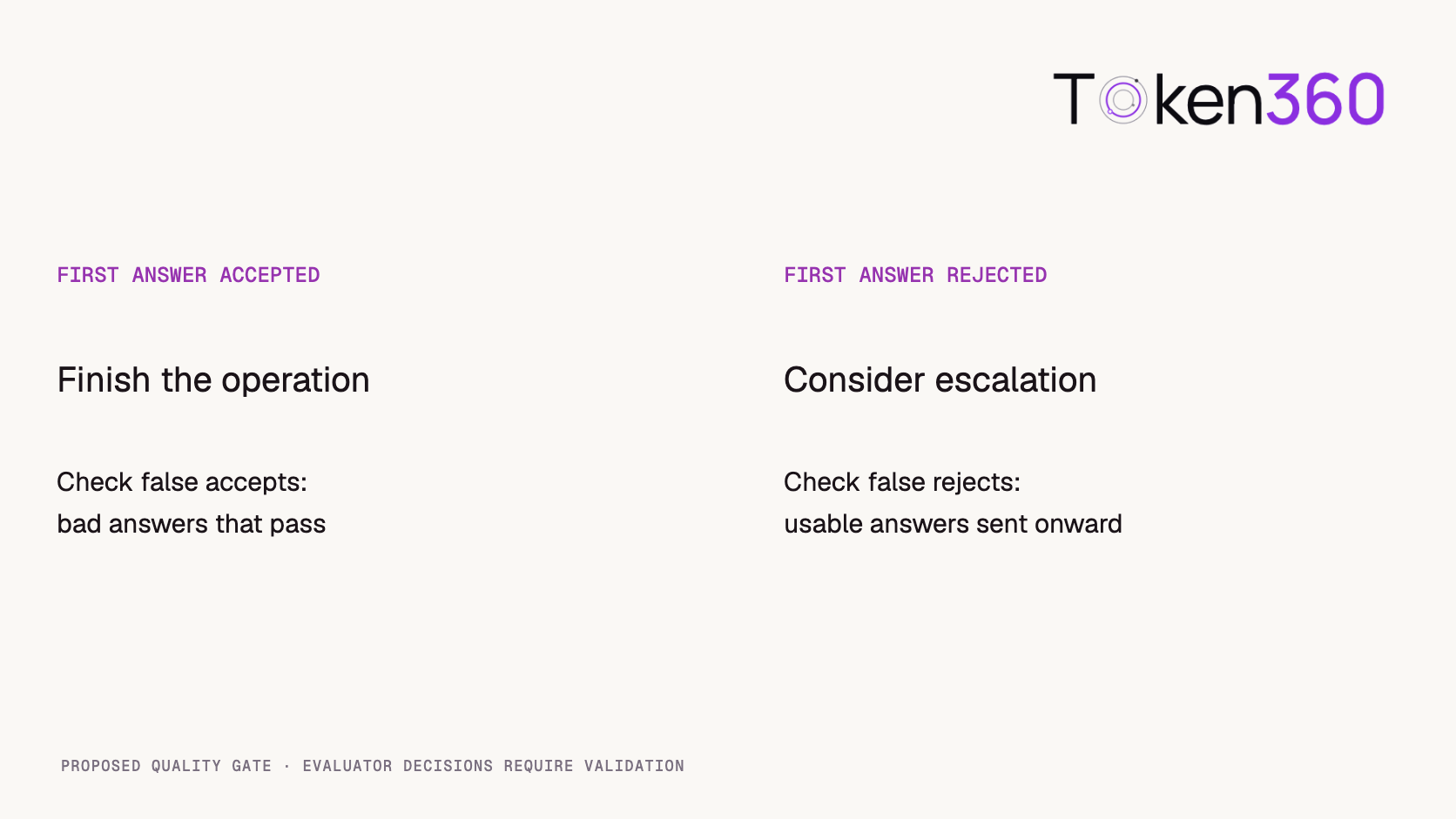
A model-based evaluator also needs validation. Compare its decisions with qualified human judgments on representative cases, including plausible but incorrect answers. Track false accepts, which let bad answers through, and false rejects, which cause unnecessary escalation. An evaluator can make both errors while appearing consistent.
Keep answer content separate from evaluator instructions. Store the evaluator version and acceptance rule with each operation. The model evaluation framework covers held-out cases and reviewer calibration; this cascade adds a specific decision policy to that evaluation.
Acceptance is a measured application decision, not a model's self-reported confidence.
When does a cascade save money?
It saves inference and checking cost only when the first-stage and verification expense is smaller than the second-stage calls it avoids. Quality and latency must still meet the same requirements.
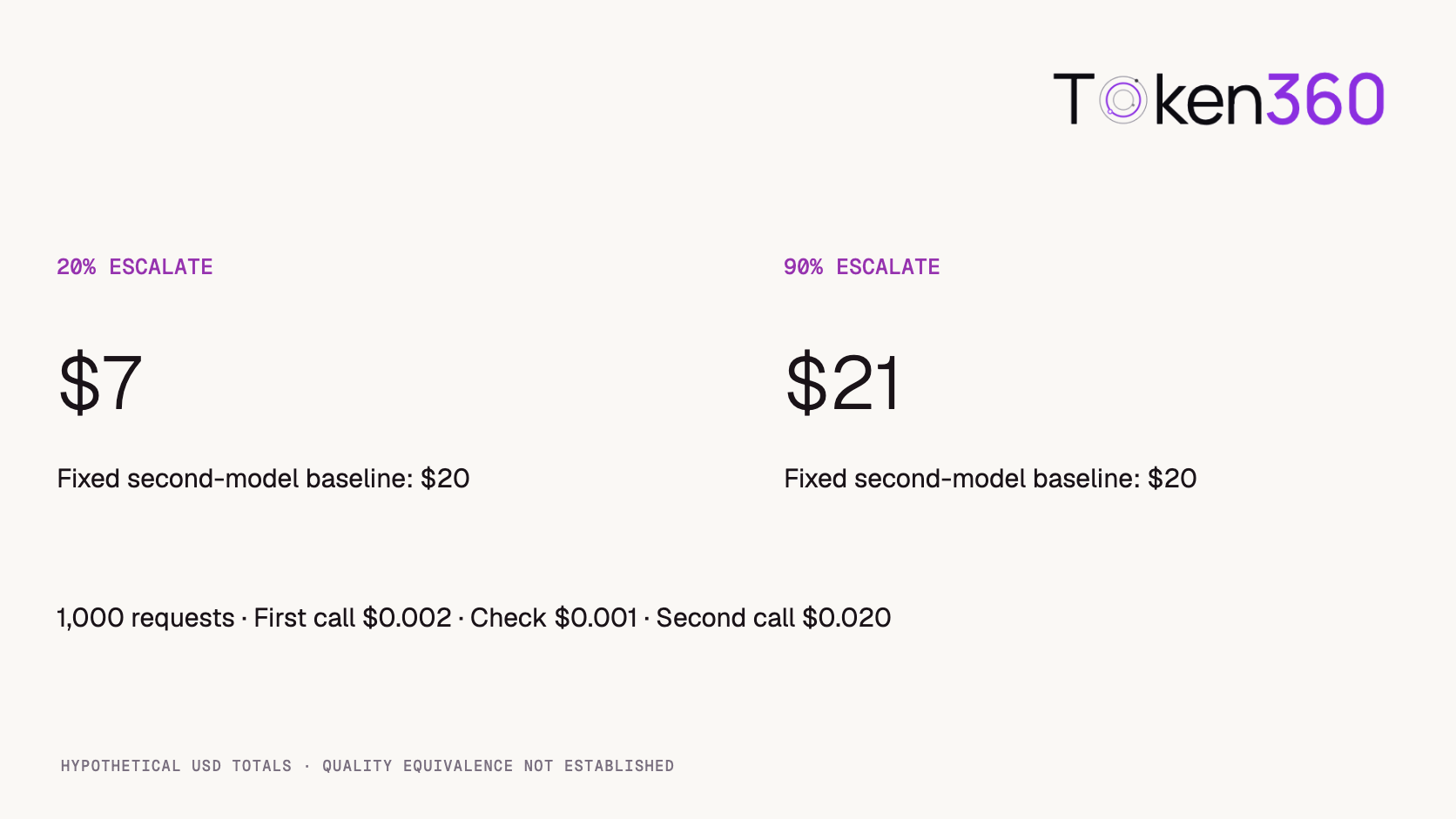
Our original worksheet uses invented USD inputs: 1,000 requests, $0.002 per initial call, $0.001 per check, and $0.020 per second-model call. Each request gets one initial call and one check. Escalated requests get one second-model call; no additional retries occur. The comparison sends every request directly to the second model.
The arithmetic breaks even at 85% escalation under these assumptions. This is not a recommended threshold: real token lengths, evaluator costs and billing rules change it. It is also not evidence of equal answer quality. The worksheet isolates cost; a deployment decision must separately establish quality and latency.
Example image fixtures: . Run python3 cascade_cost.py locally; no API key or external package is required.
Copy cascade_cost.py:
"""Hypothetical USD per-request cascade economics, not model prices or results."""
from decimal import Decimal as D
from pathlib import Path
import csv
n=D(1000);cheap=D('.002');check=D('.001');strong=D('.020')
rows=[]
for rate in ['0.2','0.5','0.85','0.9','1']:
 r=D(rate);total=n*(cheap+check+r*strong)
 rows.append(dict(requests=int(n),escalation_rate=str(r),cascade_usd=str(total),strong_only_usd=str(n*strong)))
assert n*(cheap+check+D('.85')*strong)==n*strong
with (Path(__file__).parent/'cascade-cost.csv').open('w',newline='') as f:
 w=csv.DictWriter(f,fieldnames=rows[0].keys());w.writeheader();w.writerows(rows)
print(rows)
Hypothetical cost sensitivity, calculated locally. No named model prices or live benchmark results are implied.
Final review, infrastructure and human correction are excluded from this example. If both policies use an identical final check, add it to both totals; if their review workloads differ, include that difference. For accounting, retain actual request charges rather than assuming all calls cost the same.
What happens to latency and conversational state?
Escalated requests wait for serial work: the first call, its check and the second call. Report their latency separately from requests that stop after the first stage.
A lower overall average can hide a slow escalated segment. Measure the complete user operation, including queueing and review, with the approach in the API latency measurement guide. Set a total deadline and define a clear outcome if the remaining budget cannot accommodate escalation.
For the second stage, decide whether to send the original task alone or the first answer plus critique. These are different experiments: including the first answer can introduce anchoring. Preserve required context, but do not blindly replay model-specific reasoning or tool state into another model's protocol.
Delay external side effects until the application has selected the accepted result. A cascade should not execute the same purchase, message or write action twice merely because it tried two models.
How should a Token360 cascade pilot be scoped?
Implement the quality decision explicitly in the application and use documented Token360 model contracts for each call. Begin with one workload, two eligible configurations and at most one escalation.
Token360 routing documentation describes resolving public model names to eligible upstream routes. Provider route handling is distinct from this article's quality-driven change of model. Cross-model controls should only be assumed where the selected schema documents them; a provider-routing preference is not an answer-quality evaluator.
Log the first model, acceptance result, escalation reason, second model, final outcome and total charge under one operation ID. Compare the cascade with a fixed baseline on held-out tasks. Keep quality failures, operational errors and deadline failures visible rather than summarizing all of them as “escalations.”
Read next: Use billing and usage documentation to reconcile all attempts. Token360 resources provide related integration guidance. Keep the fixed-model option if the cascade cannot demonstrate a useful tradeoff.
What if the acceptance check makes the wrong decision?
A cascade can save calls while admitting worse answers if its acceptance check is too permissive. Evaluate the checker as well as the models. Review a sample of first-stage answers that were accepted and a sample that were escalated, using the same independent task rubric.
Keep two error categories separate. A false acceptance lets an unsuitable answer reach the user. An unnecessary escalation pays for another call even though the first answer was usable. Their consequences need not have equal weight. For an invoice extraction, an incorrect total may justify human review; a harmless formatting variation may be repairable without another model.
Report the final accepted-result rate alongside total calls and checking cost. An escalation fraction alone does not establish a benefit. If the checker cannot distinguish these cases consistently, keep the simpler verified route while improving the acceptance test.
Frequently asked questions
Is a model cascade the same as API fallback?
No. This cascade escalates based on the quality of a completed result. Failure recovery responds to operational problems and needs a separate policy.
Does a cascade always start with the smallest model?
No. The first model must meet the task's mandatory capabilities. Choose it through workload evaluation, not parameter count alone.
Can the first model judge its own answer?
It can provide a signal, but self-assessment needs calibration. Use source-grounded checks, executable outcomes or validated evaluation rather than trusting confidence language.
Does Token360 automatically run this quality cascade?
This article describes application-level orchestration. Do not infer automatic answer grading or cross-model escalation from provider routing; verify any platform control in the selected schema.
Are the worksheet costs live model prices?
No. All prices and escalation rates are hypothetical. The downloadable calculation demonstrates sensitivity, not measured savings or equal quality.
What if the second answer also fails?
Stop at the defined budget and use an explicit failure, human-review or clarification outcome. Do not turn a bounded cascade into unlimited retries.
Editorial revision: November 4, 2026. Test dates and dated source snapshots remain as stated in the article.
API
Video
Production Workflow
Build faster with one AI API.
Use Token360 to call video, image, audio, and text models with one key and one bill.



 Prompt Library
 Insights
 Insights