AI Model Standardization: One Model for Every Team?
Define a default AI model, justify exceptions and retire unused options. An enterprise framework for common controls across different workloads.
ENTERPRISE AI · MODEL STRATEGY
AI model standardization means deciding which models teams should use by default, when an exception is justified, and who maintains those choices. It does not require every department to use the same model. A useful enterprise policy standardizes the approval process and operating responsibilities while allowing different models where business requirements justify them.
Start with one default for a clearly defined family of tasks. Require evidence before adding another production option, and remove options when their business purpose disappears. This balances two costs: maintaining too many models and forcing unsuitable work through one approved model.
Read first: How to choose AI models by use case. This article addresses the company-wide policy after teams have identified their requirements.
When should a company use one default AI model?
One default is a reasonable starting point when teams perform similar tasks, handle comparable data, and can accept the same output quality and response requirements. It reduces the number of configurations that need support. The decision should follow representative workload testing, rather than a general benchmark ranking or a purchasing preference alone.
Consider several departments drafting internal summaries from ordinary business documents. If the same approved configuration meets their acceptance criteria, separate models may add maintenance work without a demonstrated benefit. A common default gives application owners a shared baseline for examples, evaluations and incident investigation.
The boundary matters. A default approved for internal drafting is not automatically approved for customer-facing advice, sensitive document processing or audio generation. “Company default” should always include a scope. Otherwise, teams can mistake an administrative choice for evidence that a model fits every application.
A defensible default record names the model configuration, supported workload family, data restrictions, application owner and reasons for selection. It also states which changes require another review. Without those details, standardization can become little more than a model name in a procurement document.
What should be standardized across different models?
Standardize how teams obtain approval, identify responsibility, record configuration changes and check business outcomes. Keep capability requirements specific to each workload. Common access and purchasing arrangements can simplify administration, but they do not make different models interchangeable or establish that every model supports the same parameters and outputs.
Layer
A useful common standard
What still needs a separate decision
Business ownership
Every production application has an accountable owner.
Who accepts the output for this workflow?
Approval evidence
Document acceptance criteria and unresolved limitations.
Which examples and failure conditions represent this task?
Configuration records
Record model ID, relevant settings and change history.
Which features and limits does this configuration support?
Commercial relationship
Assign purchasing and billing responsibility.
What scope and conditions apply to each service?
Operational review
Assign review triggers and retirement responsibility.
What change would make this option unsuitable?
Token360’s model capability documentation explains why the model detail page and public schema matter: models using a shared endpoint can differ in capabilities, parameters and limits. A common connection pattern therefore supports integration consistency; it is not proof of identical behavior.
This distinction also separates model policy from centralized AI procurement. One purchasing relationship can serve several approved models. Conversely, a company can apply one internal approval standard across multiple suppliers.
How do the main standardization approaches compare?
A mandatory single model minimizes the number of supported choices but can leave important workloads underserved. Unrestricted selection maximizes local freedom while increasing coordination needs. A default with documented exceptions is a middle approach: teams begin with a supported option and justify additional choices against a defined business requirement.
Policy
Best fit
Main tradeoff
One mandatory model within a task family
Similar workloads with evidence that the default is adequate
A specialized requirement may need a formal policy change.
Default plus approved exceptions
Shared operations with some genuinely different requirements
Someone must review exceptions and maintain their boundaries.
Team-selected models within common controls
Independent products with capable local owners
Repeated integration, evaluation and support work can accumulate.
There is no universally correct number of models. The relevant question is whether each additional option has a purpose that outweighs its ongoing responsibilities. A specialist model used by one critical application may be justified; several almost identical options with no clear owner may not be.
What evidence should justify an exception?
An exception should identify a requirement the default does not meet, show evidence from the relevant workload, and assign responsibility for maintaining the alternative. “Higher on a leaderboard” is not enough. The reviewer needs to understand the business benefit, additional operating work and conditions under which approval should end.
Ask the requesting team to document five things:
The gap: which acceptance criterion does the default miss?
The comparison: how did the proposed option perform on representative inputs under recorded conditions?
The business consequence: what rework, unacceptable output or missing capability does the alternative address?
The operating commitment: who owns configuration, evaluation and incident handling?
The approval boundary: which application, data class and requirements are covered?
An exception need not start with a large experiment, but the evidence must match the claim. A few successful examples can justify further evaluation; they do not establish dependable production performance. Use a model evaluation framework to define representative cases and failure criteria before describing an alternative as better.
NIST’s AI Risk Management Framework resources describe use-case profiles in terms of a specific setting, requirements, risk tolerance and resources. That supports evaluating choices in context. The default-and-exception policy proposed here is an editorial framework, not a NIST-prescribed model portfolio.
What would this look like across three business teams?
Imagine a company with internal document drafting, structured document extraction and creative media production. It can share approval rules and purchasing ownership while making separate capability decisions. The following example illustrates a policy discussion; it is not a Token360 customer case, benchmark or verified cost-saving result.
Internal drafting: the company adopts a default after checking representative documents and expected review requirements. Teams using it within the approved scope do not need to repeat the entire selection process, although their application owners remain responsible for the result.
Document extraction: a team requests an exception because the default misses a specific acceptance criterion. The exception is approved only if relevant evidence supports the alternative and an owner accepts the additional maintenance work. If the default later meets that requirement, the exception can be reconsidered rather than retained indefinitely.
Creative media: audio, image and video generation belong to different capability families. The company defines appropriate choices for those workloads instead of expecting the text default to cover them. The same policy questions—purpose, evidence, ownership and review—still apply.
The outcome is a controlled set of choices. It is not automatically a single model, a single supplier or a runtime system that selects a model for every request.
How should approved models be reviewed and retired?
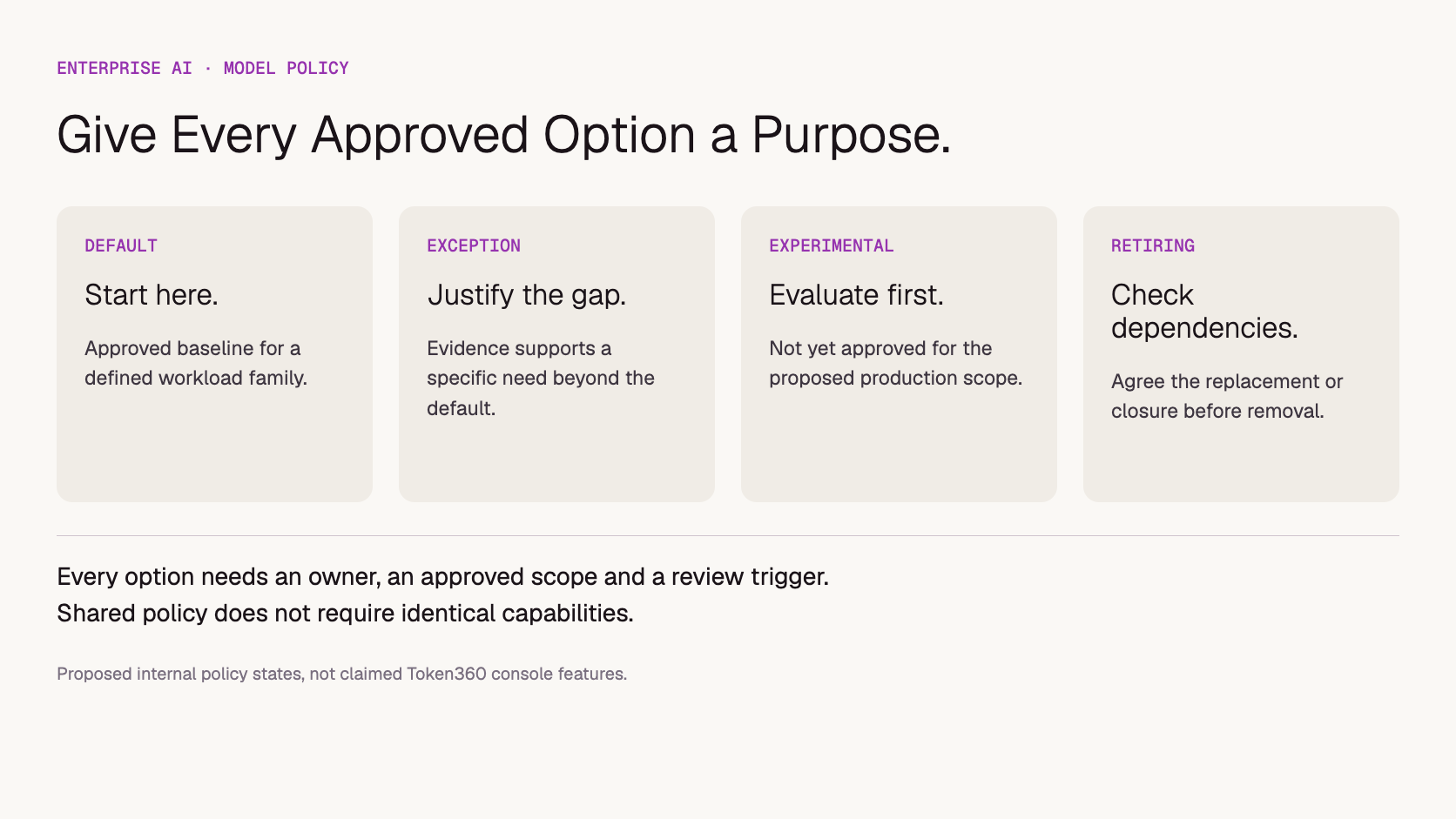
Give every approved option a status, owner and review trigger. Review when requirements change, a configuration changes materially, evidence shows a quality problem, or usage no longer supports the original purpose. Retirement should follow a dependency check so that removing an option does not silently break an application.
A proposed internal register; these are not claimed Token360 console states.
Before retiring a model, identify applications using it, their owners and any stored assumptions about output or supported features. Agree the replacement or closure decision, confirm acceptance evidence and plan the transition. Low usage alone is not a reason to remove a critical specialist dependency.
Likewise, a new model release is a reason to consider evaluation, not an automatic requirement to migrate. The burden of keeping an option should be compared with the risk and work of changing it. For deterioration in an existing application, use a separate AI quality regression investigation rather than treating every failure as a portfolio-policy problem.
Download the blank model standardization register. Record the workload family, default configuration, exception reason, evidence, owner, status and review trigger. The template contains no customer data or model recommendations.
Token360 supplies access to text, image, audio and video models and works with enterprise customers on commercial requirements. That can support a company using several approved capabilities. The customer still needs to decide its internal defaults, exception rules and application acceptance criteria; a supplier relationship does not replace those decisions.
Use the Token360 enterprise page to begin a discussion about the models and enterprise arrangement your organization needs. Confirm capacity, contract terms and compliance requirements for the specific engagement. Do not assume every model has identical controls or that an internal approval workflow is automatically enforced by the platform.
A practical inquiry includes the workload families you intend to standardize, the configurations already evaluated and the exceptions you need to preserve. That gives procurement and the supplier a concrete scope to discuss. Learn more about Token360.
Frequently asked questions
Does AI model standardization mean choosing one vendor?
No. Model choice, supplier choice and internal control standards are separate decisions. A company can use several models through one supplier or apply the same internal policy across multiple suppliers. The right arrangement depends on workload requirements and the confirmed service scope.
Should every department have its own default model?
Not necessarily. Group workloads by comparable requirements before dividing them by department. Similar drafting tasks may share a default; two applications in the same department may need different capabilities or data treatment.
How many AI models should an enterprise approve?
There is no fixed number supported by this article. Approve the options needed to meet documented requirements, with owners able to maintain them. Review overlapping options and unexplained exceptions instead of setting an arbitrary numerical target.
Does a common API eliminate the cost of supporting multiple models?
No. It may simplify connection code, but capability checks, output evaluation, configuration management and incident handling remain. Assess those responsibilities before approving another production model.
Is this the same as model routing?
No. Standardization defines the approved choices and their scope. Routing chooses an option for a request within whatever policy the application implements. Read the separate AI model routing guide for that runtime decision.
Evidence note: this is an editorial enterprise decision framework based on official documentation and the sources linked above. The example is hypothetical. It reports no controlled comparative tests, customer outcomes or measured savings.
Enterprise AI
API
Bring your next idea to life.
Create a video scene in Creator, or explore models for images, audio, and text to find the right capabilities for your project.


 Guides
 Guides
 Guides