Copilot Fusion Benchmark Results: Does Multi-Model Orchestration Cost Less?
Explore Copilot Fusion benchmark results, API cost trade-offs, and why multi-model orchestration needs task-level evaluation before teams assume lower costs.
The latest Copilot Fusion benchmark makes a credible case for evaluating orchestration alongside individual models. It does not prove that adding more models always saves money. The buying question is what that trade-off means for the work your team actually ships.
This analysis was checked on October 29, 2026. Benchmark results below belong to Artificial Analysis; product behavior is attributed to GitHub. Token360’s calculations and selection framework are labeled separately. We have not run a comparative Fusion test, and this is not a Token360 integration announcement.
What the new Copilot Fusion benchmark actually says
The October 28 Artificial Analysis report compares the following evaluated systems. These are task costs, not prices for interchangeable model endpoints. See the Artificial Analysis Fusion report.
Evaluated configuration
Reported average API cost per task
Copilot Fusion Max in GitHub Copilot CLI
$5.59
Claude Opus 5.5 (Max) in Claude Code
$11.42
Figures are from the dated report above, not a universal price list. GitHub’s release announcement states that Fusion Max scored 60, two points below the compared Opus configuration. That is a comparison of displayed benchmark scores, not evidence of a two-percent difference in developer productivity.
The interesting result is a choice frontier: a buyer can investigate a lower-cost system without assuming it must sit far below the stronger-scoring candidate. Whether that option is useful depends on the value of the work it completes and the review effort it creates. A benchmark can identify that question; it cannot answer it for every repository.
The ranking belongs to an agent configuration
The Coding Agent Index v2.0 combines FrontierCode v1.1, Terminal-Bench 4.0, and SWE-Atlas-QnA-AA with equal benchmark weights. Its methodology averages three attempts per task. It explicitly treats each public row as an agent variant, with execution and reasoning settings affecting the comparison. See the coding-agent methodology.
That makes the unit of comparison larger than a model name. A developer buys an experience that includes tools, context handling, execution choices, and integration with the working environment. Replacing the underlying model while keeping everything else constant would be a different experiment. The published comparison does not isolate orchestration as the sole cause of the cost difference.
A practical consequence follows: do not label a generic API endpoint “Fusion-equivalent” because it can access some of the same model families. Access to ingredients does not establish the behavior of the finished system. Reproducing an agent result would require its relevant configuration and evaluation conditions, followed by a new test.
The component scores reveal a more useful buying question
The dated AA report lists Fusion at 71 on Terminal-Bench 4.0, 51 on FrontierCode, and 57 on SWE-Atlas-QnA-AA. Read the per-benchmark discussion alongside the composite.
For a team whose backlog is mostly implementation work, the repository-change evidence deserves particular attention. A team focused on shell-driven investigations may emphasize a different slice. Neither should silently replace the published weighting and continue calling its result the official index.
Instead, keep two views: the external composite for context, and a separate internal scorecard for your own task mix. Mark the latter as an internal evaluation. That preserves comparability while making the procurement decision specific enough to matter.
Why multiple models can reduce cost—and why they might not
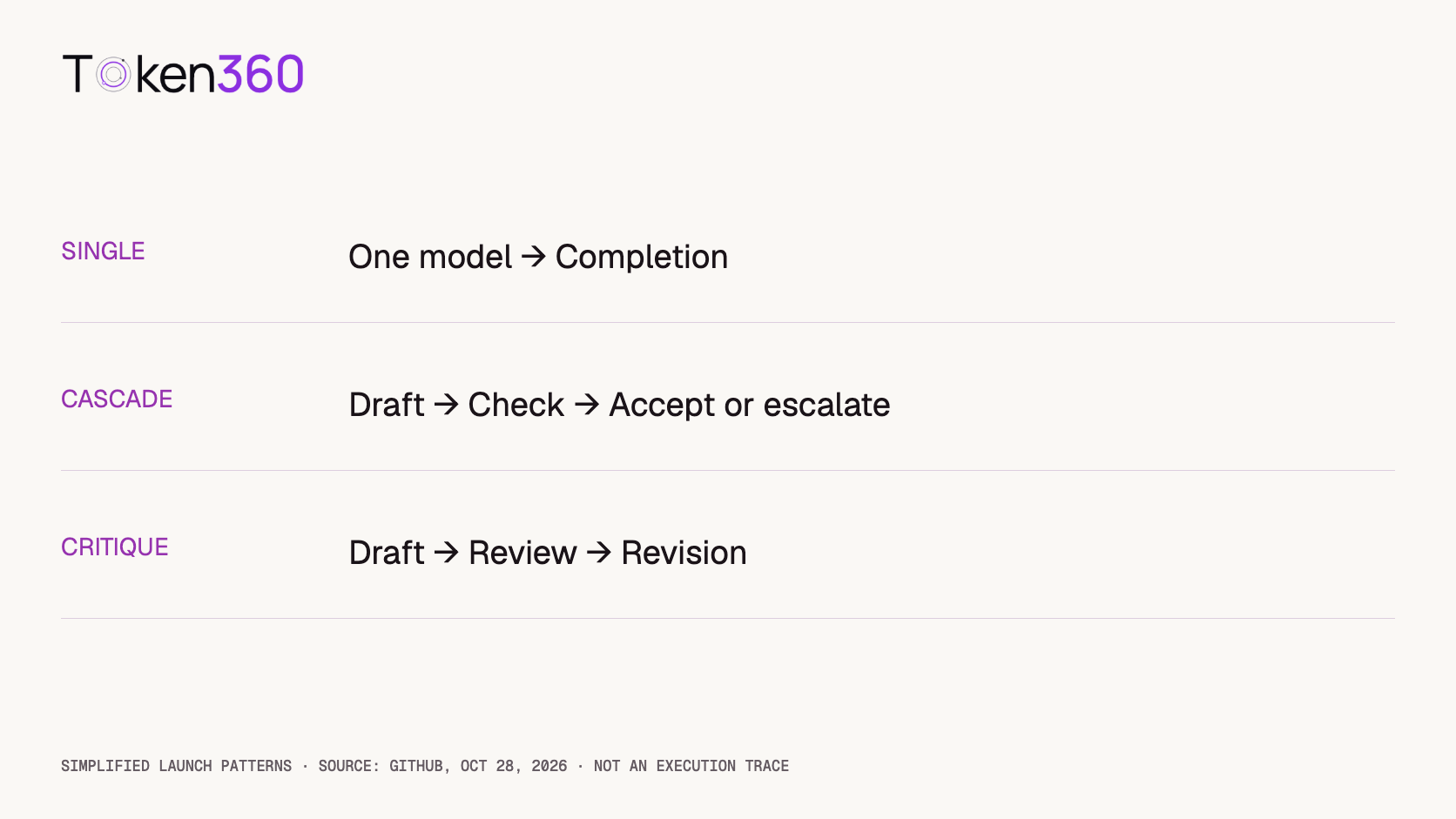
GitHub describes three execution patterns: a single model completes the task; a cascade checks an initial draft and may escalate; a critique workflow reviews a draft before revision. Selecting Fusion therefore selects an orchestration system, rather than one fixed model. See the official launch description.
The economic idea is selective effort. If a routine change can be completed adequately with less expensive work, the system need not apply its strongest route to every step. Review or escalation can be reserved for tasks that justify it. That is a plausible explanation of how orchestration can help; it is not a causal decomposition of the benchmark result.
The opposite is also possible. A weak draft can consume resources before a second attempt starts. A reviewer may receive a large context, find little useful to change, and still add latency and cost. More stages are not inherently efficient. The important question is whether the additional stage improves the final outcome enough to justify its expense.
GitHub’s current documentation says the eligible model pool can change, and its routing is subject to plan and administrator policies. It also notes that review-based paths add model calls. Those constraints belong in a rollout decision, especially when the tested configuration differs from the models a company permits. See GitHub’s Fusion documentation.
Simplified launch-pattern summary. Actual execution and eligible models can change.
Our calculation: how much review time could erase the API saving?
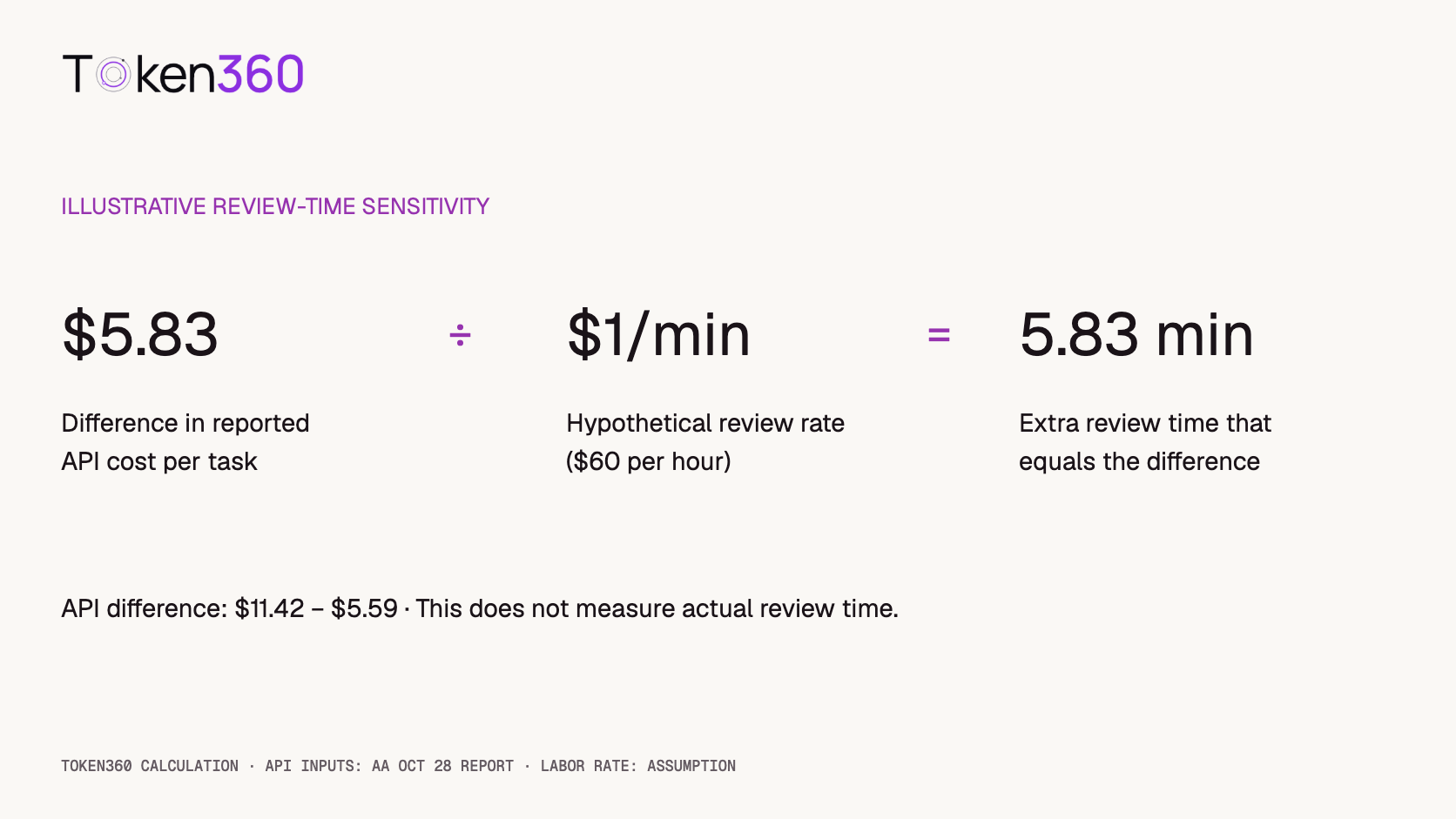
The reported $11.42 and $5.59 task costs differ by $5.83. Calculated as ($11.42 − $5.59) ÷ $11.42, that is about 51.1% lower API cost for the compared Fusion result. This is our arithmetic on third-party figures, not an independently measured saving.
To make the implication concrete, suppose reviewer time is valued at a hypothetical $60 per hour, or $1 per minute. An additional 5.83 minutes of review per task would consume that $5.83 difference, before considering other costs. The assumed labor rate is illustrative; it is neither a wage survey nor a claim about how much review Fusion requires.
Input or calculation
Value
Evidence type
Difference between reported API task costs
$5.83
Calculated from AA figures
Assumed reviewer time value
$60/hour
Hypothetical scenario
Additional review time that equals the difference
5.83 minutes
Illustrative break-even calculation
This example deliberately does not estimate cost per accepted change. The composite index is not an observed acceptance probability for your backlog, so dividing the cost by the index score would create false precision. A real accepted-change comparison needs actual accepted outputs, rejected attempts, retries, and human review from the same local workload.
Illustrative sensitivity analysis—not a measured review burden or guaranteed saving.
Three questions a buyer should resolve before switching
Does the task mix resemble the evidence?
A clean-up script, a production bug fix, and an architectural explanation are not equivalent work items. Build the local comparison around recurring tasks that consume meaningful engineering attention. Keep the environment, starting state, and acceptance criteria consistent across candidates. Record failures rather than rerunning until each system produces a flattering example.
Can the team explain the cost of a completed outcome?
Artificial Analysis describes the cost metric as pay-per-token API expenditure, not consumer-plan pricing or full operational cost. The public coding-agent leaderboard separates cost, tokens, and execution time. That separation is useful: a token total alone is not a bill, and a bill alone is not a measure of delivered value.
For a local decision, preserve the task-level chain from initial request to accepted change. Include retry charges and review time, then compare like-for-like outcomes. If several requests belong to one task, counting each as a separate success would make a longer workflow look more productive without demonstrating more useful work.
Are execution traces and model policies adequate?
The ability to inspect what happened matters when results change. Record the configuration and date with each evaluation, and retain the trace needed to understand a surprising output. Our AI API observability guide covers the operational side of connecting requests with outcomes.
GitHub also documents an important workspace boundary: discarding a draft does not automatically undo file changes that draft already made. That makes reviewing the resulting diff part of using the system responsibly. It is a documented product limitation, not evidence that a particular benchmark attempt produced an incorrect change. See the Fusion limitations.
What this means for Token360 users
The takeaway for API teams is to compare complete workflows when the application includes multiple stages. A platform’s model catalog and an agent’s orchestration policy solve different parts of that problem. Check exact model IDs, supported parameters, and availability in Token360’s capability documentation; do not infer compatibility from a benchmark label.
We are not claiming that Token360 reproduces Fusion’s routing, integrates its runtime, or offers the benchmark’s reported prices. The original contribution here is the comparison framework and explicitly labeled review-time calculation. A broader switching recommendation would require a controlled test on your workload.
FAQ
Is Copilot Fusion a single language model?
No. GitHub describes it as a runtime system that selects models and execution patterns. Its benchmark result belongs to that evaluated system and setting.
Did Fusion beat Claude Code in the cited comparison?
It had a lower reported API task cost and a slightly lower composite score. That is a trade-off, not an unconditional win across quality, price, and all task types.
Does the 51.1% calculation predict my savings?
No. It compares two published average API costs. Your workload, plan, eligible models, retries, and review requirements can produce different economics.
Why not choose the highest overall coding-agent score?
A composite helps identify candidates. The right choice still depends on your recurring tasks, acceptance requirements, and operational constraints.
Are more models always better than one?
No. Extra review or escalation needs to earn its cost. Direct completion may be sufficient for some tasks, while others benefit from additional checking.
Was the review-time example tested on Fusion?
No. It is a transparent hypothetical sensitivity calculation, not a measurement of Fusion’s review burden. We have not run a first-party comparative test.


 Comparison
 Comparison
 Tutorial