How Should Your Company Choose AI Models by Use Case?
Choose AI models by business task, required capabilities and operating priorities. Build a useful shortlist before testing or committing to a purchase.
ENTERPRISE AI · BUSINESS MODEL SELECTION
By Yuki Yu · Enterprise buying analysis · Reviewed November 7, 2026
Choose AI models by the work your company needs done. Define the task, inputs, acceptable output and operating constraints before comparing model names. Shortlist candidates that meet the mandatory requirements, then test the tradeoffs that matter to that workload. Different departments may need different models under the same purchasing relationship.
“Which AI model should we buy?” is often several questions combined. A customer-support assistant, a document-processing workflow and a marketing video pipeline have different inputs, outputs and consequences of failure. Selecting one prestigious model name first can hide those differences.
This guide helps enterprise buyers create a shortlist and a decision brief. It does not rank current models or claim that any candidate has passed a test. For the detailed testing process after shortlisting, use the AI Model Evaluation Framework. Procurement terms and supplier approval remain a separate review.
What business task are you actually choosing a model for?
Describe the task as an input, an expected output and a business action that follows. A department name is too broad to select a model. “Help marketing” might mean drafting copy, producing images or editing video, each of which requires a different capability and a different definition of useful work.
A useful starting sentence is: “For this user, turn this input into this output, within these constraints, so that this business step can proceed.” That sentence gives engineering something to assess and procurement something concrete to discuss with a supplier.
Broad request
A more useful task definition
What it changes about selection
We need AI for customer support
Draft answers using approved product documentation, with staff reviewing before sending
Evidence use, answer quality and review effort matter more than creative variety
We need AI for finance operations
Extract specified fields from approved document types for a human to validate
Document input support and field accuracy become central
We need AI for marketing
Produce product-image variations that retain required product details
Reference-image control and usable visual output determine fit
These hypothetical examples define bounded tasks. If a team cannot yet describe its inputs and acceptable outputs, clarify that workflow before shortlisting models.
Which model category does the task require?
Match the required input and output to the model category before comparing price or reputation. Reading an image is different from generating one, and transcribing speech is different from creating speech. A multimodal model may support some combinations without supporting every media workflow your business needs.
Business task
Capability to shortlist
Question that prevents a mismatch
Draft or classify text
Language generation or classification behavior
Can it follow the required business rules and output format?
Read documents containing images
Visual/document understanding for the actual input format
Can it interpret the layouts and details that matter?
Create or modify product visuals
Image generation or editing, as required
Does it accept references and preserve required elements?
Turn recordings into text
Speech recognition or transcription
Does it handle the relevant language and recording conditions?
Create spoken content
Speech generation
Are the needed pronunciation and voice controls available?
Produce video clips
Video generation or editing for the intended inputs
Do duration, reference controls and outputs match the production workflow?
Token360’s model capabilities guide directs buyers to each model’s details and schema for modalities, limits, parameters and billing meters. Do not infer a capability from the provider’s brand or from another model in the same family.
A workflow can need several capabilities. For example, creating a narrated product video may involve script generation, visuals and audio. Decide whether those are separate purchases or a supported combined workflow; do not assume one model handles the entire process because it accepts more than one input type.
Which requirements should eliminate a candidate immediately?
Separate non-negotiable requirements from preferences before building a shortlist. A candidate that cannot process the required inputs or operate within an approved data arrangement should not remain eligible because it produces attractive examples. Preferences help choose between suitable candidates; mandatory conditions determine whether a candidate belongs in the comparison at all.
Keep the initial list short and specific. Typical eligibility questions concern the needed modality, language, input size, output format, access method and approved processing arrangement. Business owners should also identify failures that would make an output unusable, such as changing a product’s identity in an advertisement.
Mark requirements as confirmed, unsupported or needing evidence. “Needs evidence” is not the same as “supported.” A supplier discussion can resolve that uncertainty, but it should stay visible in the buying brief until it is resolved.
Distinguish a model limitation from an application requirement. A model that writes a plausible answer does not automatically have access to current order records. A model that proposes an action does not itself establish authorization to perform it. Ask the technical owner what surrounding software and data access the proposed solution needs.
Before trial integration, the Token360 API selection guide helps confirm that the model, protocol and workload fit together. This is a compatibility check, not a reason to turn a buyer’s shortlist into an endpoint-by-endpoint procurement document.
Should you start with the most capable or the most economical model?
Choose the starting point according to the uncertainty you need to resolve. For a straightforward, high-volume task, an efficiency-focused candidate can establish whether modest resources are enough. For difficult analysis, a capability-focused candidate can show whether the task is feasible before you optimize cost. Neither starting point is a final purchasing decision.
Anthropic’s model selection guide describes both efficiency-first and capability-first approaches, followed by testing with actual tasks. The broader lesson is to use a starting hypothesis rather than assume that one model tier is right for every application.
Consider two hypothetical cases. Sorting short support messages into a stable set of categories may justify starting with an economical candidate. Comparing conflicting technical documents may justify starting with a more capable candidate to understand whether the task can be completed acceptably. Both still require evidence.
Ask each proposed candidate to answer a distinct question. One might establish a quality reference; another might test whether similar accepted output can be delivered with less waiting or cost. Avoid collecting many nearly identical candidates without knowing what a comparison would change.
Do not buy additional capability only because it exists. Conversely, do not select a cheaper candidate if its output creates enough manual correction to undermine the intended benefit. The decision concerns the resulting workflow, not the prestige or price of the model alone.
How should departments make different tradeoffs?
Give each workload a primary business priority after its mandatory conditions are met. An employee-facing assistant may prioritize responsiveness, while a scheduled report may tolerate waiting for better analysis. Creative work may prioritize usable output and editing effort. The company should agree on these priorities rather than apply one universal scoring formula.
The following table is a proposed discussion aid. It does not prescribe weights or assert that a particular model class always performs best.
Workload
Decision priority to discuss
Tradeoff that needs evidence
Interactive support drafting
A useful answer arrives within the workflow’s waiting budget
Whether additional reasoning improves answers enough to justify waiting
Scheduled document analysis
The analysis captures the required evidence and exceptions
Whether greater capability reduces substantive review work
High-volume categorization
Consistent accepted classifications at the expected volume
Whether a more economical option maintains required behavior
Product-image production
Approved visual details survive generation or editing
Whether a cheaper generation results in more unusable assets
Localized audio
Language and pronunciation meet editorial requirements
Whether revisions and human review change the apparent cost advantage
The business owner defines what makes an output useful. Engineering checks feasibility and operating behavior. Finance checks the cost assumptions. Procurement coordinates the purchase of the selected service. None of those roles should silently substitute its own preference for the agreed business requirement.
For work across languages, use the multilingual model selection guide to define language-specific test cases, reviewers and acceptance criteria.
What should a useful model shortlist contain?
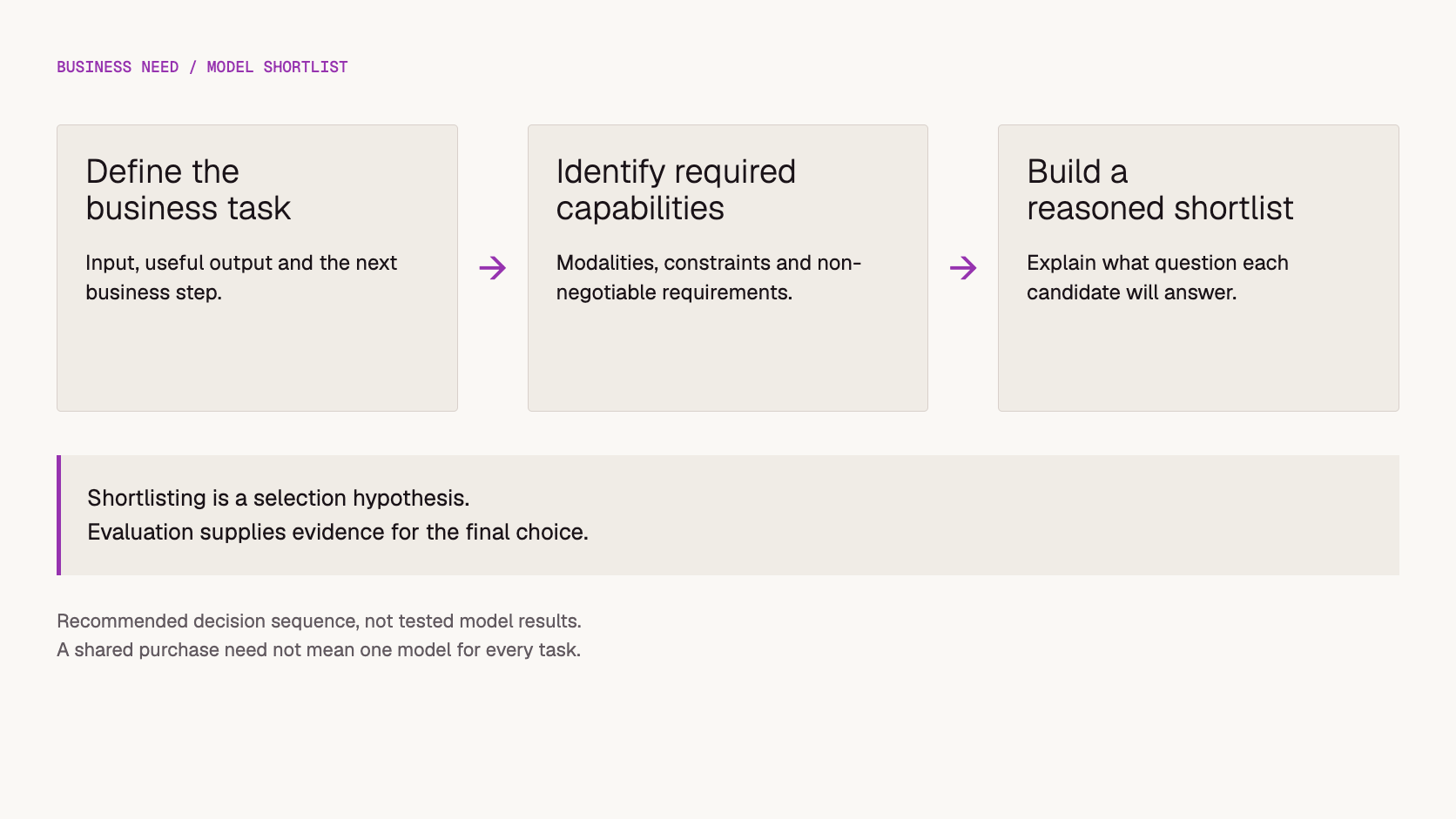
A useful shortlist explains why each candidate remains in consideration and what evidence would select or reject it. Record the actual model configuration, not just a vendor name. Keep the task and acceptance boundary constant across candidates so the next stage answers a purchasing question rather than producing unrelated demonstrations.
A procurement-ready brief can be concise while still making the decision explicit:
Brief field
What to record
Business task
Input, intended output, user and next business step
Mandatory conditions
Capabilities and operating requirements that cannot be traded away
Candidate and configuration
Exact model identifier, relevant settings and delivery route where known
Reason for inclusion
The quality, speed, cost or capability question this candidate will answer
Evidence still needed
Representative examples and unresolved capability questions
Decision owner
Who accepts the output and who approves the purchase scope
Selection narrows the buying question; evaluation supplies the evidence for a final choice.
A filled-in brief might read: “For operations reviewers, extract the required fields from approved supplier documents into a reviewable table. Required: support for our document formats and languages. Candidate A tests whether an efficiency-focused option handles routine documents; Candidate B tests whether greater capability helps difficult layouts. The operations owner accepts the output; engineering verifies input support. Neither candidate is approved until the missing evidence is collected.” This is a fictional brief, not a completed evaluation.
Keep the shortlist as a set of hypotheses to test. A candidate’s reason for inclusion should become a question in the evaluation, not an assumed advantage in the purchase recommendation.
Can one company buy different models without fragmenting procurement?
A company can keep workload-specific model choices while coordinating the supplier conversation. The shared purchasing brief should describe the mix of tasks and the requirements that differ between them. It should not assume that access to several model categories guarantees identical features, capacity terms or commercial treatment across all of them.
Token360 focuses on enterprise model access across text, image, audio and video, with pricing, capacity, contracts and compliance requirements scoped to the engagement. This makes a multi-workload discussion relevant, but the exact model coverage and production arrangements still need confirmation.
As reviewed on November 7, 2026, the enterprise page distinguishes available capabilities from roadmap and contact-sales items. Treat a requested arrangement as a question to resolve, not a standard entitlement inferred from the word “enterprise.”
A useful inquiry is: “We have support drafting, document analysis and product-content workloads. Here are the required capabilities and current candidates. Which are available through Token360, what remains unverified, and how should we scope the next evaluation?” This is more actionable than requesting the best model for the whole company.
Use the live model catalog to confirm current candidates. For company context, see About Token360. A platform relationship can coordinate access; it does not remove the need to choose the model that fits each workload.
Frequently asked questions
Should we standardize on one model for the whole company?
Only if it meets the relevant tasks and constraints without unacceptable tradeoffs. Shared procurement does not require identical model choices for support, document processing and creative production.
Can public rankings tell us which model to buy?
They can inform a shortlist, but their tasks may differ from your work. Use rankings as a starting signal, then assess the capabilities and behavior required by your own workflow.
Do we need the largest context window?
Only if the task needs that input capacity and the candidate uses the information acceptably. A larger advertised window does not by itself establish better document analysis or a better overall buying decision.
How many models should we shortlist?
Include candidates that test meaningful alternatives, within the team’s ability to evaluate them properly. There is no universal number. Remove candidates that fail mandatory requirements or add no distinct decision value.
What if none of the candidates meets the requirements?
Revisit the task boundary, supporting data, human-review role or workflow design. Do not assume that switching to a more expensive model will solve every problem. Record what remains unproven before making a production commitment.



 Guides
 Guides
 Guides