AI API Total Cost of Ownership: Beyond Token Prices
Calculate AI API total cost of ownership across usage, integration, operations and review. Compare a 12-month budget and separate cash from staff effort.
ENTERPRISE AI · PURCHASE PLANNING
AI API total cost of ownership includes model usage plus the work and services needed to build, operate, review and change the application over a defined period. Compare suppliers against the same workload and acceptance standard. A lower token rate reduces one cost line; it does not establish the lowest project cost.
This article provides a buyer-side planning framework and a hypothetical 12-month calculation. It does not report customer costs, supplier quotes or measured savings.
Read first: Token360’s billing and usage guide explains how model charges are measured. This article builds a broader project budget around that usage line; it does not replace request-level billing records.
What belongs in AI API total cost of ownership?
Include the resources required to deliver the agreed application, whether they appear on the API invoice or elsewhere. Separate initial implementation from recurring operation and planned changes. Record who pays each item, what evidence supports the estimate and which costs are excluded, so two proposals are compared on the same basis.
A useful boundary might be “the first 12 months of a document-processing service for one operations team.” That is more precise than “our AI costs.” It identifies the application, users and period. A text assistant, an image-production workflow and a voice service can all use APIs while needing different supporting systems and review effort.
Cost layer
Examples to check
Budget treatment
Model usage
Input/output tokens, images, audio, video, additional model calls and charged retries
Recurring consumption under the applicable rate
Implementation
Connecting business systems, building the interface, configuring access and preparing initial evaluations
Monitoring, incident response, prompt/application maintenance and scheduled quality checks
Staff effort or contracted service
Human acceptance work
Review, correction, handling exceptions and checking deliverables
Measured effort for the intended workflow
Change or retirement
Integration changes, regression tests, migration, archiving or decommissioning
Explicit scenario or planned event, with an owner
These layers are a planning structure, not a list of mandatory purchases. Do not add a vector database, fine-tuning project or dedicated capacity just because another AI application uses one. Include them when this workflow requires them.
Google Cloud’s March 2025 AI cost guide distinguishes model serving, application setup, hosting and operational support. Its example prices describe its own scenario; they are not current Token360 prices. The useful principle here is the cost boundary, not those historical figures.
How do you make two supplier proposals comparable?
Fix the deliverable, workload, quality requirement and planning period before comparing costs. Then list which responsibilities each proposal includes and which remain with your team. A cheaper service with a narrower scope may still be suitable, but the work left outside the quote must remain in the project estimate.
For a document workflow, use the same input mix, expected output and exception process. For media, preserve duration, resolution, number of candidates and approval requirements. If one proposal requires more manual correction, do not hold review cost constant merely to simplify the spreadsheet.
A scope comparison should answer three questions for every important activity:
Does the supplier deliver it, does our team deliver it, or is it not required?
Is its cost included in another line, priced separately or still unknown?
What evidence supports the amount: a quote, a measured pilot, a staffing estimate or an assumption?
The FinOps Foundation’s AI tools guidance distinguishes inference from orchestration and operations, and asks teams to examine the cost of a useful business outcome. For this comparison, that means an API response and a completed business task need separate definitions.
Keep the procurement decision practical. You do not need false precision for every line. A clearly labeled range with an accountable owner is more useful than a single number that hides unpaid work. Resolve the assumptions that could change the decision first.
When the proposed API rate is lower, use the price and model-quality comparison guide to check model identity, settings and accepted outputs alongside the cost.
Can a higher API bill come with a lower total cost?
Yes, if the additional API spending is outweighed by lower implementation or operating costs for the same accepted outcome. The reverse is also possible. The relationship must be demonstrated with your own workload and responsibilities; it cannot be inferred from a gateway label, a larger model or a higher advertised price.
The following constructed example compares two unspecified integration options over 12 months. Both are assumed to deliver the same workload, quality and review requirement. Neither option represents Token360 or a competitor. All amounts are hypothetical USD, with no taxes, financing, discounts or capacity commitments.
Cost item
Option A
Option B
Basis
Initial implementation
$24,000
$12,000
One-time internal effort allocation
Model usage
$500/month
$800/month
External consumption charge
Supporting services
$900/month
$900/month
External application-service charges
Operation and maintenance
$1,600/month
$1,000/month
Internal effort, excluding output review
Human review
$1,200/month
$1,200/month
Separate internal reviewer effort
Planned change work
$3,000
$1,800
One event within the 12 months
12-month planning total
$77,400
$60,600
Implementation + 12 × monthly costs + change work
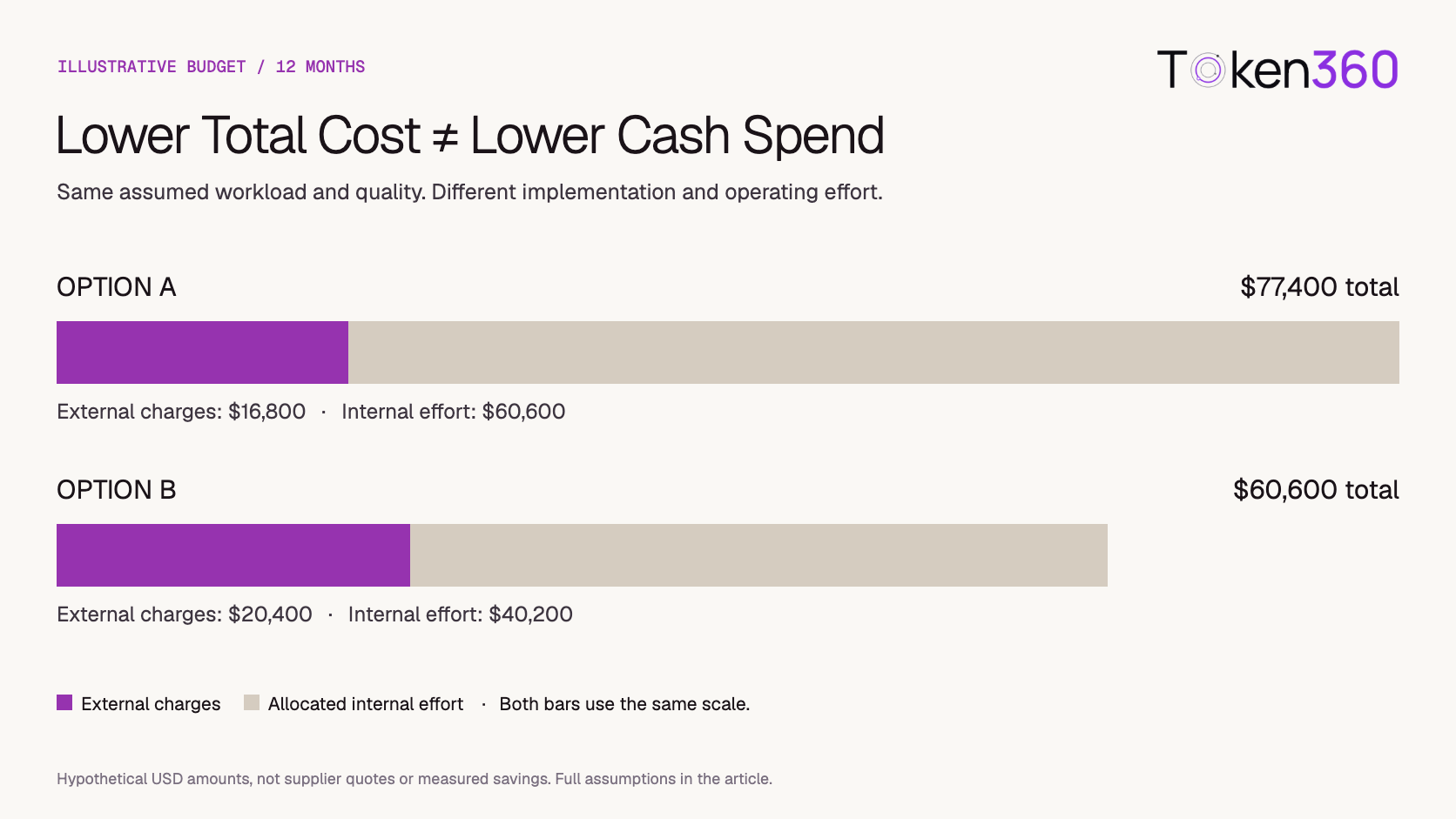
Option B has a $300 higher monthly usage bill, or $3,600 more over the year. Under the stated assumptions, its lower implementation, operation and change effort more than offsets that difference. The total is $16,800 lower. That result depends on the assumed effort differences; no measured supplier advantage is implied.
Constructed 12-month example. The lower planning total and the lower external cash requirement belong to different options.
If both integrations took the same effort, this example would no longer establish the same advantage. Before using a similar calculation to buy a service, validate the implementation estimate and the recurring staffing assumption. Do not assign an arbitrary “integration saving” to the option you prefer.
Why are project cost and cash spending different?
A planning total can include the value of existing employees’ time even when that time does not create a new payment. Keep that resource view separate from incremental cash spending. Both can inform a decision, but freeing staff capacity is not automatically a reduction in payroll or an immediate saving on the bank statement.
In the hypothetical example, external charges are only model usage and supporting services. Option A requires $16,800 over 12 months: ($500 + $900) × 12. Option B requires $20,400: ($800 + $900) × 12. Its external spending is higher even though its total resource estimate is lower.
The remaining totals—$60,600 for A and $40,200 for B—represent allocated internal effort. If the company uses contractors or makes additional hires instead, reclassify those amounts accordingly. The arithmetic must describe the actual purchase decision, not assume every hour has the same cash effect.
Keep three views distinct:
Cash requirement: what additional payments the project needs and when they occur.
Resource requirement: what internal people and shared services the project consumes.
Business value: what the delivered work achieves, assessed separately from the cost total.
This is a planning distinction, not an accounting-policy recommendation. Use your finance team’s rules for capitalization, depreciation and internal allocation. Also separate spending already incurred from future avoidable costs when comparing a change with staying on the current system.
Which assumptions can reverse the comparison?
Test the assumptions that differ between options and those most exposed to change. Adoption, output length, calls per task, review effort and implementation time can all affect the result. Use a small set of explicit scenarios, showing what changes in each, rather than applying one unexplained contingency percentage to the whole project.
For a new application, fewer active users may reduce consumption without reducing the initial build. Greater usage may increase API and review costs together, while some supporting costs remain steady until a capacity step. Do not multiply every line by the same growth factor unless the underlying resource actually scales that way.
Uncertainty
Scenario to calculate
Evidence that improves it
Adoption
Fewer, expected and more completed tasks
Active usage observed across a representative pilot
Calls and output size
Different call counts or output lengths for each task type
Request records, including rework and billed retries
Review effort
More correction or exception handling than expected
Timed review of representative outputs
Implementation effort
A delayed integration or additional required connector
Technical discovery and an owned delivery estimate
Change requirements
A model or interface change within the planning period
Known dependencies and a scoped retest/migration plan
Keep overlapping uncertainty out of the spreadsheet. If “calls per task” already includes expected retries, do not add the same retries again as a separate allowance. If maintenance staff handle routine prompt changes, do not also count that work in an undifferentiated annual change reserve.
For the usage line, Token360’s billing documentation distinguishes estimates from final measured charges and identifies model-specific billing units. Use measured charges where available; retain assumptions where they are not. A model’s upstream public rate is not automatically the price of your Token360 route.
What changes when you buy through Token360?
Token360 supplies access to text, image, audio and video models, with enterprise pricing and production requirements scoped to the engagement. That can change the supplier and integration work your company needs to manage. It does not remove your application, data preparation, review or operating responsibilities, and it does not prove lower total cost.
Token360 does not charge a separate service fee alongside model usage charges, as confirmed by the company for this article. That is a statement about the charging structure. It does not mean inference is free, every model uses its upstream list price, or the rest of your project has no cost.
Ask which work the proposed arrangement actually covers. Is support limited to API access, or is a specific integration activity included? What capacity or service commitment is agreed? Which tasks stay with your team? Record the answers against your cost lines instead of crediting an undefined managed-service benefit.
As checked November 9, 2026, the enterprise page lists custom enterprise pricing and distinguishes current capabilities from roadmap or sales-scoped items. Confirm any support or capacity requirements for your engagement. Do not treat a roadmap entry as an included service.
The right comparison is the same workload under the actual offers available to your company. Keep the model usage quote, implementation scope and internal staffing estimate together, while preserving their separate owners and assumptions.
What should the final cost worksheet contain?
The worksheet should make the comparison auditable: one cost item per row, a stated period and currency, an owner, an evidence source and a treatment for cash versus internal effort. Include an explicit exclusions list. The person approving the project should be able to trace a total back to the assumptions behind it.
Download the AI API TCO worksheet. It is a blank planning template, not a supplier quotation. Record one-time amounts separately from recurring monthly estimates, and add scenario-specific costs only when they are relevant to the period you are comparing.
Cost item,One-time amount,Monthly amount,Months in scope,Other planned amount,Currency,External payment or internal allocation,Owner,Evidence or assumption,Already included elsewhere?,Scenario
Model usage,,,,,,,,,,
Initial implementation,,,,,,,,,,
Supporting application services,,,,,,,,,,
Operation and maintenance,,,,,,,,,,
Human output review,,,,,,,,,,
Planned change or retirement work,,,,,,,,,,
Before approving the comparison, check that shared costs are allocated once, internal hours use the agreed rate, and quantities match the proposed delivery scope. If a supplier quote already includes a service, do not add its underlying cost again. If an item is unknown, keep it visible with an owner and a next step.
Once you know the total cost, use the AI API chargeback guide to decide which teams should carry direct usage and shared expenses.
What else should buyers know about AI API TCO?
Total cost of ownership is useful when its boundary stays explicit. It can support a supplier decision, but it cannot prove application quality or business value by itself. Use the same acceptance conditions across options, keep unknowns visible, and update the estimate when the workflow, adoption or commercial terms materially change.
Is the cheapest token price always the cheapest option?
No. It is one input to the usage calculation. A fair decision also needs the number of calls and accepted tasks, the surrounding services and the effort required to build and operate the workflow.
Should an API buyer include foundation-model training costs?
Not as a separate buyer cost unless the project actually purchases or performs that work. Do not add a model publisher’s underlying costs to the API bill. Include your own tuning or data-preparation work only if it is part of the agreed solution.
How should we include human review?
Estimate or measure reviewer time for the intended workflow and apply your agreed internal cost basis. Keep output review separate from maintenance. If review is already included in a contracted service or another staffing line, do not count it twice.
Does no service fee mean there are no other costs?
No. Token360’s no-separate-service-fee position does not remove model usage charges or your company’s application and operating costs. Check the actual quote and your own project scope.
How often should we update the estimate?
Review it when material assumptions change, such as usage, model mix, review effort, an integration requirement or supplier terms. Use a scheduled review appropriate to the project as well; do not wait for an annual procurement decision to notice a changed operating model.
Read next: use AI API cost management to move from a planning estimate to operational ownership and controls. Bring your workload and scope to the Token360 enterprise team for an engagement-specific discussion.
Prepared by Yuki Yu for Token360. Sources checked November 9, 2026. The sample figures and worksheet are editorial tools; no real supplier comparison, customer saving or industry-average cost share is claimed.
Enterprise AI
API
Bring your next idea to life.
Create a video scene in Creator, or explore models for images, audio, and text to find the right capabilities for your project.


 Guides
 Guides
 Guides