How Do I Know Which AI Model My API Is Actually Using?
Verify AI model identity with agreed versions, routing records, and upstream correlation. Learn what model labels and output tests can—and cannot—prove.
ENTERPRISE TRUST · MODEL VERIFICATION
To verify which AI model handled a request, compare the agreed model and version with the submitted request, the resolved route, and records that can be correlated with the upstream service. A model name in a dashboard or response is useful metadata, but it is not independent proof of execution. Output quality, speed, and price are not proof either.
An enterprise customer may ask: “If we select Seedance, how do we know the service did not use a different, cheaper video model?” This is a legitimate procurement question about model identity, authorized changes, and evidence. It is not an allegation that Token360, Seedance, or any named provider has substituted a model.
This guide explains what to request, what different evidence can establish, and what Token360's public documentation currently confirms. It applies to creative production teams buying video generation, SaaS companies embedding inference, and enterprise procurement and security teams.
Evidence boundary: Public documentation reviewed November 15, 2026. No production routing audit or model-substitution experiment was performed. Suggested controls and evidence fields below are buyer requirements to confirm, not a claim that Token360 currently exposes every field or implements every control.
Specify the model family, version or release, service variant, and any approved alias behavior. Also identify whether the requirement concerns the model itself, a particular hosting provider, or both. A public product name can be mapped to a provider-specific identifier, so different strings do not automatically mean a different model.
“Seedance” alone may be too broad for a production agreement. The buyer should identify the catalog entry and relevant version or tier, along with the expected generation mode and capabilities. A faster variant or draft mode should not be assumed equivalent merely because it belongs to the same family.
A mapping record should explain how the public ID relates to the upstream model or deployment at the time of the request. Where a vendor uses a rolling alias rather than a fixed release, ask what may change and how the buyer will learn about it. For naming conventions, see AI model ID suffixes.
Is changing the provider the same as changing the model?
No. A platform may route the same offered model through different eligible service providers. Cross-model substitution means selecting a different model, while an alias update may change the version behind a public name. These are separate events. Each can matter to an enterprise, but they require different policies and evidence.
Event
What changes
Buyer question
Provider route change
Service route hosting or serving the offered model
Is this route approved for our workload and data requirements?
Alias or version update
The release behind a product-facing identifier
Is the new mapping permitted, disclosed, and evaluated?
Cross-model fallback
The model used after the preferred model cannot serve
Which alternatives have we authorized, and how is their use recorded?
Unapproved substitution
A model outside the agreed policy
How is it prevented, detected, and investigated?
OpenRouter documents provider selection separately from fallbacks between models. That distinction is useful when asking questions across platforms; it does not mean their request fields or behavior apply to Token360. Do not copy routing parameters between APIs without checking the selected endpoint's documentation.
Provider selection can also affect data handling and operations even where model identity is unchanged. Treat identity assurance and approval of the data-processing route as related but separate checks. The general model routing guide covers routing choices; this article covers the evidence behind a specific execution.
What do Token360's public documents actually say?
Token360 documents public model identifiers and eligible upstream routing, but the public pages reviewed do not establish a complete customer-verifiable proof of model execution. They also do not provide an explicit blanket promise, in the wording reviewed, that cross-model changes can never occur without customer consent. Confirm the applicable policy and evidence scope directly.
The routing documentation describes resolving a public model name to an eligible upstream route. It distinguishes a product-facing identifier from an upstream deployment or account. It also describes session-affinity controls; these should not be treated as a universal video-model identity lock.
The same routing page describes allow_fallbacks=false in the context of a remembered affinity preference. If no preference exists, it says the request still uses the normal candidate set. Therefore, sending that field is not by itself evidence that a particular upstream was used on the first request. Check endpoint and model applicability instead of assuming it prevents every kind of change.
For the documented text endpoints, response compatibility documentation says Token360 normalizes the public model name and removes provider-private routing and diagnostic metadata from the public payload. This explains why a returned public name should not be treated as a raw upstream attestation. Media APIs have their own contracts; do not assume identical response behavior across modalities.
The video submission reference documents a task ID and a response model field. These are useful for correlating a submitted generation with its result, but a field definition alone does not establish how independently its value can be verified.
Token360's Terms of Service describe routing to third-party offerings. Its Privacy Policy lists model identifiers and usage metadata among information generated through use. Neither statement alone establishes customer access to raw upstream logs or an independently verifiable execution certificate. This review describes published information, not a legal interpretation of a particular customer's agreement.
Which evidence is useful, and what are its limits?
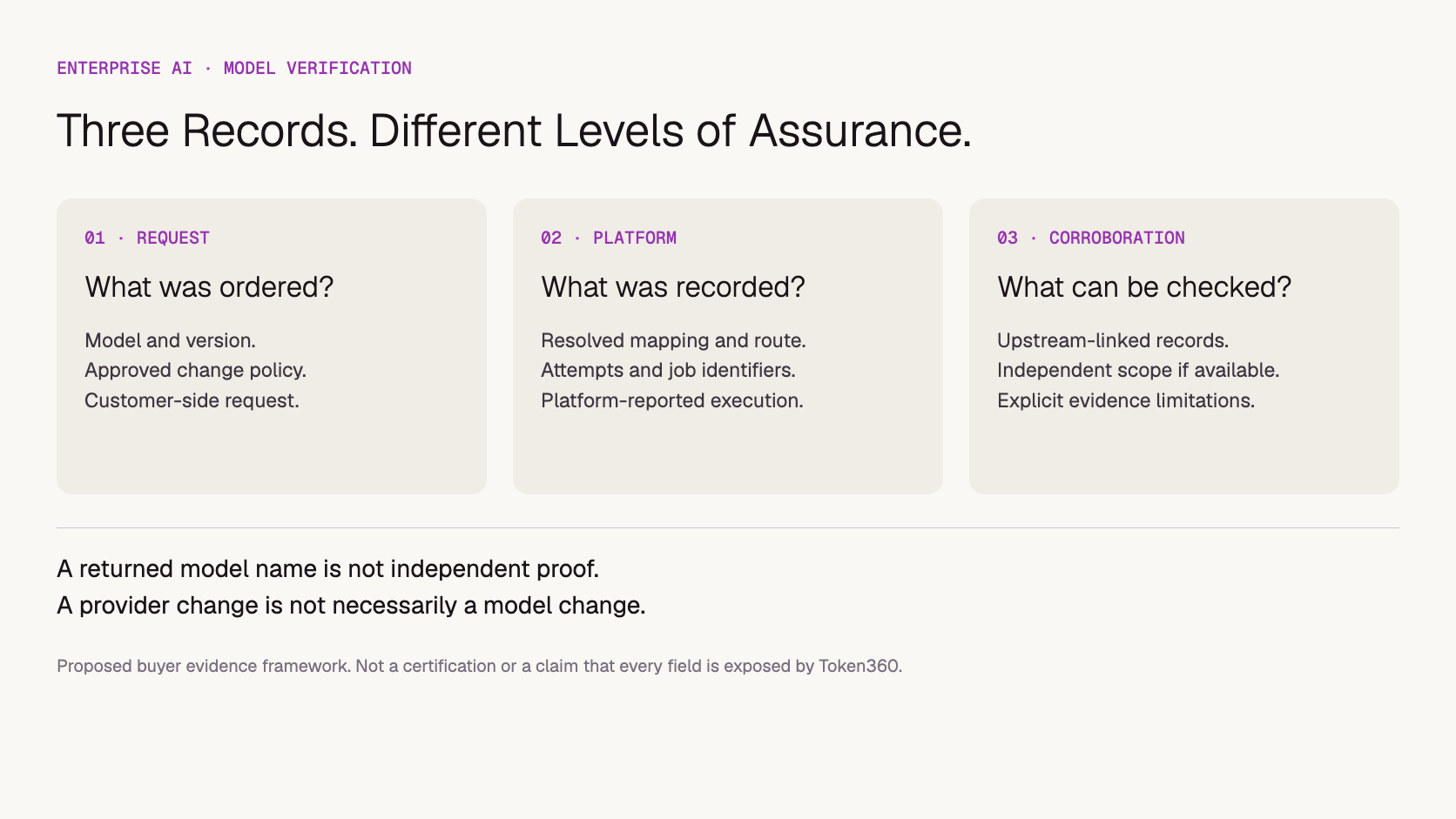
Use several linked records rather than relying on one label. Customer-side requests establish what was asked for; platform records describe how it was handled; upstream-correlated records can strengthen the connection to execution. The confidence depends on who produced the evidence, whether it can be independently checked, and how it is protected from alteration.
Evidence
What it helps establish
What it does not establish alone
Saved request and configuration
The model and policy requested by the customer
Which backend actually executed it
Response model and task ID
The service's reported identity and correlation handle
Independent verification of the backend
Platform route/attempt record
Recorded alias resolution, route selection and retries
Truth beyond the platform's own records
Upstream request or job correlation
A link to records from the serving service
Cryptographic proof of the exact weights used
Independent assurance or attestation, if available
The specific controls or execution claims it actually covers
All requests, models, or periods outside its scope
OpenTelemetry's GenAI attribute registry distinguishes requested-model and response-model attributes. That is a useful observability pattern, not a verification service. Recording a value with a standard attribute name does not authenticate the value.
Likewise, hashing a downloaded video can establish whether that saved file has changed relative to the recorded hash. It cannot establish which model generated the video. Keep file integrity, event correlation, and model identity as separate claims.
Evidence should become more corroborated, not merely repeated across fields owned by the same system.
What should a Seedance verification request include?
For a selected video job, preserve the exact catalog ID, request time, relevant parameters, platform task ID, final status, and retained output reference. Then ask whether the service can correlate that task with the upstream model mapping and job record under the agreed disclosure process. Mark unavailable evidence explicitly rather than treating it as a match.
A practical review request can ask:
Which model version or service variant did this public ID represent at that timestamp?
Which route handled the job, and which identifiers can be shared or reviewed under confidentiality?
Were there retries, route changes, or model changes across attempts?
If another model was used, which policy authorized it, and how was it disclosed and billed?
Which part of the explanation can be corroborated beyond a platform-generated label?
Do not attach API keys, unrestricted signed URLs, or confidential prompts to a public support ticket. Start with non-sensitive identifiers and use an agreed secure channel for additional evidence. A provider may have legitimate limits on exposing internal identifiers; document the substitute assurance offered and decide whether it satisfies the buyer's requirements.
The blank model identity evidence register records requested, reported, mapped, and corroborated identity separately. It is a proposed procurement worksheet, not a Token360 API schema or a completed audit.
Can visual quality, timing, or a test prompt prove identity?
No single output-style test, latency observation, or self-identification prompt proves which model executed a request. Such tests can reveal an anomaly worth investigating, but different configurations and normal output variation can affect behavior. A model saying “I am model X” is generated content, not independent execution evidence.
A video that looks worse than expected does not establish substitution. Different reference images, prompts, duration, resolution, optional processing, or service variants can affect a comparison. Conversely, a convincing video does not prove the expected model was used.
Lower pricing also does not establish that a cheaper model was substituted. A negotiated commercial rate and the identity of the executed model are different questions. Check the quoted SKU and usage record, but do not infer model identity from the amount charged.
If a controlled comparison reveals a persistent change, preserve the inputs and configurations and ask for trace investigation. Use quality-regression analysis for evaluating output changes. Do not present that evaluation as definitive forensic identification of a backend.
What policy should an enterprise agree before production?
Agree which models and versions are allowed, what counts as an acceptable route change, what happens when the selected service is unavailable, and what records can be reviewed. These decisions make a verification request actionable. A general assurance of quality does not answer whether an alternative model is authorized.
For workloads requiring the selected model, ask whether the service can return an error rather than use an unapproved alternative. For workloads permitting alternatives, specify the list, approval process, disclosure, billing treatment, and evaluation requirements. Confirm the actual enforcement mechanism and its scope; do not infer it from a sales statement or an untested request field.
Also define the evidence retention window, investigation contact, response expectations, and handling of discrepancies. These are topics for procurement, technical, and legal owners to agree, not ready-made contract language. An assurance report only supports the controls and period it covers; it should not be described as proving model identity for every request.
Token360 focuses on enterprise access to text, image, audio, and video models, with commercial and contractual requirements scoped to the engagement. The enterprise page provides the discussion entry point. The current public material reviewed does not justify advertising universal upstream-log access, immutable routing logs, or a certified non-substitution guarantee. See Token360 company information for broader context.
How should a discrepancy be investigated?
First determine whether the mismatch concerns naming, an approved alias update, a route change, or a different model. Correlate the specific request and all relevant attempts. Preserve records and ask for an explanation before attributing intent. If evidence remains unavailable, describe the result as unverified rather than inventing either a pass or a violation.
For example, different public and provider IDs may be explained by a documented mapping valid at the request time. A response naming an unexpected model requires checking the authorized policy and upstream evidence. A missing upstream identifier is an evidence gap; it does not on its own prove substitution.
Record the conclusion, evidence source, limitations, corrective action if needed, and who accepted it. A sampled audit only supports the sampled scope. Wider assurance requires appropriate ongoing controls and a review plan, not extrapolation from one successful request.
Frequently asked questions
Does the returned model name prove Seedance was used?
It records the service's reported model identity. For stronger assurance, correlate the task with mapping and execution records. Check how the endpoint populates that field and whether independent corroboration is available.
Is a different upstream provider evidence of a different model?
Not necessarily. A model can be offered through multiple service routes. Verify the mapping and approved provider scope rather than equating a provider change with a model change.
Can I disable all substitutions with one API parameter?
Do not assume so. A fallback field may govern only a particular routing layer. Token360's documented affinity behavior has specific prerequisites and scope; it is not a universal video-model verification control.
Does Token360 publicly guarantee no unapproved model substitution?
This review did not find an explicit blanket guarantee in the public pages examined. That is a documentation finding, not evidence of substitution. Confirm the applicable policy and available evidence for the engagement before making that claim.
Does a security certification prove the model behind each request?
Only if its actual scope supports that precise claim. General security assurance and request-level model identity are different matters. Review what the assurance covers rather than relying on a badge.


 Guides
 Guides
 Guides