Move an AI pilot to production when business value, review capacity and operating readiness support a defined rollout. Use a practical decision record.
ENTERPRISE AI · ROLLOUT DECISIONS
Move an AI pilot into production when a defined workflow delivers useful results, the team can handle review and exceptions, and the next rollout has an agreed owner, budget and stop condition. A convincing demo earns further evaluation. Expansion needs evidence that the complete service can support real users.
This is a proposed decision framework for enterprise teams, informed by the primary sources linked below. The worked example is hypothetical; it is not a Token360 customer result or a model benchmark.
Read first: use the AI model evaluation framework to assess candidate outputs. This article addresses the next business decision: whether to expand an already tested workflow.
What does an AI pilot need to prove before expansion?
An AI pilot needs to show that a specific group of users can complete a specific task more effectively under the proposed operating conditions. Define the task, the current process and the acceptable outcome before interpreting results. More generated answers, images or clips do not by themselves establish business value.
Consider a customer-service team drafting replies, a marketing team preparing product images, or an operations team extracting fields from documents. Each can demonstrate attractive model outputs. Each also needs a separate answer to “What happens between the generated output and the completed work?” Review, corrections, rejected attempts and manual exceptions belong in that answer.
Google Cloud’s business-use-case guidance starts with measurable business goals and works backward to technology and workflow changes. For an expansion decision, turn that principle into a written boundary:
For this user group and this task, we will increase use only if the complete workflow meets our agreed quality, time, cost and risk requirements.
Specify whether the next stage produces internal drafts, human-approved deliverables or automatic customer-facing actions. Evidence from the first does not automatically justify the third. A useful pilot can graduate to a limited production service without being ready for unrestricted use.
Decision
Evidence that supports it
What happens next
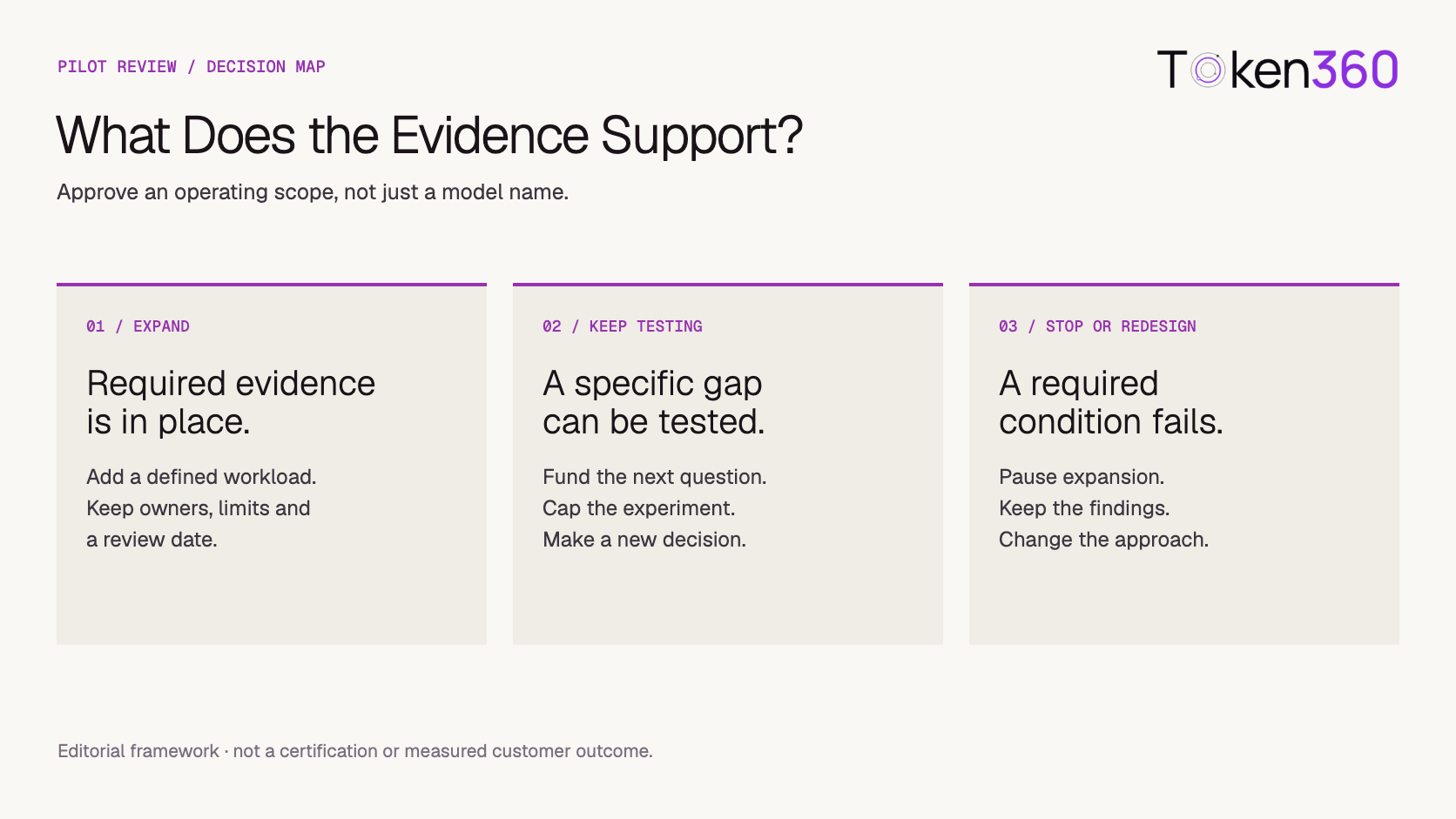
Expand within a defined scope
Required checks pass for that scope; owners and operating resources are in place
Add a named user group or workload with monitoring and a review date
Continue the pilot
A specific uncertainty remains, with a feasible test that can change the decision
Fund that test, set a spending cap and decide again
Stop or redesign
A required condition fails, or no viable route to value is evident
Keep the findings; change the task or return to the existing process
These are proposed decision categories, not an industry certification. Agree on pass conditions before reviewing the final results so the team does not redefine success around its best examples.
Which pilot results should leadership see?
Leadership should see outcomes for the full set of work attempted, including rejected outputs and tasks completed manually. Report what users finished, the quality standard applied, the human effort required and the actual scope tested. Keep unmeasured areas visible instead of treating missing evidence as a passing result.
A compact decision packet is more useful than a gallery of selected successes. Keep the original input set and record exclusions. If the pilot only used short English documents, do not describe it as validated for long multilingual files. If a specialist corrected every result, record that person’s work rather than assuming ordinary users will need the same time.
Question
Evidence to include
Misleading shortcut to avoid
Did the work meet its purpose?
Completed tasks checked against a defined acceptance rule, with failure examples
Counting every generated result as usable
Was it easier for the team?
Review, correction, exception and coordination time
Reporting model response time as total time saved
Can the service handle the next scope?
Results from the intended workload mix and load, with unresolved limits
Multiplying a quiet demo’s throughput by the planned user count
Can someone operate it?
Named business, technical and review owners, plus an escalation path
Assuming the pilot champion remains available indefinitely
What would invalidate approval?
Specific quality, data, spend or availability conditions and who can pause use
Declaring “production-ready” without a boundary
Use “not measured” when appropriate. A pilot may have good quality evidence and incomplete capacity evidence. That should lead to a focused capacity check, rather than either an unconditional rollout or an indefinite experiment.
Use the enterprise AI ROI guide to test whether saved time produces a measurable business outcome before expanding the rollout.
How do you separate time saved from work shifted?
Compare the current process with the entire AI-assisted process, including review and failed attempts. A fast generation can move effort to checking rather than remove it. Record both the reduction in total effort and the remaining workload by role, because a smaller total can still overwhelm the people responsible for review.
The following example uses invented inputs to show the calculation. It assumes the same 100 tasks can be completed to the same standard in either process. It does not estimate API prices, revenue or a financial return.
Hypothetical weekly workload
Calculation
Human time
Current manual process
100 tasks × 6 minutes
600 minutes
AI-assisted tasks accepted after review
80 tasks × 2 minutes of total handling
160 minutes
Rejected AI attempts completed manually
20 tasks × 6 minutes of total handling
120 minutes
AI workflow coordination
Additional weekly overhead
40 minutes
Total AI-assisted human effort
160 + 120 + 40
320 minutes
Time released in this example
600 − 320
280 minutes, or 4 hours 40 minutes
“Total handling” must include the work of checking and rejecting an attempt. If the 20 rejected tasks need extra triage beyond the assumed six minutes, add it. The example’s result becomes smaller. Measure this explicitly rather than hiding it inside a rounded average.
The released time is not automatically cash savings. It may increase capacity, reduce a backlog or improve service. To build a financial case, add actual model usage charges, integration and operating costs, and explain how the released capacity creates value. Do not count both avoided labor expense and the same hours redeployed as two independent benefits.
AWS’s guidance on sustaining generative AI value connects technical measurements with business outcomes and treats value as something to track after launch. That distinction matters when a pilot’s economics change with usage, review needs or user behavior.
What should the first production rollout include?
The first production rollout should expand one explicit boundary while preserving the controls that made the pilot acceptable. Name the additional users or tasks, the review arrangement, the spending limit and the check-in date. Avoid changing audience, model, workflow and autonomy at once, because the earlier evidence may no longer describe the new service.
For a reply-drafting assistant, the next step might be one support queue with mandatory approval before sending. For generated product imagery, it might be one asset category with brand review before publication. For document extraction, it might be one known document family with exception handling. These are proposed scopes, not customer deployments.
A proposed decision map. Missing required evidence leads to a focused test; a failed required condition calls for a pause or redesign.
Keep a route back to the existing process. Specify who can pause new work, how pending work will be handled, and where users should go for help. Do not label a transition reversible unless that route has been checked. A manual fallback that needs more staff than are available is a dependency, not a completed safeguard.
AWS’s launch-stage guidance emphasizes selected production applications, operating responsibilities, monitoring and human oversight. The practical implication here is to approve an operating scope, not simply a model name.
What should you confirm with your AI API supplier?
Give the supplier the proposed production workload rather than only the pilot’s average usage. Confirm the intended models, traffic pattern, output requirements and commercial scope. Ask which capacity and support arrangements are actually agreed for this rollout, and distinguish those commitments from catalog availability or features discussed for a future release.
For Token360, this conversation can cover text, image, audio and video access, negotiated pricing and project-specific production requirements. It does not replace your team’s quality checks, application integration or acceptance decision. Confirm the exact API and model capabilities before expanding the workload.
Workload: model IDs, input sizes, expected output sizes or media duration, and the mix of interactive and background work.
Demand: normal volume, peak bursts, timing of the rollout and how much uncertainty remains in the forecast.
Service requirements: acceptable waiting time, concurrency needs, support contacts and what happens when the intended route is unavailable.
Commercial scope: quoted usage rates, any agreed capacity, term and change process; do not assume an experiment’s purchase arrangement covers the next stage.
Data scope: the approved data categories and processing requirements for the production task, including any change from pilot inputs.
As checked on November 9, 2026, the Token360 enterprise page distinguishes current capabilities from roadmap and sales-scoped offerings. Custom enterprise pricing is listed as available; priority support and SLAs appear under a roadmap item marked “Coming Soon.” Obtain the terms for your engagement rather than treating a discussion as a standard entitlement.
For integration preparation, the Token360 API overview describes model access and request metering, while the model capability guide identifies the parameters to verify for a chosen model. Those pages support implementation planning; they do not certify a particular business workflow as ready.
Who should sign off on expansion?
Expansion needs an accountable business owner and explicit acceptance from the people who will operate the service. Assign ownership for outcome quality, technical operation, human review, spend and any required data or security approval. One person can hold several roles in a small team, but no essential responsibility should remain implicit.
Use a short decision record instead of relying on a launch meeting alone. The record should say what is approved, what remains excluded and what evidence would trigger a fresh review. Model substitutions, new languages, sensitive data and a move from drafts to autonomous actions may require reassessment, depending on the agreed scope.
Decision-record field
What to write
Approved workflow
Task, user group, inputs, outputs and required review
Evidence and gaps
Test period, workload boundaries, accepted results, rejected cases and unmeasured requirements
Operating owner
Person responsible for service quality, exceptions and user communication
Expansion boundary
What increases now, what stays unchanged and what remains out of scope
Resources
Usage budget, reviewer availability and confirmed supplier arrangements
Pause and review
Who may stop new work, the trigger, recovery path and next decision date
Download the blank pilot-to-production decision record and fill it with your own evidence. It is an editorial worksheet, not a Token360 approval form or a guarantee of production readiness.
Field,Your evidence or decision,Owner,Review date
Workflow and business outcome,,,
Current process baseline,,,
User group and task mix,,,
Quality acceptance rule,,,
Results and rejected cases,,,
Review and exception effort,,,
Actual usage and operating costs,,,
Untested conditions,,,
Next rollout boundary,,,
Supplier arrangements confirmed,,,
Pause trigger and fallback,,,
Final decision: expand / targeted test / stop,,,
What else do enterprise teams ask about scaling an AI pilot?
The common decision is how far the evidence justifies expanding, rather than whether AI has passed a universal readiness test. Duration, quality thresholds and review requirements depend on the task and the consequences of failure. Keep unanswered questions attached to a named next action so they do not disappear after a successful demonstration.
How long should an AI pilot run?
Long enough to examine the expected task mix and operating conditions, including relevant peaks and exceptions. A calendar duration alone is not a readiness criterion. Define what evidence is needed and when the team will decide whether to expand, test a specific gap or stop.
Does a high model accuracy score mean we can launch?
No. Check what the score measured and which errors matter. You also need evidence about the full workflow, human review, operating capacity and the proposed user scope. The expansion decision should use the model evaluation without treating it as the entire business case.
Should we buy dedicated capacity before the pilot ends?
Do not infer that need from a successful demo. Bring expected load and service requirements to the supplier, check whether the available arrangement meets them, and evaluate any proposed capacity commitment against the workload you actually plan to run.
Can we expand if some outputs still need human review?
Yes, a human-reviewed service can be the intended production design. The review must be staffed, measured and included in the operating cost. Approval for that design should not silently become permission for outputs to reach customers without review.
Does using Token360 make the application production-ready?
No. API access is one component. Your team still owns application behavior, output acceptance, user experience and the decision to expand. Discuss the supplier-side requirements through the enterprise process and record what has actually been agreed.
Read next: turn the proposed workload into a supplier discussion using the Token360 enterprise page. If output quality is the unresolved condition, return to the model evaluation framework before expanding.
About this article: written by Yuki Yu for Token360. Sources checked November 9, 2026. The decision categories, worksheet and numerical example are editorial proposals; no customer deployment, live load test or measured savings is claimed.
Enterprise AI
API
Bring your next idea to life.
Create a video scene in Creator, or explore models for images, audio, and text to find the right capabilities for your project.



 Guides
 Guides
 Guides