Enterprise AI API Quote: What Usage Data Should You Send?
Prepare an enterprise AI API quote with model mix, monthly usage, peak demand and procurement requirements. Includes a four-modality workload template.
ENTERPRISE PROCUREMENT · BLOG 146
By Token360 · Editorial review: November 5, 2026
To request an enterprise AI API quote, send a workload brief: the models and tasks you need, monthly usage in the relevant units, peak demand, completion targets, data requirements and purchasing conditions. Separate measured usage from forecasts. A monthly budget alone does not describe the service you need priced.
An email saying “we expect high volume—what is your best price?” starts a conversation, but leaves most of the scope unresolved. Two teams can submit the same number of requests and need very different model configurations, turnaround times and capacity arrangements. A useful brief makes those differences visible before anyone compares discounts.
This article provides a reusable buyer-side template and a worked planning example. The example is hypothetical: it is not a customer account, a measured benchmark or a Token360 quote.
Read first: Token360’s model capability documentation identifies the model settings and billing units to verify before estimating a workload.
What is the minimum information needed for an enterprise quote?
A first quote request should identify the workload, expected scale, timing constraints and commercial scope. For each task, name the model or selection criteria, record the input and output settings, estimate monthly usage and describe the busiest period. Add the launch date, mandatory data conditions and the person responsible for procurement.
Field
What to send
Why it matters
Workload and model
Task, model ID/version if selected, acceptable alternatives.
Defines what the supplier is pricing.
Input and output
Typical sizes, duration, resolution, audio settings or token lengths.
Prevents different configurations from looking comparable.
Monthly volume
Observed usage plus low/base/high forecasts, each with units.
Separates current demand from uncertain growth.
Peak demand
Requests per minute, burst duration, concurrent jobs and time zone.
Shows traffic concentration hidden by monthly totals.
Service target
Interactive response target or batch completion deadline.
Defines acceptable waiting rather than simply asking for “fast.”
Data and procurement
Required geography, retention questions, payment preference, contract term and launch date.
Surfaces conditions that could change availability or scope.
These are relevant questions across suppliers. As checked on November 5, 2026, fal’s FAQ asks high-volume customers to contact sales with expected usage for invoice billing and custom pricing. OpenRouter’s enterprise page describes workload- and volume-based quotes. Neither source establishes a universal spend threshold at which every buyer qualifies for the same terms.
How should you describe text, image, audio and video usage?
Keep each modality in its own units before converting it to money. Text workloads need input and output token estimates; image workloads need generation counts and settings; audio and video workloads need duration and configuration. Confirm the selected model’s actual billing meter instead of assuming every provider prices a modality the same way.
Workload
Useful demand record
Configuration to preserve
Text
Calls, input tokens, output tokens; cached and reasoning usage if applicable.
Model version, typical and long-context requests, output limits.
Image
Requests and number of generated images, including extra variants.
Resolution, quality, reference inputs, generation versus editing.
Audio
Input/output duration or characters/tokens, as relevant to the model.
Transcription, speech, music or effects; language, channels and format.
Video
Submitted generations, requested duration and output count.
For a text task, “one million requests” is incomplete if some requests contain a short sentence and others carry a document. For video, “ten thousand clips” leaves open whether each clip is six seconds or twenty seconds, and whether the count refers to all attempts or only approved assets.
Preserve the distinction between a business deliverable and a generation attempt. If a team needs 1,000 approved images, ask how many candidate images it actually generates to obtain them. Where that ratio is unknown, label it as an assumption and quote scenarios rather than presenting it as measured demand.
The Token360 model schema and capability guide is the reference for supported settings and model-specific billing meters. The workload template below records demand; it does not replace a model rate card.
Why is monthly usage insufficient for capacity planning?
Monthly usage describes total work, while peak demand describes when that work arrives. A supplier needs both to assess the requested service. Spreading requests across a month is different from submitting them during a campaign window. State arrival rate, burst duration and the completion deadline separately, without treating any of them as guaranteed throughput.
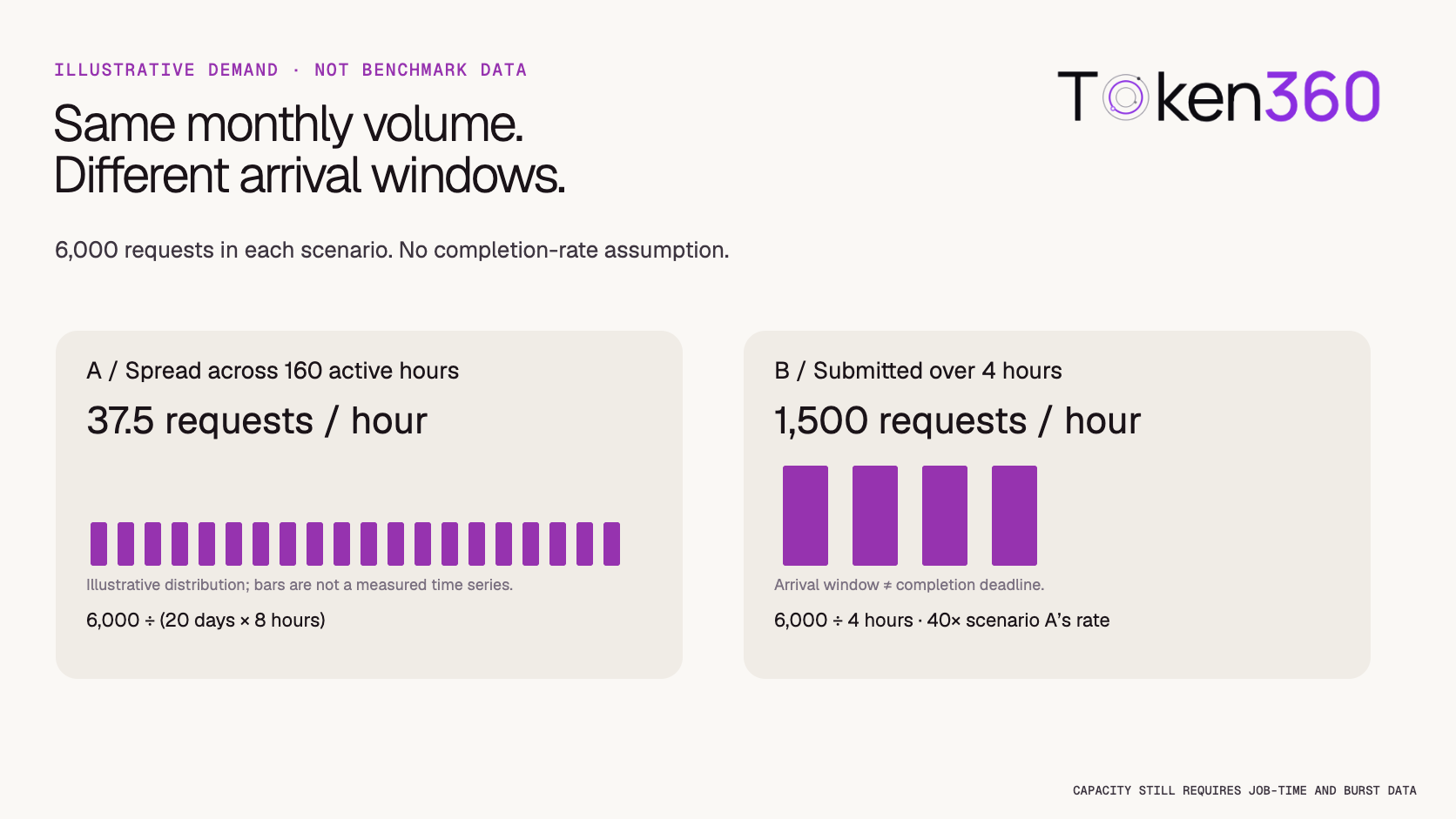
Illustrative arithmetic, not performance data. The same 6,000 requests imply a 40× difference in average arrival rate across these active windows.
Suppose two teams each plan 6,000 video-generation requests in a month. Team A submits them across twenty eight-hour working days: 6,000 ÷ 160 = 37.5 requests per active hour. Team B submits the same volume during a four-hour event: 6,000 ÷ 4 = 1,500 per hour. That is a 40× difference in average arrival rate within the stated windows.
This calculation does not identify the required concurrency, GPU count or achievable completion time. It also hides shorter bursts inside each hour. The brief must say whether the four-hour window is an arrival window, a deadline for finished outputs, or both. Actual job durations and queue behavior are needed for a capacity assessment.
If you do not have peak measurements, describe the business trigger: for example, a batch uploaded at 09:00, an evening campaign launch or a customer-facing feature used throughout the day. Ask the supplier to state the assumptions behind any proposed capacity arrangement.
What if the product has not launched yet?
A pre-launch estimate can support an initial discussion if its assumptions are visible. Provide low, base and high scenarios, explain what drives each one, and mark unknowns. Do not treat a forecast as a purchase commitment. Ask which parts of an indicative quote require pilot measurements before the supplier can confirm them.
A simple planning model starts with business activity: active users × tasks per user × model calls per task. For media, separately estimate the number of candidates requested per task. Keep optional retries or creative revisions separate from the base estimate so they are not counted twice.
Record the evidence behind each input. “Measured during a two-week pilot” is different from “estimated by the product team.” A launch forecast should name its owner, date and review point. If usage is especially uncertain, ask the supplier to show how the proposal changes across your scenarios rather than asking for one apparently precise annual number.
A pilot can replace assumptions about input size, output length and demand concentration with observations. It does not automatically validate future volume or justify a long-term commitment. The commercial decision still depends on the launch plan and the terms offered.
What does a complete multimodal workload brief look like?
A useful multimodal brief has one row per workload, with an explicit time period and configuration. The example below describes a hypothetical content operation over one month. It makes the arithmetic inspectable while leaving model selection and prices open. Its numbers should not be interpreted as recommended minimums or likely customer usage.
Example workload
Assumed monthly activity
Derived demand
Product copy
100,000 calls; average 2,000 input and 400 output tokens per call.
200 million input tokens and 40 million output tokens. No cache discount assumed.
Product imagery
2,000 briefs; four candidates per brief; one image per request.
8,000 image outputs/requests at the specified resolution.
Voiceover
500 requests; one 30-second output per request.
15,000 output seconds = 250 minutes. Billing unit still needs confirmation.
Product video
3,000 briefs; two candidates per brief; one eight-second output per request.
Attach the missing conditions: selected models, image resolution, video audio setting, arrival schedule and acceptable completion time. Requested output seconds are planning units here; they are not a claim that all outputs complete successfully or that every model bills exactly that quantity.
The candidate multipliers are already included in these totals. Do not add a second generic “revision buffer” without explaining what new work it represents. Ask the supplier to identify how unsuccessful requests, partial results and additional services would be treated under its actual terms.
Which fields can you copy into an inquiry?
Use the following brief as a starting point, completing only what you know and marking the rest unknown. Send aggregate workload information and sanitized examples rather than production credentials or confidential inputs. The objective is to let technical and commercial teams discuss the same scope without requiring a full production-data export.
Copy the worksheet below into a local CSV file. Blank fields are for your own review:
Section,Field,Your response,Guidance
Project,Company / project,,Name the purchasing entity and application.
Project,Owners,,Technical and procurement contacts.
Project,Launch date,,Include dependencies and forecast revision date.
Workload — duplicate per task,Task / modality,,"Text, image, audio or video; explain business output."
Workload,Model,,Exact ID/version or selection criteria; alternatives allowed?
Workload,Configuration,,"Input/output lengths, resolution, duration, audio, references."
Workload,Observed usage,,"Unit, measurement period and evidence source."
Workload,Low / base / high forecast,,Monthly volumes with units; do not mix tokens and media counts.
Workload,Peak arrivals,,"Rate, burst duration, time zone and arrival window."
Workload,Concurrent jobs,,Observed or unknown; not inferred from monthly volume.
Workload,Service target,,Response target or output deadline; desired versus mandatory.
Workload,Variants and retries,,State what is already included; avoid double counting.
Workload,Evidence level,,Measured / estimated / unknown; owner of assumption.
Shared,Data requirements,,"Geography, retention, permitted inputs; mandatory versus preferred."
Shared,Review documents,,Security/procurement evidence requested.
Shared,Commercial scope,,"Term, payment preference, acceptable commitment, validity requested."
Shared,Support,,Required coverage and response expectations; subject to agreement.
Supplier response,Metering / configuration,,Priced units and exact included settings.
Supplier response,Fees / exclusions,,"Commitment, overage and excluded work."
Supplier response,Capacity / open questions,,Confirm scope and unresolved dependencies.
. Open it in Excel or another spreadsheet app; it includes blank response cells and field guidance, without macros.
Company / project:
Technical owner / procurement owner:
Target launch date / forecast revision date:

For each workload:
- Business task and modality:
- Model ID/version, or selection criteria:
- Input and output configuration:
- Observed usage and measurement period:
- Monthly low / base / high forecast, with units:
- Peak arrival rate, window, duration and time zone:
- Concurrent jobs observed, if known:
- Response target or completion deadline:
- Candidate/retry assumptions already included:
- Evidence level: measured / estimated / unknown:

Shared purchasing requirements:
- Required data geography and retention conditions:
- Security review documents needed:
- Proposed contract term and payment preference:
- Minimum commitment acceptable to buyer, if any:
- Support and incident-response requirements:
- Requested quote validity and launch dependencies:

Please return:
- Priced configuration and metering definitions
- Assumptions, exclusions and unresolved requirements
- Applicable fees, commitments and overage treatment
- Capacity scope and conditions for confirming it
The template is a buyer-created specification aid, not a Token360 order form or a promise that every requested condition is available. Security, geography, retention and service commitments need explicit confirmation for the proposed arrangement.
How should you use this brief with Token360?
Use the brief to describe the mix of text, image, audio and video inference your business needs from Token360. Separate requirements that are mandatory from preferences that can change. Request a proposal tied to that scope, including any capacity, pricing or contractual conditions that need individual agreement.
As checked on November 5, 2026, the Token360 enterprise page describes custom pricing based on volume, model mix and production requirements. It also identifies contact-sales or roadmap items separately. A submitted requirement is not confirmation that a capability or SLA is generally available.
Before accepting a proposal, compare its assumptions with your brief. Check that it prices the same models, settings, usage windows and payment conditions. If the supplier substitutes a model or changes a completion target, ask for the change to be explicit. This article prepares the inquiry; it does not determine the negotiated price.
No. A labelled estimate is useful for an initial discussion. State what is measured, what is forecast and what still needs a pilot. Do not present the estimate as committed spend.
Can I send only my existing monthly bill?
A bill can provide context, but it may omit configuration, traffic peaks and future requirements. Attach a workload breakdown so the new proposal is not based on an unexplained total.
What if I have not selected a model?
Describe the task, required inputs and outputs, acceptance criteria and latency needs. Ask for clearly identified alternatives, with each proposal’s assumptions kept separate.
Does a larger forecast guarantee a lower unit price?
No. The agreed configuration, volume, commitments and commercial terms determine the actual proposal. A forecast alone is not a guaranteed discount or an accepted capacity reservation.
Should I include API keys or raw customer prompts?
No. The inquiry normally needs aggregate measurements and sanitized examples. If further data is required for validation, agree the handling process before sharing it.



 Insights
 Guides
 Guides