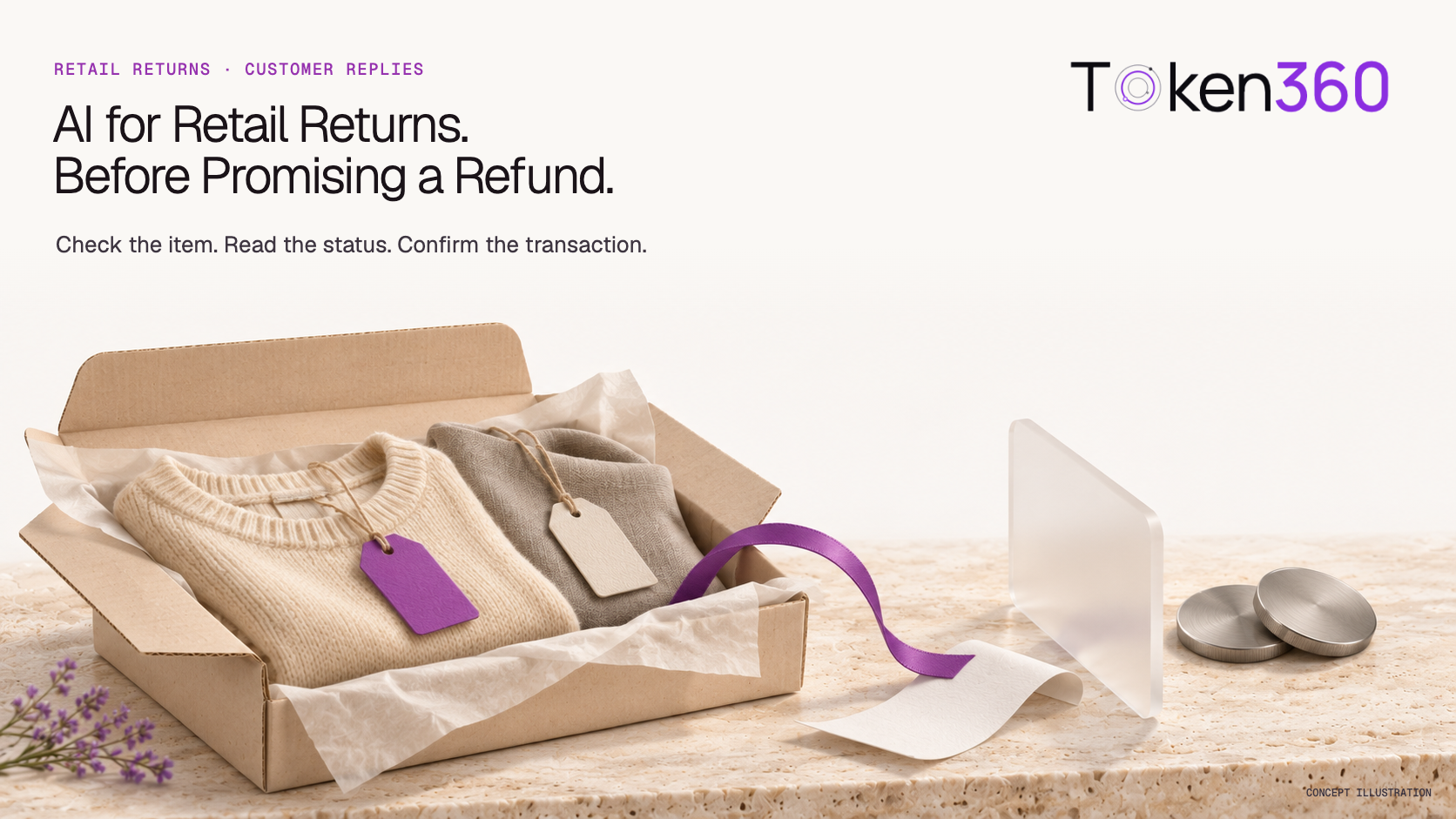
AI for Retail Returns: Check Before Promising a Refund
Use AI APIs for retail return questions. Match the item, return and payment records before promising a refund, exchange or shipment.
INDUSTRY USE CASES · RETAIL RETURNS
Retailers can use AI model APIs to interpret return requests, assemble case summaries and draft status replies. The assistant needs current order, item, return and payment records before making a case-specific statement. A return request, a received parcel and an issued refund are different events; a helpful reply should explain the verified state without inventing approval, payment or an arrival date.
For retail brands and ecommerce operations teams, the risk is not limited to an incorrect policy answer. An assistant can quote the correct general policy while applying it to the wrong item, overlooking a partial refund or telling a shopper that an exchange has shipped when only a request exists.
The appropriate starting point is a bounded returns-assistance workflow with a clear division of responsibility: models interpret and explain; commerce systems supply records; authorized rules or people decide and execute actions. This article covers that post-purchase workflow rather than AI-generated ecommerce catalog content.
Evidence boundary: This is a proposed implementation and evaluation framework. The multi-item order example is fictional. Official Shopify documentation and Token360 enterprise information were checked November 14, 2026. No tested commerce connector, autonomous refund capability or measured support saving is claimed.
Which retail returns tasks are suitable for AI assistance?
Begin with interpreting the customer's request and preparing an evidence-linked response for review. A model can distinguish a size exchange from a refund-status question, summarize relevant messages and identify missing information. It should use authorized commerce data for case facts and should not treat its interpretation of the request as permission to change an order or move money.
Useful first tasks include classifying a message's intent, locating the item the shopper mentions within an already authorized order, and drafting a concise explanation of the next step. If an item reference is ambiguous, asking a focused clarification is more useful than confidently choosing the wrong line item.
Keep the requested outcome separate from the available outcome. “I want the blue one instead” expresses an exchange preference; it does not prove that the alternative is available, reserved or approved. The application should retrieve those facts before the assistant offers a case-specific commitment.
Customer question
Useful model task
Required authority
“Can I return this?”
Identify item, reason and unanswered questions
Applicable policy and approved eligibility process
“Did you receive my parcel?”
Explain the latest verified tracking or warehouse event
Carrier and warehouse records, with timestamps
“Where is my refund?”
Explain item-level payment status
Refund transaction record and supported timing guidance
“Can I swap sizes?”
Prepare an exchange request
Variant availability, reservation and exchange approval
Why must return, exchange and refund states stay separate?
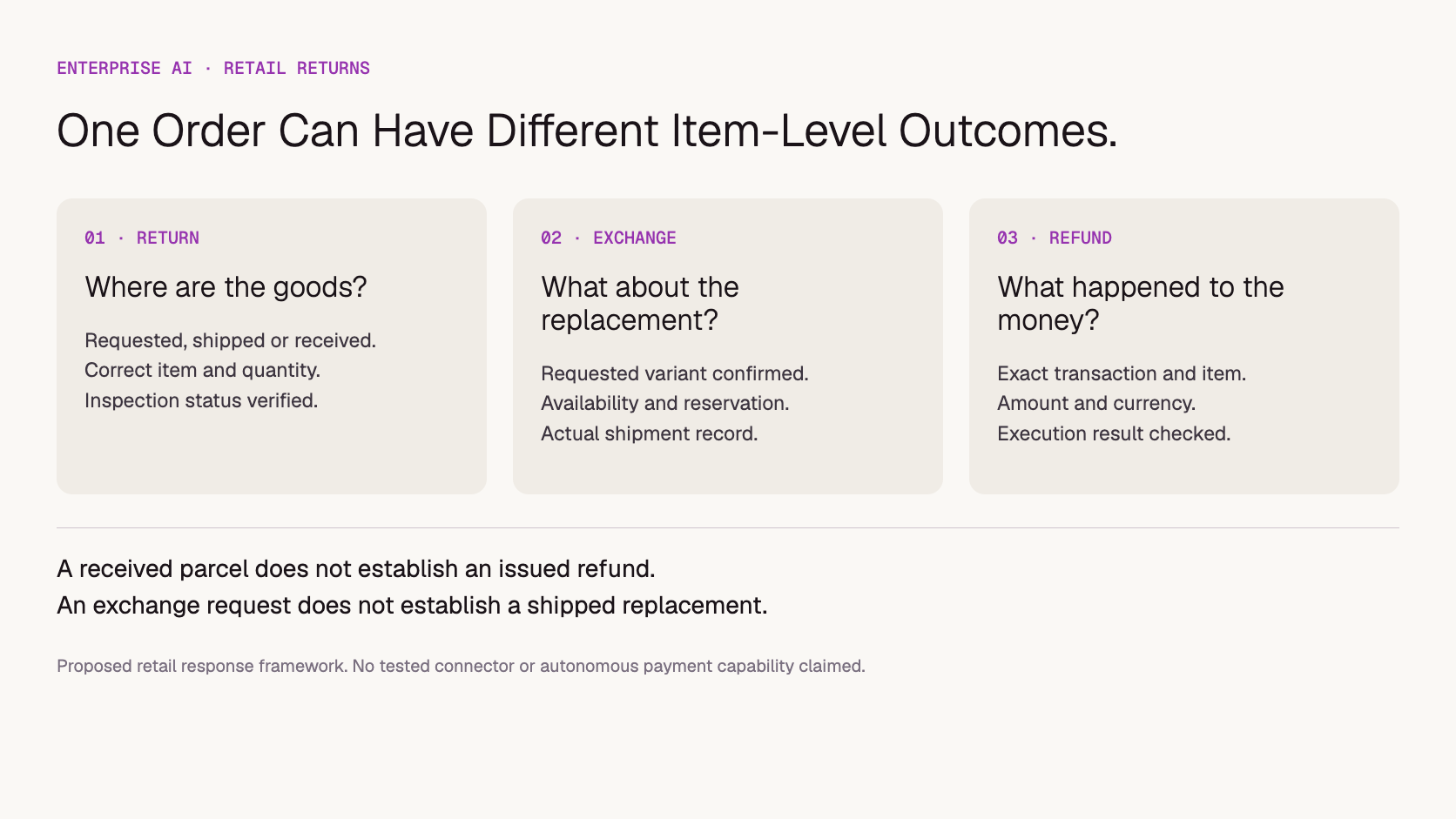
A return describes goods coming back, an exchange involves an alternative item, and a refund concerns money. These processes can progress independently. The assistant should read each relevant record rather than infer payment status from a parcel event or treat the status of one returned item as the outcome for the entire order.
Shopify's returns and exchanges documentation distinguishes these operations. Its order-status reference also separates payment, fulfillment and return statuses, including requested returns, inspections and partial refunds. These are useful examples of why a single “order complete” label is insufficient; other platforms may use different fields and terminology.
Build the response around explicit facts: which item, which quantity, which return, which transaction and when the source was last updated. An order-level partial-refund flag cannot by itself tell the model which item was refunded or whether a particular shopper question is resolved.
Prefer a statement such as “The return for the cream sweater is awaiting inspection in our current record” over “Your refund is on its way” when no refund transaction is present. If the warehouse and payment records disagree, route the case for review and describe the uncertainty rather than blending the two into a reassuring but unsupported answer.
What goes wrong in a multi-item return?
Multi-item orders require item-level reasoning because shoppers may return one product, exchange another and keep the rest. A model should assemble a separate state for each requested item before drafting the overall reply. It must distinguish evidence of a request from evidence of an action and keep quantities, variants and transaction references attached to the correct item.
Fictional example: A shopper bought a cream sweater, a gray cardigan and a belt. They requested a refund for the sweater and a size exchange for the cardigan. A return parcel arrived, but the latest warehouse record identifies only the sweater. The account also shows an earlier shipping-charge refund. The shopper asks, “Have you refunded everything and sent my new size?”
Record
Supported conclusion
Unsupported leap
Sweater received; inspection pending
The recorded return item is awaiting inspection
The sweater refund has been issued
Cardigan exchange requested
The shopper asked for another size
The replacement is reserved or shipped
Earlier shipping-charge refund
A separate payment adjustment exists
Both garments have been refunded
No belt return request
No belt return appears in the supplied record
The whole order should be refunded
A review-ready response would explain the sweater's inspection status, say that the cardigan shipment is not confirmed in the available record, and distinguish the earlier shipping adjustment. It would then route the missing cardigan information to the appropriate team. It should not claim that the parcel contained only one garment simply because only one has been logged.
This example is deliberately about conflicting evidence, not a fabricated model failure. It supplies a test case that a retailer can adapt to its actual systems and vocabulary. The expected answer should be agreed with operations before testing a model.
Do not collapse goods, replacement and payment states into one conversational promise.
What data and controls does the assistant need?
Provide a small, authorized case packet rather than an unrestricted customer history. Include verified order access, item identifiers, quantities, relevant policy context, return records, transaction details and source timestamps. Application code should enforce access and perform exact calculations. The model can explain the resulting facts, identify gaps and draft the next question without deciding which private records it may retrieve.
Do not rely on a prompt saying “only answer about this customer” as an access-control mechanism. The surrounding application must establish the user's authority and restrict the data returned. An order number alone should not become permission to disclose another person's address, purchase history or payment details.
Policies also need controlled selection. A retailer may have different channels, product categories or approved exceptions. Supply the applicable policy record or eligibility result and its version. Do not ask the model to choose freely between an old help-center paragraph and a current internal rule when the business has not resolved which governs the case.
For refund amounts, discounts and allocations, retrieve the commerce system's calculated values. Use deterministic calculations when needed; do not let a language model reconstruct a financial amount from prose. If relevant fields are missing, request review rather than substitute a plausible amount.
When can the workflow take an action?
An action should occur only after the application verifies permissions, eligibility and the exact target, then executes it through an authorized integration. A model's tool request is a proposed instruction, not evidence that a refund happened. The reply should reflect the actual execution result, including failures or unresolved outcomes, before telling the customer that anything changed.
Start the pilot in draft-only mode. If the retailer later enables actions, define them separately: creating a return request, generating an authorized label, submitting an exchange or issuing a refund have different consequences. Each needs explicit preconditions and an auditable result.
Also decide how duplicate messages and uncertain execution results are handled. If a request times out, the system should check the existing transaction or action record before repeating a money-moving operation. The assistant should not “try again” simply because it has not received a conversational confirmation.
The underlying distinction is covered in our guide to tool calls and actual execution and AI approval workflows. This returns-specific article applies those controls to line items, exchanges and payment records rather than repeating a general agent architecture guide.
Should retailers use a returns app or model APIs?
Use a returns application or native commerce feature when it already handles the required portal, eligibility and operational actions. Consider model APIs for a custom interpretation and communication layer across authorized systems. A model endpoint does not supply warehouse events, return labels or payment execution on its own, and a custom workflow needs engineering ownership after launch.
Approach
Useful when
Check before purchase
Native commerce returns features
Standard policies and operations fit the platform
Supported actions, staff permissions and customer-facing status
Dedicated returns or support application
The team needs a ready-made operational interface
Integration coverage, exception handling and total subscription cost
Custom model-API assistance
Messages and evidence span systems or require a custom review experience
Data access, action boundaries, integration maintenance and reviewed output quality
A stronger model cannot repair an absent warehouse integration. Conversely, a simple rules-based status page may be sufficient when the question is straightforward and the data is clean. Use language interpretation where it adds value rather than placing a model in every step. The broader software-versus-API purchasing guide explains this ownership decision.
How should a retailer evaluate quality and operating cost?
Test whether the assistant gives the right answer for the right item using the available evidence. Measure unsupported promises, incorrect item matching and missed exceptions separately from tone and fluency. Compare review effort and cost against the same work in the existing support process, including integration and correction time rather than counting only model tokens or deflected tickets.
Create a permitted, redacted evaluation set containing a partial refund, a pending inspection, an unavailable exchange size, a duplicated customer message, conflicting timestamps and missing order authorization. Have operations define the expected disposition for each case: answer, clarify, escalate or propose an action. A case requiring escalation should not be rewarded merely because the model produced a complete-sounding answer.
Item accuracy: Did the answer refer to the correct SKU, variant and quantity?
State accuracy: Did it distinguish requested, recorded and executed events?
Promise control: Did it invent a refund, shipment or deadline?
Evidence coverage: Can a reviewer trace each material claim to a source?
Operational effort: How much checking, correction and follow-up did the draft require?
Copy the blank returns-response review sheet below for those checks. Keep the pilot's unit of work consistent, such as one reviewed response for one case snapshot. Multiple replies on a changing case are not equivalent to independent resolved returns.
A lower cost per draft is useful only when the quality requirement is met. Calculate cost per accepted response using model usage, retries, review labor and allocated integration costs. Do not claim a reduction in returns, refunds or fraud based on response quality alone; those outcomes require separate evidence.
What should retail teams discuss with Token360?
Describe the model workload, not just the number of support tickets: input length, languages, image needs, peak traffic and review requirements. Token360 provides enterprise access to text, image, audio and video models, with negotiated pricing, dedicated capacity, contracts and compliance requirements scoped to the engagement. The retailer still needs its commerce integrations and authorization process.
Text may be sufficient for intent classification and state explanations. An image-capable model can help describe submitted photos, but that does not establish product authenticity, fraud or refund eligibility. Add modalities only when the specific task and evaluation justify them.
As checked November 14, 2026, the Token360 enterprise page describes model access and commercial options. Confirm actual availability, capacity commitments and data-processing terms for the selected models. This article does not claim a ready-made Shopify connector or automatic payment handling. Token360 resources and company information provide platform context.
Limit customer data to what the task requires and confirm the applicable retention and training terms. When budgeting, include the full operating cost of the workflow, not just inference pricing.
The vehicle inquiry review guide applies similar availability and confirmation checks in automotive retail.
Frequently asked questions
Does a return approval mean the refund was issued?
No. Read the separate return and payment records. Approval to return merchandise does not establish that a refund transaction has occurred. The customer reply should state only what the current records support.
Can AI process refunds automatically?
A model alone cannot move money. An application may allow a narrowly defined action through an authorized integration, but it must enforce permissions, policy and transaction checks. This article has not tested such an implementation.
Can a customer photo establish refund eligibility?
A photo can support a case, but it does not establish the complete policy or transaction context. Keep image interpretation separate from eligibility decisions, warehouse inspection and authorized exceptions. Do not label a customer fraudulent on the basis of an unverified model judgment.
Does Token360 include a returns-management platform?
No such product is claimed here. The proposed workflow uses model APIs inside a retailer's application or support integration. Confirm the selected model's capabilities and the commerce-system connections your team must provide.
What is the safest useful first deployment?
Begin with reviewed status-response drafts for authorized cases, without enabling money-moving actions. Evaluate difficult item-level cases and unsupported promises before expanding the workflow. Keep a clear path to human review when records disagree or evidence is missing.


 Guides
 Guides
 Guides