Buy AI software for a workflow that already fits. Choose a model API for an application you can own. Compare integration, responsibility and total scope.
Buy ready-made AI software when its existing workflow fits the work your employees need to do. Consider a model API when AI must become part of your own product or business process and someone can own the application around it. Many enterprises need both. Compare the delivered workflow and ongoing responsibilities, rather than treating software seats and model calls as interchangeable purchases.
This article provides a buyer-side decision framework. Its business scenarios are hypothetical, not customer case studies or measured savings. It compares purchase scope, not the quality of particular models.
Read first: Token360’s API quickstart shows what an initial model request involves. A successful request establishes access to a model; the decision below concerns how that capability becomes useful work inside your company.
What are you actually buying in each case?
Ready-made AI software provides a product experience around model capabilities, while a model API provides programmatic access that an application can use. The practical difference is the work already included: interface, workflow, integrations, administration and support. Actual coverage varies by product and contract, so inspect the scope rather than relying on the label.
For example, Microsoft’s Copilot service description describes AI integrated with Microsoft 365 applications and organizational data. That illustrates the application layer a buyer may value. It does not establish that every AI software product includes those integrations or that every feature is available under every plan.
An API-based application may still use managed services, low-code tools or a delivery partner. “Using an API” does not necessarily mean building everything from scratch. Equally, buying software does not eliminate configuration, rollout, access review or user training.
Decision dimension
Ready-made AI software
Application using a model API
What employees or customers use
The vendor’s product experience
Your chosen application or embedded workflow
Workflow control
Within the product’s supported configuration and extensions
Within what your application team or partner implements
Integration work
Verify included connectors and their limitations
Assign responsibility for system connections and data handling
Operation
Vendor runs the product; your organization still administers its use
Model provider runs the agreed inference service; application operation needs an owner
Commercial comparison
Check licenses, usage allowances, add-ons and implementation scope
Check model usage plus application build and running costs
Acceptance evidence
Employees complete the real task in the product
The integrated workflow completes the real task under agreed conditions
When is ready-made AI software the better starting point?
Start with software when the required workflow already exists in a product your team can use and administer. The strongest case is a task where adopting that workflow is acceptable and custom behavior adds little business value. Test the complete experience before deciding that building your own interface is necessary.
Suppose a sales team wants help drafting follow-up emails and summarizing meeting notes. If an approved product works inside the tools employees already use, purchasing that experience may address the need directly. A custom chat box calling the same underlying model would not automatically reproduce the document access, editing controls or meeting integration employees expect.
During evaluation, have a real user complete a representative task from start to finish. Include getting the source material, reviewing the output and saving it in the correct place. Record where the employee still copies information manually or switches systems. Those remaining steps determine whether the software actually fits.
Ask what is configurable without custom development. Also verify which connector permissions, administrative controls and support terms are included in the proposed plan. A convenient demonstration in a vendor’s prepared environment is not the same as a completed workflow in your organization.
When should a company consider a model API?
Consider a model API when the required behavior belongs inside your own application, uses a distinct sequence of business steps or must serve customers through an experience you control. The case is strongest when the benefit of that integration is clear and a team or partner can maintain it after launch.
Imagine a support product that needs to classify incoming tickets, retrieve permitted account information, draft a reply and place the result into an existing review queue. The purchase is not simply an employee assistant. The organization needs a repeatable process connected to its support system, with clear rules about who may approve and send a response.
A model API can supply capabilities within that process, but your application must arrange the surrounding work. This includes providing relevant inputs, interpreting outputs, handling unavailable results and deciding what happens next. If generated media is involved, the workflow may also need job tracking, storage and human review before delivery.
Check the selected model’s supported modalities and parameters before promising a workflow. A general description such as “multimodal AI” does not establish that one model can perform every text, image, audio and video step your application requires.
Who owns the work outside the model call?
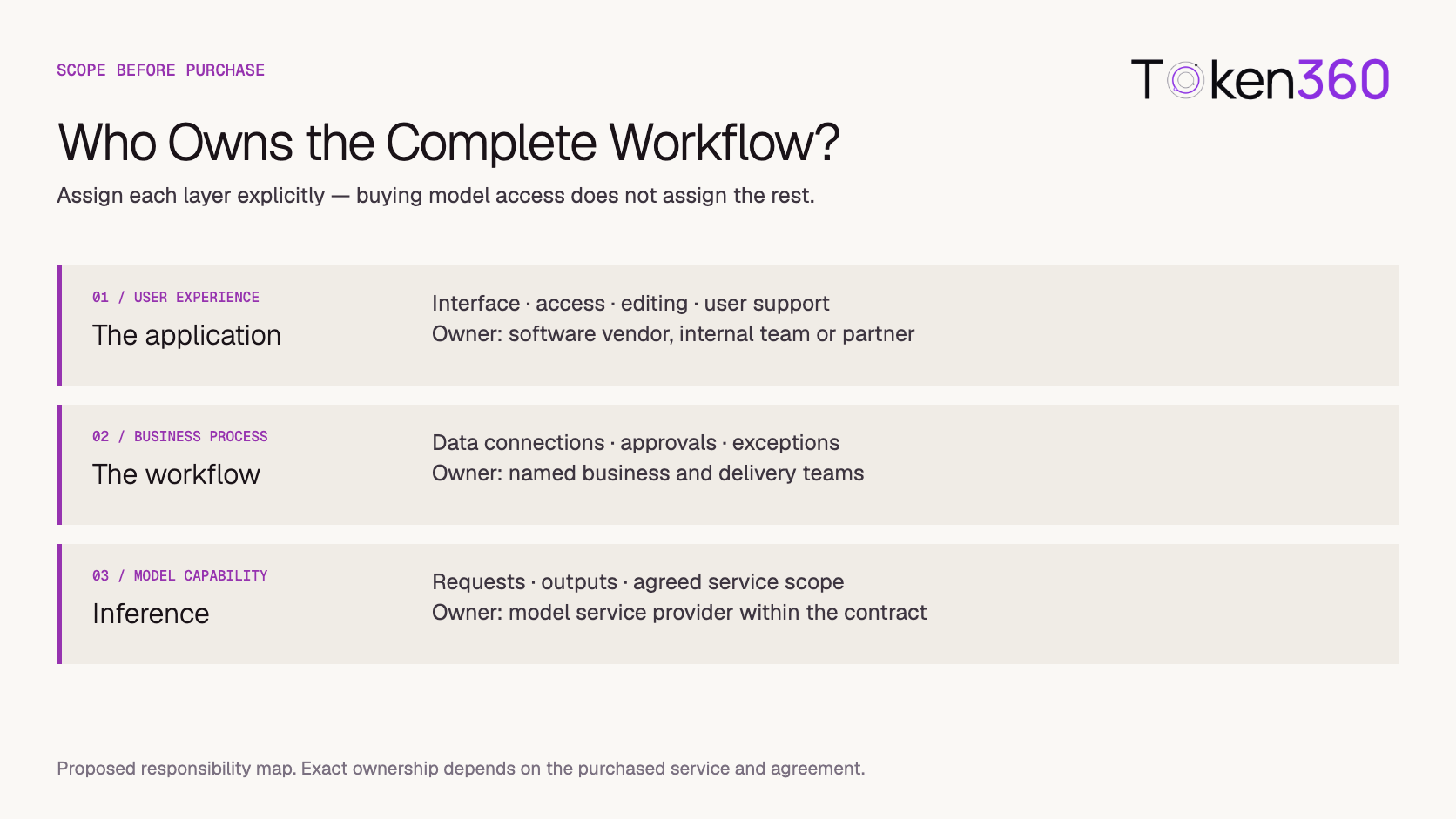
Every API-based proposal should name an owner for the application around inference. A provider can successfully return a model response while the business workflow still fails elsewhere. Separate responsibility for the user experience, data connections, review rules and incident handling before approving the purchase.
For the support example, a good response is not enough if it is attached to the wrong ticket. A functioning ticket integration is not enough if a user sees restricted account data. A correct draft is not enough if nobody owns the review queue. These are different acceptance checks and may involve different teams.
Proposed scope map: assign each layer explicitly. The diagram describes responsibilities, not Token360 product features or a completed implementation.
A useful statement of work identifies who changes prompts and model configurations, who maintains integrations, who investigates failed tasks and who communicates with users. If an implementation partner owns those functions, confirm how the organization receives documentation, configuration and operational access when the engagement ends.
The decision should not depend on an assumption that the API supplier will build all missing software. It should also not assume a software vendor will maintain a custom integration that falls outside the contracted product.
Should one company buy both software and API access?
Yes, when the purchases support distinct workflows. Employees may need a general productivity application while a customer-facing product needs model inference through an API. Define the purpose and owner of each purchase, then look for actual duplicated work rather than treating every use of the same model family as redundant spending.
In a hypothetical company, sales uses an approved writing assistant, operations uses AI inside its ticketing workflow, and the product team embeds a model into a customer feature. Removing the writing assistant will not automatically fund a usable replacement for sales. Buying more software seats will not automatically supply the customer feature’s backend.
Maintain a short inventory: user group, task, product or API route, data involved, budget owner and expected output. If two tools serve the same users on the same task, compare their practical fit. If they serve different tasks, a shared model name is not enough evidence of duplication.
Where the company’s specific need is to use internal documents, distinguish the application purchase from the customization approach. RAG versus fine-tuning for enterprise AI addresses that separate choice; this article does not assume either is required for every API project.
How should finance compare the two options?
Compare the cost of delivering the same accepted workflow over the same period. A software license and an API usage charge usually cover different scopes. Include the work needed to reach the output your business will actually use, and keep external cash payments separate from allocated internal staff effort.
For a software proposal, identify the relevant users, included capabilities, usage terms, required add-ons and any deployment work. For an API-based proposal, identify model usage, application services, implementation, maintenance and review. Do not assume that one option eliminates all human work while the other carries the entire cost of it.
A useful comparison asks what changes for the business after purchase. If employees still transfer every result manually, include that residual work. If an automated workflow requires regular exception handling, include that too. Evaluate the same task quality and coverage rather than comparing the fastest demonstration with a fully operated system.
There is no universal seat count or request volume at which an API becomes cheaper. The AI API total cost of ownership framework provides the deeper budgeting method. Use it after defining the delivery scope, so both proposals cover the same work.
Does an AI subscription include model API access?
Do not assume that buying an AI application grants the API access or usage allowance your integration needs. Check the exact products, account setup and applicable credits. Vendors can bundle benefits while still operating separate application and API services, so read the current terms rather than applying a universal rule.
As checked on November 9, 2026, Anthropic’s billing explanation distinguishes paid Claude plans from the Console and API. The page also identifies monthly API credits for certain plans. That is why “subscriptions never include any API benefit” would be too broad, while “we bought seats, so all API use is covered” would also be unsafe.
Request confirmation of which account receives any included allowance, which workloads can use it and what happens beyond it. Keep this entitlement check separate from whether the product is a good workflow fit. A small included allowance does not turn a software purchase into a complete integration project.
Where does Token360 fit in an enterprise purchase?
Token360 is relevant when the company needs model access for an application or workflow, particularly across multiple modalities. Scope that role explicitly. Model access can be part of the solution without being the complete employee application, business-system integration or implementation service your organization also needs.
Token360’s enterprise positioning covers text, image, audio and video model access. Dedicated capacity, negotiated pricing, contracts and compliance requirements can be scoped to an engagement; availability and terms need confirmation for the specific project. Review the enterprise offering and describe the application you intend to operate, not only the model name you want.
A useful first brief names the users, the task, the systems involved and the party responsible for delivery. Add expected workload, output requirements and any capacity or contractual needs. This helps distinguish an inference procurement discussion from a request for a finished software product. Background on the business is available at About Token360.
What should the team decide before requesting quotes?
Write down the workflow, the required delivery scope and the owner of everything excluded from the purchase. If a ready-made product already meets the requirement, evaluate it directly. If the business needs a custom integrated process, assess whether the application delivery and ongoing operation have credible owners.
Use the AI purchase scope worksheet to compare proposals. It asks for the task, user experience, connections, approvals, operational owner and exclusions. The fields are deliberately unscored: a missing owner can matter more than a long feature list, and the weight of each requirement depends on the business.
A suitable decision record might read: “Buy the existing employee application for drafting; evaluate API access for the ticket workflow; the application team owns integration and support.” That is an illustrative structure, not a recommendation for every company. The important outcome is that purchasing, engineering and the business owner agree on what is being delivered.
What changes when the purchase is for a coding team?
A coding assistant can package editor context and execution tools; a model API supplies the model interface. If an assistant supports an external API route, verify the complete coding workflow, including tool calls and context handling, before buying it as a substitute for the included provider. A successful chat response is not a completed coding-task test.
Do not assume a software subscription includes separate API usage. Confirm the billing route and the external tool’s supported configuration. This is a concrete instance of the software-versus-API decision, not a separate supplier ranking or a completed coding benchmark.
Frequently asked questions
We have no developers. Should we avoid model APIs?
Not necessarily, but identify a capable implementation and operating owner first. A managed application, low-code platform or delivery partner may use APIs on your behalf. Confirm what that party maintains and what remains your responsibility rather than buying API access with no plan to use it.
Can the same model give different results in software and through an API?
Yes. The application may add instructions, context, tools and other processing around the model. A matching model name does not prove matching end-to-end behavior. Compare the actual task and configuration instead of assuming the application experience is reproduced by a basic request.
Is a model API automatically more private?
No. Evaluate the actual data flow and applicable terms for either purchase. The application, integrations, logs and model service can each affect how information is handled. “API” and “enterprise software” are not sufficient descriptions of data controls.
Can we replace every employee AI license with one shared API?
Only if you provide an application that meets those employees’ needs and the relevant terms permit the arrangement. API access alone does not provide their interface, permissions, document integrations or support. Compare the replacement experience before treating license removal as a saving.
What is the clearest sign we should reconsider building?
If no one owns the application after the initial demonstration, pause the build decision. Establish operational responsibility or evaluate a product that already covers the workflow. A technically successful model call is not a sustainable service for employees or customers.
Read next: choosing AI models by use case helps shortlist the model capabilities once you have decided to procure inference. Local links to unpublished drafts must be replaced with their verified published URLs before launch.
Evidence boundary: this is an editorial purchase framework informed by official product documentation. No comparative deployment test, customer interview or measured ROI study was conducted for this article.
Task,User group,Expected output,Software or API proposal,Included interface,Required integrations,Approval owner,Operating owner,Excluded work,Cost scope,Acceptance evidence,Open question
,,,,,,,,,,,
Enterprise AI
API
Bring your next idea to life.
Create a video scene in Creator, or explore models for images, audio, and text to find the right capabilities for your project.


 Guides
 Guides
 Guides