AI APIs for Ecommerce: Build a Catalog Content Workflow
Connect approved product facts to AI copy, images and video. Build an ecommerce catalog workflow with SKU checks, review and channel-ready publishing.
INDUSTRY WORKFLOWS · ECOMMERCE & RETAIL
AI APIs for ecommerce can turn approved product information into draft descriptions, images and video assets inside a repeatable catalog workflow. The critical requirement is preserving product truth: the correct SKU, variant, materials, dimensions and supported claims must remain attached to every asset. Generation is one stage; validation, approval and publishing remain separate responsibilities.
For brands, retailers, marketplace operators and agencies managing catalogs, the buying decision is broader than finding a model that makes an attractive image. The workflow needs to know which item an asset represents, which source version it used, whether it passed review and where it is allowed to appear.
Read first: Choose AI models by business use case. This article applies that decision to recurring ecommerce catalog production, rather than a single product-ad prompt.
Which ecommerce work is a good fit for model APIs?
Model APIs are useful when catalog work needs to run repeatedly from structured records, connect to internal review systems or produce multiple asset types. A built-in commerce tool may be enough for occasional manual drafting. Choose an API workflow when you need integration and operational control, and can maintain the surrounding application.
Relevant tasks include preparing descriptions from approved attributes, adapting copy for a channel, generating candidate lifestyle images from product references, and creating short video drafts for selected products. The team should define a business output—such as an approved listing package—rather than treating every generated file as completed work.
Catalog task
Potential model role
What must remain controlled
Product descriptions
Draft language from approved attributes and brand instructions.
Facts, variant identity and permitted claims.
Localized listing copy
Adapt wording for the target language and market brief.
Units, product names, terminology and market-specific review.
Product imagery
Create or edit candidate visual settings where the selected model supports the required inputs.
Product shape, color, components and destination requirements.
Short product videos
Generate candidate motion or scenes from a controlled brief.
Product identity, credible actions and approved representations.
Voiceover or music
Produce optional audio for selected media assets.
Approved script, pronunciation, rights and the final mix.
These are possible application roles, not a claim that every model performs every task or that Token360 supplies a finished commerce integration. For the broader software purchasing choice, read AI software versus a model API.
What product information should the workflow start with?
Start with an approved product record and a specific variant, not a loosely written marketing brief. Include the factual fields the model may use, reference assets, prohibited assumptions and the target channel. Missing information should become a review exception rather than an invitation for the model to invent a plausible specification.
The record can come from a product information management system, commerce backend or controlled catalog file. The important requirement is an accountable source. Keep price and availability tied to their authoritative systems instead of letting generated prose become a second, stale source of truth.
A useful generation brief identifies:
The product and variant IDs, plus the source-record version.
Approved materials, measurements, features and included components.
Verified reference images and the variant each image represents.
Claims that are supported, and claims that must not be introduced.
The language, channel, asset type and review owner.
Shopify’s product-description guidance warns that generated copy can introduce unsupported benefits or facts from similar products, and makes the merchant responsible for checking published accuracy. Detailed input helps, but it does not remove that review responsibility.
For example, “canvas upper” does not establish that a shoe is waterproof, machine-washable or made with recycled material. A persuasive sentence containing one of those claims is a rejected draft unless the approved product information supports it.
How should text, image and video generation connect?
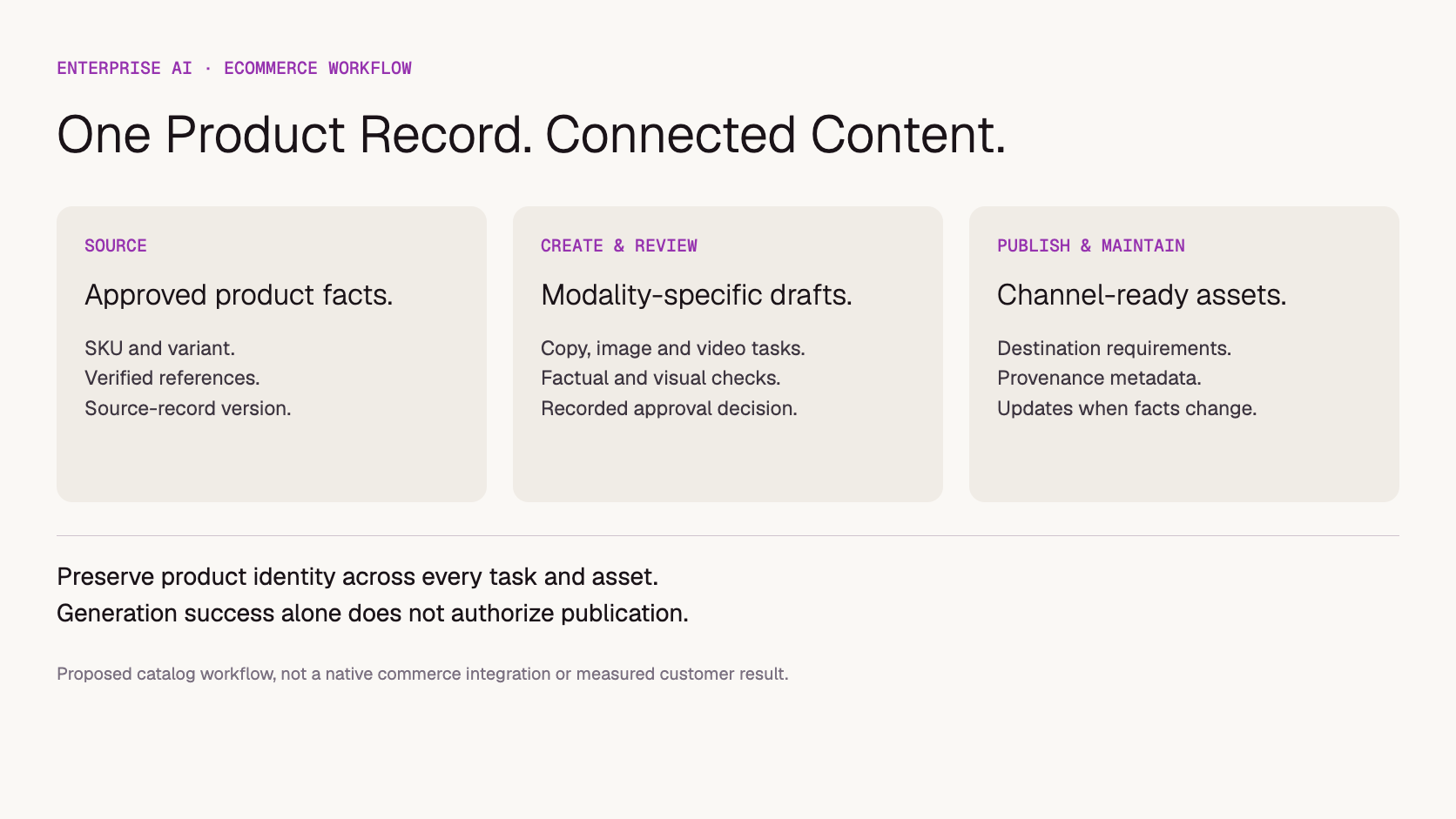
Use the approved product record as the common reference for each generation task. Do not let an unreviewed text draft become the factual source for an image or video prompt. Each task should preserve the same product identity while using instructions suited to its modality and the selected model’s supported capabilities.
A practical sequence is:
Prepare: assemble the approved product facts, references and channel brief.
Generate drafts: request only the asset types the product actually needs.
Validate: check record mapping, required fields, files and factual consistency.
Review: have the responsible team assess product fidelity, language and suitability.
Publish: send approved assets through the commerce platform or feed process.
Maintain: flag affected assets when source facts or requirements change.
Token360’s model capability documentation makes the selected model’s detail page and schema the reference for accepted inputs, parameters and limits. Check whether reference-image input, the required output format and other necessary features are supported. A shared API endpoint does not establish identical capabilities across models.
Keep asynchronous generation results associated with the original task and SKU even when jobs finish in a different order. Your application needs to handle that relationship; filenames or the position of a result in a folder are weak substitutes for explicit identifiers.
A proposed application workflow. Model access does not automatically provide catalog approval or publishing.
What would a single-product workflow look like?
Use one product to establish the relationship between facts, drafts and review decisions before expanding to a category. The following sneaker example is hypothetical, not a customer case or generation test. It shows how different outputs can share a record without allowing one unverified asset to redefine the product.
Suppose the approved record describes an ivory canvas sneaker with a purple heel tab and a rubber outsole. The team requests a short description, a candidate lifestyle image and a short video draft. No waterproofing, sustainability or performance claim is supplied.
Draft
Acceptance question
Example reason to reject
Description
Does every factual claim map to the approved record?
The text calls the shoe waterproof without supporting information.
Lifestyle image
Does the depicted product preserve the approved variant and visible construction?
The heel tab changes color or the sole gains a different structure.
Video
Does the product remain accurate throughout the relevant motion?
The shoe changes design between views or demonstrates an unsupported feature.
Passing the description does not approve the imagery. Passing one image does not approve the video. If visual fidelity is uncertain, retain verified product photography for factual presentation and use generated candidates only where the merchandising team and destination rules allow them.
The existing product reference-fidelity test plan covers visual comparison in more detail. This catalog workflow adds the record, ownership and publishing connections around that test.
What must be checked before content reaches a sales channel?
Check both product accuracy and the destination’s content requirements. An internally approved asset is not automatically ready for every marketplace, ad feed or storefront. Preserve the origin information needed by the destination, and validate the final exported file or feed rather than assuming the source asset’s metadata survived processing.
As checked November 11, 2026, Google Merchant Center’s AI-generated content guidance specifies structured title and description attributes for generated text, including the relevant digital source type. It also requires AI-generated image metadata and says existing digital-source metadata should be preserved. These are Merchant Center requirements, not a universal rule for every ecommerce platform.
Assign feed mapping and metadata checks to the publishing process. A model generating a title does not automatically place it in the correct feed attribute. Likewise, resizing or exporting an image can require another metadata check. Verify the current destination documentation before release.
Keep content approval separate from channel approval. A product description may be factually correct but need a different format for a feed; an image may be visually attractive but inappropriate for a particular placement. Neither condition should silently change the underlying product record.
How should a retailer measure whether the workflow is useful?
Measure accepted catalog work, review effort and elapsed time to publication rather than the number of files generated. Include failed attempts and revisions in the cost view. A cheap draft that requires substantial correction may be less useful than a more expensive draft that meets the team’s requirements with less rework.
Track outcomes by category and asset type. Apparel variants, electronics specifications and homeware imagery do not necessarily present the same review burden. Useful measures include factual rejection reasons, visual-fidelity failures, review time per approved asset and the number of products blocked by missing source information.
Distinguish production efficiency from commercial performance. Faster listing preparation does not prove higher conversion or fewer returns. Those outcomes need separate measurement that accounts for traffic, price, promotions and other changes. Use the enterprise AI ROI guide to keep operational improvement separate from realized financial benefit.
A first evaluation can cover a deliberately varied set of approved products, including variants and incomplete records. Record what was attempted and why drafts were rejected. The goal is to discover where the workflow needs better data, different models or a different review process—not to select only the most attractive examples.
When does an API workflow make sense commercially?
An API workflow is most defensible when repeated volume, multiple channels or existing systems justify the integration and maintenance work. For a small catalog with occasional updates, a commerce platform’s built-in tools may be simpler. Compare the full workflow cost, including review and operations, before assuming custom automation will be cheaper.
For an enterprise model-access discussion, prepare the expected product volume, assets per product, languages, typical reference inputs and demand pattern. Separate recurring catalog updates from seasonal peaks. Include observed retry and rejection information if available; do not treat one generation per product as a guaranteed production requirement.
Token360 serves enterprise buyers across text, image, audio and video models. Pricing, dedicated-capacity requirements, contracts and compliance requirements can be discussed for a specific engagement through the enterprise page. Learn more about Token360.
The customer or implementation partner still needs to connect the product source, generation tasks, approval process and publishing destination. This article does not claim a ready-made Token360 Shopify connector, product information management system or automatic Merchant Center compliance feature.
Download the blank catalog content review register. It links product and variant IDs, source version, asset type, model configuration, review decision, channel and provenance checks. It contains no tested product results or recommended model ranking.
Can one AI model produce the entire ecommerce content package?
Do not assume so. Check the actual modalities and features each selected model supports. A text model may draft copy and briefs while separate image, video or audio models handle other tasks. Each result still needs its own acceptance checks.
Can we publish generated product descriptions automatically?
Only within a workflow whose factual checks, review rules and publishing permissions your organization has approved. Start by identifying unsupported claims and missing information. A successful generation request alone is not a publishing decision.
Should AI-generated lifestyle images replace product photography?
That depends on fidelity, the intended placement and destination requirements. Verified product photography remains useful evidence of the actual item. Evaluate generated imagery against that reference rather than assuming visual appeal proves product accuracy.
How do we handle a product specification change?
Use the source-record version to find affected content, then decide what needs regeneration or renewed review. Do not let older generated assets remain authoritative simply because they were approved before the product changed.
Evidence note: industry workflow analysis based on official Shopify, Google Merchant Center and Token360 documentation. The sneaker example and workflow are proposed illustrations. No production integration, customer results, conversion uplift or savings have been measured for this article.
Enterprise AI
API
Bring your next idea to life.
Create a video scene in Creator, or explore models for images, audio, and text to find the right capabilities for your project.



 Guides
 Guides
 Guides