AI API Data Retention vs Training: Separate Decisions
No training does not mean no storage. Separate AI API content, logs and media retention, then review each layer with an enterprise checklist.
ENTERPRISE DATA HANDLING · BLOG 149
By Token360 · Editorial review: November 5, 2026
“Not used for training” does not mean “not stored.” Training restrictions describe a permitted use of data; retention describes what remains, where and for how long. An enterprise AI review should document both, separately for request content, operational records and media files, across the application, gateway and upstream provider.
A team may ask whether its prompts train a model and receive a clear “no.” That answer is useful, but it leaves another purchasing question unresolved: which copies of the prompt, response, uploaded image or generated video can remain after the request finishes?
This is a policy and implementation review, not a retention benchmark or a ranking of providers. No live deletion experiment was performed for this article. The worksheet and hypothetical workflow below are original review aids; they are not evidence of a particular account’s configuration.
Read first: the Token360 security and data-handling documentation identifies the layers involved in a model request. Use it to establish the scope of your review before asking for a single platform-wide privacy answer.
What is the difference between no training and no retention?
A no-training commitment limits a particular use of the covered information. A retention commitment defines whether covered information remains after processing, for what purposes and for how long. Neither statement should be expanded beyond its stated scope. Ask which data, services, providers and exceptions each commitment actually covers.
Question
What the answer establishes
What it does not establish by itself
Is content used for training?
Whether the specified training use is permitted.
Whether any copy is stored.
How long is content retained?
A storage period and its triggering event.
All permitted uses during that period.
What does ZDR cover?
The provider’s defined zero-retention scope.
That your application also retains nothing.
Where is processing allowed?
A geographic processing boundary.
A retention period or training prohibition.
Who can access a file?
An access-control boundary.
That the file no longer exists.
For procurement, turn a broad statement into a precise question: “For this endpoint and route, are request and response contents retained after processing, for any purpose? If so, which purpose, duration and exceptions apply?” Ask the training question separately. A written answer can then be checked against the actual service being purchased.
What do OpenRouter and fal document about retention?
Official provider documentation illustrates why storage cannot be inferred from a training statement. Policies can distinguish metadata from content, and request history from media storage. The examples below are scoped observations checked on November 5, 2026. They are not a complete comparison of either company’s privacy arrangements or enterprise contracts.
OpenRouter’s FAQ says basic request metadata is logged, while prompts and completions are not logged by default unless the user opts in. It also distinguishes endpoint policy tiers: ZDR, Safety Retention, and Retention and Training. Safety Retention can allow content retention for abuse prevention without training use. Its ZDR definition includes a stated CSAM exception. This is a concrete example of why “no training” and “no routine content storage” are different statements.
fal’s Model API retention documentation separates request-history payloads from CDN media and deployment-controlled logging. It says ZDR is not enabled by default and requires confirmation of endpoint coverage. Disabling request-history payload storage alone does not configure every storage location. The documentation describes separate controls for payload storage and media lifecycle.
Do not copy another provider’s header into a Token360 request and assume equivalent behavior. Control names, supported routes and contractual definitions belong to the service documenting them. Use these examples to improve the questions you ask, rather than to infer undocumented compatibility.
Which data should an enterprise retention review inventory?
Inventory concrete data objects, not only “customer data” as a single category. Prompts, outputs, files and operational records can have different owners and lifecycles. For each object, record its location, purpose, retention rule and deletion mechanism. Treat a missing answer as unresolved rather than assuming the shortest possible retention.
Object to inventory
Example
Review question
Request content
Prompt text, attached document, reference image.
Which copies reach each processing layer?
Response content
Generated text or structured output.
Is it stored in history, traces or an application database?
Media objects
Input audio and generated video.
Are inputs and outputs covered by separate lifecycle rules?
Operational records
Request ID, model, usage, status and latency.
Which fields remain, and can they identify a user?
Delivery copies
Webhook payload, downloaded file, retry queue.
What does the receiving system persist?
Support material
A voluntarily supplied screenshot or failure sample.
Does a separate support process retain this copy?
The table is an inventory template, not a claim that every service stores every object. A text-only integration may not have a media bucket. A media workflow may never persist the raw prompt in its own database but still keep uploaded assets. Remove inapplicable rows and add the actual systems your application uses.
Also inspect what your team calls “metadata.” A request ID can be useful for troubleshooting without revealing the full prompt. A field containing a customer email, file name or full signed URL can carry more information than its label suggests. Review the fields themselves before treating the record as harmless or anonymous.
Why does a gateway policy not cover the whole workflow?
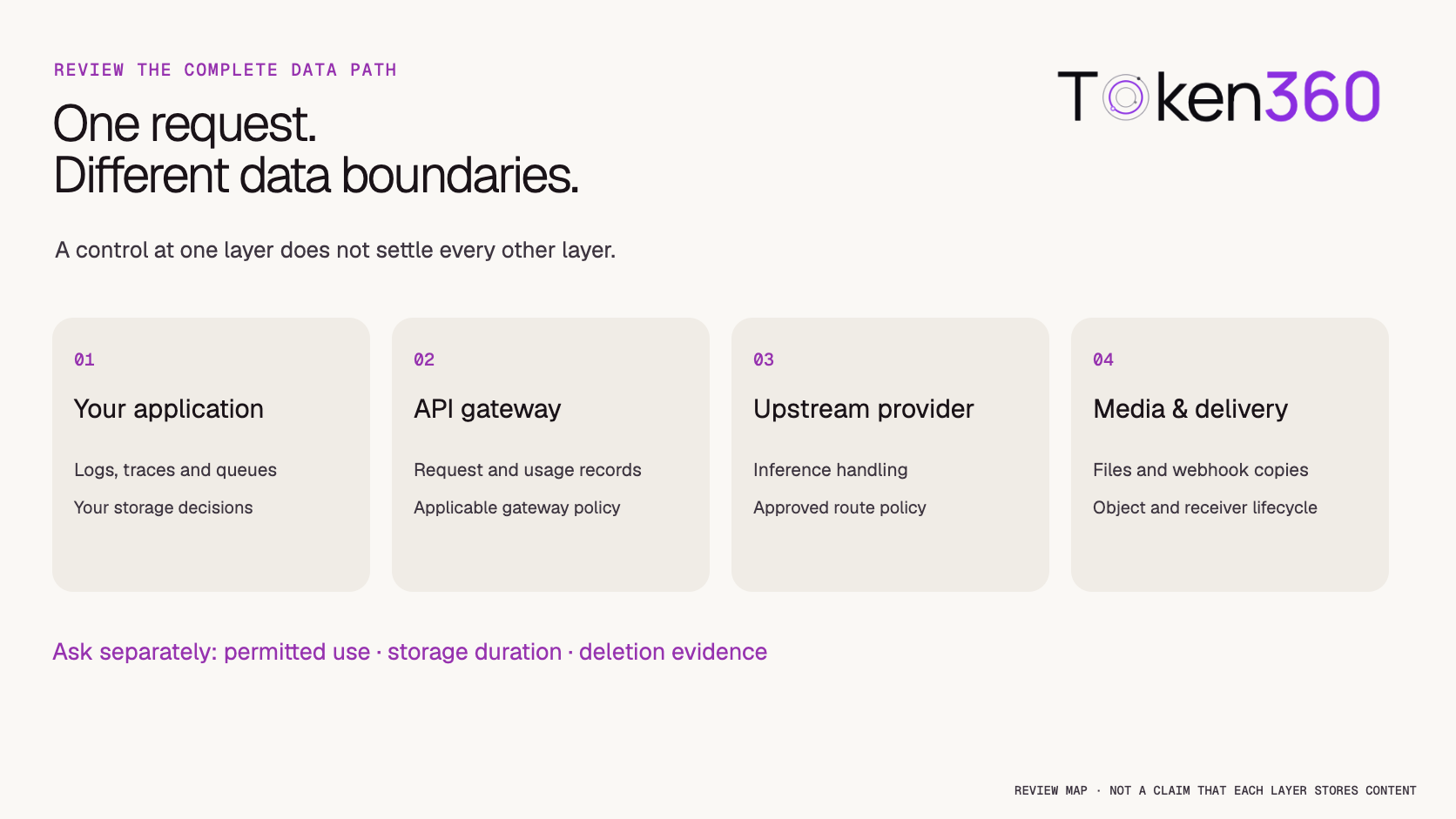
A gateway is one participant in a request path, not necessarily the owner of every copy. Your application can store inputs before submission and outputs after receipt. Upstream processing and downstream media delivery add other boundaries. Review each participant’s responsibilities and confirm how the approved configuration behaves when routing changes.
A review map, not a claim that all four layers retain content or have identical controls.
Consider a hypothetical product-video application. An employee uploads an unreleased product photo. The application sends it to a model through a gateway, receives a video URL and saves the completed video to its own storage. A monitoring service also records the job result. These are possible implementation choices, not observations of Token360 customer traffic.
Even if the inference route has a no-training commitment, the application’s photo and video copies still need lifecycle decisions. If the monitoring record contains the full response, it needs review too. Changing the upstream policy cannot retroactively change a separate application database’s retention configuration.
For fallback routing, ask whether every eligible destination satisfies the approved policy. If no suitable route is available, agree whether the request should fail rather than silently relax the requirement. This is an acceptance question for the integration; do not assume a specific failure behavior without supporting documentation or a controlled test.
What should Token360 buyers confirm before approval?
Ask Token360 to identify the commitments applicable to the selected models, routes and account agreement. Separate content retention, training use, operational records and media lifecycle. If a requirement is mandatory, obtain an explicit answer for that scope; a general enterprise discussion is not confirmation that every route supports the same controls.
As checked November 5, 2026, Token360’s documentation directs customers to the applicable agreement and legal documentation for binding retention, privacy, residency and training commitments. It also states that the Token360-DataInspection header controls documented upstream inspection behavior, with route-dependent support. It is not a retention, residency or training opt-out.
Use the enterprise API guide to orient the account review, then ask the commercial and technical contacts to resolve the remaining policy questions. This article does not establish a universal Token360 ZDR setting, deletion deadline or certification.
For a mixed text, image, audio and video workload, avoid accepting a text-endpoint answer as coverage for every media route. List the actual workloads in the review sheet. Record the evidence date and a responsible owner so a later model or integration change triggers a fresh check.
How can you validate the workflow without real customer data?
Use synthetic content to check the behavior you can observe, and keep contractual evidence separate from technical observations. A successful test can show that a file is accessible or a payload appears in a log. An empty dashboard cannot prove that no backend, backup or upstream copy exists anywhere.
Define scope before sending anything. Choose one approved endpoint and route, identify relevant stores and agree the behavior under review.
Create a harmless marker. Use a unique synthetic phrase and a non-sensitive test asset. Do not use real customer records to test a claim that is still unconfirmed.
Inspect your own systems. Check application logs, traces, queues, webhook receivers and storage for the marker or test asset.
Exercise documented controls. Where supported and approved, test retention or deletion behavior. Record the request identifier, configuration and observation time without storing credentials.
Separate access from deletion. Record whether a link fails, an object disappears from a listing or a documented deletion request is acknowledged. These are different observations.
Close the unobservable gaps with evidence. Ask the responsible party to explain upstream copies, backups and exceptions. Keep unverified points open.
This is a proposed validation procedure, not a test already completed by Token360. Do not report “zero retention verified” merely because the interface stops displaying a result. State exactly what was checked and which systems remained outside the review.
What belongs in the final retention decision record?
The decision record should connect each requirement to a specific object, system, policy and piece of evidence. Separate a requested control from a configured control and an observed result. This makes the review useful when engineering, procurement and the application owner revisit the arrangement after a route or feature change.
Copy the worksheet below into a local CSV file. Blank fields are for your own review:
Data object,System/layer,Endpoint and route,Permitted purpose,Training use,Retention duration and start event,Exceptions,Deletion mechanism,Policy evidence/date,Configured control,Observed result/limits,Owner,Decision/open question
Request content,,,,,,,,,,,,
Response content,,,,,,,,,,,,
Input media,,,,,,,,,,,,
Generated media,,,,,,,,,,,,
Operational metadata,,,,,,,,,,,,
Application logs/traces,,,,,,,,,,,,
Webhook receiver/queue,,,,,,,,,,,,
Downloaded copies,,,,,,,,,,,,
Support material,,,,,,,,,,,,
. It provides blank fields for each data category, including permitted purpose, training use, duration, exceptions, deletion evidence and owner. It contains no pre-approved supplier answers or assumed retention periods.
For example, “no training” in a supplier response can close the training-use question for the stated scope while leaving the retention-duration column unresolved. “Deleted from our application bucket” can close an application-side action while leaving upstream handling unresolved. Keeping those results separate prevents a partial answer from becoming a broader claim.
Yes. Retention and training are separate policy questions. The OpenRouter policy example above explicitly distinguishes safety retention from training use. Check the purposes and exceptions in the policy applicable to your request.
Does an expired media URL prove the media was deleted?
No. Access expiry and object deletion are different events. Token360’s security documentation explicitly notes that a signed URL can expire without deleting the underlying resource. Verify the object lifecycle separately.
Does disabling content inspection disable storage?
Do not infer that. Token360 documents its inspection header as an inspection control, not a retention or training opt-out. Obtain the applicable retention commitments separately.
Can metadata remain when content does not?
Yes; policies can distinguish them. Record the actual fields and purposes rather than interpreting a visible request record as proof that the entire prompt is stored.
Does this article certify a provider’s privacy compliance?
No. It explains review boundaries and documents specific public statements. Account-level commitments, implementation checks and the responsible reviewers’ approval remain separate work.
Enterprise AI
API
Build faster with one AI API.
Use Token360 to call video, image, audio, and text models with one key and one bill.


 Insights
 Guides
 Guides