Does an AI Tool Call Actually Execute the Function?
For custom functions, a tool call requests an action. Learn what your Token360 application must validate, execute and return before claiming success.
AI AGENTS · TOOL EXECUTION
By Yuki Yu · Reviewed November 6, 2026
For an application-defined function, no: a model’s tool call requests an operation; your application must validate and execute it. In Token360’s documented tool-calling flow, the application runs the function and returns its result to the model. A tool-call response alone does not prove that an order was checked, a record changed or a video generated.
There are exceptions for explicitly hosted server tools, so the first question is where execution happens. This guide covers your own functions connected to a tool-capable model through Token360. It is based on official documentation reviewed November 6, 2026, with an illustrative order-lookup example—not a live agent deployment or a measured reliability test.
What does the model return, and what still has to run?
The model returns a structured request naming a tool and supplying arguments. That request is input to your application’s execution logic, not an execution receipt. Your code decides whether the requested function exists, whether the arguments are acceptable and whether the current user is allowed to perform the operation.
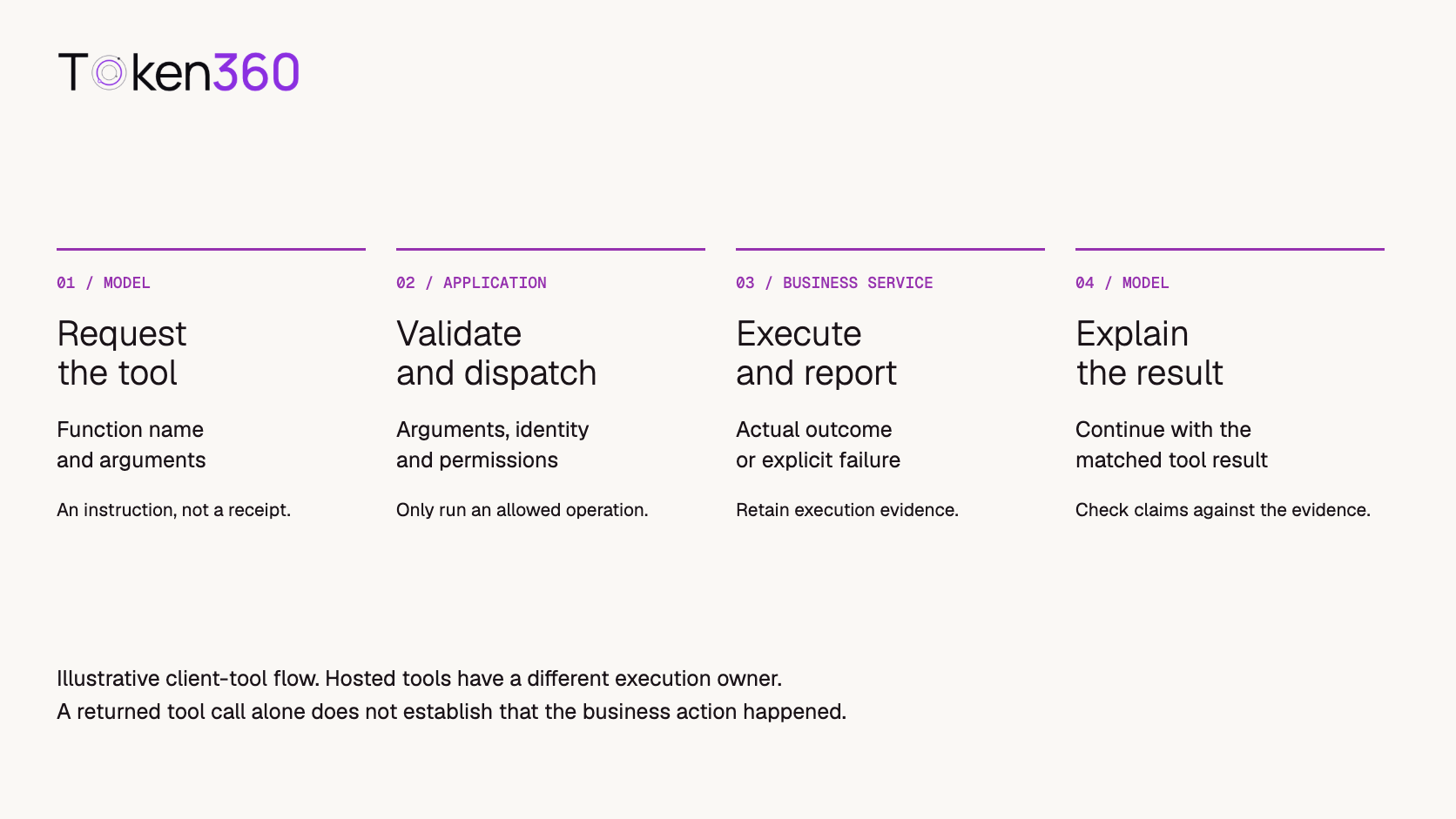
Token360’s documented tool flow requires the application to execute the returned call, retain the assistant’s tool-call message, attach the corresponding tool result and continue the conversation. Tool-call IDs link results to requests. Tool support is model-specific; a gateway does not automatically supply it for every model.
Evidence you have
What it establishes
What it does not establish
Model requests lookup_order
The model selected that operation and supplied arguments.
The order system was contacted.
Application dispatch record
The application attempted a specific operation.
The downstream system completed it successfully.
Order-service response
The service reported a result under its API contract.
The model’s subsequent explanation is accurate.
Final assistant answer
The model produced a user-facing response.
The claimed action happened without supporting execution evidence.
Keeping these events distinct makes a support investigation concrete. Instead of asking why “the AI did nothing,” identify the last evidenced stage: request returned, validation completed, dispatch attempted, result received or answer produced. Each stage has a different owner and a different next check.
How would an order-lookup tool work through Token360?
A read-only order lookup needs a model request, an authorized backend lookup and a result returned to the conversation. The model can propose an order ID; the application supplies the trusted user context. Treat those as separate inputs so a plausible-looking ID does not become permission to read another customer’s order.
Consider this constructed example. A user asks, “Where is order A104?” The model requests a function named lookup_order with order_id set to A104. Your application then:
Finds lookup_order in its configured function registry.
Checks the argument type and permitted format.
Obtains the user identity from the authenticated application session.
Checks that this user can access order A104.
Calls the order service and records the actual outcome.
Returns a bounded result associated with the original tool call, then requests the model’s answer.
A result such as {"status":"shipped","tracking_available":false} would support saying the order shipped. It would not support inventing a tracking number or promising delivery tomorrow. The example result is fictional and is not a Token360 response schema.
If the function is absent, nothing in its name causes it to appear. If access is denied, the correct outcome is a denial, not a different account lookup. If the order service is unavailable, an honest unavailable result is preferable to allowing the assistant to speak as though a lookup succeeded.
Illustrative client-tool flow. Application authorization is separate from the model’s choice of function.
Does valid JSON mean the action is authorized?
No. A well-formed argument object can still name the wrong resource or request an action outside the user’s permissions. Format validation answers whether the input fits the expected structure. Authorization answers whether this caller may perform this operation on this resource. Both belong before a sensitive function is dispatched.
For the order example, A104 could pass every string-format check while belonging to another account. A field containing a user ID should not override the authenticated identity merely because the model supplied it. The same distinction applies to customer documents, internal usage reports and paid asset-generation requests.
The proposed implementation rule is to expose a small registry of deliberately supported functions, validate their arguments and enforce existing business permissions inside the application. Do not interpret a model-generated function name as arbitrary executable code. For write operations, define any required approval at the business-action level rather than treating a fluent assistant response as consent.
This follows OWASP’s authorization guidance: enforce access rules on each request and check permissions against the requested resource. These are application-design recommendations, not claims that Token360 automatically enforces your order-system permissions. An inference credential authenticates access to the model service; the downstream business service has its own access rules.
What must return to the model after execution?
Return the actual outcome using the selected protocol’s tool-result structure, with the result matched to its originating call. Preserve the assistant message that requested the operation. The follow-up model request needs that relationship to interpret the result; a detached snippet of text can lose the context of which operation produced it.
OpenRouter’s client-tool documentation describes the same general round trip: inference requests a tool, client code executes it, and a later inference request supplies the result. That is useful corroboration of the client-tool pattern, not a reason to mix OpenRouter and Token360 URLs or payload formats.
A tool result should distinguish “not found,” “permission denied,” “temporary failure” and “completed” when those states matter to the user. Converting every failure into an empty object makes it harder for the model and application to communicate the outcome accurately. Conversely, do not include secrets or unnecessary customer data simply because the tool can access them.
The return payload is not necessarily the final user answer. The model may need to explain it, request another permitted lookup or ask for missing information. Your application should bound that loop by its own operation count and deadline, and expose an unresolved outcome when the task cannot be completed within those limits.
Are hosted tools and agent frameworks different?
Yes. A hosted tool can execute on a provider’s infrastructure, and an agent framework can run client tools on your behalf. That changes who implements the execution loop, but it does not make a tool definition equivalent to execution. Identify the actual runtime, credentials and result evidence for the specific integration.
Anthropic’s tool-use documentation explicitly separates client tools, which run in the application, from server tools, which run on Anthropic infrastructure. Its hosted-tool capabilities do not establish that the same tools are available through every gateway endpoint or model route.
For an enterprise review, ask the framework owner: Where is this handler registered? Which service account calls the backend? Where are access checks performed? Which record proves the backend outcome? A framework that hides boilerplate can still have a well-defined answer to every question.
Also separate tool discovery from tool authority. Finding a tool through a connector or protocol does not establish that the current user may invoke it for every resource. This article focuses on the execution handoff; choosing an MCP integration or inference protocol is a separate architecture decision.
What should you test before connecting real business actions?
Test the application handoff with controlled fixtures before interpreting a model demonstration as operational success. Verify not only that the handler runs, but also that invalid and unauthorized requests do not run it. Then test the supported model-and-endpoint combination separately, preserving the distinction between application behavior and model behavior.
The following is a proposed acceptance checklist, not a completed experiment. It can be applied first to a read-only function and then extended to actions that change records or incur charges.
Fixture
Expected application outcome
Evidence to retain
Known function, valid ID, permitted user
Execute the intended lookup and return its real result.
Dispatch record and downstream outcome.
Unknown function name
Reject without invoking arbitrary code.
Rejection and absence of backend dispatch.
Malformed argument
Reject or request correction before execution.
Validation outcome and dispatch count.
Valid ID belonging to another account
Deny access without returning protected data.
Authorization decision, without copying private content.
Backend unavailable
Return a truthful failure state.
Backend error and corresponding tool result.
Assistant claims an unsupported outcome
Fail the answer-quality acceptance check.
Actual result compared with the final claim.
A timeout can leave execution unknown. If a backend accepts an action but its response is lost, the absence of a tool result does not prove that nothing happened. Check the downstream operation record or its documented status mechanism before deciding whether to retry. Keep “failed before dispatch” distinct from “dispatched, outcome unconfirmed.”
For a write operation, also define how your application identifies a repeated business action before testing recovery. A repeated model request should not automatically create another purchase, send another message or start another paid generation. The appropriate safeguard depends on the downstream operation’s contract; this article does not assert universal exactly-once execution.
When validating through Token360, check the exact public model and endpoint using the capability checklist. Retain sanitized call IDs and outcomes. Do not publish API keys or private customer payloads as proof that the integration works.
Frequently asked questions
Do I need a second model request?
In the standard client-tool round trip, the application sends the tool result back so the model can continue. An orchestration library may perform that step for you. An application can also display a tool result directly when its product design permits, without asking the model to explain it.
Does a tool-call ID prove the action succeeded?
No. It associates a request with its result in the conversation. Execution success needs evidence from the handler and downstream service, not merely the presence of an identifier.
Does every Token360 model support tools?
Do not assume so. Check the selected model’s advertised capabilities and the protocol you intend to use. A model producing text that resembles a function call is not sufficient evidence of documented tool support.
Read next: check Token360’s response protocol contracts for the interface you use. If your team needs an enterprise deployment discussion, use Token360’s enterprise page to define the scope, while keeping responsibility for business-function execution explicit.
Developer Guide
API
Bring your next idea to life.
Create a video scene in Creator, or explore models for images, audio, and text to find the right capabilities for your project.


 Guides
 Guides
 Guides