AI APIs for Car Dealerships: Answer for the Right Vehicle
Use AI APIs for vehicle inquiries without mixing equipment, inventory or booking status. Compare dealership workflows and test the sales handoff.
INDUSTRY USE CASES · AUTOMOTIVE RETAIL
Car dealerships can use AI APIs to interpret buyer questions, explain verified vehicle information and prepare a useful sales handoff. The application must identify the exact vehicle and store, retrieve current facts and separate an inquiry from a confirmed action. A listed car is not automatically available, and a requested test drive is not a confirmed appointment.
A buyer asks, “Does the white one have heated seats, and can I drive it tomorrow?” A fluent answer is easy to produce. A dependable answer requires identifying which white vehicle the buyer means, checking the equipment recorded for that unit and confirming the next step with the dealership’s systems or staff.
This article is for dealer groups, independent dealerships and automotive-software teams evaluating a buyer-assistance workflow. It focuses on inventory-grounded questions and staff handoff, not automated financing decisions or advertising generation. The example and test plan are proposed designs, not a Token360 customer deployment or a measured sales result.
Which buyer questions should the assistant answer first?
Begin with questions that can be answered from a defined inventory record and approved store information. Keep the first pilot narrow: identify the vehicle, explain supported facts and prepare a handoff when evidence is missing. Do not make the model responsible for negotiating, approving finance or promising a reservation it cannot verify.
Suitable initial questions include the recorded mileage, listed equipment, dealership location and opening hours. The assistant can also help clarify whether the buyer is asking about a specific stock unit or searching for a vehicle that meets several preferences. Those are different tasks and should not share an assumed vehicle identity.
Buyer request
Useful response
Required boundary
“Which branch has this car?”
Return the location in the current unit record.
Do not substitute the group’s main address.
“Does it have heated seats?”
Explain verified unit equipment, or flag an unknown.
Do not infer installed options from the model name alone.
“Is it still available?”
Use the current approved availability source.
A public listing alone may not establish saleability.
“Can I drive it tomorrow?”
Offer a verified booking flow or submit a request.
State whether the appointment is requested or confirmed.
“What is my final price?”
Route to an approved quote process or staff.
Do not invent a personalized offer or eligibility decision.
A helpful pilot can reduce repeated clarification without taking over the transaction. A staff member should receive the buyer’s question, the selected vehicle, the facts already checked and any unresolved issue. Capturing a name and phone number without preserving that context is an incomplete handoff.
How do you make sure an answer refers to the right car?
Bind the conversation to a verified vehicle record using the application’s identifiers and store context. Carry that identity through retrieval and tool calls, then recheck it when the buyer changes vehicles. Natural-language descriptions such as “the white one” or “the cheaper SUV” should trigger clarification when more than one unit fits.
The website page can supply a stock identifier, VIN or internal inventory ID, depending on the integration. Validate the supplied identifier rather than trusting an arbitrary value in a chat message. Keep the authoritative ID separate from the model’s generated description of the car.
At minimum, the answer context should identify the store, unit, record timestamp and source for each important fact. Equipment data, inventory state and promotional wording may come from different systems. A general manufacturer specification can describe a model or trim without establishing the equipment installed on a particular used vehicle.
Missing fields need a deliberate response. If the unit record does not establish an option, the assistant can say that it needs staff confirmation. It should not quietly borrow the option from another vehicle with the same model name. For vehicle photos, keep observation separate from verification: a picture may suggest a feature without proving its specification or operating condition.
Conversation history needs the same discipline. When a buyer switches from one unit to another, refresh vehicle-specific context and invalidate assumptions from the earlier car. The previous price, equipment and location must not follow the buyer into the new selection simply because they remain in the chat transcript.
What happens when similar vehicles have different status?
Answer each part of the question from the selected unit’s current evidence. When identity or status is unresolved, ask a focused question or hand off rather than combining records. The most important failure to test is a plausible composite: features from one car, availability from another and a location that belongs to neither.
Consider this fictional, untested example involving two white compact SUVs in one dealer group:
Field
Stock A-17
Stock B-29
Store
North branch
South branch
Recorded equipment
Heated seats confirmed in approved unit record
Heated-seat field not verified
Current internal status
Pending sale
Available for staff scheduling review
Public page
Still visible
Visible
The buyer asks about “the white SUV” and a test drive tomorrow. An incorrect response says that the available South-branch vehicle has heated seats and is booked for tomorrow. That answer merges A-17’s equipment with B-29’s status, then invents an appointment.
A safer sequence starts by clarifying the stock unit or showing both choices. For A-17, the application should follow the dealership’s approved public wording for a pending-sale state rather than disclosing unnecessary internal notes. For B-29, it can explain that the equipment needs confirmation and that a test-drive request can be passed to the South branch.
“Available for scheduling review” is illustrative wording, not a universal dealership status. Define the mapping between internal states and permitted customer-facing responses for the actual system. An ambiguous state such as “hold” should not be translated into an unconditional promise by the model.
Test this example again after changing the selected unit mid-conversation. A workflow that handles each car correctly in a fresh chat may still carry equipment or availability from the first car into the second. The evaluation should include both single-question and multi-turn cases.
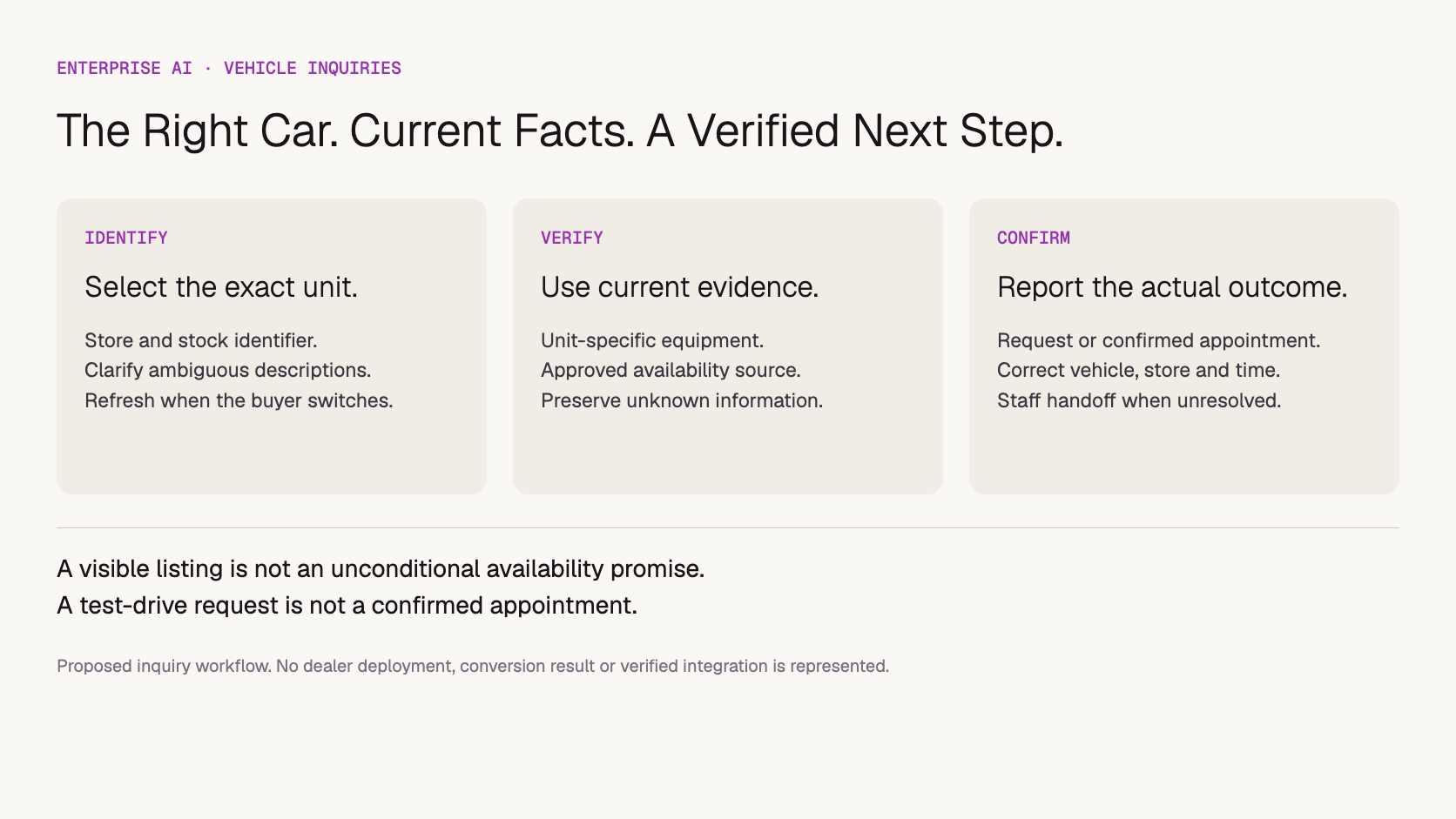
A proposed response workflow. Identity, current evidence and transaction confirmation are separate checks.
When can a test-drive request be called confirmed?
Call an appointment confirmed only after the authorized booking process returns a confirmed result for the correct vehicle, store and time. Before that, describe it as a request or proposed slot. The assistant’s ability to generate a booking tool call does not establish that the dealership accepted the appointment.
Record the requested time with the store’s local time zone, selected stock unit and customer contact details collected through the approved process. Ask for clarification when “tomorrow afternoon” is insufficient. A staff callback request and a calendar booking should have different statuses and different response text.
If the booking system times out, avoid saying either “confirmed” or “failed” without checking the actual outcome. The application needs a recovery path that can look up the request and prevent duplicate submissions. A human can resolve the uncertainty when the destination does not support reliable verification.
The handoff should include the known outcome: request submitted, staff follow-up pending, appointment confirmed or outcome unknown. Keep the reference returned by the destination system where available. The more general distinction between a tool call and an executed action applies, but the dealership pilot must verify its own appointment path.
Do not add outbound follow-up to the pilot merely because a model can draft messages. The business still needs approved recipient selection, contact rules, stop conditions and staff ownership. A draft answer, a created lead and a sent customer message are separate operations.
Should a dealer buy an automotive assistant or build with APIs?
Compare complete workflow coverage before comparing model names. An automotive assistant may already connect store context, inventory and staff follow-up. A custom model-API approach is more relevant when a dealer group needs a distinct workflow and has resources to maintain data access, permissions, testing and operational support.
DealerAI’s official connector documentation describes connections scoped to one store and separate permissions for reading inventory versus creating leads or starting follow-up. This is a useful example of product-level controls to evaluate; it is not evidence of comparative performance. See DealerAI’s connector and permission documentation, checked November 13, 2026.
Approach
Reason to consider it
What to verify
Existing automotive assistant
The packaged workflow fits store operations.
Actual inventory access, store boundaries, handoff and action permissions.
Staff responses with CRM templates
Inquiry volume or system complexity does not justify a new integration.
Response ownership, current facts and consistent handoff records.
Custom workflow with model APIs
The group needs control over logic, model choice or multiple systems.
Integration access, freshness, evaluation, support and total operating cost.
Automotive data access is a separate procurement dependency. Fortellis describes an API directory covering vehicle data and other automotive services; access to a directory is not proof that a specific dealer’s inventory or CRM is available to your application. Verify the exact provider, permissions and commercial requirements. See the Fortellis API directory overview.
No native Token360 dealership connector is established here. Model access cannot compensate for an unavailable inventory feed or a CRM integration that cannot record the handoff. The broader software-versus-model-API buying decision helps distinguish those responsibilities.
How should the dealer evaluate answers before launch?
Test whether the assistant answers for the correct unit and gives an accurate next-step status under realistic changes. Include stale listings, missing equipment, multiple stores and unsuccessful booking attempts. Score critical factual and action errors separately from tone, because an engaging response can still send a buyer to the wrong branch.
Create a reference set from authorized inventory snapshots or synthetic records. Have dealership staff establish the expected response and escalation for each case. Keep the source version with the test so an inventory change does not silently invalidate the expected answer.
Ambiguous identity: two vehicles fit the buyer’s description; clarification is required.
Missing equipment: an option is absent from verified unit data; the answer should preserve uncertainty.
Status change: the public page remains visible after the internal state changes.
Cross-store request: the selected unit and the buyer’s preferred branch differ.
Vehicle switch: the buyer changes units halfway through the conversation.
Booking uncertainty: the request times out or returns a pending result.
Access boundary: one store’s restricted notes should not appear in another store’s conversation.
Use the blank vehicle-inquiry review register to record expected facts, source references, action status and reviewer decisions. It contains no fabricated test outcomes. Track incorrect availability promises, mixed-unit answers and false booking confirmations as distinct failure categories.
Measure staff correction effort and handoff completeness alongside response time. A fast assistant that repeatedly requires staff to reconstruct the vehicle identity may save little work. For latency, distinguish retrieving current evidence from generating the final wording; an answer generated quickly from stale data is not the desired result.
Start with staff-visible drafts or a limited reviewed workflow if that best fits the risk and integration maturity. Broaden the audience or action permissions only after the corresponding tests pass. Avoid translating a small pilot into a claimed sales uplift without an appropriate business measurement design.
Where does Token360 fit in a dealership stack?
Token360 can be evaluated as the model-access layer inside a dealership application. The dealer or software partner supplies vehicle data, authorization and action integrations, while the selected model helps interpret requests and form responses. Procurement should cover both inference requirements and the application work needed to make those responses dependable.
The Token360 enterprise page describes access to text, image, audio and video models and custom enterprise pricing. A buyer-inquiry pilot may need only language capabilities at first. Voice and visual inputs require separate tests; they should not be added just because the catalog includes them. For company information, see About Token360.
Enterprise discussions can scope model mix, capacity, negotiated pricing, contracts and compliance requirements. Confirm the arrangements for the specific engagement rather than assuming an automatic SLA, certification or data-residency commitment. Token360 has confirmed that it does not charge a separate service fee; usage and application costs still need to be budgeted.
For a useful quote, specify expected conversations, typical turns, retrieval context, concurrent traffic and required response behavior when upstream systems fail. State whether the pilot is text-only or includes voice, and separate scheduled testing from live store traffic. Prepare workload information for an enterprise quote after defining what counts as an acceptable answer and handoff.
The same distinction between reported and confirmed status applies to a retail returns workflow.
Frequently asked questions
Can an AI API know whether a car is still available?
Only through the evidence supplied by the application or authorized tools. General model knowledge cannot establish a dealership’s current inventory state. Define the approved source and freshness requirements, and provide a fallback when that source is unavailable or ambiguous.
Is a VIN enough to answer every equipment question?
No. A vehicle identifier helps select the right record, but the answer still needs a reliable source for the requested fact. Do not assume an identifier or general trim description verifies every installed option, modification or condition detail.
Can the assistant offer another vehicle if the first is unavailable?
It can suggest verified alternatives if that is within the pilot scope. Make the change explicit and retrieve the alternative’s own facts. Do not carry over the original vehicle’s equipment, price or store location.
Does a confirmed test drive reserve the vehicle for purchase?
Do not imply that it does unless the dealership’s actual process explicitly establishes that outcome. The application should communicate the specific action confirmed by its system. Appointment status and purchase reservation status need separate definitions.
What should a first deployment avoid?
Keep unsupported negotiations, financing decisions and unverified booking promises outside the first workflow. Focus on exact vehicle identity, supported facts and a complete staff handoff. Add further actions only when the application can authorize, execute and verify them.
Evidence note: official sources checked November 13, 2026. The stock-unit example, evaluation plan and response workflow are illustrative and untested. No customer deployment, conversion gain, accuracy rate or verified integration is claimed.
Enterprise AI
API
Bring your next idea to life.
Create a video scene in Creator, or explore models for images, audio, and text to find the right capabilities for your project.



 Guides
 Guides
 Guides