AI for Freight Forwarders: Review Shipping Documents
Use AI APIs to compare shipping documents, flag version and quantity conflicts, and prepare source-linked questions for freight operators.
INDUSTRY USE CASES · FREIGHT FORWARDING
Freight forwarders can use AI model APIs to extract shipment details, compare document versions and prepare discrepancy lists for an operator. The useful output is a source-linked review packet, not a declaration that the shipment is compliant or ready for release. Preserve document roles, units and shipment identity before deciding whether two values genuinely conflict.
A shipment file can contain an invoice, packing list, booking reference, draft shipping instructions and a late email correction. Reading each file is only part of the work. An operator must determine which documents belong together, which version applies and whether a difference is an error, a different unit of measure or a legitimate difference in what the field describes.
This article addresses pre-submission document review for forwarding operations and logistics technology teams. For customer communication after a shipment event, see AI-assisted shipment exception explanations; that is a separate workflow and search intent.
Evidence boundary: The workflow and shipment packet below are illustrative, not a tested Token360 deployment. Carrier documentation was checked November 14, 2026. This is an operational document-review framework, not a complete customs checklist, classification service or clearance guarantee.
Which document task should a forwarder automate first?
Start with assembling an operator's discrepancy queue from a defined shipment packet. A model can extract candidate fields, identify possible omissions and draft precise clarification questions. Keep document amendment, submission and approval outside that initial task. This creates a reviewable output without asking a general model to decide the full documentary or regulatory requirements for every shipment.
A useful queue says where a value came from, what it was compared with and why the difference needs attention. “Packing list revision B shows 12 cartons; draft instructions show 10 cartons” is actionable. “Documents contain errors” is too vague to support an operator's decision.
Not every case needs AI. If the shipper already supplies validated structured fields, ordinary rules can compare them. Model assistance is most relevant when the inputs vary: scanned tables, different document layouts, multilingual descriptions or corrections embedded in email threads. The task still needs a defined output and an accountable reviewer.
What must remain separate across shipping documents?
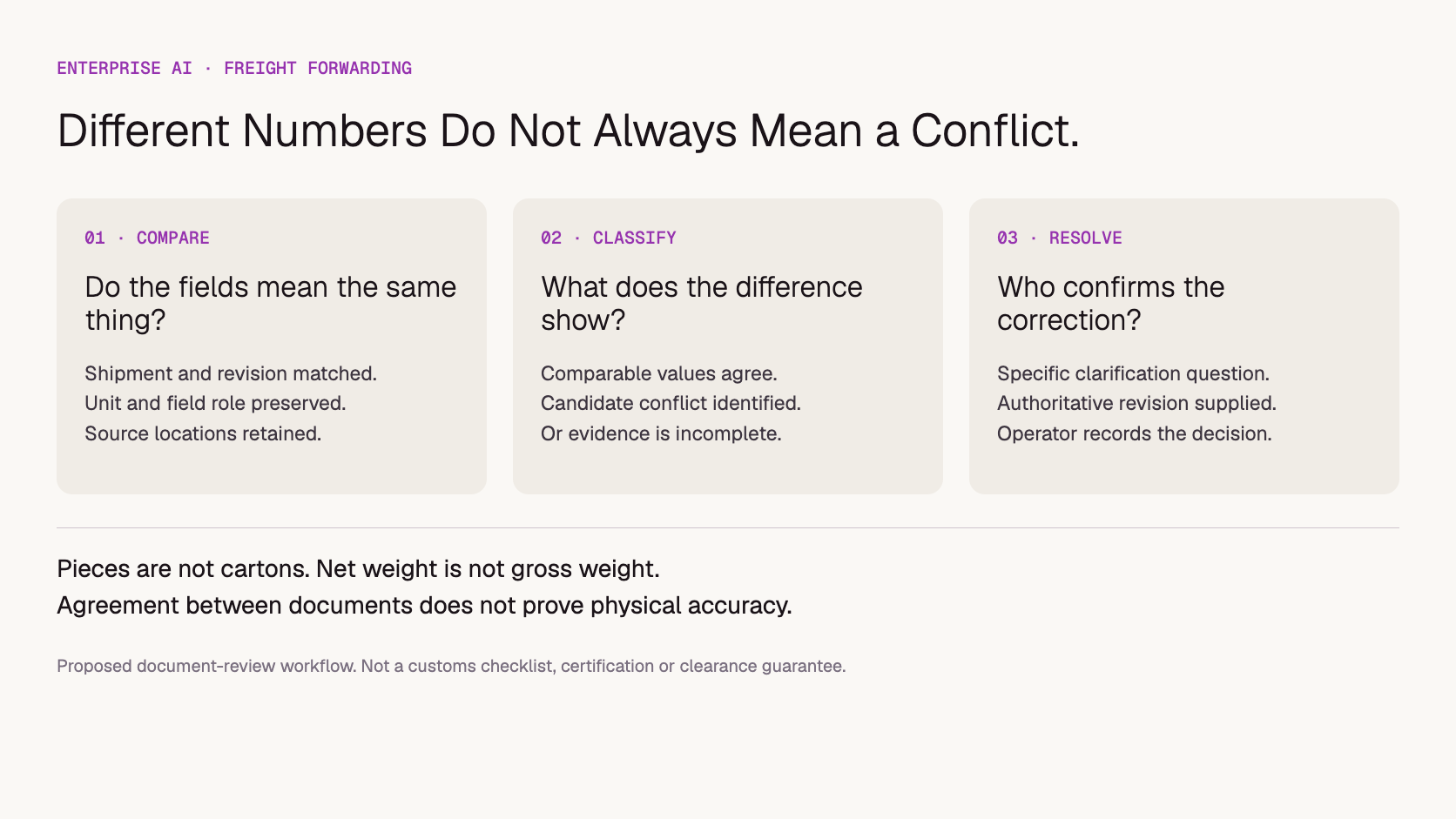
Keep the document's purpose, version and field meaning alongside every extracted value. Product quantity, package count, value and weight are not interchangeable. Comparing two numbers before identifying their units and scope creates false discrepancies. The review should distinguish genuine conflicts from non-comparable fields and missing information, rather than forcing every value into one normalized shipment summary.
Maersk's shipping-instruction checklist includes shipment and container identifiers, package count and type, cargo gross weight, cargo description and shipper/consignee details. It also points to additional local requirements. This is a carrier-specific reference, not a universal list that a forwarder should apply unchanged to every movement.
DHL's commercial-invoice guide discusses shipment references, parties, quantities, units and values. These field categories help frame extraction checks. The present workflow does not adopt that article as a complete legal interpretation or infer that one invoice format covers all jurisdictions.
Field family
Preserve with the value
Common comparison trap
Quantity
Item, unit and line reference
Comparing pieces with cartons as if they were equal units
Weight
Unit and stated weight type
Treating net and gross weight as conflicting versions of one number
Party
Role and authoritative record
Replacing a consignee with a similar-looking customer name
Reference
Reference type and source system
Confusing an invoice number with a shipment or booking number
Revision
Document date, issuer and confirmation state
Assuming the last uploaded file is the approved version
How should the workflow establish shipment identity and version?
Build a document manifest before extracting a consolidated record. List each file, its issuer, document role, shipment references and revision status. Use authorized operational data to confirm that the files belong to the same shipment. If the relationship is uncertain, hold the file for clarification rather than allowing the model to merge similar names or descriptions into one case.
Distinguish the document's date from the date it arrived in the system. A supplier can resend an old attachment after sending a newer revision. The newest email therefore does not necessarily contain the newest document. Explicit instructions about superseded versions should be retained with the relevant files.
Revisions also need field-level attention. A correction to package count does not establish that every other field has changed. Keep a comparison against the prior accepted version, and require the reviewer to decide which changes carry forward to draft instructions or other downstream records.
For unreadable pages or ambiguous table headers, preserve the uncertainty and link to the source page. Do not fill an empty cell from a nearby row unless the document structure establishes that relationship. The PDF input guide explains why text extraction alone may miss scanned content or layout-dependent information.
What does a useful discrepancy review look like?
A useful review separates confirmed matches, candidate conflicts, non-comparable values and missing evidence. Each finding should contain the exact source locations and a proposed clarification question. The operator then records a decision, identifies the authoritative correction and determines whether any downstream document needs amendment. The model should not silently choose a winner simply to produce a tidy result.
Fictional shipment packet: An invoice lists 240 pieces. A packing list says 12 cartons with 20 pieces per carton. Draft shipping instructions list 10 cartons. A later email says “updated packing list attached,” but the attached file has the same revision as the first copy. The packet also contains net weight in one document and gross weight in another.
Observation
Proposed classification
Next review step
240 pieces and 12 cartons × 20 pieces
Numerically consistent under the stated packing relationship
Confirm that the packing relationship applies to all relevant items
12 cartons versus 10 cartons
Candidate package-count conflict
Ask which count is authoritative for this shipment
“Updated” email with unchanged revision
Revision uncertainty
Request confirmation or the intended replacement file
Net weight versus gross weight
Different field meanings
Do not flag inequality alone as an error
The multiplication in this example is a simple arithmetic check, not evidence that the shipment physically contains the stated goods. A deterministic calculation can verify the arithmetic once the packing relationship has been confirmed. The model's useful contribution is interpreting the document structure and preparing the question, not making the arithmetic authoritative by restating it fluently.
A suitable clarification is: “Packing list revision B states 12 cartons, while the draft shipping instructions state 10. Please confirm the package count for shipment X and provide the approved revision if the packing list has changed.” That request is more useful than asking the shipper to resubmit every document without explaining the discrepancy.
A proposed discrepancy classification. Matching documents do not independently establish physical accuracy or regulatory acceptance.
What should remain outside the model's authority?
The model should not invent a missing declaration, classify goods autonomously, replace an approved party record or submit an amendment merely because it detects a difference. Keep regulated judgments, carrier submissions and release decisions with the authorized process and responsible specialists. A document consistency check can support that process without claiming to perform all of it.
Provide the assistant with the organization's approved checklist for the specific workflow, together with its version and scope. If an item is absent, report that it is missing from the supplied packet; do not state that the law universally requires it unless a qualified process has established that requirement.
Data quality and documentary consistency are also separate. Two documents can repeat the same incorrect address. A matching value should therefore mean “these sources agree,” not “this fact has been independently verified.” The review system should retain the source of an authoritative correction rather than replacing evidence with a model-generated consensus.
When integration eventually supports amendments, use explicit permissions, review gates and execution records. The approval-workflow guide explains why an accepted draft and an executed business action must remain separate. Initial pilots can remain entirely read-only.
Should the team use TMS features, document software or model APIs?
First check whether the existing transportation management system or document tool already supports the required extraction and validation. Consider model APIs when layouts and correspondence vary enough to need language or visual interpretation, or when the team needs a custom review interface. Compare the complete operational workflow, including source traceability and exception handling, rather than buying on extraction accuracy claims alone.
Approach
Potential fit
What to verify
Existing TMS/document features
Standardized records within the current operational system
Supported documents, validation rules and audit history
Dedicated document-processing software
Repeated extraction workflows with established review screens
Layout coverage, field provenance and export controls
Custom model-API workflow
Variable documents and emails requiring a tailored discrepancy queue
Model input support, integration ownership, access control and reviewer effort
Retain deterministic logic for identifiers, arithmetic, exact comparisons and permission checks wherever it fits. A model can propose a field mapping, but the application should retain the original text, normalized value and mapping decision separately. This makes it possible to investigate an incorrect comparison without recreating the whole conversation.
A custom API solution is an engineering commitment. Someone must maintain document ingestion, failed-page handling, retries, reviewer edits and export destinations. The broader software-versus-model-API guide covers that procurement tradeoff.
How should a forwarder evaluate the pilot?
Evaluate the discrepancy queue against a human-reviewed reference packet, including difficult examples and clean packets with no issues. Measure missed conflicts, false alarms and unsupported corrections separately from extraction completeness. The pilot should show whether operators reach a justified decision with less total effort, rather than simply whether the model can fill more fields.
Include scanned tables, multiple revisions, mixed units, similar party names, partial shipments and an attachment from the wrong case. Record the expected disposition before reviewing model output: match, clarify, reject the association or refer to a specialist. A model that escalates genuine ambiguity can be more useful than one that always produces a complete normalized record.
Field fidelity: Does the extracted value preserve its unit, role and source location?
Packet identity: Are unrelated files kept out of the case?
Comparison quality: Are actual conflicts found without treating different field meanings as errors?
Correction discipline: Does the assistant avoid overwriting values without authority?
Operator effort: How long do review, clarification and correction take?
Use the blank shipping-document review register to record those outcomes. It contains no benchmark results. Compare the existing process and model-assisted process on equivalent packets, including failures and rework. Track cost per accepted review packet using model charges, ingestion, review labor and allocated integration effort.
Do not infer faster customs clearance from a faster internal review. Clearance, carrier acceptance and departure depend on additional processes that this evaluation does not measure. Likewise, a lower model price is not enough if false alarms add operator work. See the full-cost framework for AI APIs when planning the budget.
What should freight teams discuss with Token360?
Bring representative, authorized document types and a defined workload: pages per packet, languages, scan quality, expected peak volume and the review output required. Token360 provides access to text, image, audio and video models, with dedicated capacity, negotiated pricing, contracts and compliance requirements scoped to an engagement. For this task, text and document-image capabilities are the relevant starting point.
Confirm the actual input formats and limits for each selected model. Access to a vision model does not mean every endpoint accepts a PDF directly or preserves every page's layout. Prototype the ingestion path and verify that source references survive extraction before comparing model answers.
As checked November 14, 2026, the Token360 enterprise page describes model access and commercial options. This article does not claim a ready-made TMS connector, carrier submission integration, customs certification or universal SLA. Confirm the proposed deployment's availability and terms; Token360 resources and company information provide platform context.
Limit access to shipment documents by customer and case. Confirm the applicable data-retention and training terms before processing commercial records. Drafts, originals and corrections should remain distinguishable in the operational system.
Use the equipment rental booking guide for a separate example of validating dates and availability before confirming a request.
Frequently asked questions
Can AI check a commercial invoice against a packing list?
It can assist with extracting and comparing relevant fields when the inputs are supported. Preserve units, field meaning and document versions, and review potential conflicts. Agreement between documents does not prove that either document is correct.
Should different quantities always be flagged as errors?
No. Pieces, cartons and pallets describe different units. Establish the packing relationship before comparing quantities. If that relationship is missing, ask for clarification rather than invent a conversion.
Can the model choose the latest approved revision?
Only supplied, authoritative version information can establish approval. The newest upload or email may contain an older attachment. The assistant can identify revision clues, but ambiguous authority needs confirmation.
Does a successful AI review mean the shipment will clear customs?
No. This workflow checks a defined document packet for selected issues. It does not establish complete compliance, acceptance by a carrier or approval by an authority. Those decisions remain with the applicable authorized processes.
Does Token360 provide a freight document-management system?
No such product is claimed here. The proposed workflow uses model APIs within a forwarder's application or document system. Ingestion, reviewer controls and downstream integrations need to be provided and tested for the deployment.



 Guides
 Guides
 Guides