AI APIs for Equipment Rental: Check the Whole Booking
Use AI APIs to organize equipment rental inquiries. Check dates, kit components and reservation status before promising availability to customers.
INDUSTRY USE CASES · EQUIPMENT RENTAL
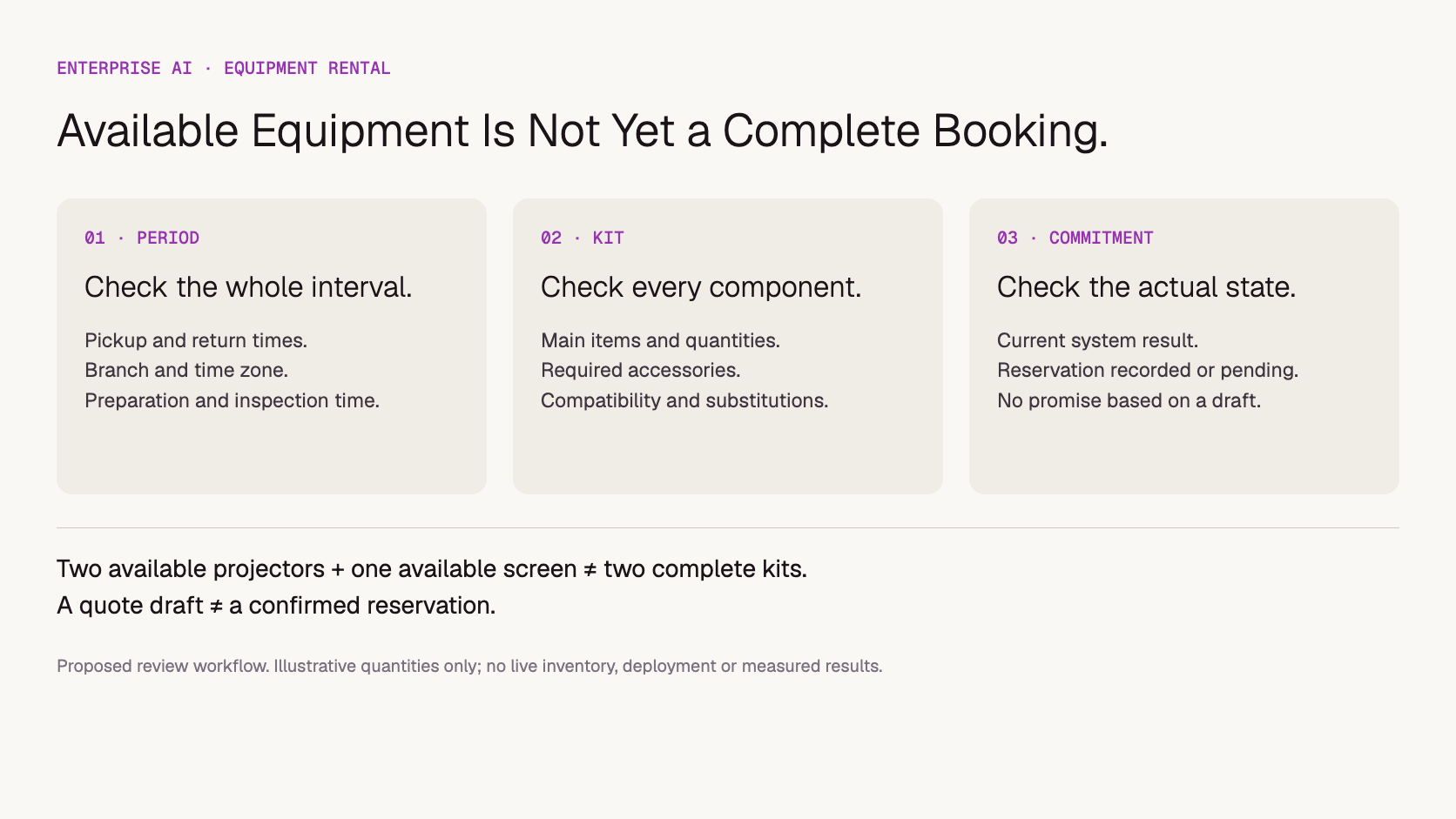
Equipment rental companies can use AI APIs to turn customer messages into structured rental requests, identify missing details and draft replies. Availability, prices and reservations should come from the rental system. A projector that is free today is not necessarily available—with its screen, cables and turnaround time—for the customer's entire booking.
The useful starting point is a reviewed inquiry assistant. It helps a coordinator understand what the customer needs before a promise is made. The business case depends on fewer clarification rounds and less correction work, not simply faster email generation.
Evidence boundary: This is a proposed workflow for rental businesses and software teams serving them, based on official documentation reviewed November 13, 2026. The example is fictional. We have not tested a Token360 rental-system integration or measured booking outcomes.
Where can AI help an equipment rental business first?
Start where customers describe needs in ordinary language and staff must convert those descriptions into a rental request. AI can summarize the intended use, extract quantities and dates, and ask for missing information. Keep product selection, suitability decisions and inventory commitments under the controls your rental operation already uses.
A customer might ask for “a projector and everything we need for a Friday presentation.” That describes an outcome, not a complete booking. Staff still need the venue, audience or room requirements, connection type, pickup time, return time and delivery arrangements. The model can organize those gaps without pretending the answers were supplied.
For audiovisual or photography rental, a reviewed assistant can assemble a candidate kit from an approved catalog. For tool and machinery rental, it can organize the request for qualified staff, but it should not independently certify equipment suitability, operator qualifications or a safe working method. Choose the first category where the team can clearly define what a correct draft contains.
Task
Useful model contribution
Operational owner
Understand the inquiry
Extract requested equipment, purpose and unresolved details
Customer confirms ambiguous requirements
Build a candidate kit
Match language to approved catalog candidates
Catalog rules and trained coordinator validate compatibility
Check fulfillment
Explain returned availability results
Rental system checks dates, quantities, location and downtime
Prepare a reply
Draft a concise explanation or clarification
Staff approve commitments and exceptions
Why is rental availability different from stock on hand?
Rental availability is a question about a particular interval, quantity and location. Equipment may be present now but allocated tomorrow, or expected back before the next hire but still require inspection. An inquiry assistant must use the requested period and operational constraints rather than treating a catalog listing or current stock count as a promise.
Booqable's availability calendar documentation illustrates the distinction: it shows booking periods, quantities, stock-item identifiers, downtime and buffer-time extensions. These are rental-system inputs, not facts a language model should reconstruct from an old conversation.
In your own workflow, make the meaning of the interval explicit. “Friday to Monday” could mean Friday morning pickup and Monday morning return, while the customer's event lasts only Friday evening. Store the operational pickup and return times, the branch time zone and any applicable preparation or inspection period separately from the event description.
Do not invent a universal buffer. A battery-powered kit may require charging; another item may need inspection; a different product may be ready immediately. Apply your approved rules through the rental system. If those rules are not maintained anywhere, the first improvement is operational data preparation.
What would a complete rental inquiry look like?
A complete draft preserves the customer's requested use while making every unresolved dependency visible. Record the equipment and accessory quantities, pickup and return details, location and requested services. Then distinguish what the customer said, what the catalog suggests and what the rental system has actually checked. That separation makes the draft reviewable.
Fictional example: A customer requests two presentation kits for Friday 9 a.m. through Monday 10 a.m., collected from the central branch. Each approved kit contains one projector, one screen and one compatible signal cable, plus the catalog's required power accessories. The customer has not specified the laptop connection.
Check
Illustrative finding
Implication for the reply
Main equipment
Two projectors available for the requested period
Do not yet promise two complete kits
Required accessories
Only one screen available across the whole period
The requested two-kit configuration is incomplete
Compatibility
Laptop connection not supplied
Ask before choosing an adapter
Alternative branch
Another screen exists elsewhere; transfer unconfirmed
Present a transfer as a pending option, not fulfilled availability
Booking state
Inquiry draft only
Do not say equipment has been reserved
A suitable draft could say: “We can prepare a quote, but the second screen needs confirmation for your full rental period. Which laptop connection will you use? We will check the complete kit before confirming the reservation.” This is more useful than a fluent but unsupported “Everything is available.”
The example deliberately does not quote a rate or claim a hold. Price calculation, transfer feasibility and reservation status require their own verified results. An available substitute is also not automatically an acceptable substitute: changing a screen size or connection can change whether the equipment meets the customer's needs.
Proposed review sequence. A successful equipment lookup does not establish a complete reservation.
When does an inquiry become a reservation?
An inquiry becomes a reservation only when the rental system records the appropriate commitment under your business rules. An AI reply, a draft quote and a successful availability lookup are separate events. The assistant should report the returned state accurately and avoid implying that stock has been held just because a draft exists.
For a concrete software example, Booqable distinguishes draft and reserved orders: products on a draft are not reserved for the period, while reservation makes the relevant quantities or items unavailable to other orders. Other systems may use different states, so map their documented behavior instead of copying these labels blindly.
Availability can also change between checking and committing. Design the integration to handle a rejected reservation without sending the earlier optimistic reply. Let the operational system resolve competing bookings; the model should explain the actual result and offer a reviewed next step.
The same principle applies to extensions. A customer who already has a kit cannot necessarily keep it another day. Recheck every retained component for the extended interval and any affected turnaround time. For the broader boundary between model recommendations and executed operations, see what an AI tool call actually executes.
Should you use rental software features or build with an API?
Use existing rental software features when they already cover the inquiry channel, inventory workflow and staff approval process. A custom model API becomes worth evaluating when language-heavy requests span multiple channels or systems and your team can maintain the integration. Keep the reservation platform authoritative in either approach.
Option
Good fit
What to verify before buying
Existing rental platform
Standard catalogs, forms, quotes and reservation workflows
Whether current features solve the actual coordination problem
Platform-connected assistant
Vendor-supported language assistance within an established workflow
Supported actions, source visibility, approvals and additional charges
Custom model API integration
Complex messages across channels, multiple catalogs or custom review needs
API permissions, data access, engineering ownership and acceptance tests
Booqable's official API documentation includes availability resources for orders, products and bundles. That demonstrates a possible integration surface; it does not establish that Token360 has a ready-made Booqable connector, that every subscription includes the necessary access, or that your workflow has been tested.
Before commissioning a build, have the developer demonstrate a read-only request using your actual system and permissions. Then verify how quotes and reservations are created, which failures are recoverable, and who supports the connection. The distinction between buying AI software and buying model access matters here: model access does not supply the rental application.
How should a rental company evaluate a pilot?
Evaluate whether the assistant produces a correct, reviewable inquiry with fewer staff corrections. Include unavailable accessories, ambiguous dates, branch transfers and extensions, not just easy catalog matches. Record operational mistakes separately from writing quality, and compare reviewed work with the existing process before allowing customer-facing commitments.
Build a small evaluation set from authorized, appropriately minimized examples. Have an experienced coordinator establish the expected interpretation and the required next action before reviewing model output. Use the same catalog and inventory snapshot for paired comparisons, or record when live availability changes so the comparison remains interpretable.
Date boundary: Does an evening event incorrectly become an evening pickup when collection must happen earlier?
Quantity boundary: Does the draft request two complete kits or merely two main devices?
Compatibility boundary: Does it ask about an unknown connector instead of assuming one?
Turnaround boundary: Does it preserve inspection or preparation time returned by the system?
State boundary: Does it label an uncommitted inquiry as reserved?
Change boundary: Does an extension or substitution trigger a fresh operational check?
Track draft acceptance, correction minutes, missed required information and unsupported commitments. A reply that staff can rewrite quickly is not equivalent to one that silently promises unavailable equipment. Agree on escalation rules for these failures before considering any automated sending.
Copy the blank rental inquiry review register below to record the requested interval, component checks, actual booking state and reviewer decision. It contains no measured results. For a broader rollout decision, apply the pilot-to-production readiness checks after this workflow passes its own acceptance criteria.
Discuss the model workload, data formats, peak inquiry volume and review requirements. Token360 supplies enterprise model access across text, image, audio and video; the rental application still needs its inventory connection, operational rules and approval process. Dedicated capacity, negotiated pricing, contracts and compliance requirements must be scoped to the engagement.
For an initial inquiry assistant, text may be enough. If voice messages are material to the workflow, evaluate transcription as a separate step and check dates, quantities and product names against the recording. Adding more modalities should follow a real input need, not expand the pilot merely because models are available.
As of November 13, 2026, Token360's enterprise page describes model access and custom pricing and distinguishes current capabilities from roadmap or sales-scoped offerings. Confirm the exact throughput, support and contractual scope rather than assuming a blanket SLA. About Token360 provides company context.
Token360 does not charge a separate service fee, based on the company's confirmed commercial positioning. Model usage, rental software, integration and review work still belong in the budget. Use the enterprise quote preparation guide to document request volume and model mix, and compare the cost per reviewed inquiry with your baseline. No cost saving or latency improvement is claimed in this article.
When rented equipment needs service, repair status updates follow a separate evidence and approval workflow.
Frequently asked questions
Can AI automatically confirm equipment availability?
It can communicate a current result from an authorized rental-system query. It should not infer availability from a catalog description or old message. Confirmation of a reservation requires the relevant recorded commitment, not just an availability response.
Can the assistant recommend substitute equipment?
It can propose approved alternatives for review. Validate compatibility, capacity, accessories, price and availability, and obtain the required customer approval. Do not silently substitute a product merely because its name looks similar.
Do we need image or video models for rental inquiries?
Not necessarily. Text is a sensible starting point for emails and forms. A photo may help staff identify a requested item, but appearance alone should not certify an exact model, safe condition or suitability. Add modalities only when the workflow and evaluation justify them.
Will a model API prevent double bookings?
No. The rental system must enforce reservation rules and handle competing requests. A model can help interpret and explain the outcome, but a convincing response is not a stock lock or a scheduling control.
Is this a tested Token360 rental solution?
No. It is a proposed design informed by public rental-software documentation and Token360's confirmed scope. A production connector, customer results and performance figures have not been demonstrated here.



 Guides
 Guides
 Guides