AI APIs for Logistics: Explain Shipment Exceptions
Use AI APIs to summarize shipment exceptions, preserve tracking evidence and draft clear customer updates without inventing causes or delivery promises.
INDUSTRY USE CASES · LOGISTICS & FREIGHT
AI APIs for logistics can help operations teams summarize shipment events, identify missing information and draft customer updates about exceptions. They need current, authorized tracking and operational data as input. The model should explain what the records support, preserve uncertainty and identify the next owner—not invent a location, delay cause or delivery commitment.
For a freight forwarder, third-party logistics provider or shipping platform, a customer question rarely arrives as a neat event record. “Where is my shipment?” may require checking several packages, a carrier status feed, an internal note and an earlier promise. A useful AI-assisted workflow brings those facts together without pretending that a fluent answer resolves the underlying exception.
Read first: choose AI models by business use case. This article covers shipment exception communication, rather than route optimization, warehouse robotics or generic chatbot deployment.
What should a logistics AI assistant produce?
It should produce a concise case summary that separates observed events, estimates, unresolved questions and proposed next actions. Each material statement should point to its source and time. The immediate deliverable is a reviewable operational explanation, while carrier investigations, customer commitments and transport changes remain separate actions with their own authority.
A useful output answers four practical questions: what was last reported, which shipment or package that report concerns, what remains unknown and who should do what next. The customer-facing version may be shorter than the internal record, but it should not become more certain simply because detail was removed.
For example, consider a hypothetical shipment with two packages. One has a delivery event, while the other has an earlier depot scan. A summary saying “Your order was delivered” would collapse two different states. A better draft identifies the delivered package and describes the last available information for the other one, with its timestamp.
Which shipment data does the model need?
Supply the correct shipment and package identifiers, relevant carrier events, source timestamps, current estimates and authorized operational notes. Keep the relationship between an order, a shipment and its individual pieces explicit. Give the model only the records needed for the question, after verifying the requester's access to them.
GS1's explanation of EPCIS describes visibility data as events recording what happened, when, where and in what business context. That is a useful reference for preserving event meaning. This article does not require every carrier feed to use EPCIS or claim that Token360 implements the standard.
Input
Keep with it
Why it matters
Shipment and package identifiers
Order relationship and source system
A status for one piece must not become the status of the entire order.
Reported event
Original code, description, location and event time
A model's paraphrase must not change what the carrier reported.
Retrieval time
When the application last fetched the source
Old information should not be presented as freshly checked.
Delivery estimate
Source, applicable package and update time
An estimate must remain distinct from an observed arrival.
Operations note
Author, time and confirmation state
A proposed explanation is different from a verified cause.
Customer commitment
Approved wording, owner and conditions
A generated reply must not create a new promise.
Keep event time and retrieval time separate. An application might retrieve a record today whose last physical scan occurred yesterday. Displaying today's retrieval time alone could suggest a movement that never happened. Preserve time-zone context as well, especially when events cross locations.
The application should reconcile identifiers before asking for a summary. If the customer supplies an order reference that maps to multiple shipments, the model should not guess which tracking number is intended. Resolve the relationship through authorized business data or ask a clarifying question.
How should the assistant explain a delay without guessing?
Use the recorded reason if one is supplied and relevant. If the source only shows a delay or a missing update, say that the cause has not been confirmed. Distinguish an explanation supported by evidence from a possible cause an operator might investigate, and keep that distinction in the customer-facing response.
Suppose an illustrative case has a last depot scan at 14:20 and no later movement record. “The parcel is delayed because of severe weather” is unsupported unless an applicable source says so. “The latest available scan is at the depot; we do not yet have a confirmed reason for the missing update” describes the evidence more accurately.
That example does not mean every gap is an exception. The operations team should define which event gaps, customer commitments or status changes warrant review for the relevant service. A model should not invent a universal threshold or classify routine transit as a failure simply because a customer asks about it.
Keep internal hypotheses in an internal field. An agent may consider a missed connection or missing paperwork, but those possibilities should not automatically become facts in an outgoing message. A case owner can investigate them and update the record when there is confirmation.
Can an AI model provide an accurate delivery ETA?
A language model can explain an ETA supplied by an appropriate operational source, but a generated sentence is not a delivery forecast. If your workflow needs prediction, evaluate the forecasting system separately. Preserve the source and uncertainty of its estimate, and avoid turning a time window into a guaranteed appointment.
The FedEx Basic Integrated Visibility documentation describes tracking events, delay details where available and estimated delivery windows. It notes that delivery-window information is not returned for every tracking number. These are FedEx-specific examples of source capabilities and limits, not features supplied by Token360.
If an ETA is absent, the assistant should not fill it from a typical transit time or from general knowledge about the route. A useful reply can state that no current estimate is available and identify the planned follow-up. If an estimate changes, compare the current source with the prior one and avoid describing the old date as current.
Keep the customer's requested delivery date separate from the carrier's estimate and from the logistics company's approved commitment. All three may appear in the same case. The model should label them rather than choose the most reassuring date.
How should customer messages and operational actions connect?
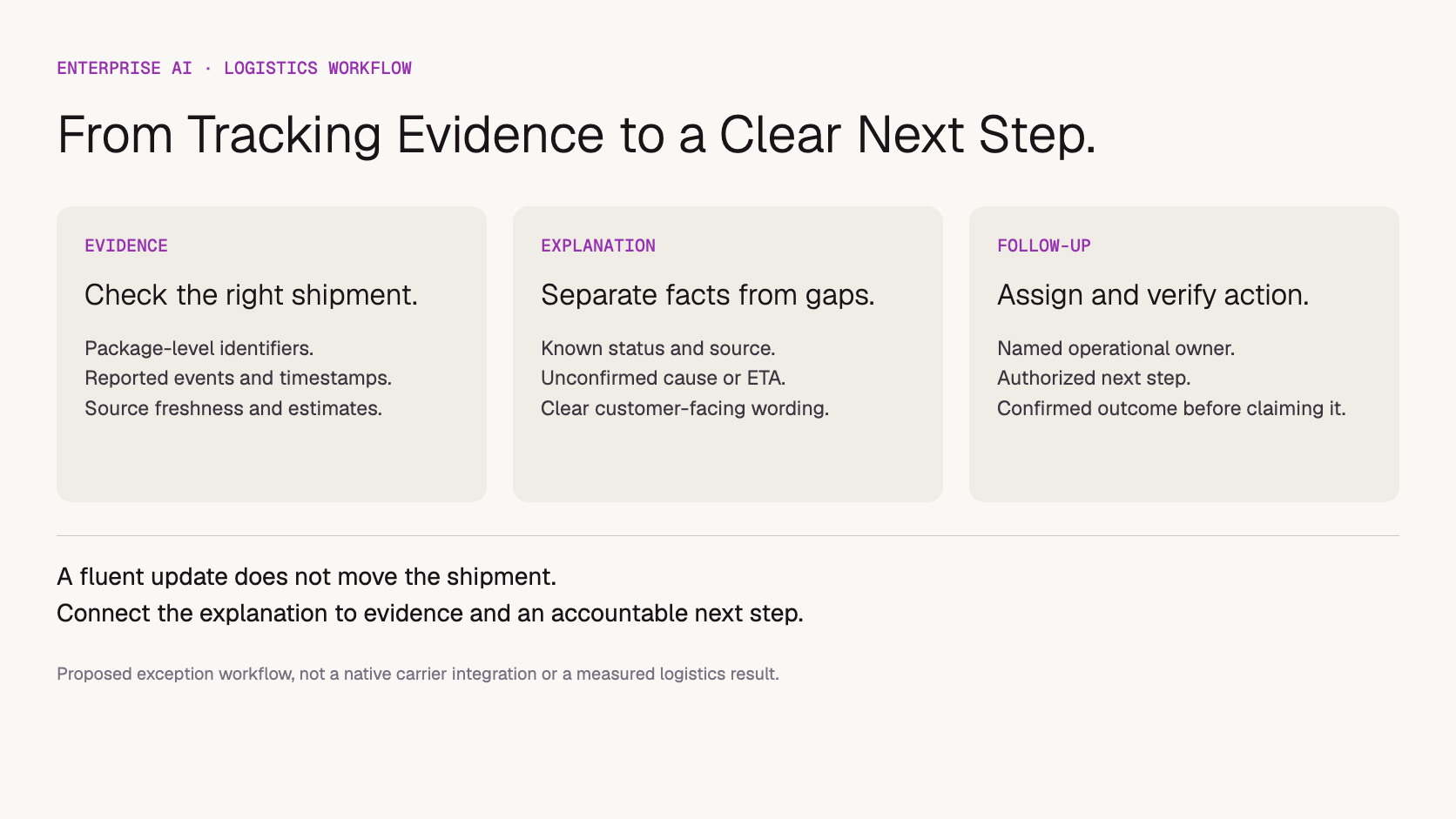
A customer update should state what is known, what remains uncertain and the next confirmed step in clear language. An operational action needs an authorized owner and a recorded outcome. Drafting “we have opened an investigation” is not evidence that an investigation exists; check the system before making that statement.
For the hypothetical two-package shipment, a draft might say: “The tracking record shows package A as delivered. Package B's latest reported event is a depot scan yesterday afternoon. No updated delivery estimate is available in the current feed. Our operations team will review the missing update.” The final sentence is appropriate only if that review is actually assigned under the company's process.
If a customer asks to redirect a shipment, the assistant can classify the request and prepare the relevant details. The application must still verify eligibility, authority and the result of the carrier operation. See why an AI tool call is not proof of execution for the general distinction.
Translation can help a multilingual service team, but it should preserve shipment identifiers, dates and uncertainty. Review important operational terms and avoid translating a status into a stronger claim. For recurring approved wording with little variation, a deterministic template may be simpler than a new generation.
Where should a human take over?
Escalate when records conflict, the customer disputes the reported outcome, a required source is unavailable or the proposed action exceeds the assistant's authority. The handoff should carry evidence and the unresolved question. Human review is most useful when the operator can see why the case needs attention without rebuilding its history.
Suggested exception workflow: evidence, explanation and authorized follow-up are different stages.
A delivery record and a customer report of non-receipt are conflicting pieces of information to investigate. The model should not dismiss the customer or decide liability from the tracking status. Collect the applicable records and route the case according to the company's procedure.
Similarly, an unavailable carrier API is a data-access problem, not proof that a shipment has stopped moving. Describe the failed refresh separately from the last known status. Give the operator the retrieval failure and the age of the available information.
The shipment exception review register provides blank fields for sources, unresolved facts, case ownership and the confirmed action result. It is a planning template, not a carrier connector or a functioning transport management system.
Measure whether the assistant produces correct, useful explanations from the available evidence and reduces the work needed to prepare a case. Include failures to retrieve data and difficult multi-piece cases. Evaluate response speed alongside factual errors, unsupported promises and operator corrections; fast wording alone does not establish service quality.
Build an authorized historical test set with known case outcomes. Include stale scans, multiple packages, changed estimates, contradictory notes, missing delay reasons and completed actions that need accurate reporting. Have operators define acceptable summaries before comparing model outputs.
Identity accuracy: Does every statement refer to the correct order, shipment and piece?
Time fidelity: Does the explanation distinguish event time, retrieval time and estimate validity?
Evidence discipline: Are missing reasons and absent ETAs left unresolved?
Handoff quality: Does the next owner receive the relevant records and a clear question?
Action truthfulness: Do messages describe only actions that are assigned or confirmed at the stated stage?
Record model usage, source retrieval, retries, review and manual correction separately. Compare the cost of an accepted case summary, not just the price of one model response. This article contains no measured reduction in support workload, delay duration or delivery failures.
Begin with internal drafts for one exception category. Moving to customer-facing delivery requires separate checks for access, wording, freshness and escalation. The pilot-to-production guide covers the wider decision to scale.
Where does Token360 fit in logistics operations?
Token360 can supply enterprise model access for interpreting text and, where the selected model supports it, reviewing relevant document images. The logistics application still retrieves carrier data, controls customer access, manages cases and executes actions. Model access should be evaluated as one component of the workflow, not as an out-of-the-box tracking platform.
As checked November 12, 2026, Token360's enterprise page describes multimodal access and custom enterprise pricing. Dedicated capacity, contracts and compliance requirements can be scoped for an engagement. No native carrier integration, transport management system, ETA forecasting engine or guaranteed delivery improvement is claimed here.
For an initial discussion, describe daily case volume, peak periods, typical event-history size, languages and expected response times. Distinguish source-system waiting time from model generation time. More inference capacity cannot fix a carrier feed that has no new information.
Share only the information required for the task under the applicable data arrangements. A package identifier, recipient address and proof-of-delivery record may require different access controls. Keep authorization in the application rather than relying on a prompt telling the model to be careful.
How do you connect a first exception-summary pilot?
Use a read-only carrier or tracking-data connection in your application to resolve the shipment and fetch its events. Normalize package identifiers, event times and retrieval times before calling a text model. Return the proposed summary to an internal case screen with the original evidence. Keep carrier credentials and customer authorization in the application, outside the prompt.
For the two-package example, acceptance requires separate statements for package A and package B; the draft must not mark the order fully delivered. Test a failed refresh as well as a successful one: the interface should expose stale evidence instead of silently treating it as current. Start without automated customer sending or shipment changes, then add those integrations only after the relevant approval and result checks work.
If a shipment exception starts with an ambiguous sales order, the wholesale order intake workflow shows how to validate item and quantity before fulfillment.
Can Token360 track a shipment from its tracking number?
No direct tracking capability is established here. Your application needs authorized access to a carrier or tracking-data service, then can pass relevant results to a model for interpretation.
Can AI tell us why a shipment stopped updating?
It can explain a reason provided by a relevant source. Without that evidence, it should identify the missing information and support investigation rather than invent a cause.
Should every tracking event trigger a generated message?
No. Use operational rules to decide which changes matter to the customer. Routine states may suit templates, while unusual cases may benefit from a reviewed explanation.
Does a delivered status resolve a non-receipt complaint?
No. Preserve both the carrier record and the customer's report, then route the discrepancy for investigation under the company's process.
What is a useful first logistics AI project?
Prepare internal summaries for one well-defined exception queue using authorized records. Test identity, evidence, timestamps and handoff quality before allowing automated customer updates.
Evidence scope: proposed workflow analysis using GS1, FedEx and Token360 sources checked November 12, 2026. The shipment examples are hypothetical. No live carrier integration, controlled model test or measured logistics outcome is claimed.
Enterprise AI
API
Bring your next idea to life.
Create a video scene in Creator, or explore models for images, audio, and text to find the right capabilities for your project.



 Guides
 Guides
 Guides