AI API vs Self-Hosting: Who Should Run Your Models?
Choose AI API access, managed deployment or self-hosting by model availability, operating responsibility and workload fit—not GPU price alone.
ENTERPRISE AI · INFERENCE OPERATIONS
Choose an externally operated AI API when you want to buy model inference without running its serving stack. Consider self-hosting when a deployable model meets your needs, control has a concrete business purpose and your team can operate the service reliably. Compare managed dedicated deployment as a third option. The decision is who operates inference, not simply who owns the GPU.
This article is an enterprise deployment decision framework, not a hardware benchmark or supplier price comparison. The scenarios are hypothetical. It does not establish that any particular deployment will be cheaper, faster or more secure.
Read first: AI software versus a model API addresses whether to buy a finished application. This article starts after the company has decided it needs model inference and must choose how that service will be operated.
What is the difference between an AI API and self-hosting?
In this comparison, an AI API means a model service operated by an external provider. Self-hosting means your organization operates the model-serving software on infrastructure it owns or rents. A self-hosted model can also expose an API. The interface may look similar while the operational responsibilities differ substantially.
Renting cloud GPUs is therefore compatible with self-hosting; buying physical servers is not required. Conversely, dedicated infrastructure does not necessarily mean self-hosting if a supplier operates it for you. Ask who manages the serving software, scaling, changes and incidents rather than relying on labels such as “private” or “dedicated.”
Operating model
What the buyer receives
Responsibility to establish
Useful reason to investigate
Externally operated model API
Access to a supported inference service
Provider service scope; customer application and data responsibilities
Reduce direct serving operations or access models offered as a service
Managed dedicated deployment
A specified deployment or capacity arrangement with an operator
Who manages each layer, what is isolated and what changes require approval
Meet defined capacity or deployment requirements without owning every operating task
Self-hosted serving
A deployment operated by your team on owned or rented infrastructure
Runtime, capacity, monitoring, updates and recovery within your scope
Exercise needed deployment control with a capable operating team
These are purchasing categories, not standardized guarantees. A contract and technical design determine the actual division of work.
Can the model you need actually be self-hosted?
Check deployment eligibility before comparing infrastructure prices. Your preferred model must be available in a form you can deploy, its applicable terms must permit the intended use, and a suitable serving implementation must support the required workload. An API catalog entry alone does not establish any of those conditions.
Ask for the exact model artifact or revision, supported runtime and relevant deployment documentation. Have the appropriate internal owner review the applicable model terms. Do not assume every hosted model has downloadable weights, or that every downloadable model has identical commercial conditions.
Then confirm the capabilities the application needs: context length, input modalities, tool handling, structured output or generation settings. If the comparison changes the model or its execution configuration, test whether the business output still meets the requirement. A cheaper deployment of a different candidate is a new proposal, not automatically an equivalent replacement.
For a specific open-weight example, the separate gpt-oss-20b deployment guide covers that model’s API-versus-self-hosting considerations. Keep model-specific decisions in that evaluation rather than generalizing one model’s results to the entire portfolio.
When is an externally operated API a sensible starting point?
An externally operated API deserves consideration when the required model is available as a service, demand is still uncertain or the company does not want to maintain inference infrastructure. It can let the application team focus on its workflow. The buyer must still verify service limits, data handling, commercial terms and escalation paths.
Consider a hypothetical product team introducing an AI feature whose adoption is unknown. Procuring a large fixed deployment before understanding traffic may create an avoidable commitment. A provider-operated route can be evaluated first, provided its available capacity and terms fit the pilot and intended rollout.
This does not make an API unlimited or operationally effortless. The application still needs to handle errors, timeouts and unsuitable outputs. The service may have rate limits, model changes or contract constraints. Ask what happens when demand exceeds the agreed scope and how the team obtains support.
Use Token360’s model capability documentation to check the selected model’s interface and limits. A successful demonstration is evidence of a working request, not evidence that the service has already been validated at your production load.
When does self-hosting deserve a serious evaluation?
Self-hosting deserves evaluation when the company has a specific need for deployment control, a suitable model and the ability to run the serving environment. Name the control you need: a particular runtime, change schedule, network arrangement or artifact. “We want control” is not enough to establish a business case.
A hypothetical organization might already operate a supported model for a stable internal task and have an infrastructure team responsible for it. Extending that service could be reasonable. Another organization may need to retain a particular tested configuration for its application. Both cases still require capacity, security and continuity planning.
Do not treat GPU availability as evidence that the service is production-ready. Someone must manage the software, monitor behavior under load, respond to failures and validate changes. vLLM’s production metrics documentation, for example, exposes measurements such as waiting requests, queue time and time to first token. Those signals illustrate the operating work beyond starting a model process.
Before approving self-hosting, name an operating owner and a backup, define service hours and record the recovery plan. If the proposal depends on one engineer informally maintaining a demonstration, treat that as a gap to resolve rather than a completed operating model.
Why does the traffic pattern matter more than a monthly total?
The same monthly request count can arrive steadily, in short bursts or after long idle periods. Those patterns create different capacity and responsiveness requirements. Compare the workload over time, including peaks, request size and acceptable waiting time, before concluding that owned or reserved compute will be well used.
For example, a nightly document-processing job may tolerate waiting that an employee-facing chat application cannot. A burst following a campaign may require spare capacity even when average use is modest. These examples do not identify a universal winning architecture; they identify the evidence the proposal should include.
Scaling down can reduce idle resource use but may introduce restart delays. Hugging Face’s endpoint autoscaling documentation explicitly describes a cold-start period after scaling to zero. That is a documented example, not a claim that every managed endpoint or self-hosted system behaves identically.
Ask the operator to demonstrate the relevant conditions: ordinary load, a representative burst, recovery after an interruption and any scale-from-idle behavior. Record the actual configuration and accepted output quality. Keep a hardware-throughput demonstration separate from an end-to-end application result.
If connectivity is a mandatory constraint, use the offline AI versus cloud API guide to check what must run locally and what the deployment must support.
Does self-hosting automatically improve privacy or security?
No. Self-hosting changes the deployment boundary and the tasks your team controls, but does not automatically make those tasks secure. An externally operated service also needs review. Compare actual data flows, access, storage, logging and operating responsibilities in each proposal rather than using the hosting label as a security conclusion.
AWS’s shared responsibility model illustrates the distinction for rented infrastructure: customers using EC2 retain responsibilities such as guest operating-system and application management, while AWS operates underlying infrastructure. The allocation changes with the service used. This is an AWS example, not a description of Token360’s contractual commitments.
A company evaluating deployment control should trace prompts, outputs, logs, backups and administrative access. Determine which requirements are mandatory, what evidence demonstrates them and who maintains the controls. Do not equate a chosen server location with a complete data-handling assessment.
If isolation or location is the reason for considering a dedicated service, request a specific description of what is isolated or located there. An account label, a private endpoint and dedicated compute describe different things; the project needs the arrangement that satisfies its actual requirement.
Compare the same accepted workload, quality standard, service period and availability requirement. For self-hosting, include the resources and people needed to operate the service, including idle and recovery capacity where required. For a managed API, include the applicable usage and contractual commitments. Avoid comparing a GPU rental line with an entire service invoice.
Ask finance to separate cash payments from internal resource allocation. An existing infrastructure team is not necessarily a new cash expense, but the work still consumes capacity. Likewise, an existing GPU may avoid a new purchase while remaining unavailable for another project.
There is no defensible universal break-even token volume without matched workload and configuration evidence. Use the AI API total cost of ownership framework for the broader calculation. This article intentionally does not invent a GPU price, latency advantage or savings percentage.
Record what could reverse the decision: a change in traffic, a different required model, additional redundancy or a departure from the expected operating effort. Those assumptions are more useful for the buyer than a single attractive unit price without its conditions.
The Hugging Face inference API procurement guide distinguishes who serves the selected model and who bills the request, helping separate routed inference from a dedicated deployment in the comparison.
Could managed dedicated deployment be the middle option?
Yes. A supplier may operate a deployment with agreed capacity or technical requirements while the customer retains application ownership. That can address some needs that motivate self-hosting without transferring every operating task internally. The exact split must be documented; “managed” and “dedicated” do not settle the details.
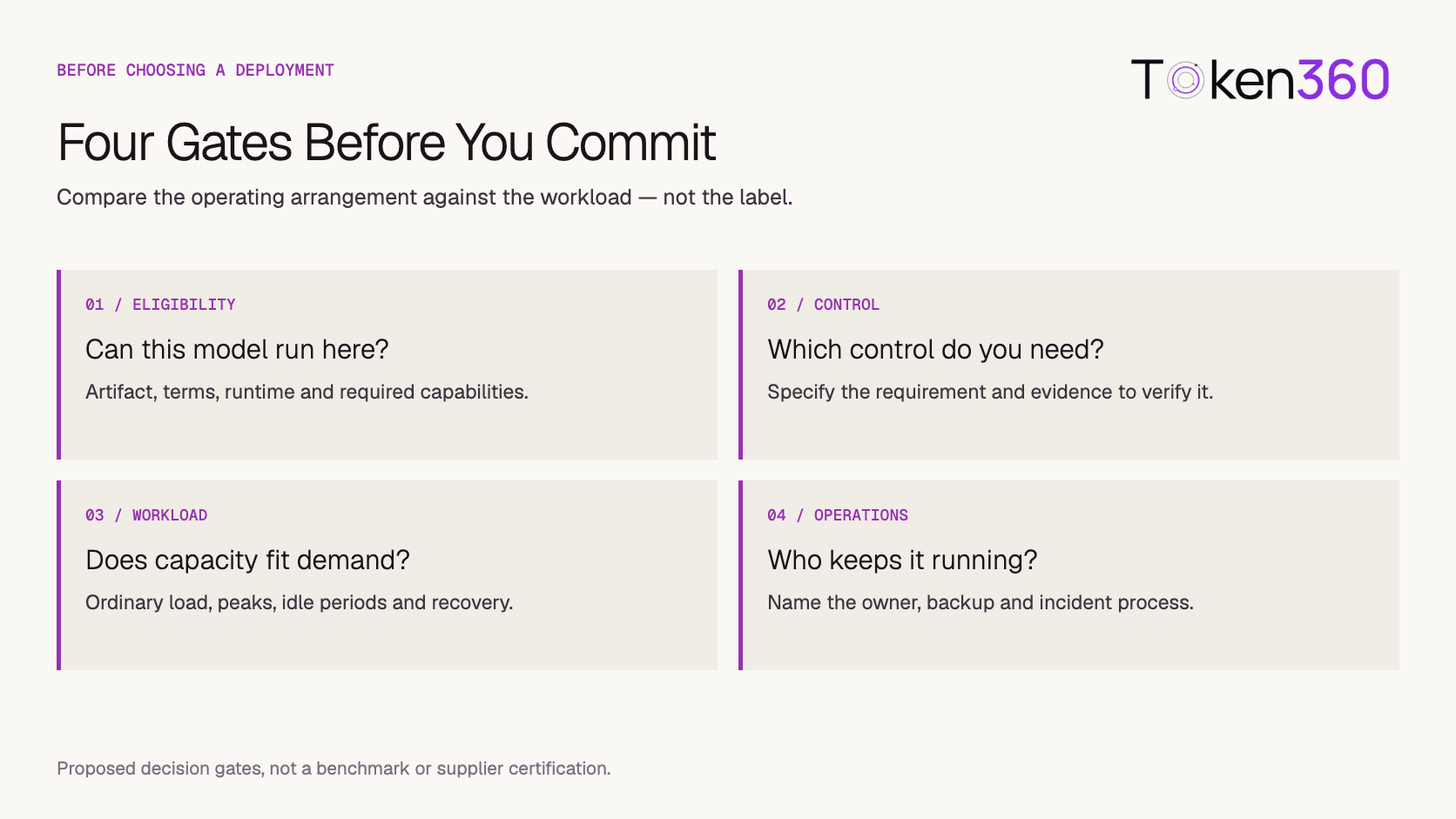
Proposed decision gates. A failed gate identifies an unresolved requirement, not an automatic recommendation for another supplier.
Ask who selects and updates the runtime, who monitors the service, who handles a failed deployment and whether configuration changes require your approval. Establish the capacity boundary, incident process and exit arrangements. Request evidence for any proposed latency or availability commitment rather than inferring it from dedicated hardware.
A managed option also has a commercial scope: what happens when usage falls, rises or requires a different model? Keep those questions explicit in the proposal instead of assuming that a dedicated arrangement has the flexibility of every shared API service.
What should you discuss with Token360?
Discuss the inference workload and the responsibilities you want the provider to take on. Token360’s enterprise model access can be relevant to an externally operated service decision, while specialized deployment requirements require confirmation. Do not assume the public catalog establishes support for every private model, runtime or infrastructure design.
Token360 focuses on enterprise procurement across text, image, audio and video models, with dedicated capacity, negotiated pricing, contracts and compliance requirements scoped to each engagement. As checked on November 9, 2026, its enterprise page directs custom deployment discussions to sales and marks priority support and SLAs as forthcoming. Obtain the applicable written terms rather than treating roadmap language as a current commitment.
Send the desired model or artifact, expected load pattern, required outputs, deployment constraints and proposed operating boundary. Use the inference deployment worksheet to record open requirements and the evidence needed to close them. Company background is available through About Token360.
It can. If your organization runs the model-serving stack on rented compute, it is self-hosting in this article’s terminology. If a provider operates that stack as a managed service, describe the agreement accordingly. Ownership of the physical machine is not the only distinction.
Can a self-hosted model use an API interface?
Yes. API describes how software communicates with the service, not who operates it. An interface compatible with another provider’s request format does not prove identical model behavior, operational support or deployment responsibilities.
Can we use an API for some workloads and self-host others?
Yes, if the application and operating processes support that arrangement. Evaluate each workload and document its data route, model configuration and owner. A hybrid portfolio adds coordination work, so do not assume it automatically combines every benefit at no extra cost.
Are open weights enough to make migration straightforward?
No. You still need to verify the model terms, artifact, runtime support, configuration and application behavior. Availability of weights is one input to portability, not evidence that a new deployment has passed your requirements.
Should a small company always use a managed API?
No. Company size alone does not decide deployment fit. A small specialist team may have strong operating capability, while a larger company may prefer to buy inference as a service. Use the actual workload, constraints and accountable operating resources.
Read next: AI pilot to production explains the separate decision to expand a validated workflow. Local draft links must be replaced with verified published URLs before publication.
Evidence boundary: the decision gates and worksheet are original editorial planning tools. No self-hosted system was deployed, no supplier performance test was run and no customer savings were measured for this article.
Enterprise AI
API
Bring your next idea to life.
Create a video scene in Creator, or explore models for images, audio, and text to find the right capabilities for your project.


 Guides
 Guides
 Guides