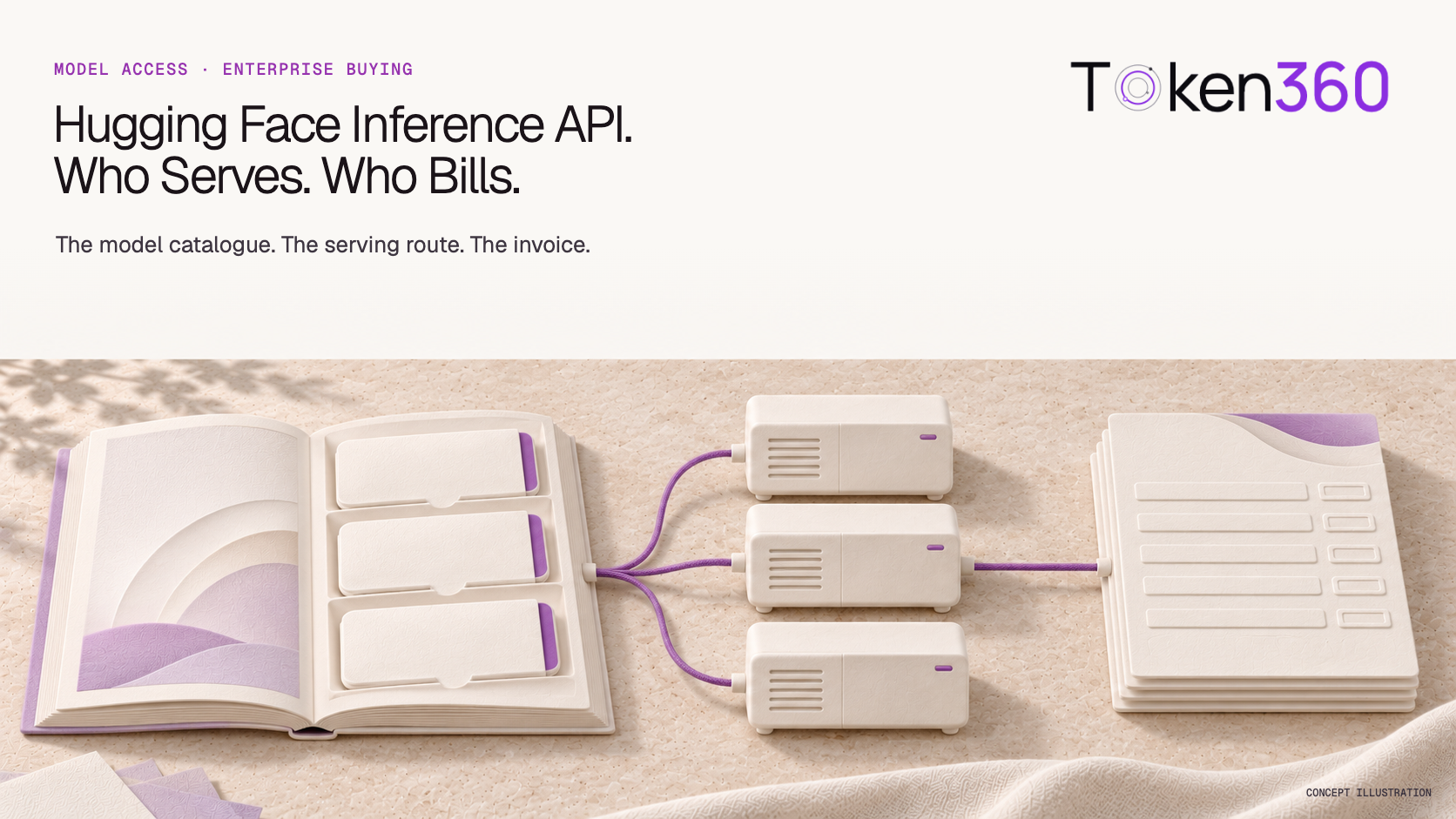
When buying Hugging Face inference API access, separate the model you select, the provider that runs it and the account that pays. A Hub listing is not a dedicated deployment. Before approving production use, identify whether the proposal uses routed Inference Providers or dedicated Inference Endpoints, then document the billing and operating responsibilities.
A procurement request that says “we need the Hugging Face API” leaves important decisions unresolved. Engineering may mean a quick call to an available model. Security may expect an approved processor. Finance may expect all usage on one company account. This guide turns that ambiguous request into a purchase scope that those teams can review together.
Scope: documentation-based procurement analysis, not a performance test or a customer case study. Product behavior described below was checked on November 20, 2026. The November 16 language-model routing update matters when reviewing older integration examples.
What does “Hugging Face inference API” mean in a purchase request?
The phrase can refer to different arrangements, so procurement should ask for the named service rather than approve the phrase alone. Start with a model listing, then establish how that model will be served. Routed API access and a dedicated deployment create different operating scopes, even when the intended model is the same.
| Layer | What it identifies | What a buyer still needs |
|---|
| Hub model listing | The model repository being considered | Applicable license, exact model and a supported serving path |
| Inference Providers | Routed access to available models through providers | Eligible providers, routing restrictions and the billed account |
| Inference Endpoints | A managed dedicated deployment service | Deployment configuration, capacity requirements and applicable commercial terms |
Hugging Face describes Inference Endpoints as a managed model-deployment service. Its Inference Providers documentation describes a different access product. These are product distinctions, not a ranking of quality.
Ask engineering to attach the actual model page and service configuration to the purchase request. A repository name alone does not tell finance what is being purchased or tell security which production path to review. For the broader role of a supplier, use our separate explanation of what an AI inference provider provides.
Who actually serves language-model requests through Hugging Face?
For a routed request, identify the serving provider separately from the model publisher and the API entry point. Procurement should record which providers are permitted and what may happen if the preferred route is unavailable. A familiar model name in an application is insufficient evidence of the complete processing path.
In its November 16, 2026 announcement, Hugging Face says language-model requests through Inference Providers now use OpenRouter routing. Existing Hugging Face tokens and code remain usable. Provider selection and retries can change the serving route; the announcement also documents provider suffixes and provider exclusions. Only models served by an available provider can be called through that path.
This is a reason to refresh the supplier diagram, not evidence that a different model is secretly substituted. Changing the provider serving a requested model and changing the requested model are separate events. Ask for both fields in the evaluation record rather than using “model” as a label for every organization in the chain.
The same announcement says image, video and audio generation continue through Hugging Face without OpenRouter. Do not apply a language-model routing description to every media task. A multimodal procurement review needs a route for each task category.
Practical implication: if your approval permits only a particular processor, make that restriction part of the technical acceptance test. A diagram prepared before a routing change should not be treated as current evidence without rechecking the configuration and terms.
Does the bill go to a developer, an organization or an upstream provider?
The billed account should be explicit before a production pilot starts. A developer’s access credential and the company’s payment responsibility are separate decisions. Ask the implementer to show the intended billing context, then check a small approved request in the usage records before treating the setup as ready for a procurement commitment.
As of this review, Hugging Face’s pricing and billing documentation says routed usage is charged at provider rates without an additional Hugging Face markup. Team and Enterprise users can retain individual access tokens while billing an organization, using the X-HF-Bill-To header. Organization provider restrictions apply when the organization is billed.
The November 16 custom-key change also says language-model requests are billed to the Hugging Face account or organization rather than using a customer’s own upstream provider key. Custom image and video provider keys remain supported. Older instructions should therefore be checked against the task and current documentation.
Keep three questions separate in the approval email: which account authenticates, which entity receives the charge, and whose rate schedule applies. If the distinction between credentials is unfamiliar, the existing BYOK and gateway-key guide covers that general concept. This article concerns the current Hugging Face purchase path.
A useful pilot acceptance record contains the request date, requested model, configured route, intended billing organization and corresponding usage entry. Use approved non-sensitive input. Redact access tokens before sharing the record with procurement; the evidence needed is attribution, not the secret itself.
When should the request specify Inference Endpoints instead?
Specify a dedicated deployment requirement when the purchase depends on a particular deployment configuration rather than access to whichever eligible routed provider serves the model. Ask the vendor to price and document that requirement separately. The word “enterprise” on an account or proposal should not substitute for an explicit statement of what is deployed.
Hugging Face’s dedicated Inference Endpoints documentation provides deployment, configuration, scaling and security guides. That is the relevant product documentation to review when evaluating a managed deployment. This article does not establish that a particular model, region or capacity is available for your account.
Write the requirement in operational terms: the model and task, expected request pattern, maximum acceptable wait, deployment constraints and the workload used for acceptance. Then ask what is included in the quote and what the customer still configures. Dedicated infrastructure should not be assumed to solve application latency or output-quality problems without measurement.
If your team has not decided between usage-based access and a deployment commitment, the serverless inference buying guide owns that broader decision. Here the narrower point is to put the correct Hugging Face product name on the procurement request before comparing offers.
What evidence should procurement request before approval?
Request a short record that connects the proposed service to the model, processing path, billing owner and acceptance test. Each entry should name its evidence and an accountable owner. A successful demo answers whether one request worked; it does not by itself establish the commercial or operational scope of the proposed production purchase.
| Question to resolve | Evidence to attach | Suggested owner |
|---|
| Which model and task are being purchased? | Repository or model identifier, task and approved configuration | Engineering |
| Which service and providers are in scope? | Named product, routing settings or deployment specification | Platform team |
| Who is charged? | Billing organization plus a matching pilot usage record | Finance and engineering |
| Which processing terms apply? | Vendor responses and applicable documents for the actual route | Security and procurement |
| What must work before launch? | Agreed workload and acceptance criteria, with measured results later | Application owner |
| What happens if the route changes? | Named contact and an agreed review process | Procurement |
This is a proposed buyer worksheet, not a list of controls verified in a Token360 or Hugging Face account. Leave unknown entries open. Replacing an unknown with an optimistic assumption makes the document easier to approve but less useful when a bill or processing route differs from expectations.
For example, a hypothetical team evaluating document summarization could first name the requested language model, list acceptable providers, designate the company billing organization and define its test document set. It can then ask vendors to respond to that same scope. There is no reason to invent throughput, discounts or a dedicated-capacity requirement before the application team supplies its actual needs.
How can an enterprise compare this purchase with a Token360 quote?
Compare the defined workload and responsibilities, not the two brand names alone. Send Token360 the model or capability needed, expected usage, permitted processing arrangements and required commercial terms. Ask for confirmation of availability and scope before comparing price; this guide does not establish that Token360 offers every model listed on Hugging Face.
Token360 focuses on enterprise procurement across text, image, audio and video models. Its enterprise quotes are tiered: higher usage receives lower quoted rates, and Token360 does not charge a separate service fee. The quote must still specify eligible models, usage and terms. No discount bands or universal savings against Hugging Face are established here.
Dedicated capacity, contracts and compliance requirements can be discussed for the engagement. Review the Token360 enterprise offering and API documentation, then ask for written confirmation of the exact integration and commercial scope. These discussions do not imply a Hugging Face partnership, automatic Hub-model coverage or an already-verified compliance configuration.
A concise quote request could read: “We are evaluating the following model and task through a routed Hugging Face service. Please confirm whether you can supply the required capability, the allowed processing path, billing units, applicable volume tier and support responsibilities. Identify any differences from the attached configuration before quoting.”
That comparison may favor keeping the existing route, buying a dedicated deployment or negotiating another supply arrangement. The useful outcome is a purchase whose model access, serving responsibility and billing owner are all explicit. For company context, see About Token360.
Editorial evidence: Yuki Yu prepared this analysis from the linked official documentation and company-confirmed commercial positioning. No production benchmark or account-level validation was performed. Recheck routing, billing and availability before signing; formal publication URL and publication date are pending.


 Guides
 Guides
 Guides