Downloadable models still need compute and operation. Separate model rights, API usage charges and service scope before choosing a paid provider.
A paid API can charge for running and delivering inference even when the underlying model is available to download. Model access and service operation are different purchases. For an enterprise, the useful question is whether the quoted service provides enough value for the workload—not whether downloadable weights make every API request free.
“Open source” also needs care. Publicly available weights do not automatically establish every permission or satisfy every definition of open-source AI. Identify the exact model release and its terms before treating a catalog label as a procurement fact. This article examines why a paid serving route can coexist with an open model, rather than recommending payment in every case.
What are you paying for if the model can be downloaded?
You may be paying for the execution and delivery of model requests: compute, deployment operation and whatever service scope the provider actually includes. Downloading weights does not supply those resources. Ask the supplier to define its charge and deliverables instead of assuming the fee buys ownership of the model or every enterprise feature.
Hugging Face’s Inference Providers pricing documentation describes paid usage for hosted model access. Its separate Inference Endpoints pricing documentation describes charging for deployed compute resources. These illustrate two commercial routes for serving models; they are not a price comparison or a recommendation for a particular supplier.
Item
What it establishes
What it does not establish
Downloadable model artifacts
Access to the published files
Free hardware, a running endpoint or unrestricted permissions
Model license and associated terms
The stated conditions for the release
A hosted service’s performance or support commitments
Paid API access
A service route for making supported requests
Ownership of weights, dedicated capacity or source availability
Enterprise agreement
The agreed commercial and operational scope
Benefits that were discussed but never included
The broader inference-provider scope guide explains service components. Here, the purchasing issue is narrower: a model’s availability does not settle the cost or value of a particular way to run it.
Are open source, open weights and free API access the same?
No. Open-source terminology concerns what is made available and under which conditions. Open weights describes access to model parameters, while free API access concerns the service’s charging policy. An open model can have a paid API, and a free API can serve a model whose weights are unavailable to its users.
The Open Source Initiative’s Open Source AI Definition includes requirements beyond simply publishing parameters, including relevant code and data information. Use the exact release documentation when recording a model’s status. Do not classify a specific model solely from a vendor’s informal “open” label.
Does paying mean you receive a better version of the model?
Not necessarily. A service fee or usage charge does not prove better model quality, and a free download does not prove operational equivalence. Identify the served release and configuration, then compare the behavior that matters to your application. The provider’s role may be delivering the model conveniently rather than changing its underlying capabilities.
Ask whether the endpoint uses the named release, a fine-tuned derivative or a particular optimized serving configuration. Request clarification where model identifiers are aliases. Also check the exposed context limit, supported parameters and output features, because the API surface can differ from what a downloadable model could support in another deployment.
Do not infer an undisclosed change from one different answer. Instead, record the model route, request settings and representative outputs, and ask the supplier how changes are communicated. If the served configuration differs, evaluate whether that difference matters to your workload before accepting or rejecting the offer.
When is a paid hosted route worth evaluating?
A hosted route is worth evaluating when the business wants to use a model without taking on the full serving operation, or when its traffic and production requirements fit the supplier’s service. Payment is justified by the agreed workload and operating arrangement. It is not justified merely because the endpoint exists or the model is popular.
Consider two hypothetical teams using the same downloadable model. One makes occasional internal requests and wants a supported API integration. The other has sustained workloads and an established serving team. Their preferred route can differ even if their model requirements are identical. Neither example establishes a universal spend threshold.
Keep a real alternative in the comparison. If you already operate suitable infrastructure, include the remaining operational work rather than pretending the hardware alone is the whole cost. If you do not, account for building and maintaining a dependable route. The API versus self-hosting comparison covers that operating decision in detail.
Which charges and service promises should the quote separate?
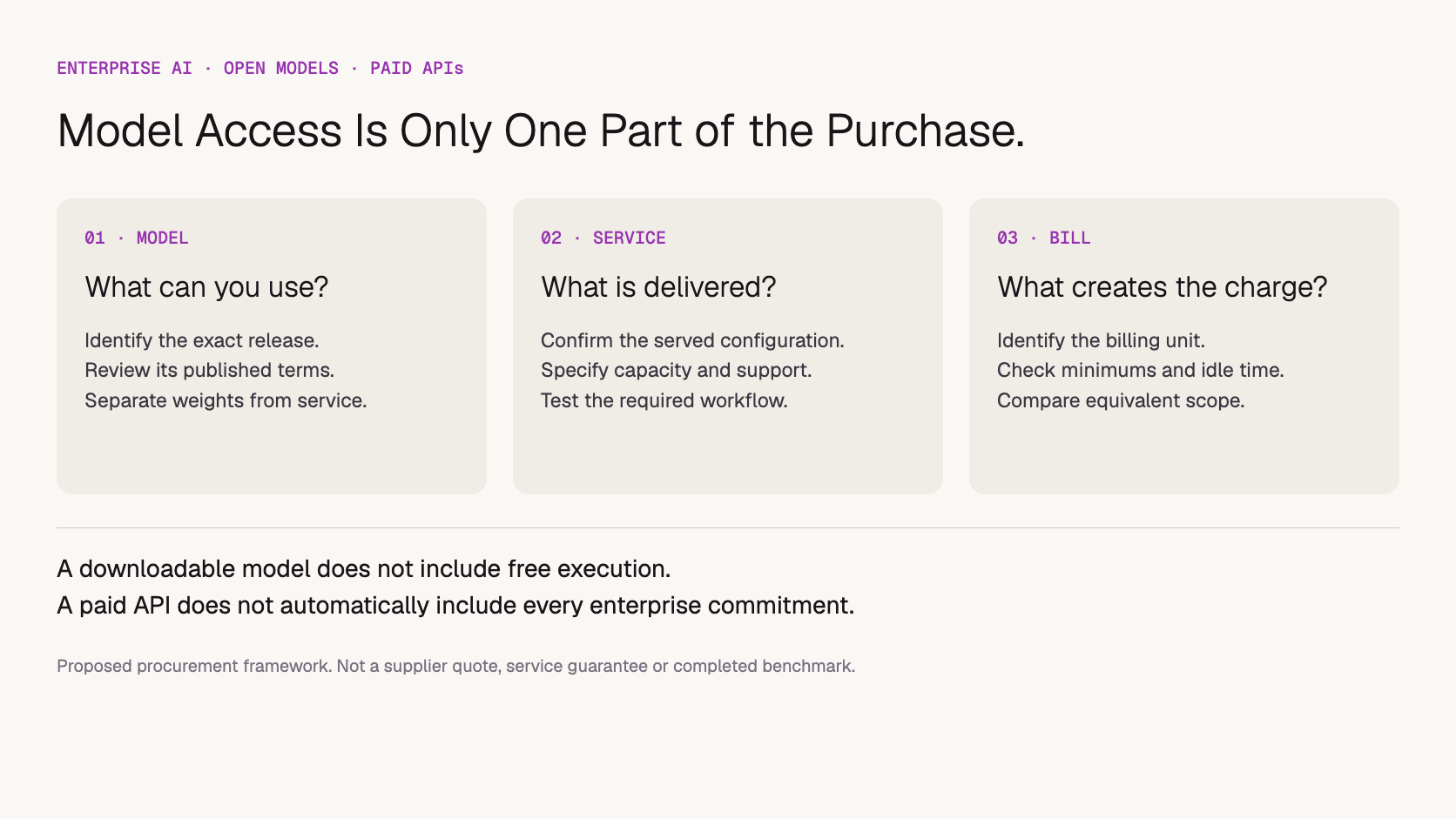
A useful quote separates the billing unit from the operating promises. Confirm what counts as usage, whether there are commitments or reserved resources, and which support or capacity terms apply. Avoid comparing a usage-only rate with a dedicated deployment price as though they represent the same scope and availability.
Proposed buyer checklist. The diagram is not a supplier rate card or a service guarantee.
Ask the provider to show how a representative workload would be billed. Include the expected input and output sizes, traffic pattern and relevant model options. For reserved or dedicated arrangements, ask what happens during idle periods and how capacity changes affect the bill. For usage-based access, clarify any minimums, quotas and separately charged features.
Support, throughput and availability should be explicit. A paid invoice alone does not establish an SLA, dedicated hardware or a particular response time. Similarly, an enterprise quote should not leave the buyer guessing whether a proposed benefit is generally available, custom-scoped or still planned.
Will an open model make switching providers easy?
Access to model artifacts can create options, but it does not make every hosted integration interchangeable. Moving may require changes to request formats, prompt handling, tools, output parsing and operational controls. Treat portability as something to demonstrate with a representative workflow, rather than a benefit fully proven by the word “open.”
For a practical check, preserve your prompts, input transformations and evaluation examples outside a single provider console. Record the exact release or identifier you depend on. Then test whether another eligible route produces acceptable results with documented changes. Include application data and logs in the exit discussion; model weights are only one part of the system.
The earlier open-weight adoption analysis examines the path from release to usable deployment. This article’s narrower point is that paying for a serving route neither removes your independent options nor proves those options are ready for production.
What should you ask Token360 about open-model access?
Bring the exact model and workload, then ask which serving route and commercial scope are available. Confirm supported features and any required capacity or contractual terms. Token360’s enterprise positioning does not mean every downloadable model is supported, every release is exposed immediately or every enterprise request is included in standard API access.
Token360 focuses on enterprise procurement across text, image, audio and video models. Pricing, dedicated capacity, contracts and compliance requirements can be scoped to an engagement through the enterprise team. Model availability and specific terms must be confirmed for the proposed purchase.
Token360 does not charge a separate service fee, according to its company-provided positioning. That does not make model usage free or imply an absence of commercial margin. Compare the quoted usage charges and agreed scope rather than treating “no service fee” as proof of the lowest total cost.
Use the open-model API quote checklist to record the model release, billing basis, capacity scope and portability evidence. It is a blank procurement template, not a completed vendor evaluation.
What else do enterprise buyers ask?
Does buying the API give us ownership of the model?
Do not assume that it does. API access is a service arrangement. Rights associated with the model artifacts and any custom deliverables need to be checked in their respective terms.
Can the model publisher and API operator be different companies?
Yes. Record both roles so you know who maintains the release and who operates your purchased service. The party billing you should explain its responsibility for the route it supplies.
Is self-hosting always cheaper if there is no model license fee?
No universal conclusion follows. Compare the actual workload, infrastructure utilization, operating effort and required service level. A missing license charge does not remove the other costs of execution.
Should we reject a paid API if a free endpoint exists?
Compare their applicable limits, data terms, operational scope and performance on your workload first. A free option may fit a test or even a suitable production use, but its existence alone does not establish equivalence.
Evidence and limits: Reviewed November 17, 2026. Pricing documentation is cited to explain charging structures, not to reproduce current rates or rank suppliers. Examples are hypothetical. No cost-saving experiment, license opinion or model-quality comparison was performed.


 Guides
 Guides
 Guides