Rule out a remote API for a task that must generate a new result with no connection to the service. Define that requirement before seeking model access. If a task can wait until connectivity returns, remote inference may remain an option, but its usefulness depends on your deadline and data-handling requirements.
For a field-service team, warehouse application or remote site, the useful procurement question is concrete: what must an employee still be able to do when the connection disappears? The answer may be “capture notes,” “recognize a part,” or “draft a report.” Those requirements call for different designs, even if each product is described as AI-enabled.
Can a cloud AI API work without internet access?
A remote API needs a working network path between the application and the service. That path may use public internet or an agreed private connection; it cannot disappear entirely while new remote requests continue. A local API can work without external connectivity if its model, runtime and required dependencies are available locally.
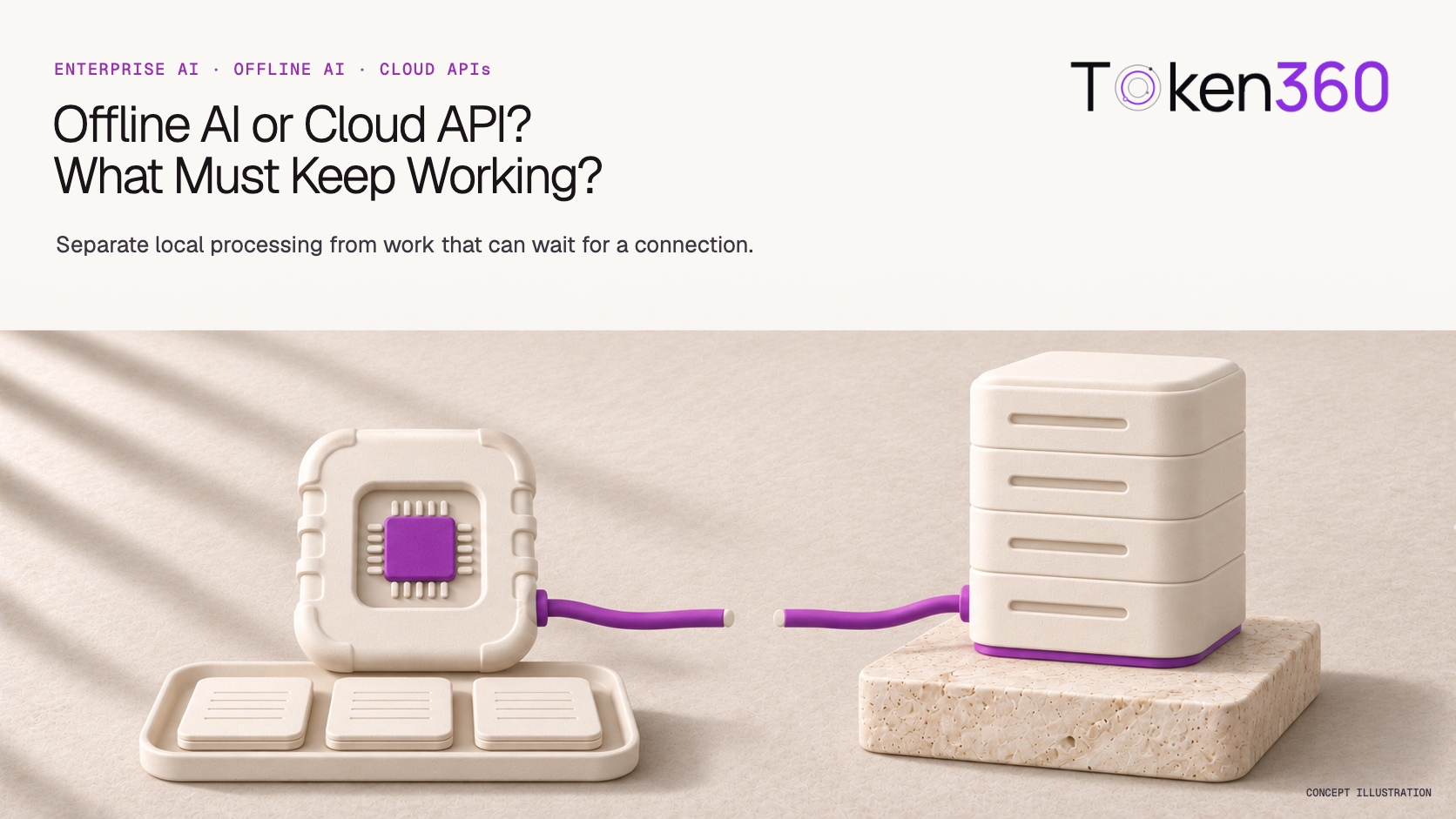
The word “API” describes an interface, not where computation happens. An application can call a model on the same device, a server on a site’s local network, or a remote cloud service. Ask where the request executes and which connections it needs rather than assuming that “API” always means cloud.
ONNX Runtime’s edge deployment documentation identifies offline inference as a benefit of on-device execution while noting model-size and hardware limits. This supports the possibility of offline inference, not a promise that every model or task will fit your equipment.
What does the business actually need to keep working?
Define the minimum useful behavior during disconnection before choosing a deployment. Capturing information may require no model at all. Producing a new classification or draft requires computation where connectivity remains available. Retrieving an old result requires stored data. These are different promises and should have separate acceptance criteria in the purchase specification.
| Required behavior | What must be available | What it does not prove |
|---|
| Save photos or notes for later | Local storage and a recovery process | No new AI output is necessarily produced |
| Show an existing answer | A valid locally stored result | The answer is not necessarily current |
| Generate a new answer on a device | Compatible model, runtime and task inputs | Remote tools or business data are not automatically available |
| Use an on-site model server | Working local network and server | A disconnected handheld cannot reach it |
| Generate through a cloud API | Reachable service and required authorization | Queued requests cannot complete while the route is unavailable |
For example, a technician may need to save evidence immediately but be able to wait until returning to coverage for a narrative report. That is a plausible capture-and-defer design. It should not be sold internally as offline report generation. The field-service report workflow covers what evidence the eventual draft should contain.
How should you compare offline and cloud options?
Compare accepted task results on the actual devices and network conditions the business expects. Measure responsiveness, completion quality and operational effort together. Removing a network round trip does not guarantee a faster usable answer, and avoiding API usage charges does not eliminate hardware, integration, maintenance or support costs.
For a device-based option, include model availability, licensing, storage, memory, battery use and behavior under sustained load in the evaluation. Test the oldest supported device as well as a convenient development machine. For a cloud option, include upload conditions and the behavior users see when requests take longer than expected.
Keep the broader decision about who operates the infrastructure in the AI API versus self-hosting comparison. Here, the decision is narrower: whether a particular user task can meet its requirements when a network dependency is absent.
Local processing can avoid sending inference inputs to a remote model service, but it does not make the entire application automatically private. Review telemetry, backups, sync and later uploads separately. Likewise, a private network connection still depends on that connection and does not turn remote inference into offline execution.
What should you ask Token360 before choosing cloud inference?
Tell the supplier which tasks need an immediate response, which can wait and where users connect from. Describe the actual workload rather than requesting “offline support” as an undefined feature. Confirm the reachable deployment, model availability, capacity expectations and contractual scope before making promises to your own users.
Token360 provides enterprise-oriented access to text, image, audio and video models. Its enterprise page, reviewed November 17, 2026, supports discussions about model access, pricing and production requirements. This article does not establish that Token360 supplies an on-device runtime, air-gapped deployment or automatic local fallback.
For work that can run online, bring a representative task and a connectivity profile to the discussion. For work that must run with no remote path, require a separately verified local solution. A cloud inference agreement cannot by itself satisfy that requirement.
When should you rule out a remote model API?
Rule out a remote API for a task that must compute a new result while no network path to the service exists. Cached answers and delayed uploads can support different requirements, but neither supplies new remote inference during disconnection. Define that acceptance condition before comparing cloud model offers.
Token360 model access can serve the connected part of a hybrid workflow; this article does not establish an offline offering. Compare operating responsibilities in API versus self-hosting.
What else do buyers ask about offline AI?
Is edge AI always fully offline?
No. “Edge” describes execution near the data source. A particular implementation may still rely on network access for identity, tools, retrieval or updates. Verify the complete task rather than the deployment label.
Can the same model run locally and through an API?
Sometimes, if suitable weights, licensing and runtime support are available. Do not assume a hosted model can be downloaded. Even similar local and remote configurations need separate quality and performance checks.
Does dedicated cloud capacity solve weak connectivity?
Dedicated capacity concerns service-side resources. It does not repair a missing route from the user’s application to the service. Assess those two constraints separately.
Should every enterprise application include a local model?
No. Reliable capture, an honest pending state or a manual workflow may meet the disconnected requirement without local inference. Add a model only when the immediate task justifies its quality, maintenance and device requirements.
Evidence boundary: This is a procurement and acceptance framework, not a tested performance comparison. Examples are proposed workflows. Sources were reviewed November 17, 2026; no offline capability, latency or cost saving is guaranteed for a specific deployment.


 Guides
 Guides
 Guides