gpt-oss-20b API or Self-Hosting: Compare Deployment Fit
Compare a hosted gpt-oss-20b API with self-hosting using task quality, runtime controls and full operating cost. Open weights do not make API calls local.
By Yuki Yu · November 4, 2026 · No live model test claimed
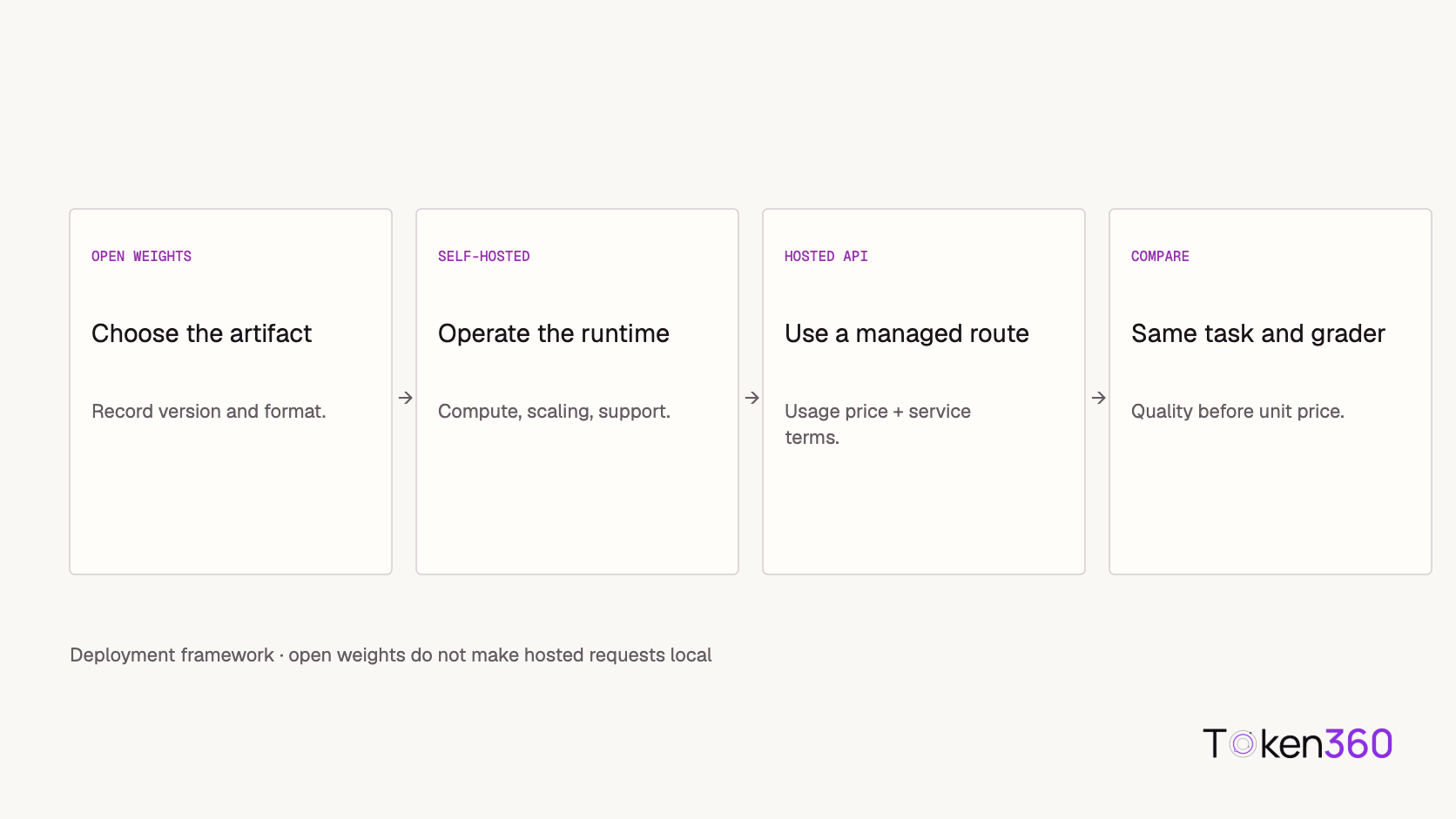
Choose between a hosted gpt-oss-20b API and self-hosting by comparing the same accepted workload, deployment controls and operating responsibilities. Open weights make the model artifact available under its license; they do not make a hosted request local, remove infrastructure costs or guarantee identical behavior across serving runtimes.
Read first. Open-weight model adoption explains the broader category. This article focuses on the concrete deployment decision for gpt-oss-20b, including the responsibilities a hosted service does and does not remove.
What does open weight mean for gpt-oss-20b?
Open weights give a team access to the released model artifact and the ability to deploy it within the applicable license terms. Deployment still requires a compatible runtime, suitable resources and an operating plan. Evaluate the actual serving configuration rather than treating the model name as a complete system specification.
OpenAI’s August 5, 2025 release announcement identifies gpt-oss-20b as an open-weight model released under Apache 2.0. Its memory example describes a possible deployment, not a guarantee of your throughput or memory needs at a chosen context length and concurrency.
The official gpt-oss repository provides implementation and formatting guidance. Record the artifact version, quantization, runtime and configuration used in a comparison. Different serving choices can affect the system even when both deployments carry the same family name. Sources checked November 4, 2026.
Deployment responsibilities differ. A hosted API request is not an on-device request.
Which responsibilities change with the deployment?
Self-hosting gives your team direct responsibility for the runtime and its operating environment. A hosted API transfers some serving work to a supplier, but the application still owns access decisions, input validation and result acceptance. Compare those responsibilities explicitly before using a token price as the deciding factor.
Area
Hosted API
Self-hosted runtime
Capacity
Evaluate provider limits and service behavior
Provision and operate the required capacity
Model artifact
Confirm the offered version and exposed controls
Select and maintain the deployed artifact
Data path
Review service and upstream processing terms
Control the environment and all supporting services
Reliability
Handle API failures and service constraints
Also maintain scheduling, health checks and recovery
Application quality
Validate task results
Validate task results
Neither column is a universal privacy or uptime guarantee. A self-hosted model can still send logs or tool requests elsewhere. A hosted service can have terms suitable for a particular workload. Draw the actual data path, including monitoring, storage and tools, before making claims about locality.
What should you verify on a Token360 route?
Check the exact model entry, operation and permitted settings before using a hosted route as the baseline. Keep the serving route distinct from the open-weight artifact. A successful request confirms one configuration worked; it does not prove that every runtime control or deployment feature is exposed by the API.
The historical model ID supplied for this series is gpt-oss-20b. Current account access and a successful call have not been established in this article. Start from Token360 model capability checks and the Token360 quickstart before collecting a paid sample.
The historical model ID supplied for this series is gpt-oss-20b. A Token360 enterprise discussion can cover model-unit pricing and dedicated-capacity requirements; neither establishes hardware ownership or on-device processing. Current route access and a successful call have not been established here. Verify the selected model before collecting a paid sample.
Retain the returned model identifier, supported settings and request evidence. If the endpoint does not identify the precise artifact or quantization, mark that part of the comparison unknown. Do not describe hosted-versus-local differences as purely infrastructure effects when the underlying configuration may also differ.
Make the quality comparison fair
Use the same permitted inputs, expected outputs and grader for both deployments. Match generation settings where their contracts allow it, and document mismatches. Test the actual task rather than asking whether the local model can produce any fluent response; a technically functioning runtime may still fail the application’s requirements.
Start with direct extraction, a constrained decision and an evidence-bounded answer. Preserve missing-value rules, tool schemas and output limits. If tools are involved, distinguish the model’s proposed call from the application’s authorized execution. A returned tool request is not evidence that the action was safely completed.
Measure cold-start and warm-service behavior separately if both occur in production. Record concurrency and input sizes. A single warm request cannot establish sustained capacity, and an idle local device cannot establish the cost of serving a burst. Report rejected results alongside successful ones.
How should you compare the operating costs?
Compare complete costs for the same period and accepted workload. A hosted API has usage charges and application-side costs. A self-hosted service has provisioned compute, utilization, operations and possibly idle capacity. Include the work needed to maintain the deployment rather than assuming that downloaded weights make inference free.
Use a simple model only after stating its assumptions: hosted cost = number of requests × observed average charge; self-hosted cost = fixed period cost + requests × variable cost. This is an accounting approximation, not a performance or pricing claim. Quality and capacity must pass separately.
Invented input
Value
Hosted charge per request
$0.001
Self-hosted fixed cost per month
$100
Self-hosted variable cost per request
$0.0002
Simplified equal-cost volume
125,000 requests per month
The calculation is $100 ÷ ($0.001 − $0.0002) = 125,000 requests. These are arbitrary teaching inputs, not Token360 or GPU prices. The result assumes equal quality, adequate capacity and constant marginal costs. If those assumptions fail, the threshold is not a buying recommendation.
For a real comparison, divide total cost by accepted tasks and include the cost of failed attempts. Keep engineering labor and one-time setup visible. If the hosted marginal charge is no greater than the local marginal cost in this simplified model, there is no positive cost-only break-even volume for the fixed local expense.
When does each option deserve a pilot?
Pilot a hosted route when you need to evaluate the task without first operating a model-serving stack. Pilot self-hosting when control over the artifact or environment is a real requirement and the team can maintain it. In both cases, require acceptable outputs before comparing economics or expanding traffic.
Write the decision as a bounded conclusion: approved workload, chosen deployment, configuration, observed limits and reevaluation trigger. Avoid “self-hosting is always cheaper” or “an API is always faster.” Those statements hide utilization, hardware, routing and quality assumptions.
If you move between deployments, retain a rollback path and the original acceptance cases. Revalidate formatting, stopping behavior and any tool interaction. The open-weight license makes deployment possible; it does not make every serving interface interchangeable.
Make an API quote and a self-hosted run comparable
Compare one deployment configuration at a time. A self-hosted result needs its quantization, runtime, hardware, active concurrency and output limits attached to the result. An API result needs the selected model route, request configuration, billed usage and service terms. A shared model name alone does not hold those factors constant.
Evidence
API side
Self-hosted side
Quality
Outputs for the fixed task set
Outputs after the chosen quantization
Capacity
Observed completion and contracted limits
Observed throughput at stated concurrency
Cost
Applicable quote and recorded charges
Compute, idle time and included operating labor
Recovery
Account escalation and retry behavior
Restart, replacement and operator responsibility
No filled hardware benchmark or deployment quote is available for this article. Use the existing hypothetical break-even calculation to identify which missing input matters most. If the decision flips with a small change in utilization, measure idle and busy periods before treating a low per-hour rate as a deployment recommendation.
Frequently asked questions
Does calling gpt-oss-20b through an API keep the prompt on my device?
No. A hosted request sends data to the service. Review the actual service data path and terms rather than inferring locality from the model’s license.
Does the released memory example guarantee my deployment will fit?
No. Runtime, context length, concurrency and supporting services affect the system. Test the intended workload and configuration.
Is the break-even figure a measured Token360 result?
No. It is arithmetic using explicitly invented inputs. The article contains no current hosted rate quote or live throughput benchmark.
Can I compare different quantizations as if only hosting changed?
No. Quantization is a configuration difference. Record it and compare accepted outputs; do not attribute every difference to the hosting arrangement.
Commercial scope reviewed November 4, 2026. Token360 pricing and engagement scope are company-confirmed; individual discounts, capacity commitments and compliance evidence require a written proposal. Token360 enterprise page. Historical test charges remain dated observations, not current universal quotes.
Editorial revision: November 4, 2026. Test dates and dated source snapshots remain as stated in the article.
API
Model Evaluation
Developer Guide
Build faster with one AI API.
Use Token360 to call video, image, audio, and text models with one key and one bill.


 Guides
 Guides
 Guides