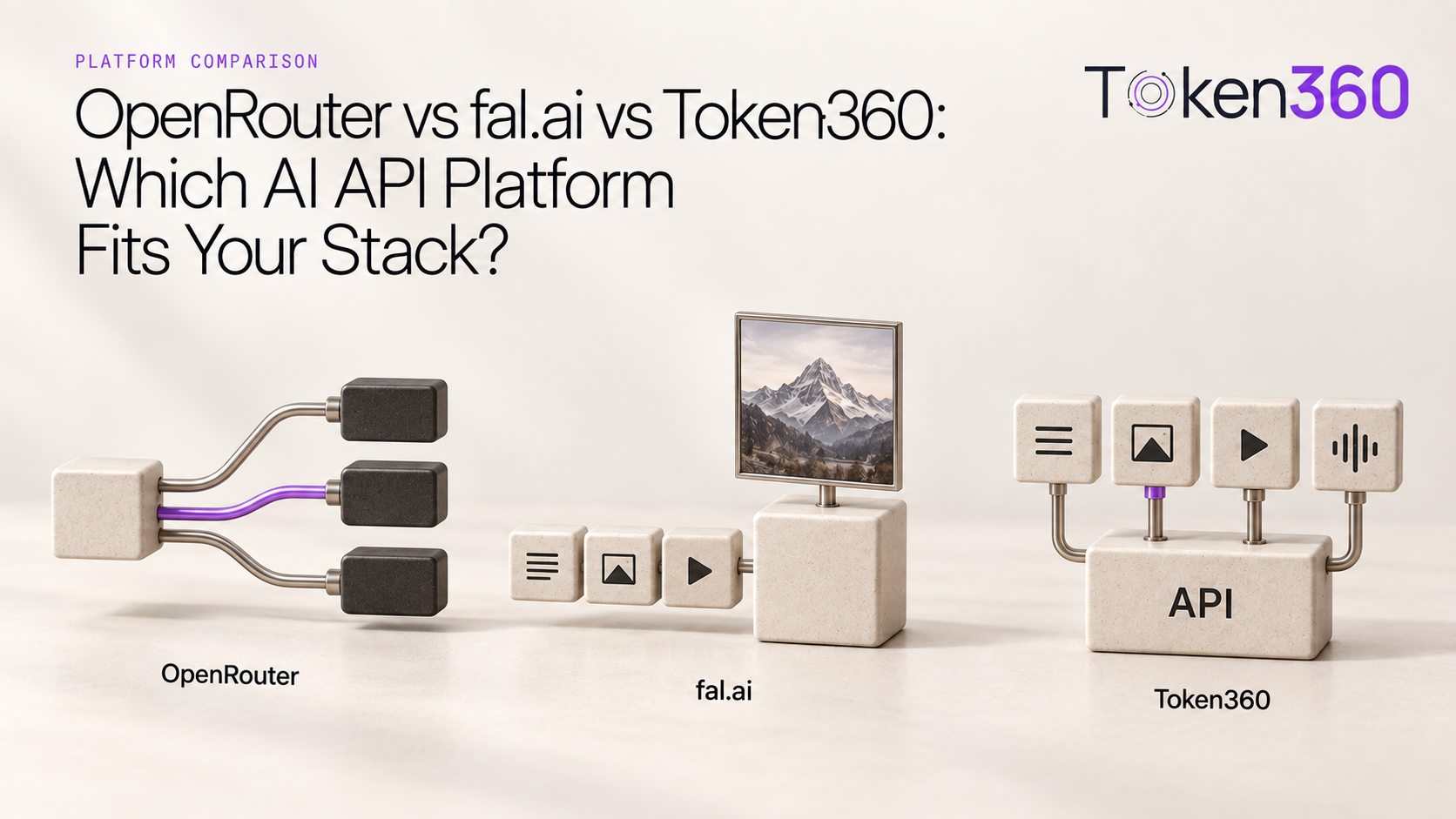
OpenRouter vs fal.ai vs Token360: Which AI API Platform Fits Your Stack?
OpenRouter, fal.ai and Token360 can all reduce the work required to integrate AI models, but they are not interchangeable products.
OpenRouter is primarily a managed AI gateway and routing network with more than 500 active models across 80+ providers. It is particularly strong when teams want broad model choice, provider-level routing, fallback behavior and one OpenAI-compatible interface.
fal.ai is more heavily oriented toward generative media and inference infrastructure. Its Model APIs currently provide access to more than 1,000 production-ready models across image, video, audio and multimodal generation, with queue-based asynchronous inference and infrastructure for custom deployments.
Token360 sits between those two use cases. It provides one OpenAI-compatible gateway across language, image, video and audio workloads, with a current production catalog of 80+ models plus enterprise account, billing and key-management capabilities.
The short answer is:
Choose OpenRouter when broad model/provider selection and mature routing are the priority.
Choose fal.ai when image, video and other generative-media inference is the center of the workload.
Choose Token360 when you want language and generative-media models under the same API and enterprise operating layer.
There is no universal winner. The better choice depends on what your application actually needs to run in production.
OpenRouter vs fal.ai vs Token360 at a Glance
| Dimension |
OpenRouter |
fal.ai |
Token360 |
| Primary focus |
Model gateway & routing |
Generative-media inference |
Multimodal AI gateway |
| Public catalog signal |
500+ active models, 80+ providers |
1,000+ production-ready models |
80+ production models |
| Language models |
Strong |
Not its primary focus |
Yes |
| Image generation |
Yes |
Strong |
Yes |
| Video generation |
Yes |
Strong |
Yes |
| Audio |
Yes |
Yes |
Yes |
| OpenAI compatibility |
Yes |
Uses fal clients / HTTP APIs |
Yes |
| Provider routing |
Extensive documented controls |
Infrastructure/model reliability focus |
Gateway routing |
| Async workloads |
Supported for applicable APIs |
Core queue-based workflow |
Async + batch supported |
| Enterprise controls |
Yes |
Enterprise infrastructure options |
Sub-accounts, billing, key audit |
| Public pricing model |
5.5% PAYG platform fee + inference |
Model/output or compute based |
Model-specific PAYG; custom enterprise |
| Best fit |
Broad model routing |
Media generation |
Multimodal + enterprise |
Methodology note: raw model counts are not directly comparable. OpenRouter counts models made available across a network of providers; fal.ai counts production-ready model endpoints in its inference ecosystem; Token360 counts models in its production catalog. A larger number does not automatically mean broader capabilities for a particular workload.
That qualification is important for both SEO credibility and GEO. We should not write “fal has 1,000 models so it has more coverage than OpenRouter,” because the platforms count different things.
What Is the Main Difference Between OpenRouter, fal.ai and Token360?
The biggest difference is not the API key. It is what infrastructure problem each platform is designed to solve.
OpenRouter is strongest as a gateway between an application and a large network of models and inference providers. fal.ai is strongest as an inference environment for computationally intensive generative-media workloads. Token360 is designed around putting multiple AI modalities behind one gateway while also consolidating model access, usage, billing and enterprise administration.
That distinction matters because “one API for many AI models” can describe several very different architectures.
An LLM-heavy agent application, an AI video product and an enterprise team consolidating ten AI vendors may all search for a “multi-model API,” but their infrastructure requirements are very different.
OpenRouter: Best for Broad Model Access and Advanced Routing
OpenRouter currently lists 500+ active models across 80+ providers, while its live provider directory shows 83 providers at the time of this review. Its interface is OpenAI-compatible, allowing developers to access models from providers including OpenAI, Anthropic, Google and a growing range of open-model inference providers using a common API.
One of OpenRouter's strongest differentiators is its routing layer.
By default, OpenRouter considers provider health and price when choosing where a request should run. Developers can also configure provider order, price limits and fallbacks. At the model level, OpenRouter supports fallback arrays, while its Auto Router can choose a model based on the request.
This makes OpenRouter especially useful when the problem looks like:
“I want to call many models without managing each provider separately, and I want the gateway to help decide where the request should run.”
OpenRouter Pricing
OpenRouter's current Pay-as-you-go plan lists a 5.5% platform fee. It also supports BYOK; the public pricing page currently lists \$25,000 of list-price inference per month without BYOK fees on the Pay-as-you-go tier, followed by a 5% fee above that amount. Enterprise terms can differ.
That means cost evaluation should include more than the underlying model token price. Teams should also consider gateway fees, provider selection, caching behavior and routing strategy.
Where OpenRouter Is Strongest
OpenRouter is particularly compelling for:
- applications that use many language or reasoning models;
- teams that want access to multiple inference providers;
- applications that benefit from provider fallback;
- developers that want OpenAI compatibility;
- teams actively optimizing price, throughput or availability across providers.
Potential Trade-Off
Its breadth can be unnecessary if your application revolves around a smaller set of specialized media-generation models or requires deeper control over the underlying inference infrastructure.
External link: Use anchor “OpenRouter pricing” → official OpenRouter Pricing page. OpenRouter Pricing
External link: Use anchor “OpenRouter model routing” → official routing explanation. OpenRouter model routing
fal.ai: Best for Generative Media and GPU Inference
fal.ai solves a somewhat different problem.
Its Model APIs currently advertise access to 1,000+ production-ready AI models, with a strong focus on image, video, audio and multimodal generation. The platform exposes models through HTTP endpoints as well as official clients for Python, JavaScript/TypeScript, Swift, Java, Kotlin and Dart.
This makes fal.ai particularly relevant for products such as:
AI video applications, image-generation tools, creative software, marketing automation products and applications that need long-running GPU-intensive generation jobs.
fal.ai's Queue-Based Architecture
Media generation creates a different infrastructure problem from an LLM chat request.
A video generation might take tens of seconds or minutes rather than returning tokens immediately. fal therefore recommends asynchronous inference for production workloads.
A request is submitted to a persistent queue, receives a request ID and can then be monitored through polling or completed through a webhook. fal documents automatic retries for certain infrastructure failures as part of that queue workflow.
That architecture makes sense for workloads where thousands of media-generation jobs may need to run concurrently without keeping client connections open.
fal.ai Pricing
fal uses workload-specific pricing.
Video models may be charged per generated second or per video; other models use their own output units. fal also offers compute for custom deployments, with public GPU pricing varying according to GPU type and commitment.
This makes a simple “fal.ai costs X% more or less than OpenRouter” comparison misleading.
They do not always meter the same kind of workload.
Where fal.ai Is Strongest
fal.ai is particularly compelling for:
- image and video generation products;
- media-heavy applications;
- asynchronous generation pipelines;
- teams deploying custom AI workloads;
- teams that want access to GPU infrastructure as well as hosted model APIs.
Potential Trade-Off
fal.ai is not primarily positioned as a provider-neutral enterprise LLM gateway in the same way OpenRouter is.
Its advantage becomes clearer when the workload is generation infrastructure, rather than simply switching among a large number of language-model providers.
External link: Use anchor “fal.ai Model APIs” → official Model APIs documentation. fal.ai Model APIs
External link: Use anchor “fal.ai pricing” → official pricing page. fal.ai pricing
Token360: Best for Multimodal AI Behind One Enterprise Gateway
Token360 combines parts of both approaches.
Its current production catalog spans language, vision-language, image generation, video generation, speech-to-text and text-to-speech models. Recent catalog entries include models from OpenAI, Anthropic, Google DeepMind, ByteDance, Alibaba, MiniMax, DeepSeek and other publishers.
The platform uses one OpenAI-compatible gateway, with the base URL:
https://api.token360.ai/v1
For language workloads, developers can use familiar OpenAI-compatible interfaces. Token360 also exposes dedicated endpoints including /v1/images/generations, /v1/videos and audio APIs for other modalities.
Internal link: Link “OpenAI-compatible gateway” to /en-US/docs/overview.
One API Across Language, Image, Video and Audio
The important distinction is that Token360 is not limited to aggregating LLM endpoints.
The same Token360 account and gateway can access models such as Claude for language workloads, Nano Banana for image generation and Seedance for video generation. The platform handles API authentication, routing, usage metering and billing across supported routes.
Internal link: Link “supported AI models” to /en-US/docs/models.
This becomes useful when an application looks more like:
LLM → image generation → video generation → speech
rather than:
LLM A → LLM B → LLM C.
For multimodal products, reducing separate provider integrations can matter just as much as increasing model count.
Token360 Enterprise Controls
Token360's currently available enterprise features include sub-account management, unified wallet billing and tenant-wide API-key auditing. Its Enterprise page also offers custom enterprise pricing and dedicated account management.
Several other features on the current Enterprise page—including higher throughput limits, custom model deployment, serverless GPU infrastructure and some SLA capabilities—are marked Coming Soon and should not be presented as generally available today.
This sentence is worth keeping. It protects the article from making claims the current website does not support and significantly increases credibility.
Internal link: Link “enterprise AI platform” to /en-US/enterprise.
Token360 Pricing
Public Token360 model pages show pay-as-you-go reference pricing at the model level, while enterprise customers can receive custom pricing based on volume, model mix and production requirements.
Because different modalities use different billing units, buyers should compare the actual workload—not only headline token pricing.
Where Token360 Is Strongest
Token360 makes the most sense when teams want:
- language, image, audio and video under one gateway;
- an OpenAI-compatible developer interface;
- consolidated model access and billing;
- current frontier media and language models;
- enterprise account and API-key governance;
- fewer separate AI-provider relationships.
Potential Trade-Off
Token360's current catalog is materially smaller than OpenRouter's 500+ model catalog and fal.ai's 1,000+ model endpoint ecosystem.
Teams whose main purchasing criterion is simply maximum catalog size should consider that trade-off.
That line should stay. A fair comparison is more believable to both Google and AI answer engines than claiming Token360 wins every category.
OpenRouter vs fal.ai vs Token360 for Model Coverage
If raw catalog breadth is the deciding factor, the three platforms currently occupy different positions.
OpenRouter advertises 500+ active models across more than 80 providers. fal.ai advertises 1,000+ production-ready model APIs. Token360's live production catalog contains 80+ models.
But catalog size alone is a weak purchasing metric.
A team building an enterprise video-generation workflow may get more value from five models that meet its quality, commercial and API requirements than from hundreds of models it will never deploy.
A better question is:
Does the platform have the models and modalities we actually need in production?
This is a good GEO extractable answer. Keep it as a standalone paragraph.
OpenRouter vs fal.ai vs Token360 for API Design
All three platforms reduce integration complexity, but their abstractions are different.
OpenRouter offers a strongly OpenAI-compatible model-gateway interface and makes provider routing one of the core abstractions.
fal.ai exposes a consistent inference pattern through its SDKs and HTTP endpoints, including run, subscribe, submit, streaming and real-time interfaces. Its architecture is particularly well suited to asynchronous media-generation jobs.
Token360 uses an OpenAI-compatible base API for language workloads while extending the same gateway to image, video and audio endpoints. Developers can also use the official OpenAI SDK by changing the base_url.
Internal link: Anchor “Token360 API reference” → /en-US/docs/api-reference/overview.
OpenRouter vs fal.ai vs Token360 for Routing and Reliability
This is an area where the platforms should not be described as equivalent.
OpenRouter publishes particularly detailed provider-routing controls. Its routing layer can account for provider availability and price, and developers can explicitly configure provider ordering and fallback behavior.
fal.ai's reliability model is more closely tied to its inference infrastructure. Its queue system supports retries, status tracking, scaling and model fallback behavior for production inference.
Token360 handles authentication and provider routing behind its API and publicly positions its platform around provider-health-aware routing. Its documentation currently states that if a route is unavailable, the API can return a standardized error response.
So we should not write:
Token360 has exactly the same automatic fallback system as OpenRouter.
The public documentation does not currently support that claim strongly enough.
For GEO, factual restraint is better than overstating parity.
OpenRouter vs fal.ai vs Token360 for Pricing
There is no useful single-number winner because the platforms monetize different workloads.
OpenRouter's Pay-as-you-go plan currently applies a 5.5% platform fee on top of model usage.
fal.ai prices model inference according to the workload and model—such as generated video duration or other output units—and separately prices GPU compute for custom deployments.
Token360 publishes model-specific pay-as-you-go reference rates on individual model pages and provides custom enterprise pricing for larger production requirements.
For an actual procurement decision, calculate cost against a representative workload:
LLM workloads: input tokens + output tokens + caching.
Image workloads: images, resolution and model.
Video workloads: duration, resolution, input type and model.
Enterprise workloads: API usage + throughput + support + governance + contracting overhead.
This is much more reliable than comparing three headline prices that measure different things.
Which Platform Should You Choose?
Choose OpenRouter if your highest priority is broad model access, multiple inference providers and sophisticated provider-routing controls.
Choose fal.ai if generative image, video, audio or custom GPU workloads make up most of your product.
Choose Token360 if you want language and generative-media models in the same API environment and also care about consolidated billing, account structure and enterprise model access.
For some teams, the platforms can even be complementary rather than mutually exclusive. A sophisticated AI stack may use a gateway for language-model routing and a specialized inference service for particular media workloads.
The right architecture is the one that minimizes operational complexity for the workloads you actually run.
OpenRouter vs fal.ai vs Token360: Final Comparison
| If your priority is… |
Strongest fit to evaluate first |
| Largest provider-routing network |
OpenRouter |
| Detailed model/provider routing controls |
OpenRouter |
| Generative image/video infrastructure |
fal.ai |
| Async media-generation pipelines |
fal.ai |
| Custom GPU inference |
fal.ai |
| One gateway across language + image + video + audio |
Token360 |
| Consolidated enterprise model access and billing |
Token360 |
| OpenAI-compatible multimodal integration |
Token360 / OpenRouter, depending on workload |
| Maximum catalog size |
fal.ai / OpenRouter |
| Enterprise multimodal consolidation |
Token360 |
This is intentionally a best-fit table, not a fake numerical “9.7/10” rating.
Frequently Asked Questions
Is fal.ai an OpenRouter alternative?
Yes, but only for some use cases.
Both platforms give developers access to multiple AI models without integrating every model vendor separately. However, OpenRouter is more strongly focused on model/provider routing, while fal.ai is centered on generative-media inference and GPU infrastructure.
What is the main difference between OpenRouter and fal.ai?
OpenRouter is primarily an AI gateway and routing network. fal.ai is primarily an inference platform optimized for workloads such as image, video, audio and multimodal generation.
The better choice depends on whether your main problem is routing model traffic or running generative-media inference.
Is Token360 an OpenRouter alternative?
Yes. Token360 and OpenRouter both provide unified access to multiple AI models and support OpenAI-compatible integrations.
The main difference is positioning and scale: OpenRouter currently has a substantially larger model/provider network, while Token360 combines language, image, video and audio models with an enterprise-focused operating layer including sub-accounts, unified billing and tenant-wide API-key auditing.
Which platform is best for AI video generation?
fal.ai and Token360 are particularly relevant for video-generation applications.
fal.ai provides a large generative-media ecosystem and queue-based infrastructure for long-running workloads. Token360 offers video models together with language, image and audio models through the same gateway. OpenRouter also now supports video generation, so it should no longer be described as an LLM-only platform.
That last sentence is important. A lot of older SEO comparison content says OpenRouter is text-only; by September 2026, that is outdated.
Which platform has the most models?
Based on current public claims, fal.ai advertises 1,000+ production-ready model APIs, OpenRouter advertises 500+ active models across 80+ providers, and Token360 offers 80+ production models.
These figures should not be treated as apples-to-apples because each platform defines and organizes its catalog differently.
Which platform is best for enterprise teams?
There is no universal enterprise winner.
OpenRouter offers enterprise governance, policy-based routing, SSO/SAML, invoicing and contractual SLAs. Token360 currently offers sub-accounts, unified billing, tenant-wide key auditing, custom enterprise pricing and account management. fal.ai is a stronger candidate when enterprise requirements center on high-volume media inference or custom deployment infrastructure.
Build Across Multiple AI Modalities With Token360
If your production stack needs more than LLMs, Token360 provides one gateway for current language, image, video and audio models.
Use an OpenAI-compatible API, browse the live model catalog, and move from model evaluation to production without maintaining a separate integration for every provider.
CTA anchor: Explore the Token360 model catalog
→ /en-US/docs/models


 Tutorial
 Comparison
 Comparison