Enterprise AI Inference Providers: Key Buying Differences
Compare fal.ai, OpenRouter and Token360 for enterprise inference. Review quote scope, capacity commitments, contract terms and acceptance evidence.
ENTERPRISE AI · PROVIDER SELECTION
When comparing enterprise AI inference providers, ask each supplier for a written quote, a defined capacity scope, the applicable contract terms and a shared acceptance plan. fal.ai, OpenRouter and Token360 may emphasize different parts of that purchase. Compare what each proposal commits to for your workload and who owns the work required to accept it.
For enterprise AI inference providers, a model catalog is only the starting point. The deciding question is whether the relationship covers your operating requirements: the models you need, who manages them, what you can negotiate, and which commitments you can verify before signing.
Disclosure and evidence: Token360 publishes this comparison. Yuki Yu reviewed public vendor documents and company-confirmed Token360 positioning; this is not an independent ranking or a matched performance test. Public facts were checked on November 10, 2026. Buyer scenarios below are illustrative, not customer case studies.
The clearest distinction is the center of each proposal. A media team may need a serving platform, a platform team may need routing and governance, and procurement may need a negotiated inference supply arrangement. Compare those requirements explicitly; none of the three labels establishes a winner for every enterprise.
Buying criterion
fal.ai
OpenRouter
Token360
Public or confirmed emphasis
Generative media and model-serving infrastructure.
Multi-provider access and inference routing.
Enterprise inference procurement across text, image, audio and video.
What to investigate first
Media workflow and deployment fit.
Routing policies and organizational controls.
Model mix, negotiated unit rates and engagement scope.
Enterprise relationship
Markets custom models, dedicated infrastructure and SLA guarantees.
Markets enterprise controls, support, SLAs and invoiced billing.
Can scope pricing, capacity, contracts and compliance requirements; availability must be confirmed.
Important limitation
A media emphasis does not mean no text access.
A developer-friendly API does not mean no enterprise offering.
Negotiability does not establish a standard certification, SLA or lowest total price.
Offering evidence: fal enterprise, OpenRouter enterprise and Token360 enterprise. Token360's negotiable commercial scope also reflects company-confirmed positioning. The “investigate first” row is our editorial interpretation, not a measured ranking.
What should an enterprise inference quote include?
Give all three suppliers the same workload brief. Record model versions, monthly volume, expected peaks, billing units, one-time charges, minimum commitments and what changes when usage exceeds the estimate. Ask for the quote validity period and the process for changing rates or replacing a model.
When a proposal includes a commitment, use the enterprise AI minimum-spend guide to check its amount, period, eligible usage and any unused balance before comparing rates.
What capacity is covered by the proposal?
Write down the covered models and routes, available regions, concurrency or throughput limits, peak periods and what happens above the agreed limit. Ask whether the supplier is committing capacity or documenting an expected operating range. Identify who owns scaling, incident response and any upstream dependency.
With a serving offer, confirm which deployment and workloads the resources cover. With routed inference or BYOK, confirm which party supplies upstream capacity and how route changes affect it. With a scoped Token360 arrangement, confirm which model mix, volume and time period the capacity applies to in the written proposal.
Which terms belong in the contract?
Compare the order form and service terms for price changes, renewal and exit, support and escalation, and data handling. Ask for the processing and retention scope that applies to the named services, including uploaded files and generated assets. Where a service level is offered, record its metric, measurement window, exclusions and remedies.
Use the supplier’s public enterprise materials to prepare questions. Confirm the exact availability of support, capacity and service commitments for the proposed engagement in writing.
A buying framework developed for this article; not a vendor feature score.
What evidence should the buyer accept before signing?
Agree on a pilot with representative inputs, documented settings and acceptance thresholds for usable output, latency and cost. Require a written record of what was tested and how unresolved items will be handled. Make the engineering owner responsible for the test results and the commercial owner responsible for reconciling the results with the quote and contract.
For an application that uses text, image and video, record evidence for each operation separately. Include failed or rejected attempts in the cost review, and verify that the final proposal covers the models and usage conditions exercised during the pilot.
Who should own the decision inside your company?
The decision needs both an operational owner and a commercial owner. Engineering should validate that the selected service works for the application; procurement should verify what the organization is buying. Security and legal should review the actual data and contractual scope. No single catalog comparison can replace these separate acceptance decisions.
Internal owner
Question to resolve
Evidence to request
Application or media team
Does the offer support the required operation?
Named model/version, supported inputs and representative outputs.
Platform engineering
Can the service operate under our production constraints?
Integration validation, defined capacity and observed latency under an agreed test.
Procurement and finance
What are we paying for, and what are we committing to?
Rate schedule, billing basis, minimums, term and change conditions.
Security and legal
Does the proposed processing arrangement meet our requirements?
Applicable documentation and contract terms for the actual service scope.
The practical failure to avoid is an engineering pilot becoming a company-wide purchase by default. A functioning request proves that a particular integration worked at that moment. It does not establish contract coverage, approved processing conditions or production capacity. Conversely, an attractive proposal does not demonstrate that the application will meet its acceptance criteria.
How should an enterprise choose a shortlist?
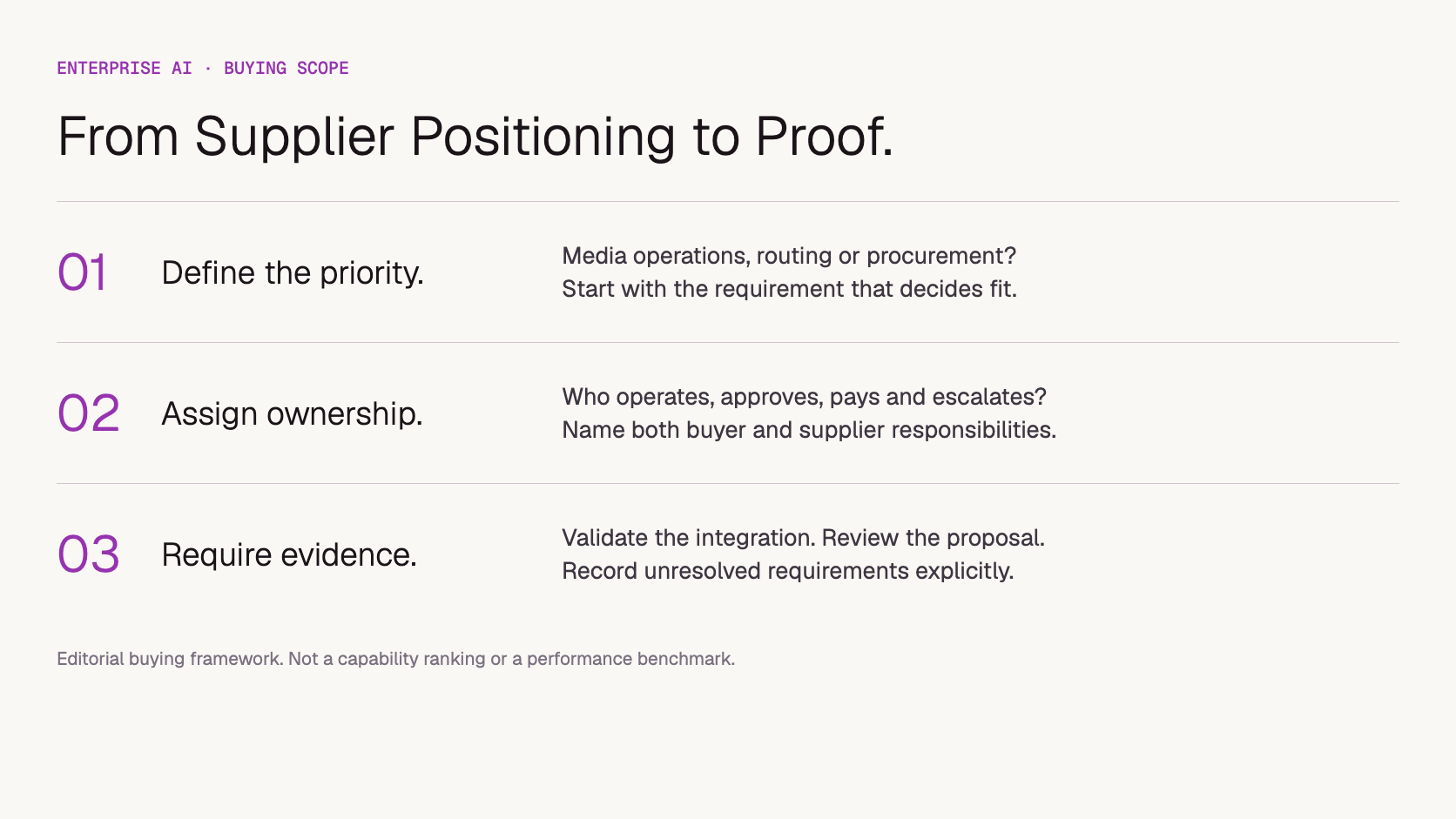
Start with the requirement that would disqualify an otherwise attractive supplier. Then compare the relevant offer from each company against the same requirement. Shortlist providers that can substantiate the scope, and use a representative pilot to resolve performance and output questions. Do not assign numerical scores to capabilities you have not verified.
Shortlist the suppliers whose written terms cover your mandatory requirements. Use the same quote, capacity, contract and acceptance checklist for each supplier, then record who can resolve any open item before signing.
A useful supplier brief can be a single paragraph: “We need these models and operations for these applications; this is our expected usage and peak demand; these are our data requirements; these commitments must be in the proposal.” Send the same brief to each shortlisted supplier. Record unanswered requirements as unresolved rather than scoring them as supported.
Keep technical comparison and purchasing comparison connected but separate. Use the model capability documentation and API selection guide to validate a Token360 integration. Use a written proposal to establish commercial scope. Neither source substitutes for the other.
Is Token360 the only one of the three that serves enterprises?
No. fal and OpenRouter both publish enterprise offerings. Token360's enterprise focus is a positioning statement, not evidence that the competitors lack enterprise customers or procurement capabilities. Compare the specific relationship and terms each company offers.
Should we choose the provider with the most models?
Only if catalog breadth solves your actual problem. A larger catalog does not establish availability of the exact operation, acceptable output, contractual coverage or capacity. Begin with the models and requirements your business will use.
Does no separate service fee mean Token360 is always cheaper?
No. Total cost depends on usage charges, the agreed model mix, output acceptance and any commitments. Compare complete proposals for equivalent requirements. The absence of one fee cannot establish the cheapest end-to-end arrangement.
Can one company use more than one of these providers?
Yes, a company can choose different suppliers for different workloads. The tradeoff is additional integration, billing and governance work. Decide whether specialization provides enough value to justify those responsibilities; this article does not assume one supplier must cover everything.
Which provider has the lowest latency?
This review does not establish a latency winner. That requires matched requests, model versions, locations, traffic conditions and measurement methods. A supplier's business positioning is not a substitute for that evidence.


 Guides
 Guides
 Guides