AI Model Deprecation: The Replacement Cost Beyond Changing a Model ID
AI model deprecation creates work beyond changing an ID. Plan workload evaluation, replacement costs, rollout timing, and contingencies before a model retires.
AI model deprecation is a product-maintenance event, not just a configuration change. A replacement can accept a request and still change the behavior that users depend on. The useful planning question is how to preserve an acceptable service when the original model is no longer available.
For product teams, this creates a cost that a token-price comparison can miss: identifying dependent workflows, evaluating replacements, adapting prompts or parsers, and managing the transition. Those activities belong in the model decision before a retirement notice turns them into urgent work.
This is a product-operations analysis checked October 31, 2026. Provider lifecycle definitions are linked to official documentation. The dependency model and test-scope arithmetic are original editorial examples, not a measured migration or a claim about Token360 customer outcomes.
Deprecated and retired describe different situations
Anthropic distinguishes a deprecated model, which still works but has a replacement recommendation and retirement date, from a retired model, whose requests fail. Its documentation also notes that partner-operated platforms can follow different schedules. See the Claude model deprecation page.
The practical implication is to record both the exact model identifier and the platform serving it. A provider’s direct-API notice is useful evidence, but it is not automatically the retirement schedule for every managed or intermediary route using the same model family name.
A warning period creates time to evaluate a replacement; it does not establish that the replacement is behaviorally equivalent. Conversely, an application that is working today may still have a known deadline. Availability monitoring and lifecycle monitoring answer different questions.
Inventory workloads, not just model names
Suppose one model supports customer-response drafts, structured extraction, and an internal search assistant. A list containing that model once understates the migration scope. The same replacement may be acceptable for drafting but require changes to extraction or tool use.
Inventory field
Why it matters
Workload and owner
Identifies who can accept changed behavior
Model ID and serving route
Connects the dependency to the relevant lifecycle notice
Prompt, schema, and tool dependencies
Shows what must be exercised in evaluation
User-facing acceptance criteria
Defines what a suitable replacement must preserve
Transition deadline and contingency
Separates the planned switch from the last possible switch
Include low-frequency jobs. A monthly report generator may not appear in a short traffic window but can still fail after retirement. Background jobs, demos, evaluation pipelines, and customer-specific configurations can contain dependencies outside the main application path.
This is where ownership matters more than the size of the spreadsheet. Each workload needs a person who can explain its requirements and accept the proposed tradeoffs. An infrastructure team can establish connectivity without being able to approve a change in customer-facing answer quality.
The replacement cost has three layers
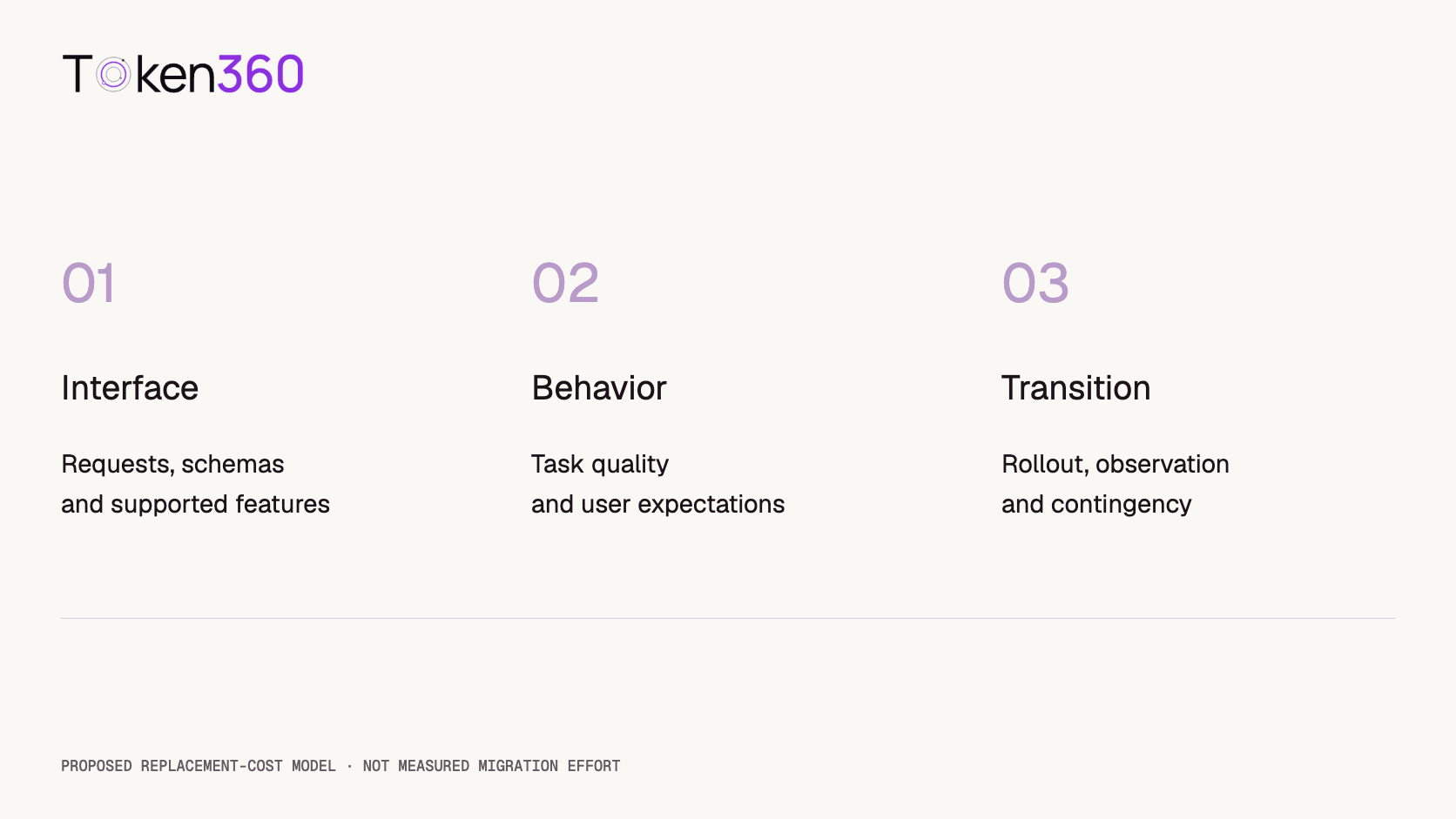
First is interface work: model identifiers, request parameters, response parsing, and supported capabilities. Second is behavior work: whether the model follows the task, produces usable outputs, and handles difficult inputs. Third is transition work: rollout, observation, and a contingency if the candidate disappoints.
A common interface can reduce some integration work. It cannot guarantee the same response style, tool decisions, output length, refusal behavior, or latency. A successful HTTP response therefore belongs in the acceptance process, but it cannot be the entire process.
A proposed cost model. The layers describe work to investigate, not measured migration effort.
For a drafting workload, the important change might be unnecessary verbosity that increases editing time. For extraction, it might be a subtle difference in missing-value handling. For a tool-using workflow, it might be a different action choice. These are illustrative failure modes, not results observed for a particular replacement model.
Original planning example: three workloads, two candidates
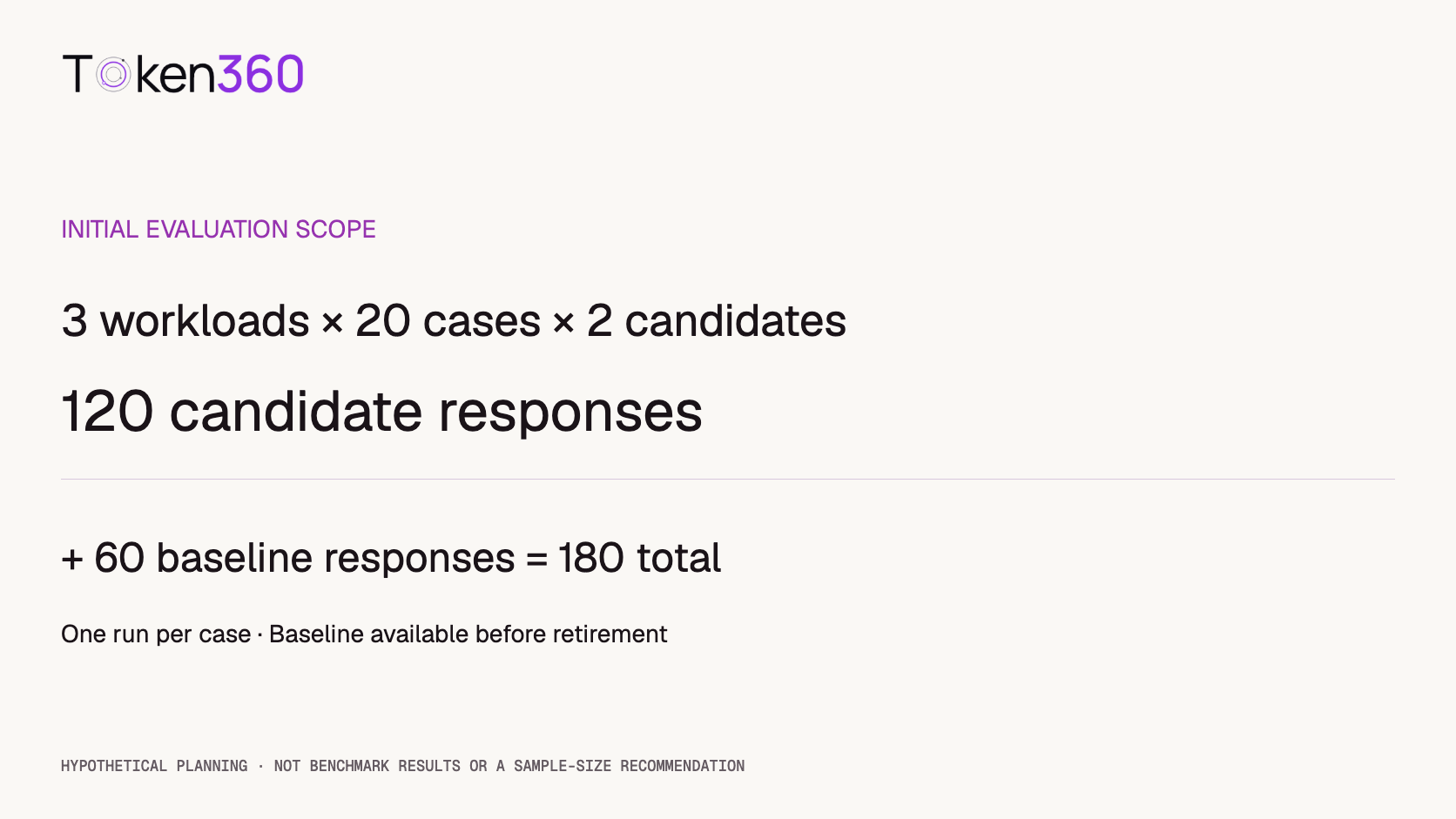
Consider a hypothetical team with three workloads. It selects 20 representative cases for each workload and evaluates two replacement candidates. With one run per case and candidate, the initial plan contains 3 × 20 × 2 = 120 candidate responses.
If the team also runs the current model once on the same 60 cases while it remains available, it adds 60 baseline responses, producing 180 responses in total. The calculation is a scope estimate. It is not a statistically sufficient sample-size recommendation, a token-cost estimate, or evidence of migration success.
Scope item
Hypothetical count
Workloads
3
Cases per workload
20
Replacement candidates
2
Candidate responses
120
Current-model baseline responses
60
Total responses for the initial pass
180
Repeated runs, tool interactions, and additional edge cases increase the scope. A multi-step workflow may create several requests for one case, so response counts should not be treated as billed-request counts without examining the workflow. Store settings and inputs with the results to make the comparison interpretable.
Original planning arithmetic for one run per case; not a benchmark or a power calculation.
Evaluate the business contract before the benchmark score
A replacement’s general benchmark position is useful for shortlisting. It does not answer whether your application still meets its own contract. That contract includes the outcome expected by the user and the constraints enforced by surrounding software.
For extraction, define how to handle absent information and malformed inputs. For a response assistant, define the necessary facts, tone, and escalation conditions. For a tool workflow, inspect action selection and whether the proposed arguments match the intended operation. Use realistic examples with appropriate data handling.
Keep the baseline and candidate evaluations comparable, but allow a second pass with deliberate adaptation. A model tested only with an old model’s prompt may be disadvantaged; a candidate receiving extensive prompt work while the baseline remains untouched answers a different question. Label the comparison as unchanged integration or adapted workflow.
Report results by workload rather than hiding them in one average. A candidate that improves two tasks but breaks the third may still be useful for a partial migration. It is not automatically a suitable universal replacement.
Set an internal switch date before the provider deadline
The provider deadline is the outer boundary, not the ideal release date. An internal target should leave room for a failed evaluation, a revised configuration, and observation after the switch. The amount of room depends on the application and the actual notice period; there is no universal buffer.
Google Cloud’s lifecycle documentation lists model retirement information and directs teams migrating after retirement-related errors to update the target, test mission-critical features, and deploy. Its model versions and lifecycle page is a source to check for the relevant service, not a promise about availability through every API provider.
A limited rollout can reveal operational issues that offline evaluation misses. Define what you will observe, which users or workloads participate, and when to stop or expand. Keep the model and configuration version identifiable in logs so a change in behavior can be associated with the transition.
Rollback expires when the old model disappears
Before retirement, reverting a configuration may restore the prior model if it is still available. After retirement, that option can disappear. Calling the same retired endpoint more often does not create a recovery strategy.
A contingency might use another previously evaluated model, temporarily narrow a feature, queue suitable work, or route a task to human review. The choice depends on the service. A fallback that produces a response but violates the task’s requirements is not a successful recovery.
For workflows that take actions, a parallel evaluation must also avoid executing those actions twice. Comparing candidate decisions offline or in a controlled environment is different from blindly duplicating production requests. Choose the observation method around the side effects of the task.
A gateway can simplify the switch without removing evaluation
A gateway may centralize model selection and reduce application-specific connection changes. The remaining question is which capabilities and behaviors the selected route actually supports. Shared request syntax is useful, but it is not a guarantee of feature parity or a longer model lifetime.
Check Token360’s model capability documentation and the exact model schema before selecting a replacement. This article does not claim that Token360 automatically migrates retired models, preserves a provider’s retired endpoint, or guarantees equivalent outputs.
Use the AI API observability guide to connect request behavior with workload monitoring. Include task quality and user impact alongside errors and latency when assessing the transition.
Budget for replacement work as recurring maintenance
The cheapest model to call is not necessarily the cheapest model to maintain in a product. Compare expected inference spending with the effort needed to evaluate, adapt, and operate the dependency. Keep those categories separate so uncertain maintenance assumptions do not masquerade as measured savings.
A useful internal record includes time spent finding dependencies, adapting the workflow, reviewing candidates, and handling post-switch issues. After a real migration, these measurements can improve the next estimate. Until then, treat them as planning categories rather than invented hours.
The product decision is whether the chosen dependency is supportable over time. That requires a known owner, a testable task contract, and a feasible next option—not simply confidence that a newer model will eventually exist.
FAQ
What is AI model deprecation?
It is a lifecycle stage in which a provider moves a model toward replacement or retirement. The precise meaning and timeline depend on the provider and serving platform; consult the notice for the exact model route.
Does deprecated mean the API has already stopped working?
Not necessarily. Anthropic explicitly distinguishes still-functional deprecated models from retired models whose requests fail. Check the relevant provider’s terminology rather than assuming every status has the same meaning.
Is changing the model ID enough?
It may establish connectivity, but task behavior and capability compatibility still need evaluation. Prompts, parsers, tools, and user-facing quality can require changes even when the request succeeds.
How many test cases should a replacement evaluation use?
The appropriate coverage depends on the workload and failure consequences. The 20-case example here illustrates scope arithmetic only; it is not a validated threshold or a guarantee of reliable results.
Can I roll back after retirement?
Do not assume so. If the old model is unavailable, a rollback pointing to it cannot restore service. Prepare a usable contingency while alternatives can still be evaluated.
Does a unified API eliminate deprecation risk?
No. It can simplify parts of integration, but availability and task suitability remain separate questions. Confirm the serving route, lifecycle notice, and replacement behavior.


 Tutorial
 Comparison
 Tutorial