AI for RFP Responses: Keep Answers Within Approved Scope
Use AI for RFP responses without turning old proposals, custom terms, or roadmap features into unsupported commitments. Build an evidence-based workflow.
ENTERPRISE USE CASES · PROPOSAL TEAMS
AI for RFP responses is most useful when it drafts from current, approved evidence and preserves the conditions attached to each claim. A model can help find relevant material and prepare an answer. It should not convert a previous customer's exception, a planned feature, or an optional service into an unconditional commitment in your next proposal.
For B2B software and IT service teams, the difficult question is often not “Can the model write this?” It is “Can we stand behind this answer for this buyer, product configuration, and proposed contract?” This article explains how to structure that decision before connecting a model API to your proposal process.
Evidence boundary: This is a proposed workflow, not a tested Token360 RFP product or customer case study. The example is fictional. Official product documentation was checked on November 14, 2026; no response-time savings, win-rate improvement, or model accuracy results are claimed.
Start with evidence retrieval and first-draft preparation for the supplier answering a buyer's questionnaire. Preserve each question, locate applicable source material, draft a qualified answer, and route unresolved claims to their owners. Keep submission authority with the proposal team. A fluent response is not proof that the offered solution meets the requirement.
This scope differs from buying AI models or reviewing incoming manufacturing RFQs. The output here is a supplier's representation of its own capabilities: what is available, under which conditions, and what requires additional agreement.
A practical first workflow covers a bounded set of questions about one product or service. It returns the original question ID, proposed answer, supporting source locations, missing information, and reviewer. Avoid starting with “complete the entire workbook” if the application cannot yet distinguish the standard offer from customer-specific arrangements.
What must an approved answer library contain?
An approved answer library needs more than polished paragraphs. Each reusable claim should carry its owner, review date, applicable product or service, and any limits on region, plan, version, or contract. Historical answers remain useful evidence, but their previous approval does not establish that they apply to the current bid.
Record
Why it changes the answer
Example value
Availability state
Separates current capabilities from plans
Available now; planned; retired; unknown
Commercial scope
Separates included services from negotiated additions
Standard; optional; customer-specific
Applicability
Prevents reuse across incompatible offers
Product edition, deployment, geography
Evidence and owner
Makes the claim reviewable
Document revision, section, accountable team
Review status
Prevents silent reuse of stale answers
Approved on a date; review required
Do not treat a recently modified file as a recently reviewed claim. A formatting edit could update the file timestamp without changing the underlying commitment. Similarly, a signed statement of work can establish what was agreed for one customer without establishing what is included for every customer.
For a changing knowledge base, retrieval and fine-tuning solve different problems. Retrieval can supply selected records at request time; neither approach automatically decides whether a contractual exception is reusable.
How can a convincing draft overstate the offer?
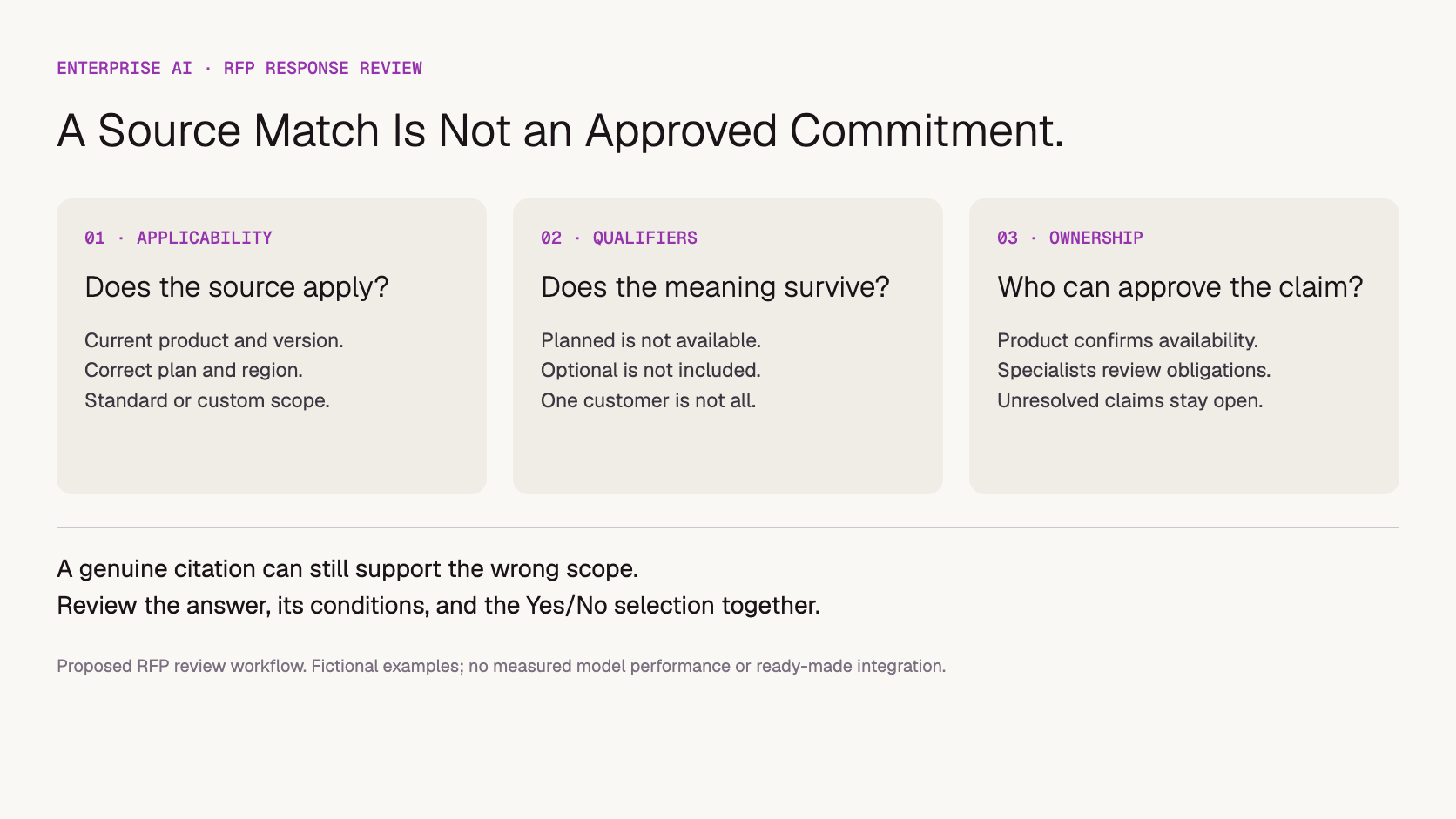
A convincing draft can combine individually genuine statements into a commitment that no source supports. This happens when scope disappears during synthesis: one customer's premium support becomes universal support, or a roadmap description becomes an available integration. Review the completed claim, including its qualifiers, rather than checking only whether its component words appeared somewhere.
Fictional example: An IT service supplier receives this requirement: “Confirm that all customers receive 24/7 human support and that Connector Z is available at launch.” Its source collection contains three records:
A previous customer's agreement includes a negotiated 24/7 support service.
The current standard service description specifies business-hours support.
A roadmap note describes Connector Z as planned, without a committed release date.
An unsafe draft would answer “Yes” and describe the two capabilities as included. It would be wrong even if the two attached citations pointed to authentic documents. The sources would not support the scope of the answer.
A review draft could instead say: “Our standard service description specifies business-hours support. A previous customer agreement includes a separately negotiated 24/7 arrangement; applicability to this proposal requires commercial confirmation. Connector Z is recorded as planned, so we cannot confirm its availability at launch from the supplied evidence.”
This is still a draft for the responsible teams to approve. If the questionnaire requires a Yes/No selection, the selection must be reviewed together with the explanation. A “Yes” beside a paragraph that says “not currently available” creates a contradiction rather than a qualified response.
Proposed review framework. A citation establishes provenance; applicability requires a separate check.
Should the system reuse exact answers or generate new ones?
Use exact approved wording when wording itself carries a commitment, and allow synthesis where a reviewer can verify the assembled answer against applicable evidence. These are different operating modes. Neither mode removes the need to check whether the source is current and relevant to the buyer's specific requirement.
Existing response platforms make this distinction explicit. Responsive's AI Draft documentation describes a content-library-only mode that returns exact matches and leaves questions unanswered when no match exists, alongside a mode that can compose drafts using library content. That illustrates why “reuse” and “generate” should be separate choices.
Loopio's automation documentation describes selecting source content, preparing a first pass, and assigning entries for editing or review. It also describes an option to avoid composing an answer when there is no exact match. These are documented workflow options, not evidence that every resulting answer is correct.
In a custom integration, specify what should happen when evidence is missing: return “needs owner input,” preserve the unanswered question, and identify the missing fact. Do not substitute general industry knowledge for an answer about your own company's capabilities.
How do you keep qualifications from disappearing?
Review the meaning-bearing qualifiers alongside the main claim: who receives a capability, when it is available, what configuration it requires, and whether it costs extra. Summarization should preserve these conditions. A shorter answer is only useful if it does not expand the promise or hide an unresolved dependency.
Protect distinctions such as “available on request” versus “included,” “planned” versus “released,” “selected regions” versus “all regions,” and “automated monitoring” versus “human support.” Ask reviewers to compare these dimensions directly, rather than judging tone or grammatical quality.
Multipart questions need separate coverage checks. A single paragraph can sound complete while answering only the first of three requirements. Store the subquestions under the original question ID, and show which part has evidence, which needs a qualification, and which remains unresolved. Preserve the buyer's requested response format when exporting the approved version.
Conflicting current sources should produce a review task, not an invisible model-selected winner. The designated owner can identify the authoritative record and document the resolution. That correction should feed back into the library so the same conflict does not recur on the next bid.
Who should approve AI-assisted answers?
Assign approval according to the claim being made, rather than sending every answer to one general editor. Product owners can confirm availability; security specialists can verify security statements; commercial or legal owners can review proposed obligations. The proposal lead coordinates completion and checks that the final answer, selection, and attachments agree.
A reusable review record should show the source revision actually used, draft changes, unresolved conditions, approver, and final decision. If an answer changes after approval, the workflow should make that change visible and determine whether reapproval is required. The model should not silently overwrite an approved response during a later batch run.
Use the blank RFP answer review register to define the fields before implementation. It contains no test results. For broader ownership and release controls, see AI API approval workflows.
Choose RFP software when you primarily need a managed answer library, collaboration, and proposal workflow. Consider a custom API integration when your approved evidence and review process live in other systems and you can own the integration. A model endpoint provides inference; it does not supply a complete proposal-management application.
Current sources, consistent review, sufficient specialist time
Token360 provides access to text, image, audio, and video models. For this use case, text models can support drafting and suitable vision-capable models can help interpret document images, subject to model support and validation. Document parsing, source access, answer storage, and approvals still require an application layer.
Restrict retrieval to documents the user is permitted to access. Do not allow one client's confidential proposal or negotiated terms to appear in another client's answer. Review data retention and training policies separately for the actual service configuration.
How should a proposal team evaluate a pilot?
Evaluate whether the workflow preserves commitments and reduces useful review work, not how many cells it fills. Include approved matches, stale answers, missing evidence, conflicting sources, and customer-specific exceptions. Have the responsible owners judge the proposed answer and source applicability before treating the workflow as ready for live proposals.
Build a labeled evaluation set with expected outcomes. Include at least one requirement whose correct outcome is unresolved, one where the correct answer must retain a qualifier, and one multipart question where only some parts are supported. These are test categories to construct, not reported Token360 test results.
Unsupported affirmation: Did the system say Yes without applicable evidence?
Qualifier loss: Did the answer expand availability, coverage, or commercial scope?
Source usefulness: Can the reviewer locate and assess the cited record?
Question coverage: Were all required subparts handled or explicitly left open?
Review effort: How much correction and specialist time did the complete workflow require?
Record the denominator and severity for each metric rather than collapsing everything into one accuracy score. Compare the same representative questions with the current process, including human review time. Estimate total workflow cost with parsing, retrieval, model calls, maintenance, and corrections included. Faster drafting does not by itself establish better commercial outcomes.
A model may populate responses, but that does not establish authority to make the commitments. Keep an accountable approval step for answers describing capabilities, security, commercial terms, and delivery obligations.
Is a previously approved answer safe to reuse?
Only after checking its applicability. Previous approval may have covered another customer, version, region, or negotiated arrangement. Confirm that the conditions still match the current proposal.
Does attaching a citation make an answer reliable?
No. A citation helps a reviewer locate evidence. The evidence may still be outdated, inapplicable, or narrower than the draft's claim. Check both what the source says and whom it applies to.
Should roadmap features appear in the answer?
Only with their actual status and approved qualifications. Do not describe a planned capability as available or commit to delivery dates that the responsible owner has not authorized.
Does Token360 provide a complete RFP response tool?
This article describes a possible application built using model APIs. It does not claim that Token360 supplies a ready-made answer library, RFP integration, or proposal approval system.


 Guides
 Guides
 Guides