AI for Customer Onboarding: From Handoff to Delivery
Turn sales handoffs into reviewed onboarding plans with AI. Keep owners, dependencies, target dates, and completion evidence separate.
CUSTOMER SUCCESS · IMPLEMENTATION
AI for customer onboarding can turn sales notes, agreed scope, and kickoff discussions into a draft implementation plan. The useful output is not just a summary: it identifies deliverables, owners, prerequisites, open decisions, and evidence of completion. A customer success or implementation lead should confirm that plan before it becomes a customer-facing schedule.
For SaaS vendors, IT service providers, and implementation partners, this is a practical model-API use case. The team already has information spread across conversations and documents. The question is whether AI can organize it without turning an aspiration into a deadline, an invitation into a completed setup, or an unassigned task into somebody else's responsibility.
Evidence and scope: This article proposes a workflow for onboarding business customers. It is not a Token360 customer case study, a tested connector, or an employee-onboarding guide. The example is fictional. Public sources were checked on November 14, 2026; no time savings, retention improvement, or model accuracy figures are claimed.
Which onboarding problem should you automate first?
Start with the internal handoff between sales and the team delivering the service. Ask AI to organize a defined customer packet into a reviewable brief and a list of missing decisions. This creates a bounded task before you attempt automatic scheduling, customer messaging, or changes to live project records.
The first useful brief answers five questions: What outcome did the customer buy? What is included? Who owns the work on each side? What must happen first? What will demonstrate that onboarding is complete? Keep the original source location attached to each material answer.
HubSpot's customer onboarding guide describes a checklist as a framework of tasks, milestones, and deliverables supporting adoption after a sale. The implementation question here is narrower: how to assemble those items from the actual customer record without inventing the missing pieces.
A summary that says “customer is ready for launch” is not enough. A useful handoff might instead say “customer selected a launch target; access confirmation and import validation are still open.” That gives the delivery lead something specific to resolve.
What information should go into the handoff packet?
Use a customer-specific packet containing the agreed scope, relevant sales context, current stakeholder list, implementation requirements, and confirmed decisions. Identify document versions and dates. Treat discussion notes as context rather than automatic authorization, and surface disagreements between sources for review instead of letting the model silently choose one account.
Give each source a stable identifier. If the model says that an import requires a customer-owned export, the reviewer should be able to open the relevant section or transcript timestamp. For audio inputs, check that transcription preserves names, negations, and dates before relying on the extracted tasks.
Do not combine unrelated accounts simply because their projects use the same template. Customer identity, purchased configuration, and permissions must be established by the application. The separate account-specific SaaS answers guide covers answering for the right customer; this article focuses on building that customer's delivery plan.
How does AI turn notes into an executable plan?
Ask for task candidates with explicit deliverables, proposed owners, prerequisite relationships, date status, and completion evidence. Preserve “unknown” when a field has no support. The model can suggest a structure, but the implementation lead must confirm responsibilities and sequencing before the application creates or updates operational work.
Separate extraction from planning. First record what the sources actually say. Then propose the tasks needed to deliver the confirmed scope. Mark proposed steps as recommendations rather than statements made by the customer. This lets reviewers accept useful planning suggestions without confusing them with purchased requirements.
A task such as “complete integration” hides too much. A reviewable version might be “validate a sample import in the test workspace,” owned provisionally by the implementation team, blocked by receipt of the customer's sample export, and completed when an agreed validation report is approved. If the packet does not establish these details, they remain proposals for the kickoff discussion.
Asana's dependency documentation explains relationships in which work is blocked by another task. This is a useful distinction for onboarding: an action can be in the plan while still being unable to start. A model-generated list should retain that relationship rather than assigning every item the same immediate due date.
What does a misleading onboarding plan look like?
A misleading plan turns tentative information into confirmed status. It may schedule launch before required inputs exist, assign a customer task to your team, or treat a sent invitation as successful access. These errors are more consequential than awkward wording because they change what people believe is ready to happen.
Fictional example: A software vendor is onboarding a business customer. The handoff packet contains an agreed service covering one data import and one administrator training session. A sales note records the customer's hope to launch on Monday. The kickoff notes say the customer will provide a sample export, and an access invitation has been sent.
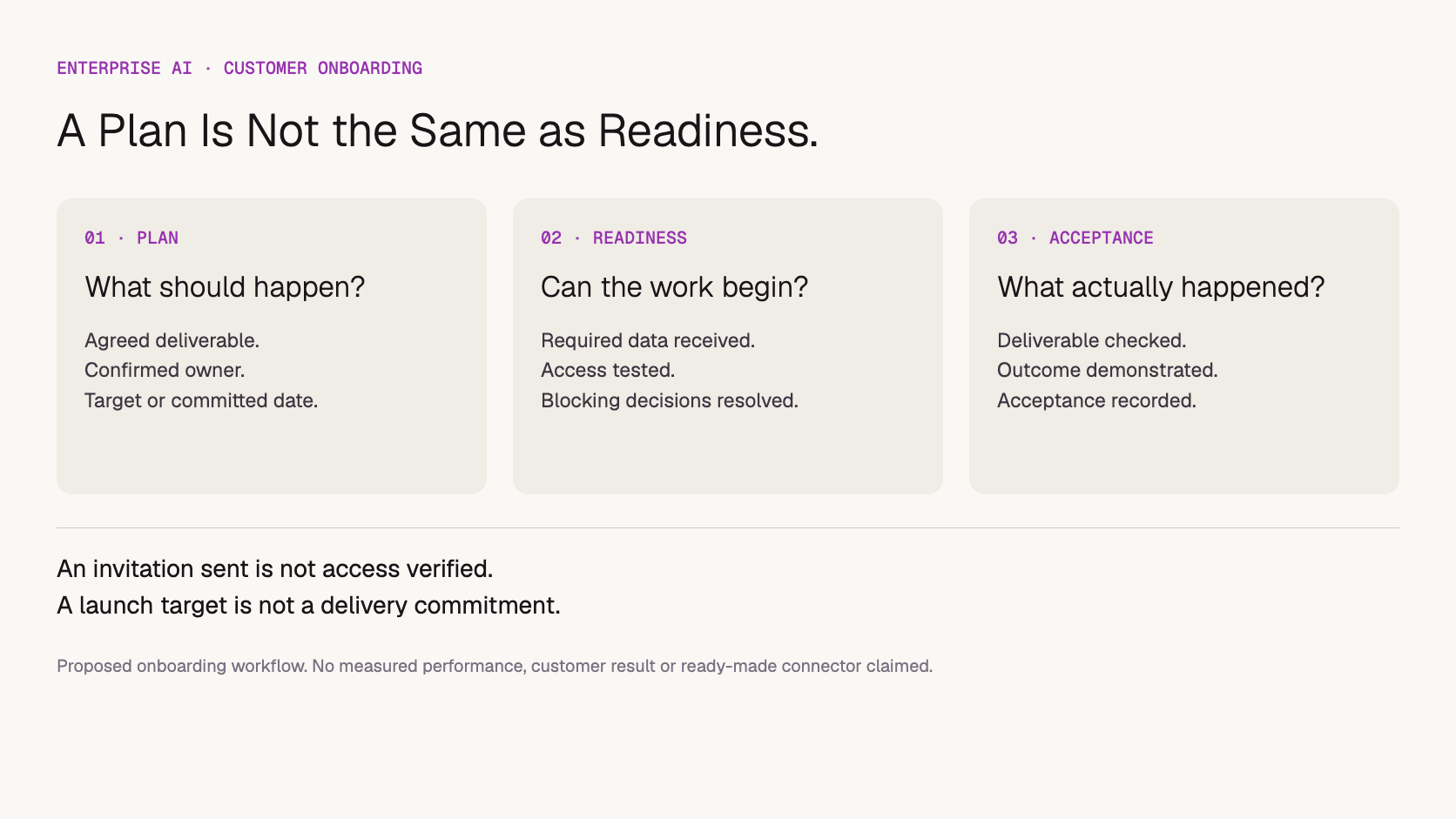
A poor AI plan could report “access complete,” assign data preparation to the vendor, and schedule Monday's launch as confirmed. None of those conclusions follows from the packet. A more useful draft would separate the following:
Item
Supported status
Next decision or evidence
Launch date
Customer target: Monday
Implementation lead confirms feasibility after prerequisites
Workspace access
Invitation sent
Named administrator confirms successful sign-in
Sample export
Customer action recorded; receipt unconfirmed
Confirm owner, delivery date, and received file
Import validation
Not ready to start
Requires sample export and working access
Training
One session included; scheduling open
Confirm attendees and readiness criteria
The proposed plan does not need to reject Monday. It needs to show why Monday remains a target and who can confirm it. Likewise, it should not mark the project unsuccessful because evidence is missing; “unconfirmed” and “failed” are different states.
A proposed onboarding review model. Plans, readiness, and acceptance answer different questions.
How should the workflow handle changes after kickoff?
Keep the approved plan as a versioned record and treat new messages as possible changes, not instructions to silently regenerate everything. Show which task, owner, date, or dependency would change and why. Have the appropriate owner approve the update before it replaces the plan shared with the customer.
A customer may request another data source after kickoff. The model can identify the request and its relationship to existing work. It should not assume that an additional integration is included, that the launch date remains feasible, or that an earlier scope statement has been superseded.
Make the proposed update explicit: new request, affected deliverable, source message, owner for decision, and unresolved impact on schedule or scope. Retain completed tasks and accepted decisions unless there is evidence requiring them to be reopened. Repeated summaries should not create duplicate project tasks.
For commitment review before a sale, see AI-assisted RFP responses. After the sale, the distinct job is to keep the implementation plan aligned with approved changes and actual readiness.
What should customers see, and what stays internal?
Customers should see a clear plan of agreed actions, responsible parties, dependencies, and open decisions relevant to them. Internal speculation, confidential sales commentary, or another account's examples should not appear in that view. Generate the customer-facing version from approved fields rather than asking a model to publish the entire internal handoff summary.
A customer update can say “We are waiting for the sample export before validating the import,” with the agreed owner and next step. It should not claim that work is complete because a task was created or because a deadline has passed.
Keep customer evidence and internal interpretation separately labeled. Restrict retrieval and exports by account and role, and check retention arrangements for recordings and documents. Data retention and model training policies need separate verification for the selected service configuration.
Before sending an update, validate that task states and dates still match the operational system. If the model wrote the message earlier, a fresh read may be necessary. Sending messages, scheduling sessions, and modifying access are application actions; generating text does not execute them.
Should you buy onboarding software or build with an API?
Use existing onboarding or project software when its workflow and customer portal fit your process. Consider model APIs when your handoff evidence spans systems and you need custom extraction or planning assistance. An API provides model inference; your application still needs source access, project records, permission controls, and a usable review interface.
Option
Best fit to investigate
What to verify
CRM or onboarding software
Established customer records and repeatable delivery process
Token360 offers access to text, image, audio, and video models. Text models are relevant to handoff drafting; supported transcription or vision models may help prepare recordings or scanned documents for review. Each step requires an appropriate model and validation. Generative video is not a prerequisite for an onboarding plan.
As checked on November 14, 2026, Token360's enterprise offering includes custom pricing discussions. Capacity, contracts, and compliance requirements should be scoped to the engagement. This article does not claim a ready-made CRM connector, onboarding portal, or guaranteed implementation outcome. See Token360's company and resources information for company context.
Evaluate the accuracy and usefulness of the reviewed plan, not just the readability of the summary. Use representative handoffs with incomplete access, disputed ownership, tentative dates, and scope changes. Compare against a plan prepared by your delivery lead, and record the corrections required before either version can be used.
Use the blank onboarding plan review register to track source evidence, proposed task, owner confirmation, prerequisite status, date type, completion evidence, and reviewer decision. It is a planning template, not a record of measured results.
Missing dependencies: Did the plan schedule work before the required input or access?
False completion: Did it mistake sent, requested, or scheduled for done?
Ownership errors: Did it invent an assignee or move a customer responsibility to your team?
Date inflation: Did it turn a preference or target into a committed date?
Review effort: How much correction was needed to create an approved, usable plan?
Measure the whole workflow, including gathering sources, reviewing the draft, and maintaining updates. If you later measure time to value, define the customer outcome and start and end events first; a shorter kickoff meeting is not automatically faster adoption. Separate customer waiting time from your team's processing time.
Include integration and review effort in total API workflow cost. A small inference charge does not prove the onboarding process became cheaper, and a polished plan does not prove delivery improved.
Frequently asked questions
Can AI create a customer onboarding plan from sales calls?
It can draft one from a usable transcript and supporting records. Review transcript errors, agreed scope, owners, and dependencies before treating the output as the delivery plan. Discussion alone does not confirm a commitment.
Should an AI-generated launch date be sent to the customer?
Only after the responsible team confirms it. Label customer targets, proposed dates, and committed dates separately. Do not infer feasibility from a requested date when prerequisites or resource availability remain unknown.
Does a completed checklist prove the customer is onboarded?
Only if completion criteria reflect the agreed outcome and have supporting evidence. “Training invitation sent” is different from training completed, and successful sign-in is different from a validated business workflow.
Does Token360 replace our CRM or project management system?
No replacement is proposed here. Token360 can supply model inference for an application you build or integrate. Customer records, scheduling, task state, and approval remain functions of the surrounding workflow.
Should every account use the same generated plan?
Use a common structure, but populate it from the account's actual scope and prerequisites. Retain customer-specific exceptions and open decisions. A template helps consistency; it does not establish that all implementations are identical.



 Guides
 Guides
 Guides