Use RAG for changing company knowledge and consider fine-tuning for persistent behavior gaps. Compare scope, evidence and ownership before buying.
ENTERPRISE AI · CUSTOMIZATION DECISIONS
For enterprise AI, start by identifying the missing capability. Retrieval-augmented generation (RAG) supplies relevant company information at request time. Fine-tuning adapts a model using training examples. Investigate RAG when answers need changing internal knowledge; consider fine-tuning when a well-defined behavior remains unreliable after a strong baseline. Some applications need neither, and some need both.
This is a procurement decision framework based on official documentation, with hypothetical business examples. It is not a Token360 implementation benchmark or a claim that either approach has been validated for your workload.
Read first: review Token360’s model capability documentation to establish what the selected model and endpoint accept. A model’s context window or structured-output support does not, by itself, establish a complete company knowledge system.
What is the difference between RAG and fine-tuning?
RAG changes the evidence available to a model during a request. Fine-tuning changes model behavior through an additional training process. The buying decision therefore concerns different assets: retrievable sources and their access controls on one side, and suitable training examples plus a supported deployment path on the other.
AWS’s RAG and fine-tuning comparison describes these as distinct approaches that can also be combined. For procurement, the useful question is not which technique is more advanced. It is which part of the application is failing, and whether the proposed work addresses that failure.
Approach
What you provide
Useful starting point
What still needs checking
Prompting and direct context
Instructions, examples and relevant material in the request
A bounded task with manageable context
Instruction following, context limits and output correctness
RAG
A searchable source collection and retrieved context
Answers that depend on current, authorized company information
Retrieval relevance, source freshness, permissions and answer support
Fine-tuning
Training examples for a defined task
A persistent behavior gap that examples can teach
Held-out performance, regression risk and deployment availability
This is a decision aid, not a rule that fine-tuning can never affect knowledge or that retrieval always produces correct answers. Both require evaluation in the actual application.
Which problem is your company actually trying to solve?
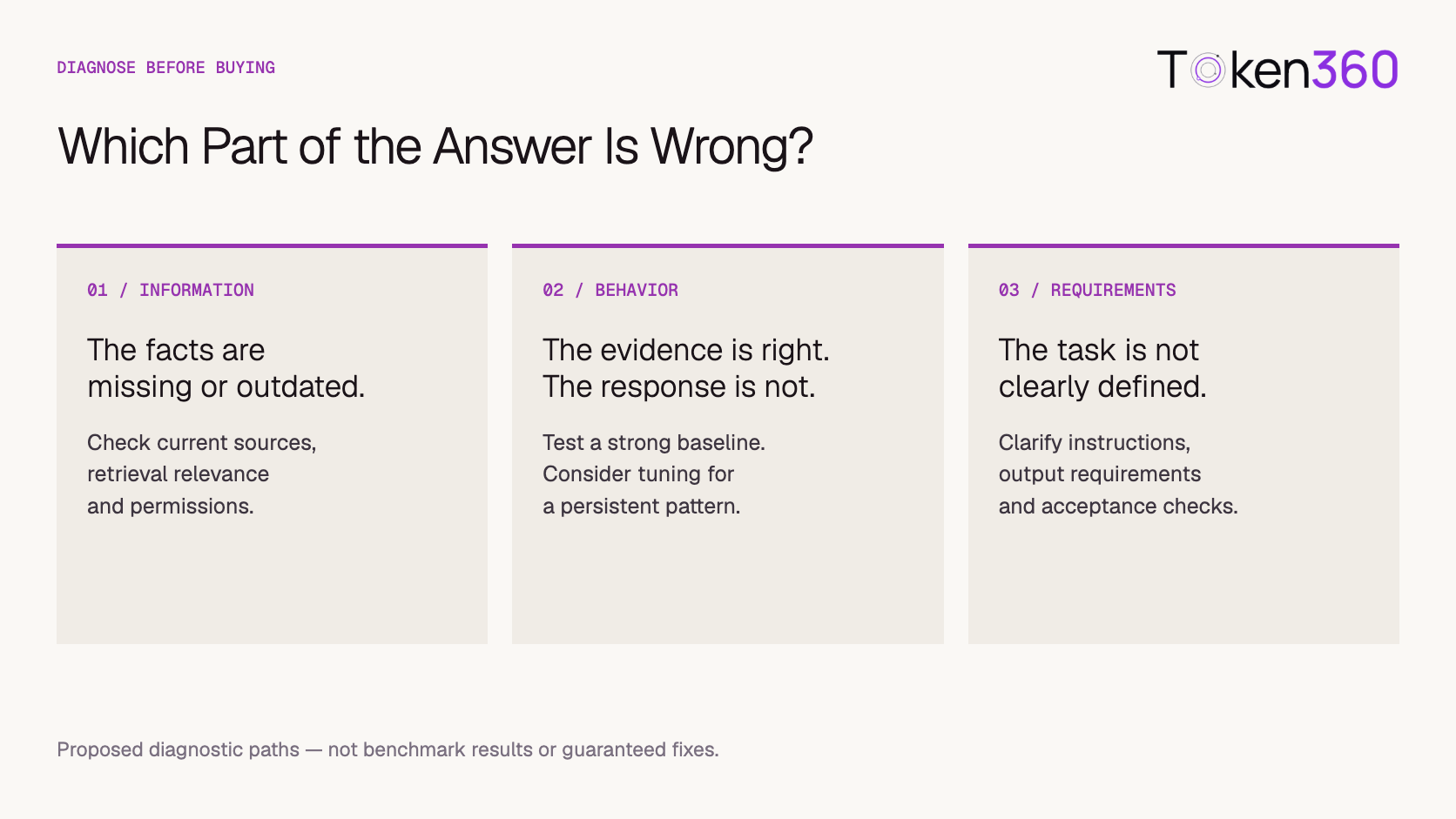
Describe the failure before choosing a customization method. An outdated answer, an unwanted response style and an invalid business decision can look similar to a user, but need different investigations. Start with the input, the information available to the model and the exact output the business expected.
Consider a hypothetical customer-support assistant. It quotes an expired returns policy. First check whether the current policy was available in the request and whether the retrieval system selected the correct version. Training on more historical answers could reinforce the outdated rule instead of fixing access to the current one.
Now suppose the assistant receives the correct policy but repeatedly writes long explanations when agents need a short decision and one reason. Test explicit instructions and examples. If that behavior remains unreliable across representative cases, a training-based approach becomes a reasonable candidate to investigate.
A third failure is an answer that has valid JSON but approves a refund the customer is not entitled to receive. A valid format does not establish a correct decision. Check the supplied evidence and business rules; keep authoritative transaction checks in the relevant business system rather than assuming a formatting constraint will enforce them.
Identify the failure layer first. These are proposed diagnostic paths, not measured outcomes.
When should an enterprise investigate RAG?
Investigate RAG when employees or customers need answers grounded in a body of company information that changes, must be traceable or cannot fit conveniently into every request. The purchase includes more than an answer-generating model: someone must maintain the sources, retrieve appropriate material and enforce access boundaries.
For a policy assistant, the important records include which policy version was retrieved, when it became effective and which passage supports the answer. A link to a document is useful only if the cited content actually supports the claim. Retrieval can surface irrelevant or outdated material, and the generator can still misinterpret a correct passage.
Permissions are part of this design. A salesperson’s question should not cause another team’s restricted material to enter the model context. Microsoft’s document-level access documentation provides a concrete example of restricting search results according to caller identity and document permissions. That is an implementation example, not a claim that Token360 automatically applies your document permissions.
Ask who handles document ingestion, updates, deletion, access changes and retrieval diagnostics. Also ask how the application responds when it finds no adequate evidence. A system that can say “I could not find an authorized current source” may be more appropriate than one designed to answer every question.
When is fine-tuning worth investigating?
Investigate fine-tuning when the task is clearly defined, you can supply credible examples of the desired behavior and a suitable baseline still falls short. The evidence should show a recurring pattern, rather than a handful of frustrating responses. Confirm training and serving support before committing to dataset preparation.
Google’s supervised fine-tuning documentation describes adapting model behavior with labeled data, including tasks such as classification, summarization and chat. It also identifies cases where prompting already works well. The availability and limitations of tuning are model- and platform-specific; an inference API listing is not proof that the same service supports training.
In the support example, useful training material might pair representative cases with approved concise responses. An unreviewed archive of old conversations is not automatically a good dataset: it may include obsolete policies, inconsistent decisions or personal information that should not be used for this purpose.
Keep a separate set of representative cases out of training. Compare the tuned candidate with the baseline on those cases, including exceptions and escalation requests. Review both the intended improvement and any loss of capability elsewhere. A better tone does not compensate for worse factual accuracy or unsafe handling of an exception.
Before signing, identify who owns data preparation, training runs, evaluation, model or adapter versions, serving and rollback. If the proposal relies on a private artifact, verify where and how that artifact can actually run. Do not assume it can be moved to any API provider.
When might you need neither approach?
You may need neither RAG nor fine-tuning when a clear prompt, a few examples or directly supplied context already meets the task’s requirements. Establish that baseline before adding infrastructure. The simplest adequate design reduces the number of components your team must maintain, diagnose and purchase.
A single contract summary can begin with the relevant document supplied directly, subject to the model’s limits and your data policy. A fixed extraction task can begin with an explicit schema and validation. A request for current stock availability may need an authorized inventory-system query rather than a search over yesterday’s product documents.
These are design hypotheses to test, not guaranteed shortcuts. For example, structured output can constrain a response’s shape while leaving the extracted values wrong. Use the selected model’s supported parameters and limits and evaluate the content as well as the format.
Before committing to model customization, the AI API without model training guide explains what your team can evaluate using an existing model and authorized reference material.
Can RAG and fine-tuning work together?
Yes. An application can retrieve current evidence and pass it to a model adapted for a particular task or response style. Combining them makes sense only when each addresses an identified gap. It also creates separate components to test, so the team must be able to distinguish retrieval failures from generation failures.
For example, a support application could retrieve the latest approved policy while a tuned model produces the company’s preferred response structure. This is a possible architecture, not an implementation tested for this article. It still needs source permissions, evidence checks and confirmation that the tuned model can be served through the chosen platform.
A useful diagnostic experiment holds the source passage constant and compares responses. Another holds the generator constant and examines which passages were retrieved. Those comparisons help locate failures. They do not justify declaring one method superior from a single successful answer.
What should you ask a supplier before purchasing?
Ask the supplier to separate model inference, knowledge-system work and training-related work in the scope. For each component, name the owner, required inputs, acceptance evidence and ongoing obligations. A proposal that says only “custom AI on your data” leaves too much uncertainty about what will actually be delivered.
Buyer question
Evidence to request
Where does company information enter the system?
A data-flow diagram covering storage, retrieval, model context and logs
How do updates and permission changes take effect?
A named owner and a demonstrable update/access-change process
What persistent behavior gap requires training?
A baseline comparison and reviewed example pairs
Which model and deployment are included?
Exact supported configuration, artifact constraints and serving responsibilities
What proves the project meets our need?
Agreed held-out cases, failure categories and acceptance criteria
Which costs continue after setup?
Separate inference, retrieval infrastructure, maintenance, evaluation and any training charges
Do not turn this into a feature-count contest. A company with frequently updated manuals may need reliable ingestion more urgently than a custom-trained model. A company with a stable classification task may need consistent labels more urgently than a document search interface.
The customization decision worksheet gives the application owner space to record the observed failure, evidence available, proposed approach and acceptance check. It contains blank fields, not a pre-scored recommendation.
Token360’s role should be scoped around the model access and enterprise arrangements your application needs. An application can supply retrieved context to a suitable model, but that does not mean the inference provider automatically owns document ingestion, permission enforcement or training. Clarify those responsibilities before comparing proposals.
Token360’s enterprise positioning covers text, image, audio and video model access, with dedicated capacity, negotiated pricing, contracts and compliance requirements scoped to the engagement. As checked on November 9, 2026, the enterprise page places custom model deployment under a sales discussion. That does not establish a generally available fine-tuning API or managed RAG service.
Bring a concrete workload to that discussion: the selected model, relevant input sizes, expected request volume, knowledge-update pattern and whether a custom artifact is involved. Request confirmation of the supported arrangement. For background on the company, see About Token360.
Frequently asked questions
Does uploading company documents train the model?
Not necessarily. Documents can be placed in request context or indexed for retrieval without a fine-tuning job. Ask how the upload is used and what the applicable data terms allow. Application behavior and contractual permission to use data for training are separate questions.
Will RAG eliminate hallucinations?
No. Retrieval can supply evidence, but it can select the wrong source and the model can misread a correct one. Check source relevance, answer support and behavior when evidence is missing. Do not accept a citation as proof without checking the referenced passage.
Is fine-tuning always cheaper than a longer prompt?
No. A shorter serving prompt may change inference usage, but training, preparation, evaluation and deployment add costs. Compare the complete workload and maintenance requirements. This article provides no measured price advantage for either approach.
Can we fine-tune now and add RAG later?
Potentially, if the deployment supports the combined application. First establish why training is needed and how retrieved evidence would enter future requests. Buying training in advance does not remove the need to build and govern retrieval later.
What should we send Token360 first?
Send a description of the task, representative non-sensitive inputs, the expected output, the current failure and your serving requirements. If you already have a tuned model or adapter, describe its format and deployment needs rather than assuming universal compatibility.
Read next: use AI API Total Cost of Ownership to budget the components you decide to include. This local draft link must be replaced with the published article URL before publication.
Evidence boundary: the examples and worksheet are editorial planning tools. No customer results, training experiment, retrieval benchmark, success rate or price comparison was conducted for this article.
Enterprise AI
API
Bring your next idea to life.
Create a video scene in Creator, or explore models for images, audio, and text to find the right capabilities for your project.


 Guides
 Guides
 Guides