AI APIs for BPOs: Scale Agent Assist Across Clients
Scale BPO agent assist with client-specific policies, knowledge access and quality checks. Compare platform tools with APIs and plan a reviewed pilot.
INDUSTRY USE CASES · BPO & CONTACT CENTERS
Business process outsourcing providers can use AI APIs to summarize cases, find approved guidance and draft replies for human agents. Scaling this assistance across client programs requires more than reusing a prompt: each case needs the right client, policy version, knowledge access and action permissions. Share the underlying capability without mixing the clients’ instructions or customer records.
A support provider may handle the same question for two clients and need two different answers. One client allows an agent to initiate a replacement; the other requires a specialist review. An assistant that produces a polite, well-written reply can still apply the wrong policy and create a promise the agent is not authorized to make.
This article is for BPO operators, outsourced contact centers and software teams building tools for them. It focuses on agent assistance across client programs, rather than a fully autonomous customer-facing agent. The examples and pilot plan are proposed operating designs, not measured Token360 deployments.
What should agent assist do before it gets more autonomy?
Start with outputs that a human agent can inspect against the active case: a factual summary, relevant source passages and a proposed reply. Keep customer messaging and business actions under the existing approval process. This makes the model’s contribution visible while preserving a clear owner for the final answer and any commitment.
Choose one recurring workflow before adding several modalities or channels. For example, the assistant might summarize an email case and draft the next reply using the current client playbook. It should distinguish what the customer said, what the system confirms and what still needs checking. A summary that turns an allegation into an established fact can mislead the next agent even without sending a message.
Assistance task
Useful output
Review boundary
Case summary
Issue, verified actions, unresolved questions and source references.
Customer statements remain attributed; completed actions need evidence.
Knowledge retrieval
Relevant approved passage and effective version.
Only sources authorized for the current client program.
Reply drafting
A proposed answer consistent with the case and policy.
Agent reviews before customer delivery.
Handoff note
Reason for escalation, completed checks and next owner.
Do not imply the destination accepted or resolved the case.
Quality review support
Potential issues with evidence for a reviewer.
A proposed flag is not a final quality judgment.
Agent assist should make review easier, not simply add another block of text. Put the policy passage next to the recommendation and show where an action status came from. If the source is missing or stale, present the gap rather than asking the model to fill it with a plausible answer.
What must remain specific to each client program?
Keep policy sources, case access, allowed actions, quality criteria and retention rules attached to the client program. Select that program through trusted application context before retrieval or generation. Asking the model to choose the client from a message is not a reliable substitute for the contact center’s routing and authorization controls.
The program context should include the client identifier, queue, language, channel, role permissions and applicable policy version. The application can then select the permitted knowledge sources and tools. A prompt can describe how to use those sources, but it cannot grant or remove access to systems.
Zendesk’s official department-spaces guidance describes restricting agent ticket access through brand membership, with documented limitations and exceptions. This is a useful reminder to inspect the actual configuration instead of assuming a brand label creates isolation. Its controls should be evaluated for the intended setup, not treated as proof that a separate AI integration inherits every boundary automatically. See Zendesk’s brand-based access documentation, checked November 13, 2026.
Trace the boundary beyond the ticket screen. Retrieval indexes, cached responses, conversation history, logs and exports can all carry client information. An agent moving between programs should start with the authorized context for the new case. A technically separate API key is not, on its own, proof that these application data paths are separate.
Define which material can be reused. A generic writing style or a tested summary format may be shared if approved. Client-specific examples, customer transcripts and internal exceptions require an explicit basis for reuse. A previous client’s approved answer should not quietly become the template for a new client’s policy.
How can a correct-looking answer use the wrong client policy?
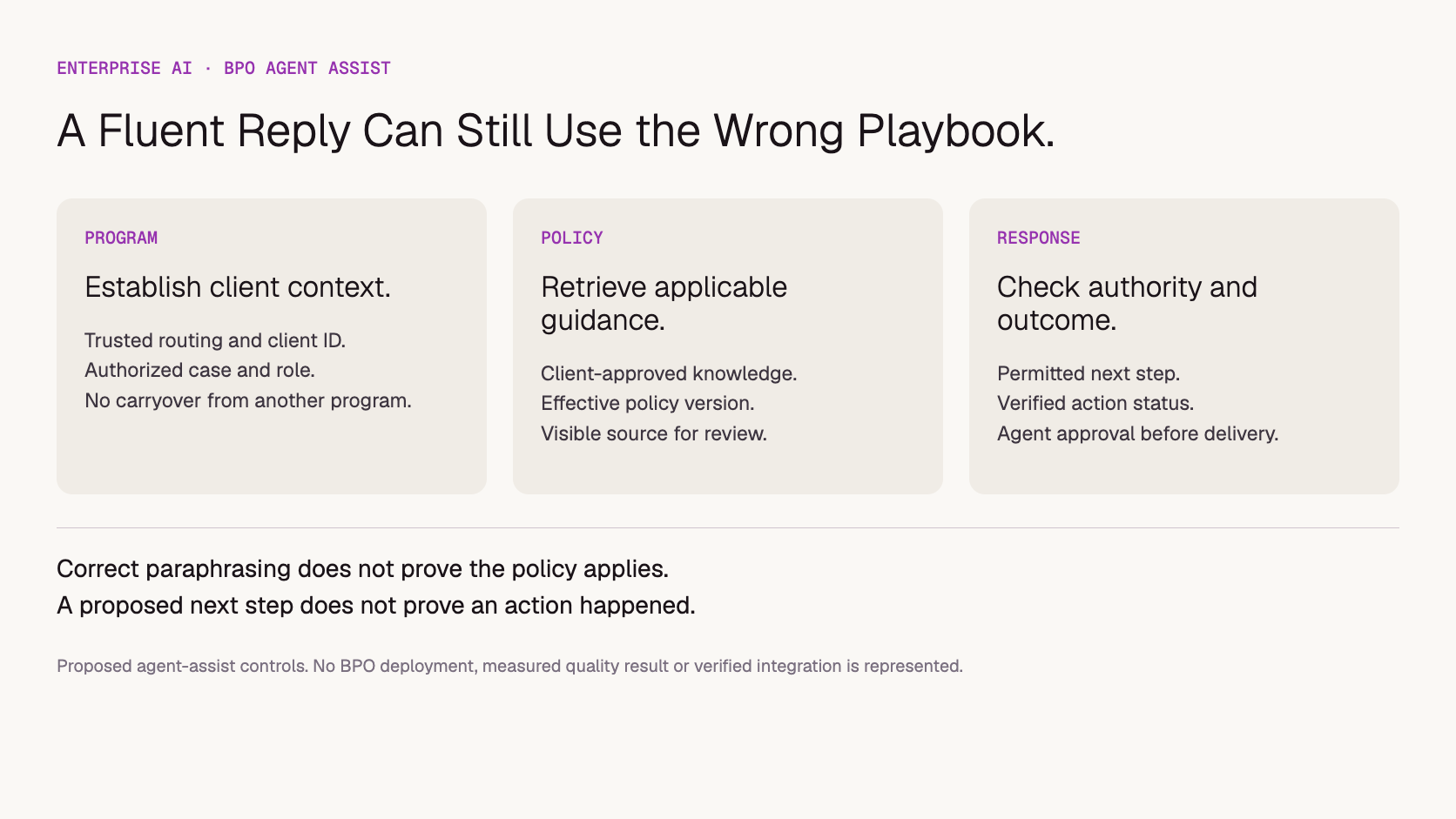
The error occurs when the assistant selects a valid rule from the wrong program or an outdated version of the right program. The response may be coherent and fully supported by that document, yet inappropriate for the case. Test source applicability separately from whether the answer accurately paraphrases the retrieved text.
Consider this fictional, untested example. A BPO supports two retail clients. A customer reports a damaged item, but the clients’ approved playbooks differ:
Question
Client A program
Client B program
What is the first check?
Verify order and required damage evidence.
Verify order and collect evidence for specialist review.
What may the agent do next?
Initiate a replacement request if the stated conditions are met.
Escalate; frontline agents cannot promise a replacement.
What may the draft say?
Describe the verified request status.
Explain the review process without promising its outcome.
An assistant working on Client B retrieves Client A’s playbook and drafts, “We have arranged your replacement.” It fails twice: it applies the wrong program’s authority and claims an action occurred without a confirmed system result. Accurate paraphrasing of Client A’s rule would not rescue the answer.
A more appropriate Client B draft would explain that the evidence can be passed for review, while the internal note lists the checks completed and the next queue. If the transfer has not happened yet, the draft should not say it has. These are illustrative wording boundaries, not tested model outputs.
Now replace Client B’s playbook with a newly approved version while leaving an old passage in the retrieval index. The assistant may stay within the right client and still give the wrong answer. Record effective dates, retire superseded content and rerun the affected cases after policy changes. Reviewers need enough evidence to see which version supported a recommendation.
Proposed client-program controls. Correct wording alone does not establish correct authority.
Should a BPO use its contact-center platform or model APIs?
Evaluate the existing platform’s agent-assist capabilities first, then identify the workflow gaps that justify a custom model layer. Packaged tools may already cover knowledge access and the agent workspace. Model APIs offer implementation flexibility, but the BPO must still own integration, client approvals, evaluation and ongoing support.
Amazon Connect’s setup documentation separates knowledge integration, flow configuration and permissions. It also describes domain-level integration scope. The buying implication is that assistance depends on configured sources and operating context, not only model access. See Amazon Connect’s AI-agent setup guidance, checked November 13, 2026. These are documented product capabilities, not comparative performance results.
Approach
Fit to evaluate
Responsibility to verify
Existing contact-center copilot
The agent workspace and supported integrations fit the client program.
Source scope, permissions, licensing, review interface and reporting.
Templates and knowledge search
Stable procedures and manageable variation.
Version control, search quality and agent handling effort.
Custom workflow with model APIs
Distinct client workflows or model requirements justify engineering ownership.
Retrieval, access, tool execution, evaluation, support and cost attribution.
Run the comparison on the same task and client-approved evidence. A custom draft with no integration or review burden included is not comparable to a complete deployed copilot. Equally, a packaged feature should be tested against the program’s actual sources rather than accepted on the strength of a demonstration.
This article does not establish a native Token360 connector to Zendesk, Amazon Connect or a BPO’s client systems. A model contract and a help-desk integration are different dependencies. The software-versus-model-API buying framework covers that distinction in more detail.
How should quality be evaluated across several clients?
Use a shared evaluation structure with client-specific acceptance rules. Test source relevance, factual accuracy, authorized next steps and review effort for each program, language and channel. A strong average across the whole BPO can conceal a serious policy error in a smaller client program, so retain results at the level where action is needed.
Have the client’s policy owner and the BPO’s quality team define reference cases together. Include routine requests, exceptions, missing information, contradictory customer statements and expired policies. Add deliberate wrong-program retrieval attempts and cases where an agent changes programs between conversations.
Keep critical defects separate from style preferences. Wrong-client evidence, unauthorized promises and exposure of restricted information should not be canceled out by high scores for friendliness. Track whether the reviewer could find the supporting passage and determine the actual action state without reconstructing the entire case.
Use the blank program-level review register to record expected policy, source version, actual recommendation and reviewer decision. It is a proposed template, not a record of successful deployment. Compare the assistance with the current workflow using comparable cases and the same review standard.
For operational value, look beyond whether an agent accepted a draft. Acceptance can reflect convenience rather than correctness. Measure correction effort, avoidable escalations and the completeness of handoff notes. If handling time improves but repeat contacts or rework rise, the faster first interaction may not represent a better outcome.
Begin with staff-visible assistance and a limited approved scope when appropriate. Changing the model, retrieval configuration or policy set should trigger relevant regression checks. A pilot on one client is evidence about that pilot; it does not establish readiness for every other client’s procedures.
What changes when a client program starts or ends?
Treat program onboarding, policy updates and offboarding as operating events with named owners. Before launch, confirm authorized data paths and acceptance criteria. When the engagement ends or access changes, remove the program’s routes and permissions and handle retained records under the agreed terms. Disabling one prompt does not retire the whole workflow.
An onboarding checklist should identify the approved knowledge owner, escalation queues, permitted actions and review responsibility. It should also state which environments may contain client data and who can inspect logs. Resolve these questions before sharing transcripts for model evaluation.
During operation, give policy owners a clear way to publish changes and identify affected test cases. Do not assume that uploading a new file updates every cache, index or agent session. A source-change rehearsal can verify that the new version appears where it should and that the old answer no longer appears.
At offboarding, inspect application access, retrieval stores, scheduled jobs, exports and retained logs. The exact deletion or retention requirements belong in the engagement’s agreed terms. Avoid promising universal deletion or a particular retention period without confirming every relevant system. See the separate questions of retention and model training.
These controls also make later client approvals easier to assess: the team can explain what is shared, what is client-specific and who can authorize a change. A broadly worded “enterprise AI” claim cannot supply that operating detail.
How should a BPO buy model capacity and compare costs?
Size model access around the actual assistance workflow and attribute usage to client programs. Conversation turns, context length, repeated retrieval and peak overlap can matter more than agent-seat count alone. Compare total cost per reviewed interaction, including correction and integration effort, rather than assuming the lowest token price produces the best program economics.
Prepare separate estimates for summarization, draft replies and any voice processing. A single contact can generate several model requests, and a retry can add cost without adding another handled contact. Keep usage records linked to a program and task without unnecessarily copying customer content into billing logs.
Token360’s enterprise offering includes model access across text, image, audio and video and custom pricing. A text-based agent-assist pilot can start with language capabilities; audio support introduces additional transcription and conversation-quality checks. For company context, see About Token360.
Enterprise discussions can scope model mix, dedicated capacity, negotiated prices, contracts and compliance requirements for the engagement. Confirm the actual arrangements; no blanket certification, latency or SLA guarantee is made here. Token360 has confirmed that it does not charge a separate service fee, which does not mean inference, platform licenses or application operation are free.
Send expected request patterns, active-program overlap and failure behavior with the enterprise quotation brief. Keep internal client allocation separate from supplier pricing: the AI API chargeback framework explains attribution without assuming that one commercial commitment automatically covers every client arrangement.
Potentially, if each program’s requirements are met. Reusing a model does not require mixing client context. The application must select authorized sources and permissions for each request, and evaluation must confirm that the model performs acceptably for the individual programs.
Is a separate prompt enough to isolate client data?
No. Prompts influence behavior, while access controls determine what information and actions are available. Client boundaries need to be enforced across retrieval, conversation history, caches, tools and logs, then tested rather than assumed.
Should agent assist send replies automatically?
Not as an unexamined extension of a drafting pilot. Automatic sending changes the workflow’s authority and consequences. First verify the drafts and review process; then evaluate messaging permissions, recipient selection, escalation and recovery as an additional scope.
Can the same quality scorecard be used for all clients?
A common structure can help compare operations, but policy-specific requirements and critical defects must remain visible. Keep results by program, language and task so an overall average does not hide a failing client workflow.
What is a sensible first pilot?
Choose one client-approved workflow, a limited set of cases and a reviewer who can judge policy adherence. Establish a baseline, retain source versions and test exceptions. Expand only after the pilot provides evidence for the next program or capability.
Evidence note: official documentation checked November 13, 2026. Client A/B policies and the proposed workflow are illustrative, not actual customer data. No accuracy result, labor saving, client deployment or verified integration is claimed.
Enterprise AI
API
Bring your next idea to life.
Create a video scene in Creator, or explore models for images, audio, and text to find the right capabilities for your project.


 Guides
 Guides
 Guides