Build SaaS product help with AI APIs using verified workspace, feature and permission context, applicable documentation and clear action boundaries.
INDUSTRY USE CASES · SAAS PRODUCT TEAMS
AI APIs for SaaS can power product help that explains documentation in the context of the customer's workspace, enabled features and permissions. The application must supply that context from authorized sources. A model's general knowledge of the product cannot establish what a particular customer can see or do, and a helpful answer must not imply that an account change has happened.
A user asks, “Why can't I export this report?” One answer might be a missing role permission. Another might be an unavailable feature, an unfinished setup step or a different interface version. Sending every user the same documentation link can leave the problem unresolved. Generating a confident account-specific explanation without checking the account can be worse.
This article describes a proposed in-product help workflow for SaaS vendors and software product teams. It is not a tested Token360 customer implementation or a claim that adding a model API automatically creates a support product.
Which product-help questions benefit from account context?
Account context is useful when the answer depends on the user's active workspace, role, feature access or configuration. Start with questions that have a clear product source and a bounded diagnostic path. Generic definitions may need only documentation; explanations of missing controls require more than a model's recollection of how the product usually works.
Examples include why an integration option is unavailable, where a setting moved after a release, or which setup step remains before a workflow can run. The assistant should identify the relevant conditions rather than inventing a single cause from the wording of the question.
For a hypothetical reporting product, the missing export control might reflect an entitlement, a workspace setting or the user's role. Those are different facts with different remedies. “Upgrade your plan” is a poor default if the feature is already enabled but the user lacks permission to use it.
Choose an initial question family with a known resolution process. A focused assistant for report setup can be evaluated against specific states. A general promise to solve every product issue makes it harder to tell whether an incorrect answer came from the model, missing context or an undocumented product behavior.
What context should the application supply?
Supply the minimum verified facts needed to answer the question: the active workspace, relevant permissions, enabled features, configuration state and applicable product documentation. Keep these facts distinguishable from user statements and retrieved prose. If a required field is unavailable, the assistant should describe the uncertainty or ask a targeted question rather than treating absence as a negative result.
Context
Question it helps resolve
Do not infer it from
Active workspace
Which customer's environment is being discussed?
A company name typed into chat
Current role or permissions
Can this user perform the relevant action?
Membership in the workspace alone
Feature entitlement
Does this account have access to the capability?
A public plan name without checking exceptions
Configuration state
Has the required setup been completed?
The user having read a setup article
Interface or release context
Which steps apply to the current experience?
The latest public announcement alone
Documentation source
What approved explanation supports the answer?
The model's unsupported memory
Do not send an entire customer database because some account context is useful. Define a small context contract for the selected task. For the export example, a few verified fields may be enough; unrelated billing details or other customers' reports are not relevant.
Keep source and observation time with changing facts. If the user switches workspace or an administrator changes access during the conversation, refresh the relevant context. An answer that was correct earlier can become incorrect without any change to the user's wording.
How do feature entitlements differ from user permissions?
An entitlement concerns whether a customer has a product capability; a permission concerns whether a particular user may use it. Both can matter to product help. Check the relevant source for each rather than translating a plan label into a complete access decision, and do not let the model grant access by describing it.
Stripe's Active Entitlements reference defines an active entitlement as access to a feature for a customer and provides retrieval and listing endpoints. It is an example of an authoritative commercial feature source, not a requirement to use Stripe or evidence that Token360 manages a SaaS vendor's customer entitlements.
In the reporting example, the account might have export access while the current user is a viewer. A useful answer can explain that the capability is available to the workspace but requires the appropriate role, if those facts are verified and may be disclosed. It should point to the approved administrator workflow rather than suggesting an unnecessary purchase.
Commercial arrangements can also differ from a public pricing page. A trial, legacy contract or custom package may affect feature availability. Use the product's resolved access state where possible, with the commercial system as its input, rather than making the language model interpret every contract at response time.
How should product documentation be selected?
Retrieve documentation that applies to the relevant feature, audience and product experience, then let the model explain it in the user's context. A page can be accurate but inapplicable to the current account. Preserve document identifiers and version information so a reviewer can distinguish a retrieval mismatch from a bad explanation.
Suppose a new export menu has been announced but is not enabled in the user's workspace. The assistant should not repeatedly direct the user to a control that does not exist for them. The retrieval process needs the applicable rollout or interface context, or the response needs to acknowledge that the available instructions may not match.
Separate public help articles from internal support notes. An internal note may describe a suspected issue or an unreleased workaround; that does not make it approved customer guidance. Define which source classes can support a public answer and which should only assist a staff handoff.
When sources conflict, do not ask the model to pick whichever passage sounds more confident. Establish a product-owned precedence rule or escalate the conflict to the documentation owner. A concise “I can't confirm which workflow applies to this workspace” can be more useful than another fabricated sequence of clicks.
What prevents one customer's information entering another answer?
The application must enforce tenant and user access before retrieving or sending context to the model, and again when executing any action. A prompt telling the model to respect boundaries is not an access-control mechanism. Keep conversation state, retrieved documents and any cached answers scoped to the authorized context they require.
Microsoft's multitenant identity guidance distinguishes authentication from authorization within a tenant and discusses explicit tenant switching. This supports an application-level design responsibility: being signed in does not establish access to every customer's information.
For a user with access to two workspaces, the active one must be unambiguous. If the user switches accounts, do not silently carry an account-specific conclusion into the next conversation context. The same issue applies when support staff use an internal tool that can access more than one customer.
Reuse generic explanations where appropriate, but avoid treating a stored account-specific answer as a universal response. The application's retrieval, state and caching design needs its own testing. This article is a product workflow guide, not a complete security design or a claim that a model provider enforces the SaaS application's customer boundaries.
When should the assistant answer, act or hand off?
Answer when the available evidence supports the guidance. Propose an action only when the product has an authorized execution path, and report completion only after receiving its actual result. Hand off when the issue requires unavailable context, conflicting sources or a support decision outside the assistant's scope.
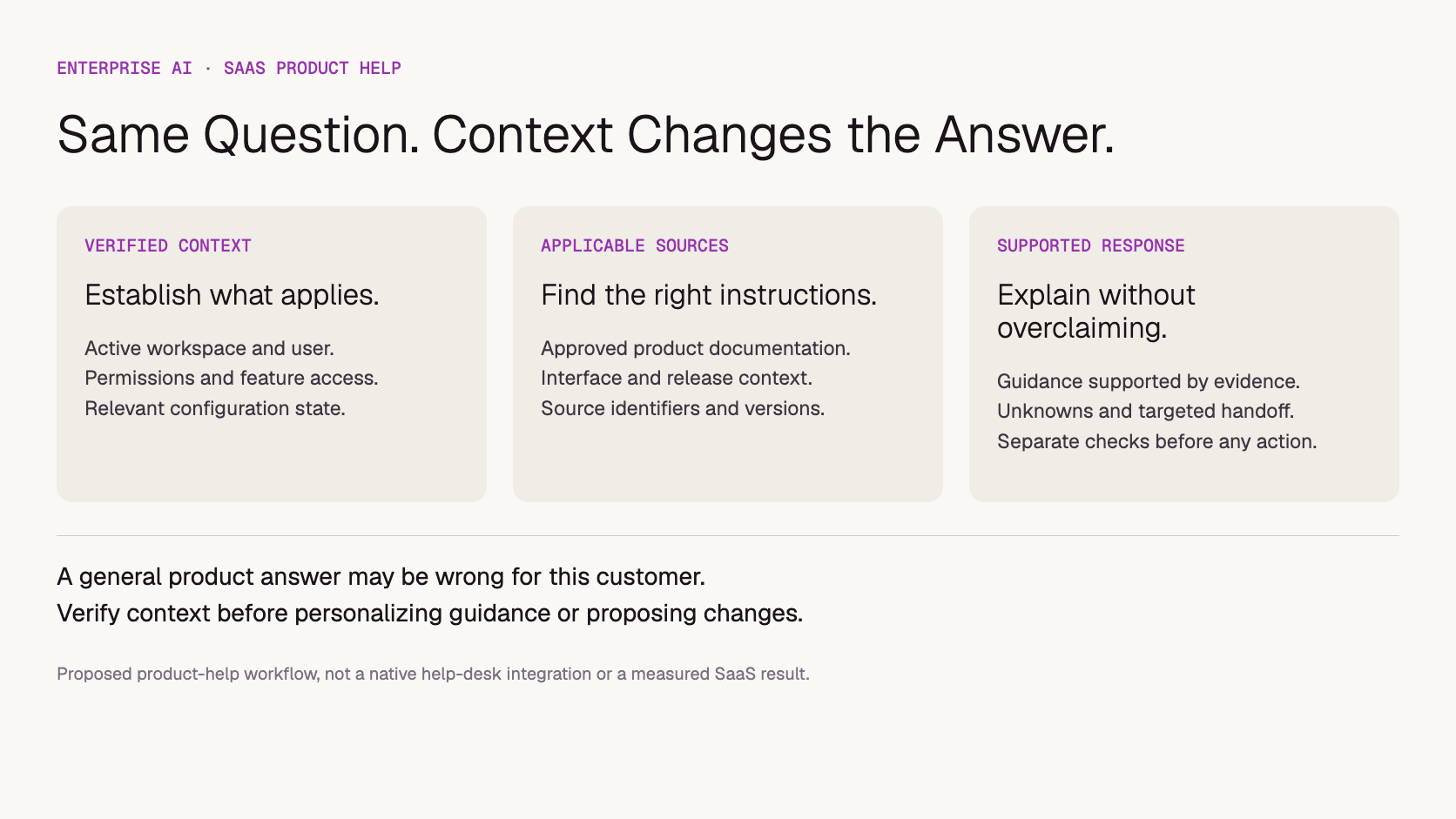
Suggested product-help workflow. An explanation and a change to the customer's account are separate outcomes.
“Here is how your administrator can enable the setting” is guidance. “The setting is enabled” is a statement about state. The second requires evidence from the product, not just a generated instruction or an attempted tool call. The general distinction is covered in whether an AI tool call actually executes a function.
A good staff handoff includes the user's question, relevant context, documentation consulted, attempted steps and the unresolved point. Avoid sending an unqualified model diagnosis as the ticket title. “Export control missing; role check unavailable” is different from “Export feature broken.”
The product-help review register provides blank fields for account context, sources, expected guidance and handoff reasons. It is a planning aid, not a help-desk integration or production authorization system.
Test the same question across deliberately different account states, not just many paraphrases of one happy path. An answer should change when relevant facts change and stay stable when irrelevant details change. Review correctness, applicability and access boundaries separately from conversational quality and apparent confidence.
For the hypothetical export question, build cases such as: feature enabled with an authorized user; feature enabled with an insufficient role; feature unavailable; access information missing; and an interface mismatch. Product and support staff should define the expected answer or escalation for each before evaluating the model.
Applicability: Does the guidance match this workspace and interface?
Diagnostic restraint: Does missing context remain unknown instead of becoming a confident diagnosis?
Source support: Can reviewers trace instructions to approved documentation?
Boundary handling: Are workspace switches and access restrictions handled by the application?
Outcome truthfulness: Does the assistant distinguish advice, attempted changes and completed actions?
Do not treat a closed chat as proof of resolution. Consider whether users completed the intended task, reopened the issue or required further support, using an appropriate product measurement design. This article provides no measured ticket-deflection rate or product activation gain.
Cost includes retrieval, inference, review and unresolved follow-up work. Compare models using the same context and acceptance criteria before attributing differences to the model. For pricing the feature itself, use the separate AI feature unit-economics guide.
Where does Token360 fit in a SaaS product?
Token360 can supply model access for language understanding and grounded response generation within a SaaS application. The product team still builds the context, retrieval, authorization and support experience. Evaluate the inference service against the chosen task rather than assuming that an API endpoint includes a complete customer-help system.
As checked November 12, 2026, Token360's enterprise page describes access across text, image, audio and video models and custom enterprise pricing. Capacity, contracts and compliance requirements can be scoped for the engagement. No native help-desk connector, entitlement sync or customer-level data isolation inside your application is claimed here.
For procurement, describe expected usage, peak concurrency, context size, languages and the chosen response mode. A screenshot-based help feature may need a vision-capable model, while a text-only pilot may not. Confirm supported inputs and test representative cases rather than selecting every modality at once.
How do you connect a first product-help pilot?
Start with one question family and a read-only context adapter in the SaaS application. After authenticating the user and resolving the workspace, retrieve the applicable access state and approved documentation. Pass only those relevant facts to a selected model, then show the answer with its supporting source. Keep account-changing tools disabled during this first evaluation.
For the export-control example, test three explicit outcomes: access enabled plus an insufficient role should lead to the administrator workflow; access unavailable should lead to the approved feature-access guidance; an unavailable role check should produce a targeted handoff. These are proposed acceptance cases, not observed model results. Refresh workspace context before each account-specific answer, and compare models with the same adapter and source set.
Use the AI API account ownership guide to assign responsibility for credentials, access and billing before deploying product help across accounts.
Frequently asked questions
Does an AI model know the customer's SaaS plan?
Not from general product knowledge. The application must supply an authorized, current source for relevant feature access. A plan name alone may not capture trials, legacy terms or custom arrangements.
Is documentation retrieval enough for product help?
It may be enough for general questions. Account-specific issues can also require role, entitlement, configuration and interface context. Retrieve the applicable documentation after establishing the needed scope.
Can the assistant change settings automatically?
Only through an implemented and authorized application workflow. Generating instructions does not change settings, and an attempted action should not be reported as completed without a confirmed result.
Does Token360 provide a ready-made SaaS support assistant?
No such product is established in this article. Token360 provides model access; the SaaS team remains responsible for the product-help application and its integrations.
What is a useful first test?
Choose one recurring product question and test it across several verified account states, including missing information. Check whether the answer adapts correctly and escalates when required.
Evidence scope: proposed product workflow using Stripe, Microsoft and Token360 primary sources checked November 12, 2026. The reporting-product examples are hypothetical. No customer deployment, security certification, controlled model comparison or measured support outcome is claimed.
Enterprise AI
API
Bring your next idea to life.
Create a video scene in Creator, or explore models for images, audio, and text to find the right capabilities for your project.


 Guides
 Guides
 Guides