AI API Chargeback: How Should Teams Share the Bill?
Allocate AI API costs by ownership, document shared-cost rules and reconcile credits. See a hypothetical three-team example and a policy template.
ENTERPRISE AI · COST OWNERSHIP
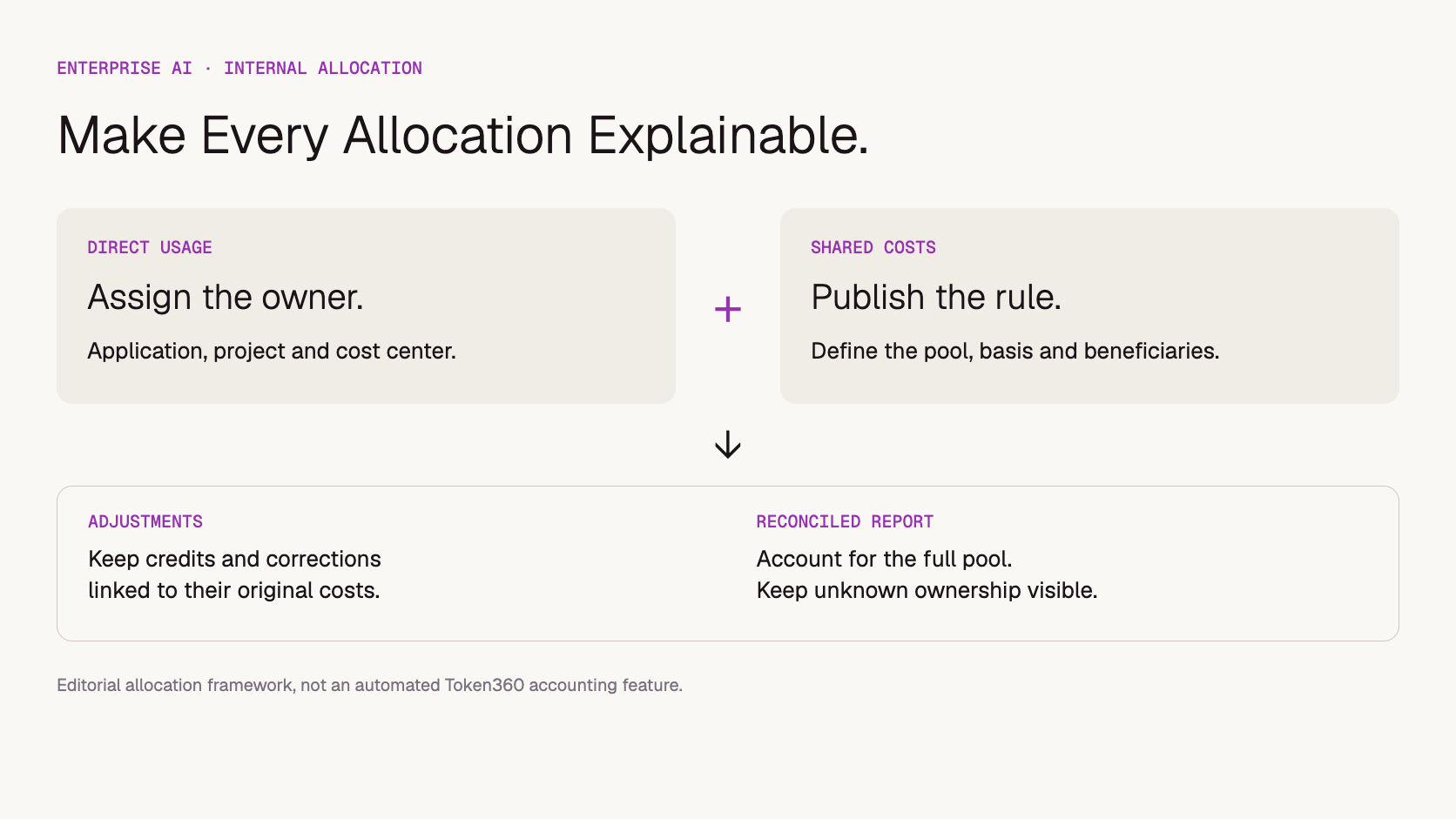
For AI API chargeback, assign identifiable usage to the team that caused it, allocate shared costs using a published rule, and return specific credits to the original owner. Reconcile the allocated total to a defined cost pool. One company account can simplify purchasing, but it does not automatically establish a fair departmental split.
When support uses text models, marketing generates media and product teams run experiments, equal shares rarely describe the underlying consumption. The enterprise decision is how to make those costs visible and accountable without hiding shared overhead or penalizing teams for work they did not authorize.
Scope and evidence: This article proposes an internal allocation process. It does not claim that Token360 automatically posts charges to your accounting system. The USD example is entirely hypothetical—not a customer bill, Token360 price schedule or measured saving. Official sources were reviewed on November 10, 2026.
Read first: The AI procurement consolidation guide explains when central purchasing makes sense. This article addresses who should bear the costs after multiple teams share that arrangement.
What is the difference between showback and chargeback?
Showback reports what each team is responsible for without making an internal financial transfer. Chargeback uses an approved allocation to charge departmental budgets or accounts. Start with showback when ownership data or allocation rules are uncertain; move to chargeback when finance and the affected teams can explain and review the numbers.
The FinOps Foundation's Invoicing & Chargeback capability places financial reporting and chargeback models in collaboration with finance, product and engineering. An API dashboard can provide evidence, but the internal posting policy belongs to the company.
Question
Showback
Chargeback
What does the team receive?
A view of attributed and allocated costs.
An approved amount charged to its internal budget or account.
What must be clear?
Data coverage, assumptions and unresolved ownership.
Those items plus posting rules, approvals and correction handling.
What happens to uncertainty?
Display it as provisional or unallocated.
Resolve it or apply an explicitly approved treatment before posting.
Neither approach reduces the supplier bill by itself. Its purpose is accountability: teams can see what their applications consume, and the company can discuss tradeoffs using a consistent basis. Cost reduction, budget admission controls and departmental accounting are related but distinct tasks.
Which costs should belong directly to a department?
Assign a charge directly when the records connect it to a named application, project or business owner. Preserve that ownership at the time of use, rather than relying only on who currently holds a key. Shared services need an additional application-level identifier when one credential serves several departments.
For example, a support assistant's inference can belong to customer support, while a separately authorized marketing campaign belongs to marketing. A central experimentation program may belong to an innovation budget. These are policy decisions: a request's technical origin alone may not identify the budget owner who authorized the work.
Maintain a mapping from non-secret key or workspace identifiers to applications and cost centers, with effective dates and an owner. When a team changes, do not silently relabel last month's costs using today's organization chart. Where the platform's available records are insufficient, capture the missing ownership context in your own application logs without storing API secrets.
The FinOps Foundation's allocation guidance identifies accounts and other metadata as mechanisms for assigning cost and usage. For a multimodal API, that mapping should survive across text, image, audio and video operations. A video job completing later must still retain the owner of the originating work.
Should you split the bill by tokens, requests or money?
Use actual monetary charges for the financial allocation, while retaining the original usage meters for explanation. Request counts and token counts can help diagnose consumption, but they are not interchangeable across different models or modalities. An equal request count does not establish an equal share of the bill.
A short language request, a long reasoning response and a generated video can have different charging rules. Even two text models can have different input and output rates. Assign the applicable charge to its owner first; avoid inventing a universal “AI unit” to combine tokens, images and seconds unless your company has deliberately defined an internal transfer-price policy.
Be explicit about the cost basis. If the report uses negotiated actual rates, do not mix them with public list-price estimates. If finance uses an internal standard rate, label it as such and account for the variance separately. Currency conversion and tax treatment should follow the company's chosen accounting policy rather than being improvised inside a usage report.
For the underlying match between requests and charges, use the API billing reconciliation guide. Chargeback begins with that reconciled information; it should not create a second independent version of what the supplier charged.
How should shared costs be allocated?
Keep shared costs in named pools, then choose a basis that the beneficiaries can understand. Options include an agreed fixed split, measured consumption, a relevant activity measure or central funding. No basis is universally fair. Document why the chosen rule fits the cost and when it should be reviewed.
Cost type
Possible treatment
Question to settle
Direct model usage
Assign to the originating workload owner.
Can the ownership record be verified?
Internal platform operations
Retain centrally or allocate with an approved rule.
Which teams benefit, and what does the allocation cover?
Shared experiments
Use the agreed research or program budget.
Who approved the experiment and its funding?
Unused committed capacity or spend
Follow the policy agreed for that commitment.
Who made the capacity decision and accepted the risk?
Unknown ownership
Hold visibly as unallocated while investigating.
Who resolves it, and by what close deadline?
A proportional split is convenient, but convenience is not proof of fairness. Allocating all shared engineering effort by inference spend can assign a large share to a video team merely because its model costs more, even if another application needs more platform support. Use a different basis when the cost driver is different.
Do not distribute an unused commitment across teams simply to make the report look fully allocated. Distinguish the supplier obligation from the internal decision about who funds it. The cross-model commitment guide explains eligibility questions; chargeback determines internal responsibility after those terms are understood.
What does a transparent three-team allocation look like?
A useful allocation example shows the direct charges, shared-cost rule and credits separately. The total must reconcile to the defined pool, and a reader should be able to reproduce each departmental amount. The example below uses an intentionally simple policy to demonstrate the arithmetic, not to recommend that policy for every company.
Hypothetical example, USD: Support incurs $600 of model usage, marketing $240 and product $120. The company also includes $120 of its own internal platform operations in the allocation pool. A $60 supplier credit relates specifically to support's usage. The company chooses to allocate shared operations in proportion to direct usage before that credit.
Gross direct usage is $960. The shared-cost weights are therefore 62.5%, 25% and 12.5%. This example keeps those weights unchanged when applying the support-specific credit; that is an explicit policy choice, not a required accounting rule.
Team
Direct usage
Shared operations
Specific credit
Final allocation
Support
$600
$75
−$60
$615
Marketing
$240
$30
$0
$270
Product
$120
$15
$0
$135
Total
$960
$120
−$60
$1,020
The reconciliation is $960 − $60 = $900 of net supplier usage cost, plus $120 of internal operations = $1,020 allocated. The internal $120 is not a Token360 service fee. The example excludes taxes, foreign-exchange effects, prepayment timing and other costs; a real report must define its own scope.
An equal split would allocate $340 to each team under the same pool. That arithmetic also totals $1,020, but it ignores the known differences in direct consumption. Correct totals are necessary; an explainable ownership rule is equally important.
Allocation logic only. The illustrative dollar amounts and assumptions remain in the article text.
How should refunds, failures and late charges be handled?
Keep an adjustment linked to the cost it corrects wherever possible. A refund for one team's request should not disappear into an unexplained company-wide reduction. For delayed charges or credits, retain the original workload owner and identify the accounting period in which the correction is recorded under the company's policy.
A failed or rejected output does not automatically mean the supplier charge is zero. Check the actual billing result before changing the allocation. Separately, the company can decide whether an avoidable platform error is funded centrally instead of charged to the requesting team. That internal decision does not alter the supplier's invoice.
Prepaid credit purchases also require care: buying credits and consuming them are different events. Do not charge teams for usage and then allocate the same wallet top-up again as another usage expense. Finance should define the period and recognition basis used by the report.
When an adjustment arrives after close, preserve an audit trail: original allocation, reason, amount, affected owner and approval. Avoid silently overwriting a departmental report that somebody has already used for planning.
What can Token360 provide, and what must your company define?
Token360 can be the centralized inference supplier, while your company defines internal cost ownership and financial posting. Confirm what usage detail and ownership identifiers are available for your account. Unified billing and key governance can support the process, but they do not prove that departmental chargeback or accounting-system integration is automated.
The Token360 enterprise page, reviewed November 10, 2026, describes sub-accounts, tenant-wide API key audit and unified wallet billing. Request the reporting detail needed for your application-to-cost-center mapping before relying on it for month-end close.
Token360 provides access to text, image, audio and video models. Based on company-confirmed commercial positioning, inference pricing can be negotiated and there is no separate service fee. Your company's internal staffing, orchestration or shared infrastructure costs are different expenses; label them separately instead of presenting them as charges from Token360.
A useful enterprise request is: “We need to identify which applications generated the charges, retain ownership over time, reconcile adjustments and export the detail required by finance.” Confirm the available fields, reporting scope and process rather than assuming a native cost-center ledger exists.
How do you introduce chargeback without creating disputes?
Publish the policy before the first chargeback, run a reviewable showback cycle and give teams a route to challenge ownership errors. Finance should approve the posting basis; application owners should validate the workload mapping. Keep unallocated costs visible and assign an owner to resolve them instead of forcing a precise-looking but unsupported split.
The monthly record should state the period, included costs, rate basis, direct ownership, shared-cost method, adjustments and approval status. Use the blank AI API chargeback policy template to document those decisions. The illustrative allocation CSV reproduces the example above; it contains no customer data.
scenario,currency,team,direct_usage,shared_internal_operations,specific_credit,final_allocation
Hypothetical; not actual pricing,USD,Support,600,75,-60,615
Hypothetical; not actual pricing,USD,Marketing,240,30,0,270
Hypothetical; not actual pricing,USD,Product,120,15,0,135
Hypothetical; not actual pricing,USD,Total,960,120,-60,1020
Once the process is trusted, it can inform departmental planning. It still does not enforce a spending limit: use the AI API cost-management guide for budgeting and admission controls. Keep financial allocation, operational controls and business-value review connected without pretending that one report performs all three functions.
Frequently asked questions
Can we split every AI bill equally between departments?
You can choose an equal split as an explicit policy, but it may not represent consumption or benefits. Use direct ownership where available and explain the reason for any shared allocation.
Does each team need its own supplier account?
Not necessarily. Central purchasing can coexist with team-level ownership records. Confirm whether your account structure and application logging provide enough detail; a single shared credential without workload attribution may be insufficient.
Should a refund change every department's share?
A credit tied to a specific charge should normally remain traceable to that charge's owner under the approved policy. A general credit needs a separately documented allocation rule. Do not silently treat both cases as equivalent.
Does chargeback measure whether an AI application is valuable?
No. It assigns costs. Assess value using task outcomes and the work required to produce them. A department with a high allocation might be generating substantial value, while a low-cost experiment might have no continuing purpose.
Can Token360 automatically handle our internal chargeback?
This article does not establish that capability. Confirm available reporting and integration scope with Token360, then define your company's allocation and posting process with finance.


 Guides
 Guides
 Guides