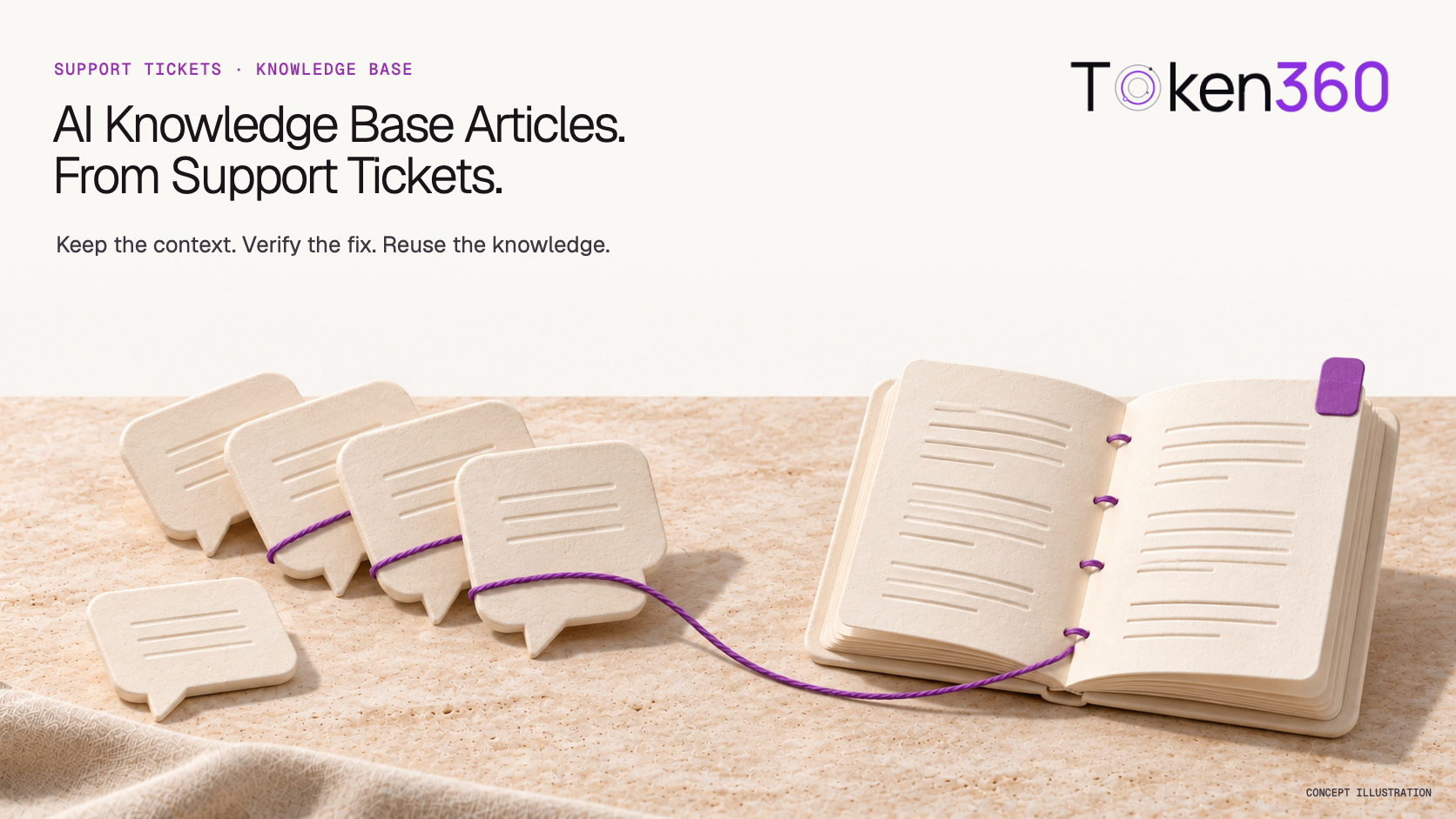
Turn support tickets into AI-assisted knowledge base articles. Verify the fix, preserve applicability, avoid duplicates, and review before publishing.
SUPPORT OPERATIONS · KNOWLEDGE MANAGEMENT
AI can draft knowledge base articles from support tickets by extracting the customer problem, applicable environment, verified resolution, and remaining limitations. Before publishing, check whether an existing article should be updated, remove customer-specific information, and confirm that the instructions work beyond the original case. A closed ticket is a source to investigate, not proof of a reusable solution.
For SaaS vendors, IT service companies, and support teams, this is a way to turn resolved conversations into maintained self-service content. The central decision is not how many articles a model can produce. It is which knowledge should be reused, who can use it, and what evidence supports the recommended steps.
Evidence boundary: This is a proposed knowledge-production workflow, not a tested Token360 integration or customer success story. The ticket example is fictional. Official documentation was checked on November 14, 2026. No ticket-deflection rate, accuracy score, or labor savings are claimed.
What is different about an article made from a ticket?
A support ticket records an interaction with one customer. A knowledge article explains a problem and a usable response for a defined audience. Converting one into the other requires preserving the relevant environment and resolution while removing conversational detours, private details, failed attempts, and assumptions that only the original agent understood.
A ticket summary might say “the agent changed the setting and the customer confirmed success.” A useful article must identify which setting, the conditions under which the change applies, the permission required, and how the reader can verify the result. If those details are absent, the draft should identify the gap instead of supplying plausible instructions.
This is a content-maintenance task, distinct from live agent assistance across clients. The output is a reviewable knowledge asset that may later support self-service or a retrieval system. Its errors can be repeated across future interactions, so the original case needs to remain traceable internally.
Which tickets should become article candidates?
Choose candidates with a clear customer question, enough context to identify applicability, and evidence of what resolved the issue. Review ticket status alongside the actual conversation. A case can be closed without a verified fix, and a frequently reported symptom can have several causes that should not be merged into one procedure.
Separate the decision to retain knowledge internally from the decision to publish it publicly. A rare case may still be worth capturing for specialists. A common case may need a product fix or an update to an existing article rather than another public page.
The Consortium for Service Innovation's KCS guidance on capturing knowledge emphasizes preserving the requestor's context and language while the interaction is understood. That supports keeping the customer's problem wording, rather than replacing it with terminology they would never search for.
Ticket evidence
Candidate treatment
Reason
Documented problem and verified repeatable resolution
Draft or update an article
Enough evidence exists for specialist review
Closed after no further customer response
Investigate before recommending a fix
Status alone does not confirm success
Agent performed a privileged backend action
Consider internal guidance or public escalation instructions
The customer may not be able to perform the action
Temporary workaround for an incident
Link to current incident or product guidance
A workaround may stop being appropriate
Same issue already covered accurately
Reuse the existing article
A duplicate can divide feedback and maintenance
Should AI create a new page or improve an existing one?
Search the existing knowledge base before drafting a new page. Compare the problem, environment, audience, and resolution, not only the proposed title. A ticket may reveal a missing prerequisite or an unfamiliar search phrase in an otherwise correct article. Updating that article can be more useful than creating a competing version.
Have the workflow propose one of four actions: reuse, update, create, or hold for investigation. Include the candidate article ID and the specific gap supporting the choice. A similarity score can help retrieve candidates, but it should not decide by itself whether two procedures are equivalent.
Zendesk documents a ticket-based help-center generation workflow that groups eligible conversations into topics and saves generated articles as drafts for review. Its documentation also warns that this particular new-help-center feature may create duplicate structure when used with an already well-maintained help center. Check the actual feature and plan rather than assuming all AI knowledge tools maintain existing content automatically.
For a custom workflow, keep one canonical article for the same supported procedure and audience. Record related tickets against it. Split articles when different versions, permissions, or causes require materially different instructions; do not split simply to produce more pages.
What should the model extract before it writes?
Extract an evidence record before generating polished prose. It should separate the reported symptom, environment, attempted actions, confirmed resolution, and verification. Attach source locations to the important fields. This intermediate record makes it easier to catch a mistaken inference before fluent wording hides it in the finished article.
Field
What to preserve
Problem
The customer's observable symptom and recognizable search language
Applies to
Product version, plan, role, configuration, and relevant prerequisites
Resolution
Supported actions, in order; who can perform them
Verification
The expected result and evidence that it occurred
Limitations
Unknown cause, temporary workaround, exclusions, or escalation path
Provenance
Internal ticket references, comment locations, owner, review date
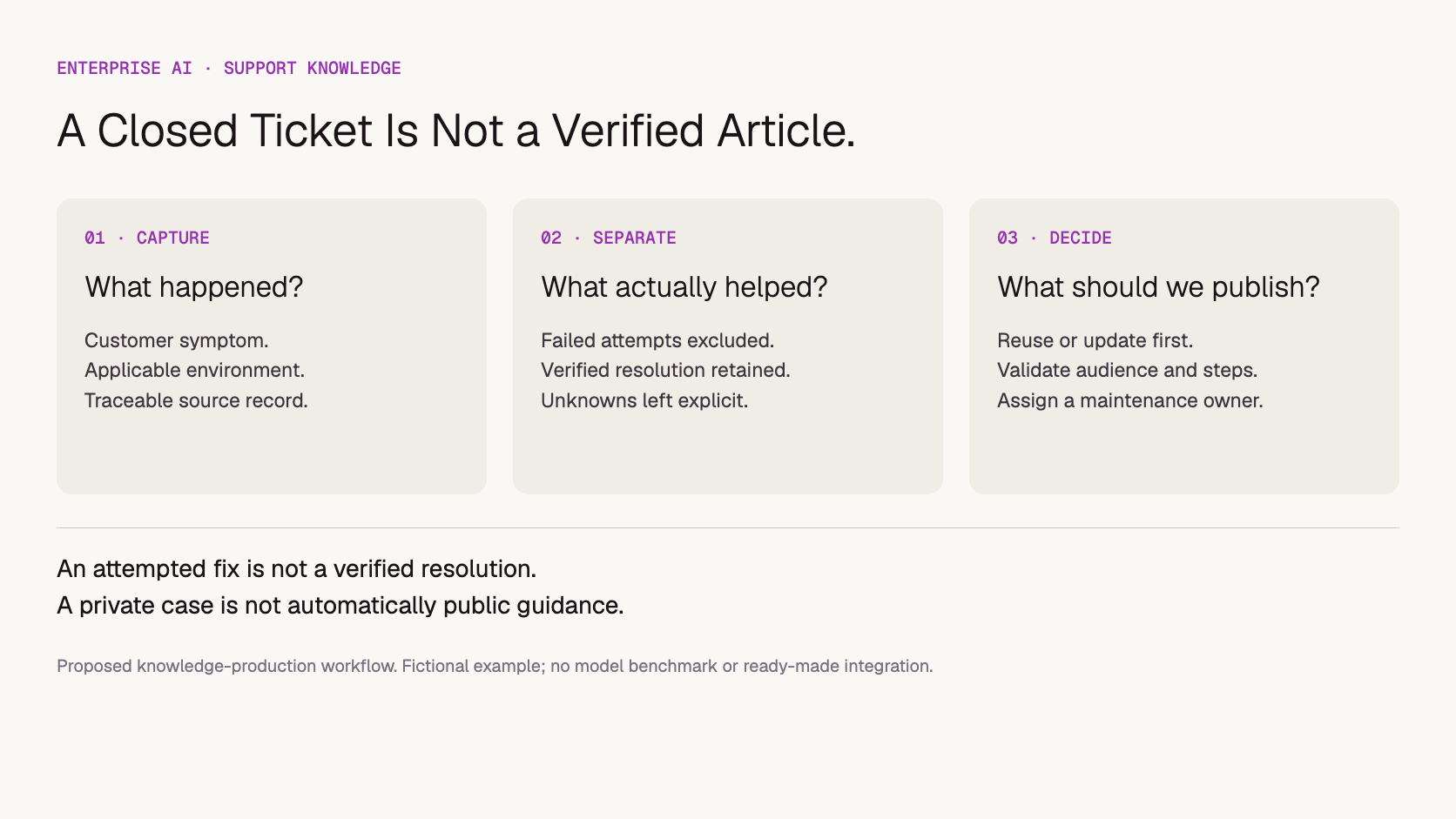
Keep unsuccessful actions separate from the resolution. A model that extracts every imperative sentence may convert “we tried restarting, but it did not help” into the first recommended step. Negation, chronology, and the speaker's role are essential evidence.
Do not fill an unknown root cause just because the fix sounds familiar. An article can accurately describe a supported recovery procedure without claiming to explain why every instance occurs. Where the resolution itself remains uncertain, keep the article in an appropriate internal draft state.
How can one ticket produce the wrong instructions?
A ticket can produce wrong instructions when the model promotes an unsuccessful attempt into the fix or generalizes a privileged intervention into customer self-service. Review the relationship between action and outcome. The fact that two events occurred in the same conversation does not establish that the earlier event caused the recovery.
Fictional example: A SaaS customer reports that a scheduled report is not arriving. The thread records a browser-cache reset that did not help, an agent finding a paused schedule, and an administrator re-enabling it. The next scheduled report arrives. The account belongs to an edition that supports scheduled delivery.
A weak draft titled “Fix missing reports by clearing your cache” would preserve the symptom but choose the wrong action. A better draft would cover checking the report schedule's status, explain that an authorized administrator is needed for the documented change, and state that delivery should be checked at the next scheduled run. It would not claim that every missing report is caused by a paused schedule.
Before publication, a product specialist must validate the actual interface path, permission names, applicable editions, and expected behavior. Those details are intentionally not invented in this fictional example. If they cannot be confirmed, the model should return a review question rather than a fabricated menu sequence.
Proposed evidence filter: preserve the resolution, not every action mentioned in the conversation.
What should remain private or internal?
Keep customer identities, account-specific configuration, credentials, private attachments, and internal investigation notes out of public articles unless there is a justified, approved reason to include appropriately sanitized material. Separate the internal evidence trail from the public explanation. Removing a name alone does not necessarily make a screenshot or log safe to publish.
Use an approved input scope before sending ticket content to a model. Minimize unnecessary fields, enforce account and brand boundaries, and evaluate the selected service's retention and training policies separately. Do not rely solely on an instruction such as “remove private information” after processing unrestricted exports.
For screenshots, check visible account names, addresses, tokens, URLs, and customer data. A vision model may help identify or explain interface elements, but it is not proof that every sensitive detail has been removed. Use authorized demonstration environments where possible.
Internal procedures may also require different permissions from public instructions. A backend repair can become a customer-facing explanation of when to contact support, while the operational steps remain restricted. Keep the two audiences distinct in the article record and publishing controls.
How do you review and maintain the resulting article?
Review the draft for technical correctness, audience fit, and discoverability before publication. Assign an owner and record the product context that was checked. After publication, use support feedback and product changes to trigger updates. A valid article can become misleading when a feature, menu, permission, or workaround changes.
A compact article structure is often sufficient: recognizable problem title; applicability and prerequisites; verified steps; expected result; and what to do if the result does not occur. Add background only where it helps readers decide whether the procedure applies.
Try the procedure in an appropriate test environment when practical. Otherwise, state the validation limitation internally and obtain the responsible specialist's review. Check that screenshots and text describe the same version. An editor can improve readability without being qualified to approve the underlying technical action.
Retain a link from the article to its supporting cases internally. When agents flag that the article failed for a different configuration, determine whether to amend its applicability, add a branch, split the topic, or retire the advice. The goal is a maintained answer, not a one-time batch of generated pages.
Where do model APIs fit alongside help-desk software?
Use your help-desk platform's knowledge tools when they meet the workflow and governance requirements. A custom model-API integration may fit when evidence spans systems, you need a particular review record, or you need more control over extraction. The API supplies inference; permissions, article storage, publishing, and maintenance still belong to the application.
Approach
Fit to investigate
Verify before committing
Native help-desk knowledge tools
Tickets and articles already share a platform
Eligible inputs, existing-content handling, review and publishing controls
Custom model API pipeline
Multiple sources or specialized extraction and approval needs
Consistent capture, technical review, ownership and updates
Token360 provides access to text, image, audio, and video models. For this workflow, text models can support extraction and drafting; suitable vision or transcription models may help prepare screenshots or recordings, depending on model support. Do not add media generation unless the article actually needs it.
As checked on November 14, 2026, Token360's enterprise offering includes custom pricing discussions. Capacity, contracts, and compliance requirements are scoped to the engagement. This article does not claim a ready-made Zendesk connector, help center, or automatic publishing capability. See Token360's company and resources information for brand context.
Measure whether the workflow produces correct, maintainable knowledge with acceptable review effort. Include cases that should update an article, remain internal, or be held rather than published. Counting generated pages rewards output even when it introduces duplicates or unsupported instructions. Evaluate the decision and the final content together.
The blank ticket-to-article review register records candidate topic, source cases, existing article, action decision, supported resolution, applicability, owner, and review results. It contains no measured performance data.
Resolution fidelity: Did the article preserve the verified action and exclude failed attempts?
Applicability: Are required versions, permissions, and conditions accurate?
Content decision: Was create, update, reuse, or hold the appropriate outcome?
Disclosure: Did private or account-specific details remain in the proposed public version?
Review cost: How much specialist correction was needed per accepted article?
If measuring self-service outcomes later, define what counts as resolution and observe whether readers need further help. A page view or a missing follow-up ticket does not independently prove that the issue was solved. Compare equivalent topics and time periods, and account for product fixes or support-volume changes.
Include source preparation, integration, editorial review, and ongoing updates in workflow cost. A cheap first draft can still be expensive knowledge if it requires extensive correction or becomes stale quickly.
Can AI generate an article from one support ticket?
Yes, but a single case may not establish a general fix. Preserve the exact applicability and require review. A rare case may be useful internal knowledge even when it is unsuitable for a broad public article.
Should every solved ticket produce a new article?
No. Search for existing coverage first. The right result may be a reused article, a small correction, an internal note, or a request for more evidence.
Can the model infer missing troubleshooting steps?
It can propose questions or candidate steps for a specialist to validate. It should not present inferred steps as verified instructions from the ticket.
Does Token360 automatically publish help-center articles?
No such capability is claimed here. This article describes an application workflow using model inference. Publishing requires the surrounding system's integration, permissions, and approval process.
Is this the same as training a model on support history?
No. Turning selected tickets into reviewed articles is a content workflow. Training, fine-tuning, and retrieving approved articles at answer time are separate technical choices with different data and maintenance requirements.


 Guides
 Guides
 Guides